
What Does a 4-Vessel Brewhouse Do?
It makes wort through separate mashing, lautering, boiling and whirlpooling stages; fermentation happens later, and output depends on more than vessel count.
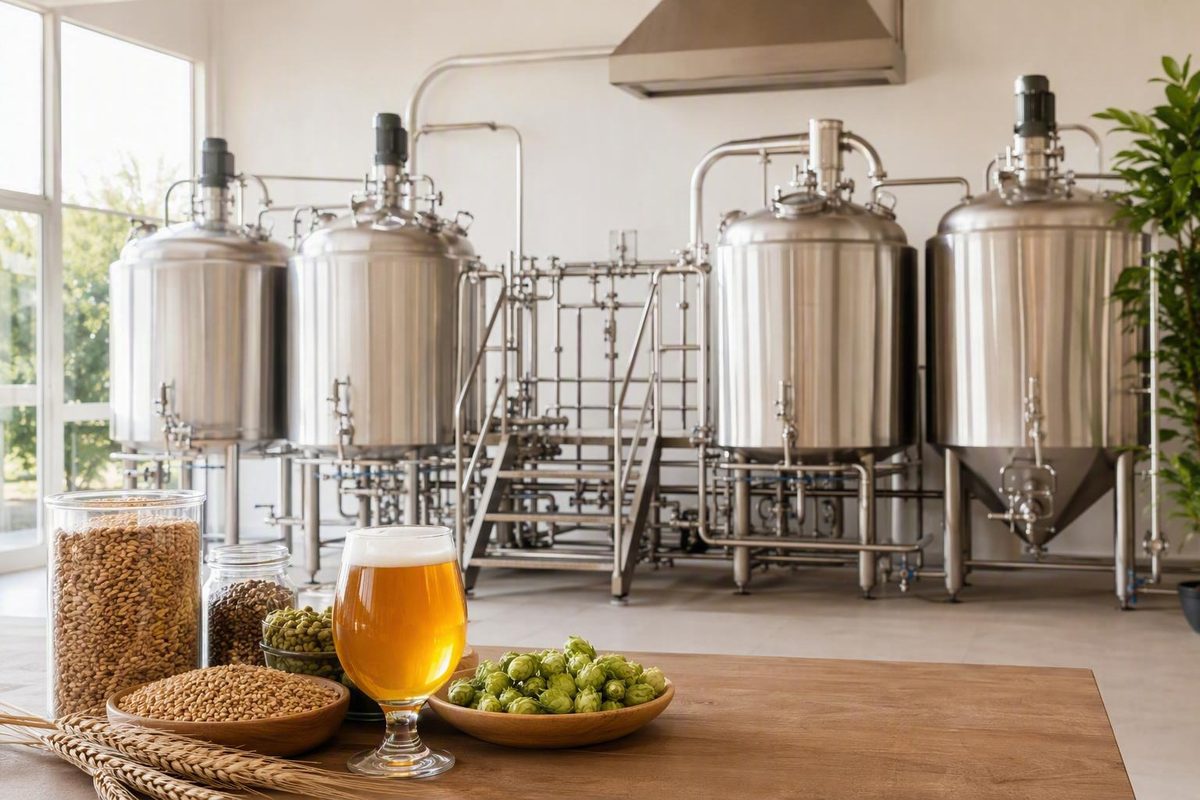
A four-vessel brewhouse makes wort by carrying out four hot-side brewing stages in separate vessels: mashing, lautering, boiling, and whirlpooling. Wort moves from the mash tun to the lauter tun, boil kettle, and whirlpool before cooling and transfer to a separate fermenter. Dedicated vessels can allow several batches to occupy different stages at once, but vessel count alone does not determine production capacity.
The short answer: it runs four wort-making stages in separate vessels
Two brewing-equipment manufacturers in the supplied material describe the typical four-vessel configuration as:
- Mash tun: Combines malted grain and hot water so grain starches can be converted into fermentable sugars.
- Lauter tun: Separates the sugar-rich wort from the spent grain.
- Boil kettle: Boils the wort and accommodates hop additions.
- Whirlpool: Separates hop matter and protein solids from the boiled wort.
This mash–lauter–kettle–whirlpool arrangement is the configuration presented in a YoLong Brewtech equipment guide. It is a typical supplier-described layout, not a universal definition covering every system sold under the “four-vessel” label.
The brewhouse makes wort, the sugar-containing liquid that will become beer. Fermentation normally takes place afterward in a separate fermentation tank rather than in one of the four brewhouse vessels. Once the hot-side process is complete, the wort must still be cooled and transferred for fermentation.
What each of the four vessels does
Each vessel is dedicated primarily to one stage. The following functions reflect the process described in YoLong Brewtech’s manufacturer guide.
| Vessel | Material entering | Primary task | Material leaving |
|---|---|---|---|
| Mash tun | Malted grain and hot water | Converts grain starches into fermentable sugars | Mash containing liquid and grain |
| Lauter tun | Completed mash | Separates wort from grain through a false bottom | Wort; spent grain remains behind |
| Boil kettle | Separated wort | Boils wort and accommodates hop additions | Boiled, hopped wort |
| Whirlpool | Boiled wort | Separates hop matter and protein solids | Hot wort ready for cooling |
In the mash tun, malted grain is mixed with hot water to form the mash. The purpose of this stage is to convert grain starches into fermentable sugars. The material leaving the vessel is still a mixture of liquid and grain rather than separated wort.
The completed mash moves to the lauter tun. A false bottom allows the wort to drain while retaining the grain material. The collected liquid proceeds to the next stage, while the retained material is spent grain.
The boil kettle receives the separated wort. Hops can be added during the boil to provide bitterness, flavor, and aroma. YoLong Brewtech’s guide also states that boiling helps control unwanted bacteria and wild yeasts, although proper handling remains necessary after the boil.
After boiling, the wort enters the whirlpool. This stage separates hop matter and protein particles from the wort before cooling and transfer to fermentation.
Lautering and whirlpooling are therefore distinct separation stages. Lautering separates wort from spent grain before the boil; whirlpooling separates hop and protein solids remaining after the boil.
Follow one batch through the brewhouse
The basic process flow is:
Grain + hot water → Mash tun → Lauter tun → Kettle → Whirlpool → Wort cooling → Fermenter
One batch follows these steps:
- Create fermentable sugars in the mash tun. Malted grain and hot water form the mash, allowing grain starches to be converted into fermentable sugars.
- Separate the wort in the lauter tun. Wort drains through the false bottom while spent grain remains in the vessel.
- Boil the wort in the kettle. The brewery boils the separated wort and makes its planned hop additions.
- Remove post-boil solids in the whirlpool. Hop matter and protein particles are separated from the wort.
- Cool the wort. The hot wort passes through the brewery’s cooling equipment.
- Transfer it to a fermenter. Fermentation then takes place in a separate tank.
Each transfer also changes which vessel may be prepared for another production step. Once the mash moves into the lauter tun, for example, the mash tun may be cleaned and readied for a later batch. When boiled wort moves into the whirlpool, the kettle may be prepared to receive the next batch of wort.
A completed transfer does not necessarily mean that a vessel is immediately available. Cleaning, preparation, utility availability, staffing, and the wider production schedule all affect when the next operation can begin.
Why separate vessels can increase throughput
The main operational advantage of four dedicated vessels is the opportunity to overlap batches. The brewery may not need to wait for one batch to complete every hot-side stage before beginning the next.
An illustrative—not guaranteed—sequence could be:
- Batch 1 moves into the whirlpool.
- Batch 2 occupies the kettle.
- Batch 3 proceeds through lautering.
- Another mash begins when the mash tun and required utilities are available.
This arrangement can make the brewhouse operate more like a production line, with separate batches moving through different stages. The benefit depends on the stages being coordinated effectively; it is not a promise of a particular cycle time or number of batches per day.
As with any production line, achievable output is constrained by the slowest or least-available stage. Having four open brewhouse vessels provides limited benefit if wort cannot be cooled when needed or if no fermenter is available to receive it.
Other potential constraints include:
- Vessel sizing and usable capacity
- Transfer capacity
- Utility availability
- Cleaning and changeover requirements
- Staffing and operator workload
- Automation and control capabilities
- Wort-cooling capacity
- Fermenter and cellar availability
Four vessels therefore create an opportunity for more production overlap; they do not automatically increase output under every operating condition. Separate vessels also do not, by themselves, guarantee better beer. The evidence supports greater scheduling flexibility, not an inherent quality improvement.
What the four-vessel label does—and does not—tell you
In the supplier material reviewed here, “four-vessel” describes separate mash, lauter, kettle, and whirlpool vessels. Because actual configurations can differ, buyers should confirm the included vessels rather than relying on the label alone.
Vessel count does not establish the system’s:
- Heating method
- Automation or control package
- Achievable throughput
- Utility demand
- Physical footprint
- Staffing needs
- Purchase price
Evaluation should begin with the intended brewing volume and the usable capacity of each vessel. Available space, budget, desired automation, and the proposed production schedule also matter. The vessels must work together at the required pace; sharing the same nominal size does not by itself demonstrate that a system can meet a particular output target.
Supplier catalogs illustrate how specifications can vary. ABS Commercial lists four-vessel models from 10 to 60 BBL, with nominal sizes of 10, 15, 20, 30, 40, 50, and 60 BBL. The company describes those listed models as having separate mash, lauter, kettle, and whirlpool vessels, steam heating, and automated controls. Those are specifications for ABS Commercial’s listed products, not universal features of all four-vessel brewhouses.
Before judging a system’s potential output, confirm:
- The exact four-vessel arrangement
- Intended batch size and usable vessel capacities
- Assumptions behind the proposed brewing schedule
- Heating method and control system
- Available utility capacity
- Cleaning and changeover plan
- Wort-cooling capacity
- Staffing requirements
- The number and availability of fermenters
A four-vessel brewhouse divides wort production into four dedicated steps: creating fermentable sugars, separating the wort from the grain, boiling the wort with hops, and removing post-boil solids. That division can make overlapping batches possible, but the complete brewery process—including utilities, cleaning, cooling, staffing, and fermentation capacity—ultimately determines real output.