
How Long It Takes to Make Beer by Style and Packaging
Budget about four hours to brew, 1-2 weeks to ferment and condition, two hours to bottle, then 1-2 weeks for natural carbonation.
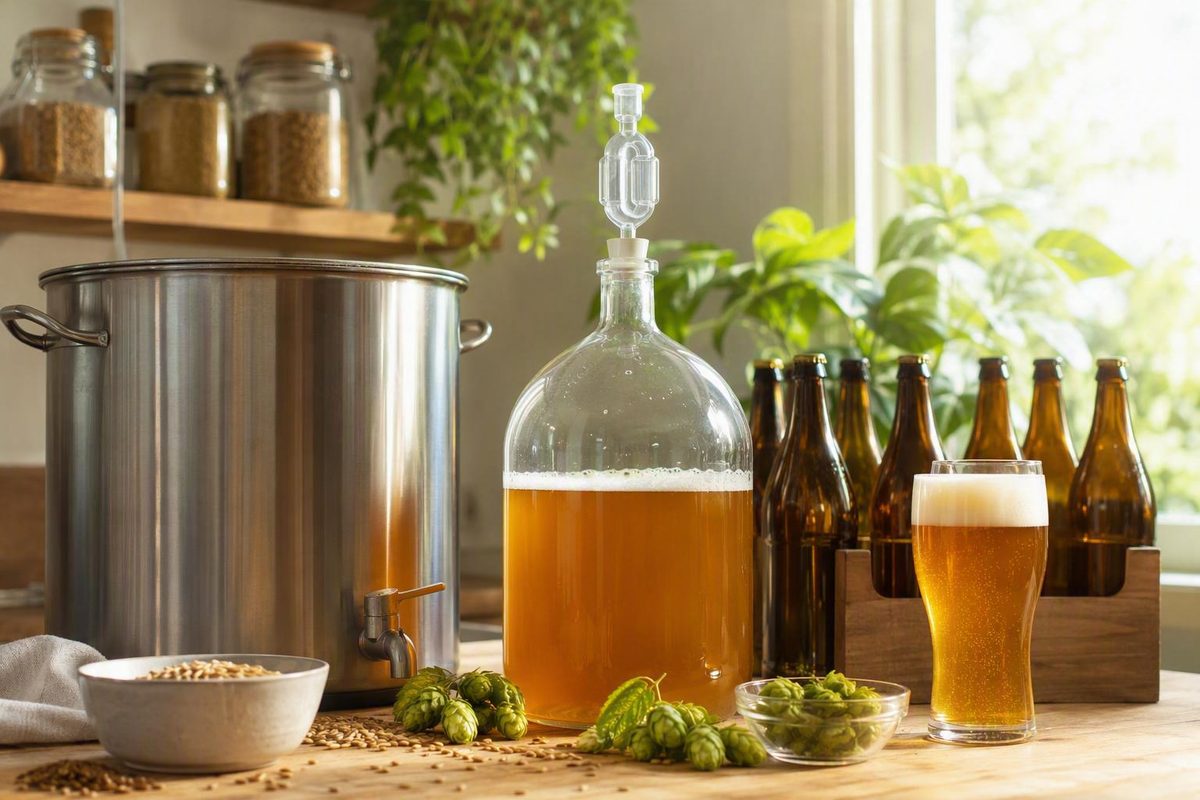
The short answer: expect about 2–4 weeks for a typical bottled ale
For a typical moderate-strength homebrewed ale that is naturally carbonated in bottles, allow about 2–4 weeks from brew day to the first pour. A practical breakdown is:
- Several hours to brew, cool, transfer, and pitch the yeast
- Roughly 1–2 weeks for fermentation and initial conditioning
- About 1–2 hours to package the beer
- Another 1–2 weeks for natural carbonation in bottles
That estimate assumes healthy fermentation, no lengthy maturation stage, and ordinary bottle conditioning. One published homebrew timeline budgets about four hours for brewing, one to two weeks for fermentation and conditioning, two hours for bottling, and one to two weeks for natural carbonation. Clawhammer Supply outlines that stage-by-stage schedule.
Here, “finished” means carbonated and drinkable, not merely that visible fermentation has stopped. That distinction explains why answers to “how long does it take to make beer?” vary. Some timelines end when fermentation is largely complete; others include clearing, packaging, carbonation, cold conditioning, or maturation.
These milestones do not necessarily occur on the same day:
- Fermentation complete: Specific gravity is no longer changing, indicating that fermentation has reached its measurable endpoint.
- Ready to package: Fermentation has been confirmed complete, and the beer is in a suitable condition for bottling or kegging.
- Carbonated: The beer contains the intended amount of dissolved carbon dioxide.
- Drinkable: The beer can reasonably be poured and enjoyed.
- Fully conditioned: The beer has reached the brewer’s preferred flavor, aroma, clarity, and carbonation development.
An optimized, force-carbonated kegged ale can reach the glass considerably sooner than a bottled batch. Traditional lagers, strong beers, and styles involving lengthy cold conditioning or maturation may require several additional weeks or even months.
Treat every duration in this guide as a planning range, not a deadline. The calendar helps organize the process, but fermentation measurements and the beer’s condition determine when to proceed.
Where the time goes: active work versus waiting
You will not be brewing continuously for several weeks. Most batches require one substantial work session on brew day and a shorter packaging session. Fermentation, settling, conditioning, and carbonation account for most of the elapsed calendar time.
The following table is a practical baseline for a standard bottled ale. Its ranges combine a multi-hour brew day, approximately 10–14 days for fermentation and initial conditioning, and another one to two weeks for natural bottle carbonation. A beginner-oriented schedule from Hazy and Hoppy gives a comparable breakdown.
| Stage | Typical duration | Active or passive? | Milestone reached |
|---|---|---|---|
| Preparation and brewing | About 3–8 hours | Mostly active | Wort has been produced and boiled |
| Cooling, transferring, and pitching yeast | Usually included in brew day | Active | Wort is in the fermenter and yeast has been added |
| Fermentation | Several days of vigorous activity within roughly 1–2 weeks overall | Mostly passive | Gravity approaches its final level |
| Conditioning or clearing | Often overlaps the fermenter period; longer if desired | Passive | Beer settles and may become ready to package |
| Packaging | Roughly 1–2 hours for bottling; often less for kegging | Active | Beer is sealed in bottles or a keg |
| Carbonation | About 1–2 weeks in bottles; potentially hours to several days in a keg | Mostly passive | Beer becomes carbonated |
| Optional maturation | Days, weeks, or months | Passive | Beer develops toward the brewer’s preferred character |
The boundary between fermentation and conditioning is not always obvious. Active fermentation may produce a foam cap and frequent airlock activity for several days, then appear to stop. The beer may nevertheless remain in the fermenter while fermentation finishes, yeast processes remaining material, and suspended particles settle.
This is why “the airlock stopped” and “the beer is ready to bottle” are not interchangeable. It is an observation, not a reliable completion test.
Carbonation and maturation are also separate. A bottle can produce a foamy pour while the underlying beer still tastes young. A keg can contain dissolved carbon dioxide before the beer has cleared or reached the brewer’s preferred flavor.
For planning, divide the schedule into two kinds of time.
Hands-on time
- Preparing and sanitizing equipment
- Producing and boiling wort
- Cooling and transferring
- Pitching yeast
- Cleaning after brew day
- Filling bottles or a keg
- Setting up carbonation and serving equipment
Elapsed waiting time
- Fermentation
- Post-fermentation settling
- Cold conditioning or clearing
- Natural carbonation
- Optional maturation
A batch that takes three weeks from ingredients to glass therefore does not require three weeks of labor. It may involve only a brew day, a packaging session, and occasional measurements or checks in between.
Brew day usually takes 3–8 hours
Brew day is the period in which you prepare the equipment and ingredients, make wort, boil it with hops, cool it, transfer it to a fermenter, and add yeast. Depending on the method, equipment, setup, and cleanup routine, a complete session generally takes about 3–8 hours.
The largest method-related difference is usually whether you brew with malt extract or make the wort from grain:
- Extract brewing: Commonly about 2–4 hours
- All-grain brewing: Commonly about 4–8 hours
These are broad estimates rather than guaranteed session lengths. User-generated accounts from experienced homebrewers commonly place extract sessions at a few hours and all-grain sessions at much of a day, although individual equipment and workflows vary considerably. This Quora discussion provides practical extract and all-grain examples.
All-grain brewing normally takes longer because the brewer must produce fermentable wort from crushed malt. Grain is mixed with heated water during the mash, after which the sweet wort is separated from the grain. Depending on the system, the brewer may also rinse the grain, recirculate wort, or perform additional collection steps.
With extract brewing, the malt producer has already performed the base extraction process. The brewer dissolves dry or liquid malt extract in water, although the recipe may still include specialty grains steeped for color or flavor. This removes much of the mash-related work, but not the need to boil, cool, transfer, ferment, and package the beer.
An all-grain mash is often scheduled for around an hour, and many recipes use a boil of approximately an hour. Neither duration is universal; recipe design and equipment can call for shorter or longer steps. Spike Brewing’s process guide describes an approximately one-hour mash within the wider brewing workflow.
Several practical factors can move brew day toward either end of the range:
- Heating power: A stronger heat source brings brewing water and wort to temperature faster.
- Chilling performance: An efficient chiller reduces the time between the boil and yeast pitching.
- Batch and kettle capacity: Equipment operating near its practical capacity can be slower or more awkward to handle.
- System layout: Moving hot liquid among separate vessels often takes longer than working with a compact system.
- Wort-production method: Some all-grain workflows require more recirculation, rinsing, or transfer steps than others.
- Preparation: Measuring ingredients and organizing equipment beforehand prevents avoidable pauses.
- Cleanup practices: Cleaning during heating or boiling periods can shorten the end-of-day workload.
- Experience: A practiced brewer usually completes transfers and equipment changes more efficiently.
Even a long all-grain session is only a small part of a multiweek grain-to-glass schedule. Fermentation, conditioning, and carbonation usually determine when the beer can be served.
Fermentation can look finished before the beer is ready
For a standard ale, roughly one to two weeks in the fermenter is a useful planning range for fermentation and initial conditioning. The vigorous phase may last only a few days, but visible activity is not the same as confirmed completion.
Foam may form on top of the beer, the airlock may bubble, and sediment begins accumulating. As readily fermentable sugar becomes less available, those visible signs often become less dramatic.
Yeast activity can continue after the airlock becomes quiet. The beer may also remain in the fermenter so suspended material can settle and its character can develop. One homebrewing guide distinguishes active ale fermentation—which it places at roughly two to five days—from the longer total period before packaging. Hazy and Hoppy explains the difference between active fermentation and total time in the vessel.
Use stable gravity, not bubbles, as the packaging checkpoint
Elapsed time is useful for planning, but it does not establish that fermentation is complete. Airlock activity is also unreliable because it can be affected by the fermenter’s seal, temperature changes, and the rate at which gas escapes.
A hydrometer provides a better checkpoint by measuring specific gravity. The recipe’s expected final gravity is a useful reference, but matching that estimate once does not by itself prove completion. Before packaging, confirm that the measured gravity is no longer changing across repeat checks. No universal number of readings or mandatory interval applies to every recipe and process.
Fermentaholics likewise recommends confirming fermentation with a hydrometer rather than assuming the beer is ready merely because a typical amount of time has passed. Its brewing timeline discusses gravity testing before bottling.
Stable gravity establishes a measurable fermentation milestone. It does not automatically mean the beer has reached its ideal clarity, flavor, or maturity. Those are separate considerations.
A practical sequence is:
- Visible fermentation begins and later slows.
- Gravity approaches the expected range.
- Repeat measurements show that gravity is no longer changing.
- The brewer decides whether additional settling or conditioning is desirable.
- The beer is packaged.
- Carbonation develops.
- The beer may continue maturing after it becomes drinkable.
Keep that warning bounded: the appropriate response is to confirm stable gravity, not to rely on a fixed waiting period or assume a particular pressure outcome.
Why lagers take longer in the fermenter
Traditional lagers are generally fermented cooler than ales, so fermentation commonly proceeds more slowly. They are also often given a separate cold-conditioning period. Brew day may be similar in length, but fermentation and conditioning can add several weeks.
This does not mean every beer labeled “lager” follows one schedule. Yeast selection and modern fermentation methods can shorten some lager timelines. For straightforward planning, however, a traditionally fermented and conditioned lager should be treated as a longer project than a moderate-strength ale.
Bottling or kegging can change the finish date by days or weeks
Beer is generally flat at the end of fermentation. If the goal is a conventional first pour, packaging and carbonation must be included in the grain-to-glass schedule.
Bottling
Bottling a typical homebrew batch may take about two hours, although batch size, bottle preparation, equipment, and experience all affect the session. The work normally includes:
- Cleaning and sanitizing bottles and packaging equipment
- Preparing and distributing priming sugar
- Transferring the beer while limiting unnecessary splashing
- Filling and capping each bottle
- Cleaning the equipment afterward
The added priming sugar gives the remaining yeast a limited amount of fermentable material. In the sealed bottle, fermentation produces carbon dioxide that dissolves into the beer.
Natural bottle carbonation commonly adds about one to two weeks. A bottle opened on a target day is therefore a test, not proof that the entire batch has reached the intended condition. The standard two-to-four-week ale timeline includes both bottling work and the subsequent carbonation wait.
Kegging
Kegging may require less hands-on packaging time because the brewer transfers the batch into one vessel instead of filling numerous bottles. Carbon dioxide can then be introduced directly from a gas cylinder.
Depending on the method, beer temperature, applied pressure, and definition of “serving-ready,” forced carbonation can take hours to several days. A slower set-and-wait method takes longer than an accelerated approach, but both can substantially shorten the final stage compared with natural bottle conditioning.
Claims of nearly instant carbonation should not be treated as universal outcomes. Accelerated methods may put carbon dioxide into beer quickly, but carbonation speed does not establish that fermentation, clearing, flavor development, or maturation is complete.
The practical comparison is straightforward:
- Bottled standard ale: Natural carbonation commonly adds around one to two weeks.
- Kegged standard ale: Much of that final waiting period can potentially be reduced to days or less.
Kegging changes the carbonation schedule; it does not make an immature beer mature.
Three realistic grain-to-glass schedules
Instead of forcing every beer into one average, choose a schedule that matches the recipe, yeast, packaging method, and desired endpoint. The following calendars are planning tools rather than promises.
1. Fast kegged ale: approximately 4–10 days
A 4–10-day grain-to-glass schedule is an optimized exception, not a dependable default for a first batch. Commercial demonstrations describe ale fermentation in as little as several days when a suitable yeast and tightly managed process are used, followed by rapid keg carbonation. Clawhammer Supply’s video contrasts these fast cases with conventional timelines.
Sample calendar
- Day 0: Brew for approximately 3–6 hours, cool the wort, transfer it, and pitch a suitable yeast.
- Days 1–3: Vigorous fermentation under controlled conditions.
- Days 3–7: Monitor gravity and confirm that it has stopped changing.
- Days 4–9: Chill and keg only when the beer is ready to package.
- Days 4–10: Force-carbonate and evaluate the first pour.
This schedule usually depends on:
- A yeast suited to fast fermentation
- Fermentation conditions appropriate for that yeast
- A modest-strength recipe
- Healthy yeast performance
- Limited additional conditioning
- No lengthy dry-hopping, fruit, or cold-conditioning stage
- Kegging rather than natural bottle carbonation
A beer produced this quickly may be drinkable, but the compressed schedule does not demonstrate that it has reached the same clarity, flavor development, or maturity it might achieve with additional time.
2. Standard bottled ale: approximately 2–4 weeks
This is the most useful baseline for a beginner making a moderate-strength ale.
Sample calendar
- Day 0: Brew, cool, transfer, and pitch the yeast.
- Days 1–7: Active fermentation begins and later slows.
- Days 7–14: Check gravity and allow fermentation or initial conditioning to finish.
- Around week 1 or 2: Bottle only after gravity has stopped changing.
- Following 1–2 weeks: Allow natural carbonation to develop.
- Around weeks 2–4: Chill a test bottle, evaluate carbonation, and serve when ready.
The schedule may land nearer two weeks when fermentation is prompt, the beer needs little conditioning, and the bottles carbonate quickly. It may approach or exceed four weeks if fermentation is slower, more settling is desired, or carbonation takes longer than expected.
If the beer is intended for an event, do not make the event date the first possible tasting day. Leave enough time to test a bottle and accommodate slower-than-expected carbonation or flavor development.
3. Traditional lager: approximately 6–10 weeks, sometimes longer
A traditional lager commonly requires cooler fermentation followed by cold conditioning. Packaging and carbonation then add further time. A 6–10-week planning range is a useful starting budget, but some lager processes extend longer. Fermentaholics’ comparison assigns substantially more fermentation time to lagers than ales and identifies packaging as another variable.
Sample calendar
- Day 0: Brew, cool to the intended pitching conditions, transfer, and pitch the yeast.
- Weeks 1–3 or longer: Conduct cooler fermentation and monitor gravity.
- Following several weeks: Cold-condition according to the recipe and desired character.
- Later in the schedule: Package after fermentation and conditioning milestones have been met.
- Final stage: Carbonate in bottles or a keg and evaluate before serving.
Published lager timelines vary because some count only primary fermentation, while others include cold conditioning and maturation. The recipe and process therefore matter more than a single universal number.
A conservative kegged-ale alternative: approximately 2–3 weeks
Brewers do not need to choose between bottle conditioning and an aggressive speed run. A more conservative kegged schedule allows:
- One brew day
- Roughly 10–14 days for fermentation and initial conditioning
- Additional time to chill, keg, and carbonate
- A first pour at approximately two to three weeks
This approach preserves much of kegging’s scheduling advantage without depending on unusually rapid fermentation or immediate service.
Whatever schedule you choose, add a buffer for a birthday, competition, holiday, or other fixed occasion. Fermentation and carbonation can take longer than planned, and rushing the final stage cannot replace conditioning that the beer still needs.
Why some beers take longer than others
The timeline is controlled by four broad groups of variables: the beer itself, fermentation, optional processing, and packaging.
Beer: style and strength
Moderate-strength ales generally turn around faster than high-gravity beers. Stronger wort contains more fermentable material for yeast to process and can place greater demands on fermentation. Strong beers may also need additional maturation before their flavors reach the intended balance.
Style matters independently of strength. Some beers are intended to be consumed relatively fresh, while others are built around prolonged cold conditioning or maturation. Longer is not automatically better: a fresh, hop-forward beer and a strong malt-focused beer can have very different preferred serving windows.
Fermentation: yeast and temperature
Yeast strains differ in:
- Fermentation speed
- Preferred temperature range
- Attenuation behavior
- Flavor profile
- Tendency to clump and settle, known as flocculation
A fast strain can shorten the path to final gravity. A yeast that remains suspended longer may require additional settling time when clearer beer is the goal. Neither characteristic makes a strain universally better; the yeast must suit the recipe and process.
Temperature also changes the schedule. Cooler fermentation generally proceeds more slowly. Simply increasing the temperature is not a universal shortcut because different yeasts have different appropriate operating ranges, and unsuitable conditions can change fermentation character.
Community discussions commonly identify strength, yeast, temperature, and optional processing as important variables, but their unusually short examples are individual experiences rather than validated norms. Homebrewing Stack Exchange illustrates those practical tradeoffs.
Processing: conditioning, clarity, and additions
Beer that is acceptable while young or intentionally hazy can often be served sooner than beer intended to become clearer or more polished. Optional processing can also extend the schedule:
- Dry hopping
- Fruit additions
- Cold conditioning
- Cold crashing
- Lagering
- Wood contact
- Specialty maturation
There is no universal duration for these steps. The recipe, ingredient, equipment, and intended result determine whether an addition requires a few extra days or substantially longer.
Conditioning should be purposeful. Additional time may help one beer while reducing the desired freshness of another. Decide what the extra time is expected to accomplish rather than assuming every batch improves indefinitely.
Packaging: bottles versus kegs
Natural bottle carbonation normally takes longer because yeast must ferment priming sugar inside each sealed bottle. Forced keg carbonation introduces carbon dioxide directly and can substantially reduce the final stage.
Packaging affects more than speed. Bottles are portable and do not require a draft system. Kegs consolidate the batch into one vessel and allow the brewer to control applied gas. The better option depends on budget, storage, serving plans, and willingness to manage draft equipment.
Brewing method and batch size
Extract versus all-grain brewing mainly changes the duration and complexity of brew day.
Batch size does not inherently require a longer fermentation when equipment capacity and yeast quantity are scaled appropriately. Real-world schedules can still change if a larger batch heats or cools more slowly, exceeds temperature-control capacity, or receives an inadequate yeast pitch. Volume alone does not dictate fermentation time, but the system must be suitable for that volume.
How to shorten the schedule without treating the calendar as proof
The most dependable way to make beer sooner is to design a shorter process from the beginning, not to push a slow recipe through an arbitrary deadline.
Choose a suitable beer
Start with a moderate-strength ale that does not depend on prolonged maturation. Avoid selecting a high-gravity beer or traditionally conditioned lager when the serving date is close.
A simple recipe also limits scheduling uncertainty. Every optional addition or transfer creates another step that may require time and attention.
Match the yeast to the plan
Choose a yeast suited to both the style and the desired turnaround. Provide the conditions that yeast requires rather than selecting it for speed and then fermenting outside its appropriate range.
A fast yeast can shorten fermentation, but stable gravity remains the packaging checkpoint. Do not package merely because a product description or another brewer’s batch suggests a certain number of days.
Control fermentation temperature
Stable, appropriate fermentation conditions make the schedule more predictable. Temperature control does not mean making the beer as warm as possible. It means maintaining conditions suited to the selected yeast and recipe.
Predictability is often more useful than maximum speed. A fermentation that proceeds consistently within the intended range is easier to plan around than one pushed through unsuitable conditions.
Use extract to reduce hands-on time
Extract brewing removes the mash and related wort-production steps, shortening brew day. It does not automatically make fermentation faster.
Keg when the equipment and serving plan justify it
Kegging is one of the largest controllable shortcuts because it can avoid the one-to-two-week wait commonly associated with natural bottle carbonation. It may also reduce packaging labor because the entire batch goes into one vessel.
Kegging compresses the carbonation stage. It does not prove that fermentation, clearing, or flavor development is complete.
Treat speed records as edge cases
Three- or four-day grain-to-glass claims generally come from commercial demonstrations or individual brewer experiences using optimized processes. One-week ales likewise tend to depend on fast yeast, modest strength, limited conditioning, and forced carbonation.
These examples show what may be possible under selected conditions. They do not establish a normal beginner timeline or guarantee equivalent maturity, clarity, or flavor development.
Plan backward from the serving date
Use this checklist when preparing beer for an event:
- Define the endpoint. Do you need merely drinkable beer, or a more polished and fully conditioned pint?
- Choose ale or lager. A traditional lager normally requires substantially more time.
- Choose moderate or high strength. Stronger beer generally warrants a larger schedule allowance.
- Estimate fermentation and initial conditioning. Base the estimate on the recipe, yeast, and intended fermentation conditions.
- Choose bottles or a keg. Add natural-conditioning time for bottles or chilling and forced-carbonation time for a keg.
- Add optional processing. Include dry hopping, fruit, cold conditioning, or other recipe-specific steps.
- Include a buffer. Allow for slower fermentation, carbonation checks, and sensory evaluation.
- Confirm completion. Package only after gravity has stopped changing rather than automatically on a preset date.
The final decision path is simple:
- Ale or lager?
- Bottle or keg?
- Moderate or high strength?
- Earliest drinkable or more fully conditioned?
Conclusion
For planning purposes, budget about two to four weeks for a typical bottled ale: one brew day, roughly one to two weeks for fermentation and initial conditioning, and another one to two weeks for natural bottle carbonation.
Kegging can shorten the final stage, while traditional lagers, strong beers, and specialty conditioning can extend the process to several weeks or months. Treat the calendar as an estimate, confirm fermentation by establishing that specific gravity is no longer changing, and decide whether your goal is the earliest drinkable beer or a more fully conditioned pint.
Frequently asked questions
Can you make beer in one week?
Yes, but a one-week grain-to-glass beer is an optimized exception rather than a reliable beginner baseline. It generally requires a moderate-strength ale, a suitable fast yeast, controlled fermentation conditions, minimal additional conditioning, and kegging with forced carbonation.
Bottling makes a one-week target considerably less realistic because natural carbonation commonly adds another one to two weeks. Even when a kegged beer is fermented and carbonated within a week, it may continue developing after the first pour.
How long should beer ferment before bottling?
For a typical ale, allow roughly one to two weeks as an initial planning range, but do not bottle solely because that period has elapsed. Use a hydrometer and confirm that specific gravity is no longer changing across repeat checks.
The recipe’s expected final gravity is a useful comparison point, not conclusive proof by itself. Visible activity may slow after only a few days, and a quiet airlock does not establish that fermentation is complete.
How long does bottle-conditioned beer take to carbonate?
Natural bottle carbonation commonly takes about one to two weeks under suitable conditions. Yeast ferments the added priming sugar inside the sealed bottle, producing carbon dioxide that dissolves into the beer. Hazy and Hoppy includes this carbonation period in its beginner homebrew schedule.
Actual timing varies with yeast condition, beer strength, storage conditions, and the desired carbonation level. Chill and test a bottle rather than assuming that every bottle is ready on a fixed date.
Why do lagers take longer to make than ales?
Traditional lagers are fermented at cooler temperatures, so fermentation generally proceeds more slowly. They also commonly receive an additional period of cold conditioning.
General commercial descriptions place lager production several weeks beyond rapid ale fermentation, although the exact schedule depends on the yeast, recipe, and whether maturation is included. Tapville Social’s ale-and-lager comparison attributes the longer lager schedule to colder fermentation.
Does a five-gallon batch take longer than a smaller batch?
Not inherently. If the recipe, yeast quantity, temperature control, oxygenation, and equipment capacity are scaled appropriately, a five-gallon batch does not automatically require a longer fermentation than a smaller batch.
It may take longer to heat or cool in a particular setup, and undersized equipment or an inadequate yeast pitch can delay the practical process. The relevant issue is whether the system and fermentation conditions suit the volume, not the five-gallon figure by itself. A brewery-equipment guide makes the same general distinction about appropriately scaled batches.