
Cartridge Filters: Types, Micron Ratings and Selection
Match cartridge filters to sediment, taste or a verified contaminant claim, then check micron rating, housing fit, flow and replacement limits.
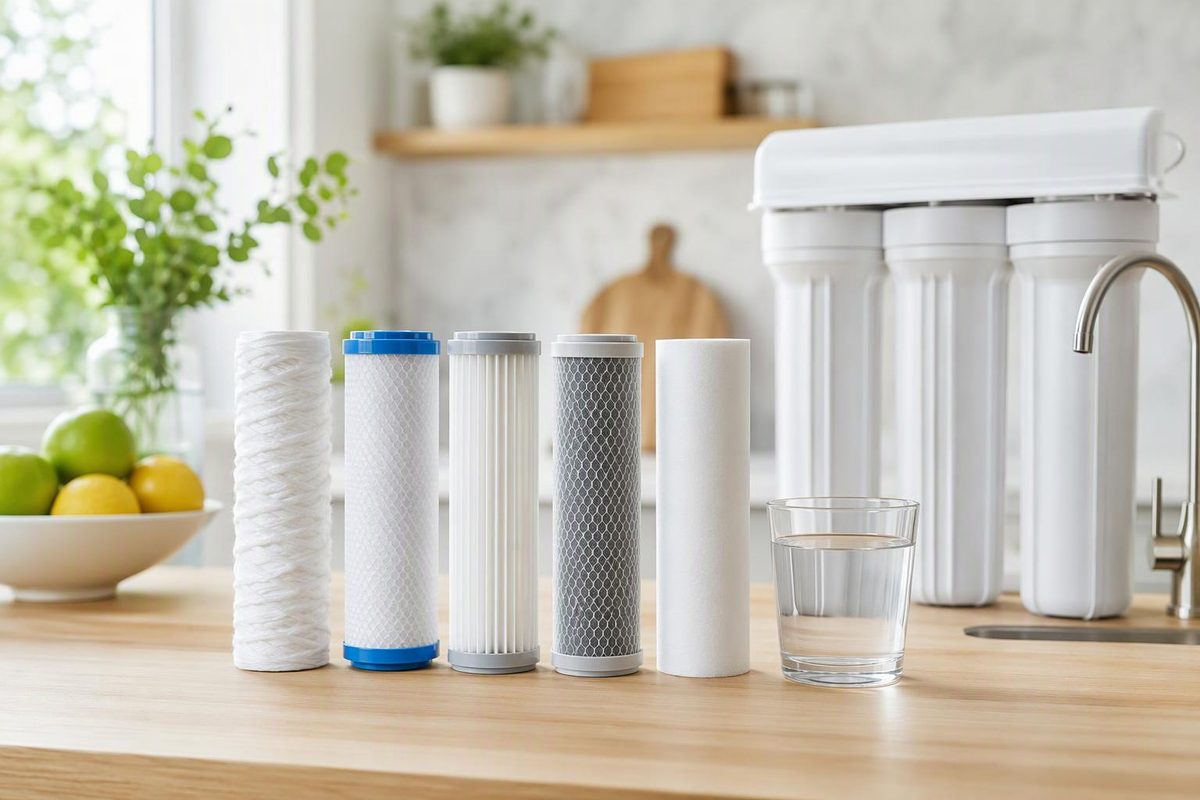
A cartridge filter is a replaceable element installed inside a housing. Choose one in this order: treatment job, verified performance, housing fit, flow and capacity. A cartridge that physically fits is not necessarily suitable for the water problem—or for the housing’s pressure and temperature conditions.
For sediment, select a particle filter with a documented micron rating. For chlorine-related taste or odor, select activated carbon with enough capacity at the required flow. For lead, cysts, PFAS or another health-related contaminant, use a complete exact-model system carrying that specific reduction claim. Neither “carbon cartridge” nor “5-micron filter” establishes broad contaminant removal.
Cartridge types at a glance
| Cartridge type | Appropriate starting point for | Important limit |
|---|---|---|
| Spun or melt-blown depth filter | Sand, rust flakes, silt and other suspended particles | Does not remove hardness, dissolved salts or most dissolved contaminants |
| Pleated surface filter | Sediment where greater surface area or a washable design is useful | Washable does not mean indefinitely reusable |
| String-wound depth filter | Sediment loading where a depth design is appropriate | Materials, temperature limits and chemical compatibility vary |
| Granular activated carbon (GAC) | Chlorine-related taste and odor; other uses only when claimed | Performance depends on flow, capacity and the exact contaminant |
| Carbon block | Chlorine taste and odor plus model-specific particle or contaminant reduction | Commonly adds more flow resistance than a coarse sediment cartridge |
| Specialty-media cartridge | A documented target such as nitrate, arsenic, scale control or deionization | Media chemistry, water chemistry and capacity must all match the job |
| Beverage or membrane cartridge | Filtering water or a finished beverage at a specified retention rating | Must suit the beverage, temperature, pressure and cleaning method |
The mechanisms are different: sediment cartridges retain particles, activated carbon adsorbs certain compounds, and ion-exchange or adsorptive media target particular dissolved substances. Penn State Extension recommends identifying the water problem through appropriate testing and matching treatment to that problem rather than buying equipment on appearance or a broad sales claim (Penn State Extension).
Read the micron rating correctly
A micron is 0.001 millimeter. The number describes particle size; it does not by itself describe chemical removal, microbiological safety or overall water quality.
Two cartridges marked “5 micron” may perform differently because the rating can be nominal or absolute:
- Nominal generally describes removal of a stated proportion of particles near the rated size under specified conditions. Look for the efficiency and test method.
- Absolute generally sets a defined maximum pore size or retention threshold. The test method and operating conditions still matter.
Do not compare bare micron numbers unless the rating basis is comparable. Our guide to nominal versus absolute 5-micron filters explains why the label alone is insufficient.
A finer rating can capture smaller material, but it may also reduce flow and clog sooner. With heavy sediment, staged filtration—coarse first, fine second—can protect the finer cartridge.
For a health claim such as cyst reduction, do not substitute an arbitrary nominal rating. EPA identifies an absolute 1-micron filter, reverse osmosis or a filter certified under NSF/ANSI 53 for cyst reduction as point-of-use options that provide the greatest assurance of removing Cryptosporidium. It also says to follow the manufacturer’s use and replacement instructions (EPA).
Match the cartridge to the problem
Visible sediment or clogged fixtures
Start with a sediment cartridge. Identify whether the material is coarse sand, rust flakes or fine silt, and note how quickly it accumulates. A very fine cartridge is not automatically better: placed before a high-flow household system, it may cause unacceptable pressure loss or require frequent replacement.
Sediment filtration does not correct dissolved iron, hardness or corrosive water. If particles return quickly, investigate their source rather than treating repeated cartridge changes as the complete fix.
Chlorine taste and odor
Use activated carbon rather than a sediment-only cartridge. Check the rated flow, capacity and whether the claim covers free chlorine or chloramine; they are not interchangeable performance claims. A combination cartridge may address both sediment and chlorine taste, but its ratings remain product-specific.
Carbon does not soften water. It also should not be assumed to remove nitrate, fluoride, microbes or every organic chemical.
A contaminant with a health effect
Confirm the contaminant through the utility’s water-quality report or an appropriate laboratory test. Then find the specific reduction claim in a current certification listing and the product’s performance data sheet.
NSF explains that NSF/ANSI 42 covers aesthetic effects such as chlorine, taste and odor; NSF/ANSI 53 covers specified health-effect claims; and NSF/ANSI 401 covers reduction claims for specified emerging contaminants. Certification to a standard does not mean a product reduces every contaminant addressed by that standard (NSF). Verify both the individual claim and exact model in the NSF certified-product database.
Brewing and beverage filtration
First decide whether the cartridge will treat source water or the beverage itself.
For brewing water, sediment and carbon cartridges can address particles or disinfectant-related taste when their claims match the supply. They do not create a complete brewing-water profile or selectively correct alkalinity and mineral balance.
For finished beer, use cartridges and housings documented for beverage contact and for the process temperature, pressure and cleaning method. Finish fermentation and clarify first so yeast and hop solids do not immediately blind a fine cartridge. See filtering homebrew beer by haze type for the practical sequence.
Verify housing fit before buying
Record the housing manufacturer and model, then check:
- Outside diameter and actual cartridge length
- End configuration: double-open-end, single-open-end or proprietary connection
- Gasket or O-ring location and material
- Housing pressure and temperature limits
- Cartridge flow rating and clean pressure drop
- Materials suitable for drinking-water or beverage contact
- Exact system certification, when contaminant reduction is the reason for purchase
“10-inch” and “20-inch” describe product classes, not complete specifications. Slim and large-diameter cartridges can share a nominal length but require different housings. Proprietary refrigerator, quick-change and RO cartridges require the specified connection; visual similarity is not proof of compatibility.
Replace by a stated limit, not color alone
Use the earliest applicable endpoint in the manufacturer’s instructions:
- time in service;
- rated gallons or liters;
- specified differential pressure;
- unacceptable flow reduction;
- a valid monitored endpoint for the target contaminant; or
- a required sanitation or service event.
A clear housing can show dirt loading, but color does not reliably reveal carbon exhaustion or contaminant breakthrough. EPA says all home treatment units require maintenance and notes that activated-carbon filters become clogged and ineffective after treating their designed volume (EPA).
Follow the housing manual during service. Typically, that means isolating the water, relieving pressure, removing the sump, replacing or cleaning the cartridge only as permitted, inspecting and seating the O-ring correctly, restoring pressure slowly, flushing as directed and checking for leaks. Never open a pressurized housing.
A useful buying specification is therefore not simply “a 5-micron cartridge.” It is: the required treatment job; stated nominal or absolute retention performance; exact dimensions and end style; acceptable flow and pressure drop; suitable materials; and a defined replacement endpoint.