
Countertop Reverse Osmosis Water Filter Systems: 7 Checks Before Buying
Compare countertop RO systems by certified claims, usable output, reject water, feed limits, upkeep and suitability for brewing.
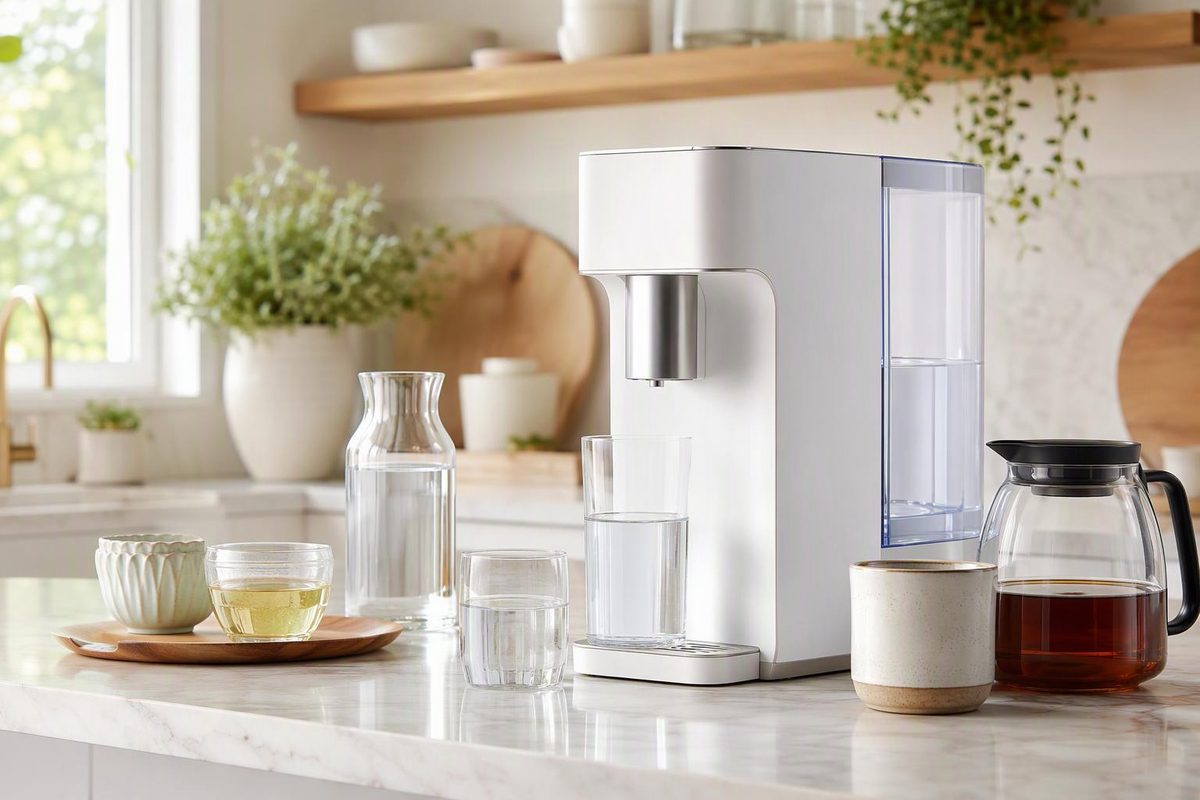
Choose a countertop reverse osmosis water filter system only after checking its exact model number, certified contaminant claims, usable output per cycle, waste-to-treated-water ratio and feed-water limits. For a renter or anyone avoiding plumbing changes, an electric batch unit can be practical. If the goal is only to reduce chlorine taste, however, a certified carbon filter is usually simpler and does not produce an RO concentrate stream.
RO is most useful when testing or a utility report identifies a dissolved contaminant the exact system is certified to reduce, or when a brewer wants low-mineral water as a repeatable starting point. See how reverse osmosis works and when it is worth it before choosing the countertop format.
Countertop RO at a glance
| Check | What to look for | Why it matters |
|---|---|---|
| Configuration | Fill-and-run batch unit or faucet-connected unit | Determines plumbing, electrical and sink requirements |
| Certification | Exact model listed by an independent certifier to NSF/ANSI 58 | Confirms core RO-system requirements and TDS reduction |
| Contaminant claim | Lead, fluoride, nitrate, arsenic, PFAS or another named substance | NSF/ANSI 58 certification alone does not verify every optional reduction claim |
| Useful output | Treated-tank volume and cycle time—not only membrane GPD | Determines whether the unit can supply drinking, cooking and brewing water conveniently |
| Water efficiency | Efficiency percentage or waste-to-treated-water ratio | Reveals how much concentrate the system produces |
| Feed limits | Hardness, TDS, turbidity, iron, manganese, pH and temperature | Water outside the limits can shorten membrane life or undermine expected performance |
| Upkeep | Cartridge availability, replacement interval, cleaning and descaling | A low purchase price can hide proprietary-filter costs or frequent maintenance |
1. Pick the physical format first
A batch countertop system has a raw-water reservoir, an internal pump and a treated-water tank or carafe. It usually needs only counter space and an electrical outlet; you fill it manually and empty the concentrated reject water after processing.
A faucet-connected countertop system draws water through a diverter and sends concentrate back to the sink. It avoids repeated tank filling but must fit the faucet, hose arrangement and available sink area. Pull-down, sensor-operated and nonstandard faucets may be incompatible.
Measure width, depth and height with the lid open. Check how far a removable tank must travel upward or backward. Rated membrane capacity in gallons per day (GPD) does not show whether a 1-gallon kettle or a 5-gallon brew day can be supplied conveniently; treated-tank volume and cycle time do.
2. Verify the model, standard and contaminant
Start with NSF/ANSI 58, the standard for point-of-use RO systems. It addresses material safety, structural integrity, total dissolved solids (TDS) reduction, efficiency or recovery, contaminant-reduction performance and information for the user. TDS reduction is required, while claims for lead, fluoride, nitrate/nitrite, arsenic and many other contaminants are optional (NSF’s NSF/ANSI 58 overview).
That distinction matters: “certified to NSF/ANSI 58” does not mean certified for every contaminant associated with RO. Search the exact model in the directory of the organization named on the certification mark, then read its performance data sheet. The NSF certified-product search can be filtered by standard and individual reduction claim.
Ignore phrases such as “tested to NSF standards” unless they lead to a current third-party listing for the model being sold. NSF/ANSI 372 concerns lead content in materials; it is not a lead-reduction claim. Standards numbers describe different requirements, not quality scores or rankings (NSF’s consumer standards guide).
A built-in TDS display may help you follow a trend in membrane performance, but it cannot prove that lead, PFAS, nitrate or microorganisms are absent. Each contaminant of concern needs an applicable claim for the exact model.
3. Match the system to an identified problem
Review the annual water-quality report for a public supply or obtain appropriate laboratory testing for a private well. CDC recommends choosing treatment for the harmful chemicals or germs actually found and notes that a household may not need treatment when neither is present (CDC’s home-treatment guidance). Taste, odor and appearance alone are unreliable safety tests.
For a private well, do not treat a countertop RO appliance as a substitute for source correction or disinfection. Follow the model’s inlet-water and microbiological-safety instructions. CDC recommends testing private wells at least annually for relevant germs and chemicals (CDC’s filter-selection guidance).
RO is also not a whole-home scale solution. A countertop unit treats only the water put through it; it does not protect a water heater, shower or dishwasher. Compare RO with a water softener if hardness is the main complaint.
4. Compare reject water with one consistent number
Manufacturers may express water use in either of these forms:
- Efficiency: the percentage of incoming water delivered as treated water; higher is better.
- Waste-to-treated-water ratio: gallons discarded per gallon delivered; lower is better.
For example, 50% efficiency corresponds to about 1 gallon rejected per 1 gallon treated. At 30% efficiency, the ratio is approximately 2.3:1.
EPA says a typical point-of-use RO system can reject 5 gallons or more for each gallon treated. A WaterSense-labeled model must be independently certified, meet NSF/ANSI 58, include automatic shutoff and achieve at least 30% efficiency—no more than approximately 2.3 gallons rejected per gallon treated (EPA’s point-of-use RO page; WaterSense specification). EPA’s WaterSense product search reports efficiency and verified claims for selected priority contaminants.
For a manual-fill appliance, include concentrate left in the feed tank when judging actual household water use. Do not repeatedly top off concentrated feed water unless the manual explicitly permits it.
5. Check whether your feed water is within limits
Read the performance data sheet before purchase because limits differ substantially by model. As one example—not a universal RO specification—the certified data sheet for the AquaTru AT2000–AT2050 countertop family lists cold-water operation, maximum hardness of 10 grains per gallon (171 mg/L as CaCO₃), maximum TDS of 1,500 mg/L, turbidity no higher than 5 NTU, and sulfide, iron and manganese below 0.1 mg/L. It warns that harder water can rapidly scale and plug the membrane (manufacturer performance data sheet). Another model may have different limits.
Heavy scale, sediment or iron can turn a compact appliance into a frequent cleaning job. If pretreatment is required, account for that equipment rather than assuming a “no-installation” unit can accept any tap or well water.
6. Calculate usable capacity and ownership cost
Estimate treated-water demand in gallons or liters per day, including drinking, cooking, coffee and brewing. Then compare:
- treated volume per batch;
- time per batch and any limit on consecutive cycles;
- separate replacement intervals for prefilters, postfilters and the RO membrane;
- annual cartridge cost at your expected use;
- tank washing, sanitizing and descaling instructions;
- availability of exact replacement part numbers.
Filter-life claims expressed only in months are incomplete because water quality and volume affect service life. Keep the model and cartridge numbers with the manual; generic “multi-stage” sets are not automatically compatible. Use the RO replacement-filter compatibility checks before ordering parts.
7. Decide what happens after RO
RO reduces calcium, magnesium and alkalinity along with unwanted dissolved substances. That can be useful for controlled beverage water, but low-TDS water is a starting material rather than a complete brewing recipe.
- For homebrew: add measured brewing salts or blend with water of known composition to reach the recipe’s mineral and alkalinity targets. A vague “alkaline” stage does not define a brew-water profile.
- For coffee: remineralize or blend deliberately if you want controlled hardness and alkalinity rather than nearly mineral-free water.
- For ordinary drinking: choose an optional remineralization stage by taste preference. It is not evidence of greater contaminant reduction; also confirm whether it changes replacement cost or the system’s certified configuration.
A countertop RO system earns its space when the exact certified claims match the water problem and its batch size, reject water and maintenance fit daily use. If the goal is only better-tasting municipal water, compare a carbon filter certified for the relevant aesthetic claim before accepting RO’s additional water use and upkeep.