
Tea Filters: Choose by Type, Size and Mesh
Compare paper pouches, metal baskets, tea balls, fabric bags and pour-through strainers by vessel fit, leaf size, cleanup and care.
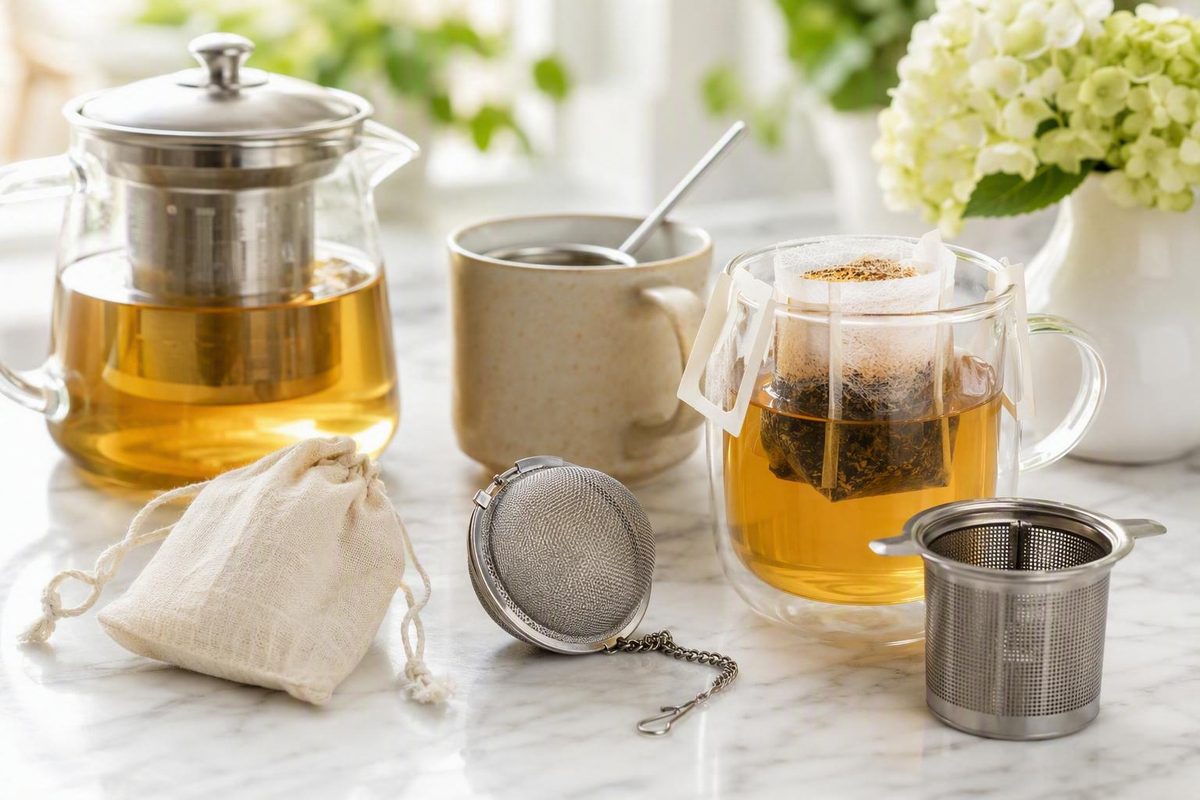
The best tea filter is not necessarily the most expensive, finest, or most popular. It is the one that fits your brewing setup and routine.
Start with four variables:
- Vessel dimensions: Will the filter sit securely in your cup, mug, teapot, or kettle?
- Batch volume: Does it have enough usable capacity for the amount of tea you brew?
- Particle size: Is the mesh or paper fine enough to contain the tea?
- Cleanup preference: Would you rather discard a paper pouch or wash and dry a reusable filter?
Those questions are more useful than vague size labels, unsupported flavor promises, or marketplace ratings. This guide compares paper pouches, metal baskets, tea balls, fabric bags, and pour-through strainers without assuming that one design is best for everyone.
The comparisons below are based on documented manufacturer, seller, retailer, and marketplace pages rather than independent product testing. Specifications reported by a seller are identified as listing information rather than independently verified measurements.
Related: Press Filter Options and How They Change Coffee.
Tea Filter, Infuser, or Strainer: What Are You Actually Looking For?
A tea filter can be understood broadly as a device or pouch that contains loose tea leaves while allowing water to circulate through them during steeping. Under that broad definition, paper bags, mesh baskets, tea balls, and fabric pouches can all function as tea filters.
An infuser usually contains the leaves throughout brewing. You put the leaves inside it, immerse or mount it in the vessel, and remove it when steeping is complete.
A strainer, in the narrower sense, catches leaves that have brewed freely in a pot. It sits over or in the receiving cup while the tea is poured. Harney & Sons makes the same functional distinction and notes that a separate strainer is generally unnecessary when an infuser already contains the leaves effectively in the pot (Harney & Sons’ explanation of strainers and infusers).
Shopping language is less precise. A mesh basket may be called a filter, infuser, or strainer. A tea ball may appear under “tea strainers” even though it contains the leaves during steeping. Retailers also use compound descriptions such as “filter strainer.”
For buying purposes, focus on what the tool does:
- If it holds leaves while they steep, it functions as a filter or infuser.
- If the leaves move freely in the pot and the tool catches them only during serving, it functions as a pour-through strainer.
- If a built-in infuser contains the leaves effectively, another strainer at the cup is usually unnecessary.
Once the function is clear, judge the design by vessel fit, brewing volume, particle containment, and the cleaning or disposal it adds to your routine.
The Main Designs: Paper Bags, Baskets, Balls, Fabric Bags, and Pour-Through Strainers
The five common formats solve the same basic problem in different ways: they either contain the leaves during brewing or separate them from the liquor afterward.
| Design | How it works | Main practical advantage | Main limitation | Often suits |
|---|---|---|---|---|
| Disposable paper pouch | Contains leaves during steeping | Little cleanup | Must be replaced after each use | Travel, offices, occasional cups |
| Metal basket | Sits in or across a cup or pot | Usually offers generous internal room | Requires fit checking and washing | Frequent mug or pot brewing |
| Tea ball | Encloses leaves in a compact chamber | Small and easy to store | Usable capacity may be restrictive | Small servings and compact kits |
| Fabric bag | Contains leaves in a washable pouch | Reusable and flexible | Must be emptied, washed, and dried fully | Brewers comfortable with fabric care |
| Pour-through strainer | Catches free-brewed leaves during pouring | Leaves move freely in the pot | Requires controlled pouring and separate cleanup | Traditional free brewing in a pot |
Disposable paper pouches
Paper filters are filled with loose leaves and placed in a cup or pot. After steeping, the entire pouch is removed and discarded. They simplify cleanup because there is no mesh to brush and no fabric to dry.
Short formats are commonly marketed for individual cups, while tall or large versions are marketed for taller mugs, kettles, teapots, or multi-cup batches. A “large” pouch from one seller may be substantially different from another.
Paper pouches also vary by closure. Some have a drawstring. Others are open sleeves with a flap or lip intended to fold over the vessel rim or connect to a dedicated holder. An open paper pouch should not be assumed to support itself in every cup.
Reusable metal baskets
A basket infuser is a cup- or pot-mounted container, usually made with perforated metal or wire mesh. Its rim, arms, or handles rest on the vessel while the basket extends into the water.
Baskets generally provide more internal volume than compact tea balls. That additional space can make it easier to avoid tightly packing broad whole leaves or bulky herbal blends. This is a geometric capacity advantage, not proof that a basket produces objectively better flavor.
Fit is the main buying challenge. A basket that is too narrow can fall into the vessel. One that is too wide may not sit securely, while one that is too deep can touch the bottom or interfere with a lid.
Tea balls
Tea balls are compact hinged, threaded, or clasped chambers. Some hang from a chain, while others attach to a handle or operate like tongs.
Their size makes them convenient to store and carry, but it can limit usable capacity. Dry leaves that appear to fit may be tightly packed after wetting. That does not mean every tea ball produces poor tea. It means the buyer should compare the chamber’s internal volume with the intended leaf size and dose rather than assuming every single-cup device has sufficient room.
Closure design also matters. Check whether the hinge, threads, or clasp align evenly and whether the screen around the seam is fine enough for the tea you use.
Reusable fabric bags
Muslin and other fabric pouches contain leaves during steeping much like paper filters, but they are intended to be emptied, washed, dried, and used again.
They are flexible and easy to pack, yet they require a particular care routine. Wet leaves must be removed from the seams, the fabric must be rinsed or washed as directed, and the bag must dry completely before enclosed storage. The supplied evidence does not establish broad claims about superior taste, durability, or environmental performance.
Pour-through strainers
A pour-through strainer is distinct because it does not contain the leaves while they steep. Instead, the leaves brew freely in the pot, and the strainer intercepts them as the liquor enters the cup.
This design suits people who deliberately prefer free brewing. The strainer must be large and stable enough to receive the pour without overflowing, and its screen must retain the unwanted particles. Both the pot and the strainer then require cleaning.
Metal infusers, disposable paper bags, and reusable muslin bags all appeared in a captured Amazon tea-filter best-seller assortment. Amazon describes the category as sales-based and frequently updated, so the assortment shows that these designs are commonly sold—not that they are equally effective or ranked by independent quality.
Disposable or Reusable? Choose by Routine, Not Marketing
The central trade-off is straightforward:
- Disposable paper filters reduce washing but create recurring purchases and recurring disposal.
Neither option can be declared universally cheaper or greener from purchase price alone. A financial comparison would require the reusable filter’s service life, brewing frequency, washing cost, and replacement rate. An environmental comparison would also need information about material production, packaging, transportation, washing inputs, and the actual disposal route.
Dated price snapshots
The following figures are retailer snapshots last checked on September 6, 2026. They are examples rather than current buying recommendations. Prices, discounts, stock, pack configurations, shipping, and tax can change.
| Seller and example | Listed pack price | Approximate filter cost |
|---|---|---|
| Green Paper Products: If You Care short filters, 100 count (listing) | $9.49 | $0.095 each |
| Clipper Ship Tea Company: large drawstring filters, 100 count (listing) | $10.00 | $0.10 each |
| Harney & Sons: Finum large, 100 count; Finum extra-large, 60 count (collection) | $6.95; $7.95 | About $0.07; about $0.13 each |
The same Harney & Sons collection listed reusable examples from a $12.95 permanent filter to a $27.55 mug infuser. Those figures provide an upfront-price comparison only.
It would be tempting to divide a reusable filter’s price by a paper filter’s per-use cost and announce a break-even point. That would imply an unsupported lifespan. A reusable filter might last for many uses, but it could also be lost, damaged, clogged, torn, or replaced because it does not fit a new vessel. Washing also has a cost that is difficult to isolate.
Which routine points to which format?
As practical synthesis rather than controlled performance findings:
- Choose paper filters when travel, office brewing, serving guests, or minimal cleanup matters most.
- Choose a reusable basket if you brew frequently at home and do not mind rinsing and drying it after use.
- Choose a tea ball when compact storage matters and the intended dose fits without crowding.
- Choose a fabric bag if you want a reusable pouch and are prepared to wash and dry it thoroughly.
- Choose a pour-through strainer if you prefer leaves to move freely in a pot and do not mind cleaning the pot afterward.
Do not let popularity substitute for fit. Sales rank indicates marketplace activity, while star ratings summarize customer sentiment. Neither independently establishes sediment control, seam strength, durability, material safety, vessel compatibility, or long-term value.
Measure the Vessel Before Choosing a Size
“Single cup,” “large,” and “extra large” are starting clues—not fit guarantees. Before buying a tea filter, measure the vessel in which it will actually be used.
At minimum, record:
- Opening diameter: Measure the inside opening and, where relevant, the outside rim.
- Usable internal depth: Measure from the support point at the rim to the practical lower limit inside the vessel.
- Rim or handle support: Determine where basket arms, a paper lip, a chain, or a handle will rest.
- Lid clearance: Check whether the vessel’s lid can close with the filter installed.
- Removal clearance: Make sure the wet filter can be lifted out through the opening.
- Loaded stability: Consider how securely it will sit once wet leaves and liquid add weight.
For a handled basket, compare the handle span with both the opening and the outer rim. The body must enter the vessel, while the supports must extend far enough to keep the basket from dropping inside. With a single-handled model, consider whether its shape and support point appear stable on the intended rim.
For an open paper filter, determine what keeps its lip above the water. A long flap may rest over the cup rim, but not every pouch is designed to stand open without a holder. For a drawstring bag, verify that the string remains reachable and that the wet pouch can be removed without awkward handling.
Capacity labels need context
Compact or short filters are commonly promoted for individual cups. Taller or larger formats are marketed for tall mugs, pots, kettles, or multi-cup batches. Those classifications say little about exact compatibility.
One large drawstring listing gives a more complete example. The seller specifies a filter measuring 4 by 3 inches, holding up to 10 teaspoons, and intended for 3–5 cups or 24–40 ounces. The listing also describes it as a single-use paper filter with a pull-to-close drawstring and calls it compostable and biodegradable, without supplying a compostability certification or processing conditions (Clipper Ship Tea Company’s specifications and claims).
Those figures apply only to that listing. “Holds 10 teaspoons” is nominal physical capacity, not necessarily useful brewing capacity or a universal dose. Broad whole leaves and bulky herbs may occupy substantially more space after wetting. Filling a pouch to its stated maximum may also make closure and removal less convenient.
A pre-purchase fit checklist
Before ordering, answer all five questions:
- Will the filter body pass through the vessel opening?
- Will its rim, handles, lip, chain, or holder support it securely?
- Is it shallow enough to fit but deep enough to reach the intended water level?
- Can it be removed cleanly when wet and full of leaves?
- Does the intended amount of tea leave visible empty space inside?
If a listing omits width, depth, handle span, or support details, do not infer compatibility from the word “large.” Ask the seller, choose a product with documented measurements, or use a retailer with a workable return policy.
Match Mesh and Capacity to the Tea
A tea filter has two jobs that pull in different directions:
- Retain the particles you do not want in the cup.
- Permit water movement around and through the leaves.
A finer screen is generally intended to retain smaller particles. A more open screen may allow greater flow but can also let fine fragments through. The appropriate balance depends on the actual tea, not merely whether its package says black, green, herbal, or loose leaf.
Use this qualitative design framework:
- Prioritize containment for rooibos, finely broken leaves, dustier blends, and other small particles.
- Prioritize internal volume for broad whole leaves, rolled leaves that open substantially, flowers, fruit pieces, and bulky herbs.
- For mixed blends, choose for the smallest troublesome particles while ensuring the filter still has enough volume for the larger ingredients.
This is not a tested tea-by-tea specification. The supplied evidence does not establish exact mesh counts or micron thresholds for rooibos, broken black tea, herbs, or whole-leaf tea.
Basket versus ball is mainly a capacity question
A roomy basket usually offers more usable internal volume than a compact tea ball. That can make the basket easier to load without crowding the leaves. A ball remains a valid option when its chamber is large enough for the intended serving and leaf type.
Do not turn that geometric difference into an unsupported flavor promise. Flavor and strength also depend on the tea, water, dose, temperature, steeping time, agitation, and personal preference. Filter design is only one variable.
Whatever the shape, avoid packing the filter to the top. Dry leaves can swell, unfold, and absorb water. Leave visible empty space and make sure the closure shuts without compressing the contents.
Troubleshooting mesh and capacity
If particles escape into the cup: Inspect the seam, closure, and rim for gaps. If the filter is intact and particles are passing directly through the screen, a finer mesh may help.
If leaves are tightly packed after steeping: Use less tea in that filter or move to a larger basket or pouch. A device can technically close while still being inconveniently crowded.
If broad leaves barely unfold: Try a roomier design. A deeper or wider basket may be more useful than simply changing to a finer mesh.
If the tea tastes weak: Do not assume the filter is responsible. Check the amount of tea, water volume, water condition, temperature, steep duration, and the character or freshness of the tea before replacing equipment.
If flow slows over time: Inspect reusable mesh for residue and clean it gently.
Universal doses, temperatures, and steeping times do not belong in a tea-filter buying rule. Those decisions depend primarily on the tea and the result you prefer.
How to Use a Disposable Paper Tea Filter Without a Spill
Paper filters are simple, but secure support and moderate filling make them easier to handle.
Basic method
- Open the filter and add loose leaves. Leave headspace rather than packing the pouch tightly.
- Secure its closure or support. Pull the drawstring closed if the product uses one. For an open sleeve, position the flap over the rim or connect it to its intended holder.
- Place the filter in the cup or teapot. Confirm that it cannot slide completely into the vessel.
- Pour water over the filter. Pour steadily enough to wet the pouch without dislodging it.
- Steep according to the tea’s instructions or your established method.
- Lift the filter slowly. Hold it over the vessel briefly so excess liquid can drain.
- Discard the single-use filter.
Headspace makes a pouch easier to fold or close and leaves room for the contents to occupy more volume after wetting. Treat this as cautious handling guidance, not an exact capacity formula.
Drawstring versus open sleeve
A drawstring filter is intended to be cinched closed. The documented large product, for example, instructs the user to pull the string to close the pouch. Use only enough force to close it as intended.
An open folded sleeve depends on outside support. Its lip may drape over the rim, tuck under a lid, or attach to a holder. Do not assume it will remain upright in every cup, especially if the vessel has a wide opening or curved rim.
When removing either style, lift slowly and let excess liquid drain without squeezing. This is a cautious way to limit drips and avoid unnecessary force on wet paper; the exact behavior will depend on the pouch’s construction.
Use the intended string, flap, handle, or removal tool to limit contact with hot water, and stabilize the vessel before lifting. Product-specific instructions take priority over general handling advice (tea-filter handling considerations).
A disposable filter is not cleaned for reuse. Nor should “paper” be treated as automatic permission to place a used pouch in home compost. Disposal depends on the specific product, any applicable certification, accepted processing conditions, and local collection rules.
How to Clean, Dry, and Replace Reusable Filters
Reusable filters should be cleaned gently and consistently rather than treated with the strongest available cleaning agent.
After each use
- Let the filter cool enough to handle.
- Empty the leaves promptly.
- Rinse the mesh, perforations, seams, hinge, and closure.
- If residue remains, use mild dish soap and a soft brush.
- Rinse thoroughly.
- Air-dry completely before storage or reassembly.
A commercial care guide recommends prompt rinsing, mild soapy water, gentle brushing, complete drying, and inspection while cautioning against abrasive cleaners, harsh chemicals, forceful handling, and damp storage. Because that guidance covers multiple designs and materials rather than specific models, the manufacturer’s instructions should control where they differ (Indecraft’s general strainer-care guide).
Dishwasher compatibility cannot be inferred from “stainless steel,” “silicone,” or another material name alone. Hinges, coatings, seals, adhesives, plastic parts, and fine mesh may have different care requirements. A commercial infuser guide likewise advises checking the exact manufacturer’s instructions before using a dishwasher (Tea Trolley’s infuser-care guidance).
Fabric and mixed-material filters
Fabric bags need attention around seams and drawstrings, where leaf fragments can remain trapped. Rinse or wash them according to their instructions, reshape them if necessary, and let them dry fully in open air before enclosed storage.
Complete drying is also a conservative care step for mixed-material filters. Water can remain around joints, under rims, inside handles, or near closures even after the visible mesh appears dry.
Treating stubborn stains
For compatible, uncoated metal equipment, one retailer’s informal test used 1 teaspoon of baking soda dissolved in a mug of hot water, soaked the infuser for at least four hours, and then used gentle scrubbing followed by thorough rinsing. The same comparison also tested white vinegar and a mixture of one part vodka to four parts hot water (Plum Deluxe’s informal cleaning comparison).
Treat this only as a reported example. The infusers began in different conditions, the comparison was informal, and it does not establish that baking soda is suitable or superior for every metal, coating, seal, or mixed-material assembly.
Before using an acidic, alkaline, or alcohol soak, check the exact product’s material and care instructions. Avoid bleach as a default treatment and do not use abrasive cleaners routinely; the commercial cleaning sources in the evidence advise against those approaches, but model-specific manufacturer guidance remains the better authority.
When replacement is better than cleaning
Inspect reusable filters periodically under good light. Replace one when damage compromises filtration or secure handling, including:
- Torn fabric or mesh
- Enlarged or deformed holes
- Persistent rust
- A loose hinge, chain, clasp, handle, or drawstring
- A closure that no longer aligns
- Deteriorating coatings, seals, silicone, or plastic
- Filtration or flow that cleaning does not restore
Structural deterioration, loose parts, and new gaps matter more because they can affect containment or stability.
Read Environmental and Safety Labels Precisely
Tea-filter packaging may place several reassuring terms beside one another. They do not mean the same thing, and one label should not be used to imply all the others.
| Label or evidence type | What it may describe | What it does not establish by itself |
|---|---|---|
| FSC-certified paper | A named paper-sourcing certification | Compostability, biodegradability, PFAS absence, or overall chemical safety |
| Unbleached | A stated paper-processing choice | Better flavor, lower health risk, or lower lifecycle impact |
| Totally chlorine-free | A stated processing attribute | Compostability, flavor neutrality, or universal environmental superiority |
| Plant-based | Some or all described material is plant-derived | Home-compostability, harmless additives, or complete composition |
| “No added PFAS” | A seller says PFAS were not intentionally added | Laboratory-confirmed absence of all PFAS |
| Biodegradable | A seller says the material can break down | Where, how quickly, or under which verified conditions |
| Compostable | A seller says the product can compost | Home-compost eligibility, municipal acceptance, or certification |
| Recyclable packaging | The stated packaging material may be recyclable | Local acceptance or recyclability of the used filter |
FSC, bleaching, and chlorine claims
It does not itself prove that a finished filter is compostable, biodegradable, free of PFAS, or chemically safe.
Similarly, “unbleached” and “totally chlorine-free” describe stated processing choices. The supplied evidence does not establish that either attribute improves flavor, health outcomes, or total lifecycle performance.
One retailer listing describes If You Care short filters as unbleached, chlorine-free, made with FSC-certified paper, plant-based, manufactured in Portugal, and made with “no added PFAS.” It also identifies the packaging as paperboard and polyolefin wrap and notes that recycling availability varies by location (Green Paper Products’ listing and packaging information).
These are documented listing statements. They are not independent laboratory findings, and the packaging information does not establish that the used filter itself is recyclable or compostable.
“No added PFAS” is not “no PFAS detected”
Read the grammar literally. “No added PFAS” is a seller statement about intentional addition. It is not equivalent to a laboratory report showing that no PFAS were detected, and it does not disclose a test method, detection limit, or range of compounds examined.
Without testing documentation, the accurate wording is: the seller claims that no PFAS are added. It should not be shortened to “PFAS-free.”
Biodegradable and compostable require conditions
A product can be marketed as biodegradable or compostable without stating where or how it can be processed. The previously cited large drawstring listing calls its paper filter compostable and biodegradable but does not provide a certification, home-compost instructions, or required processing conditions.
That information is insufficient to determine whether a used pouch belongs in a backyard pile, municipal organics bin, ordinary trash, or another stream. Follow product-specific certification and local collection instructions rather than relying on a category label.
Filter disposal is separate from packaging disposal
A disposal statement about the box or outer wrap does not automatically apply to the filter. Conversely, a seller’s filter claim does not establish that every packaging component belongs in the same waste stream.
Read each statement for its defined object:
- Does “recyclable” describe the box, plastic wrap, filter, or all three?
- Does “compostable” include the string and closure?
- Are home and industrial composting distinguished?
- Does the local facility accept that material?
- Is a named certification provided?
If the listing does not answer those questions, do not fill the gaps with assumptions.
A better evidence model for product comparisons
Place each notable product claim into one of four levels:
- Seller-documented specification: A dimension, pack count, closure type, listed material, or displayed price found on a manufacturer or retailer page. This confirms what the page states, not that the specification was independently tested.
- Promotional or disposal claim: Statements such as flavor neutrality, biodegradable, compostable, no added PFAS, superior circulation, or similar marketing language.
- Named third-party certification: A specific certification stated for a defined attribute, with its scope kept separate from unrelated claims.
- Independently tested result: A disclosed test method and relevant result for filtration, safety, durability, or another performance measure.
Do not present the second level as the fourth. A certification must also remain within its scope: a paper-sourcing certification answers a sourcing question, not every environmental, chemical, or disposal question.
Final decision checklist
Before buying, confirm:
- Fit: Measure the vessel opening, usable depth, support span, and lid clearance.
- Capacity: Match usable volume to the batch while leaving expansion room.
- Mesh: Favor finer containment for smaller particles and sufficient filtering area for practical flow.
- Routine: Decide whether washing and drying or recurring disposal is less bothersome.
- Care: Verify dishwasher and cleaning compatibility for the exact product.
- Claims: Separate seller-listed specifications from promotional claims, certifications, and independent results.
- Price: Treat every listing as a dated snapshot rather than a permanent cost.
The no-hype selection rule is simple: measure the vessel, match filter volume and mesh to the leaves, and decide whether effortless disposal or repeated cleaning fits your routine better. A short paper pouch may suit an occasional cup, a roomy reusable basket may suit frequent mug brewing, and a pour-through strainer may suit free brewing in a pot. None is universally best.
Frequently Asked Questions About Tea Filters
What is the difference between a tea filter, tea infuser, and tea strainer?
A tea filter is a broad term for a pouch or device that keeps loose leaves out of the finished drink while allowing water to pass. An infuser normally contains the leaves during steeping. A strainer normally catches freely brewed leaves while tea is poured.
Retailers often use the terms interchangeably, so check the function rather than relying on the product title.
Are paper tea filters compostable?
Not automatically. Some sellers describe particular paper filters as compostable, but that does not by itself establish home-compost suitability, municipal acceptance, certification, or processing conditions.
Do not infer compostability from natural-brown color, FSC certification, “unbleached,” “chlorine-free,” or “plant-based.” If product-specific disposal evidence and local acceptance are missing, do not make the assumption.
Which tea filter is best for rooibos or other fine particles?
Start with a fine-mesh filter intended to contain small particles, and inspect seams and closure gaps as well as the screen itself.
There is no supported universal mesh count or micron threshold for rooibos in the supplied evidence. If particles pass through an intact screen, try a finer mesh. If flow becomes inconveniently slow, a filter with a larger screening area or a different mesh design may be more practical.
How much do disposable tea filters cost per use?
In the retailer examples last checked on September 6, 2026, the approximate cost ranged from $0.07 to $0.13 per filter before applicable shipping and tax. The endpoints came from boxes of 100 large Finum filters for $6.95 and 60 extra-large Finum filters for $7.95 (Harney & Sons’ filter collection).
The other cited examples were approximately $0.095 and $0.10 each. See the dated table above for the seller and pack size behind each calculation.
Can a reusable tea filter go in the dishwasher?
Only when the manufacturer approves the exact model for dishwasher use. Material names alone do not account for hinges, coatings, seals, adhesives, fine mesh, handles, or mixed-material components.
A commercial infuser guide likewise recommends checking manufacturer instructions before using a dishwasher. When product-specific instructions are unavailable, gentle hand washing, thorough rinsing, and complete air-drying are the more conservative general-care approach (Tea Trolley’s dishwasher guidance).