
Best Home Water Filters: 3 Picks Matched to Your Water
Compare three home water filters by certified claims, capacity and installation—and learn when reverse osmosis or whole-house treatment fits better.
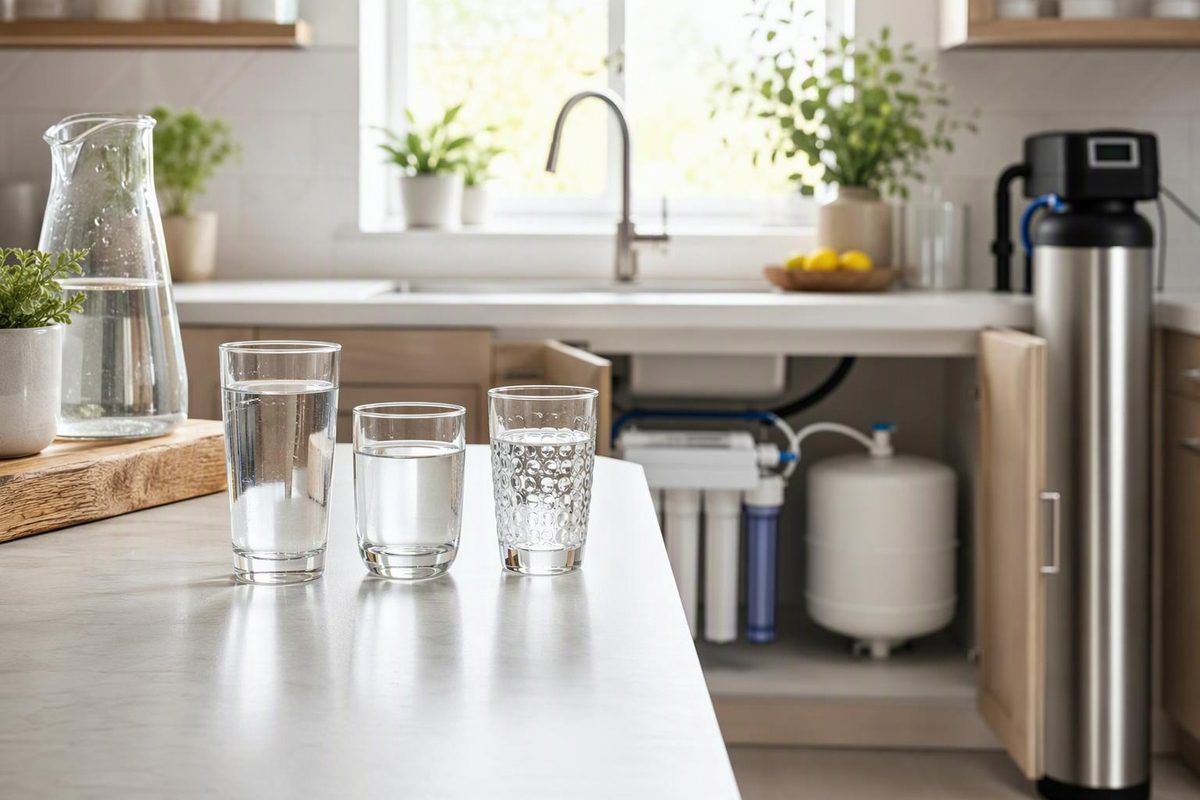
For drinking and cooking water, start with a kitchen filter—not automatically a whole-house system. A pitcher suits small daily volumes, a faucet-mounted filter avoids manual refilling, and an under-sink filter suits regular kitchen use. Reverse osmosis (RO) becomes worth considering when you need a documented reduction of dissolved substances that ordinary carbon filtration does not address.
The best home water filters match a specific water problem. A long contaminant list is not a substitute for the right certified claim, usable flow and manageable replacement schedule. EPA’s selection guide recommends identifying treatment goals first and avoiding oversized systems.
Three practical picks
These selections are based on documented claims and installation requirements, not comparative hands-on testing or a universal performance ranking. Specifications below reflect U.S. documentation checked on October 6, 2026. Use the exact system and replacement cartridge listed—not merely the same brand.
| Best fit | System and cartridge | Relevant documented reduction claims | Capacity and delivery | Main constraint |
|---|---|---|---|---|
| Small-volume drinking water without plumbing changes | Brita Tidal OB63 with Elite OB06 | Lead; chlorine taste and odor; Class I particulates | 120 gallons / 454 L; pour-through; about 6 months at typical household use | Manual refilling; data sheet recommends no more than 2 gallons / 7.5 L daily for maximum efficiency. Performance data |
| Filtered water at a compatible existing faucet | PUR PLUS PFM400H with RF9999 | Lead; chlorine taste and odor; Class I particulates | 100 gallons / 379 L; rated flow 0.52 gpm / 2.0 L/min; replacement up to every 3 months | Not compatible with pull-out or handheld faucets; check threading and adapter fit. Performance data, compatibility guidance |
| Under-sink treatment with an explicit chloramine claim | Aquasana Claryum 2-Stage AQ-5200 with AQ-5200R | Chlorine; chloramine; lead; Class I particulates | 500 gallons / 1,892 L; rated flow 0.5 gpm / 1.9 L/min; replacement up to every 6 months | Requires under-sink installation; rated operating pressure is 20–80 psi. Performance data, replacement schedule |
Choose the pitcher for modest demand
The Tidal/Elite combination is a straightforward choice when you want no plumbing work and can tolerate batch filling. Its exact OB63/OB06 combination appears in NSF’s listing for lead reduction at a 120-gallon service cycle.
Do not transfer those claims to every Brita cartridge. The Elite performance sheet identifies eligible pitcher models, and some claims apply only to specified combinations.
Choose the faucet mount to avoid refilling
The PUR PLUS makes sense when a compatible faucet is available and you want filtered water on demand without an under-sink installation. Its rated 0.52 gpm flow is for the filtered stream, not unrestricted kitchen-faucet flow.
Check the cartridge documentation carefully: PUR publishes separate current and legacy faucet-filter data sheets. A matching RF9999 label alone should not lead you to assume every package carries the newest claims.
Choose the under-sink model for chloramine
Aquasana’s AQ-5200 sheet explicitly documents chloramine reduction and WQA certification to NSF/ANSI 42, 53 and 401 for its listed claims. That makes it a better-supported choice for this problem than selecting a generic carbon filter with only a chlorine claim. Its reported 91% chloramine reduction is not a promise of complete removal. For more detail, see how to evaluate chloramine filters.
Its 0.5 gpm rating also matters for brewing: filling 5 gallons would take about 10 minutes at rated flow. Plan around actual batch demand rather than the cartridge’s total lifetime capacity.
Check your water before choosing
For public water, read your utility’s annual Consumer Confidence Report. For private wells, arrange testing through a state-certified laboratory and use local health-department advice to select the test panel. Appearance, taste and smell cannot establish safety. CDC’s filter guidance explains these starting points and notes that water without harmful germs or chemicals may not need filtration.
A utility report does not establish lead levels at your particular faucet. If household plumbing or a service line raises lead concerns, EPA recommends testing your home’s water.
Then verify the claim—not just the standard number:
- NSF/ANSI 42: aesthetic effects, such as chlorine taste and odor. Look specifically for chloramine if that is your disinfectant.
- NSF/ANSI 53: health-related reduction claims. For lead, look for an explicit lead-reduction claim; EPA also recommends NSF/ANSI 42 Class I particulate reduction.
- NSF/ANSI 58: RO systems. Confirm the particular contaminant claim; the number does not promise removal of everything.
NSF explains that certification is contaminant-specific; EPA’s lead-filter tool details the lead and particulate checks.
When these three are not the right answer
Fluoride, nitrate or dissolved-mineral reduction: consider RO with the relevant documented claim. CDC lists these among substances some RO filters may reduce. RO also removes minerals such as calcium, so it changes brewing water beyond disinfectant removal. Check your recipe or coffee-equipment water requirements before choosing it solely for better taste. EPA compares these treatment limits.
Compare reject water as well as output. WaterSense-labeled point-of-use RO systems discharge no more than 2.3 gallons of reject water per gallon treated, according to EPA. For tank-filled alternatives, use our countertop RO buying checks.
Whole-home scale or sediment: hardness treatment and sediment filtration are different jobs. A softener reduces calcium and magnesium hardness; a sediment cartridge catches particles. Neither should be selected as a universal drinking-water purifier. NSF describes softening; our whole-house versus kitchen-only guide helps decide treatment scope.
Microbiologically unsafe water: the Brita and PUR performance sheets linked above explicitly prohibit use without adequate disinfection. A taste-and-odor filter is not a disinfection plan. Seek treatment matched to the organism and water conditions, rather than choosing from these kitchen picks. CDC distinguishes filters for germs from filters for chemicals.
Budget for the replacement you will actually need
Compare the system price, installation, replacement sets and—where applicable—RO water and electricity use. Use cold water with these three systems, and follow the manufacturer’s preparation, flushing and replacement instructions rather than waiting for bad taste.
For example, at 2 gallons per day, a 120-gallon cartridge reaches its volume limit in roughly 60 days, not six months. Mark the installation date and track usage; a calendar reminder alone cannot account for a busy kitchen. EPA’s maintenance guidance warns that unmaintained treatment systems can make water quality worse.