
Best-Rated Whole-House Water Filters: 3 Picks by Problem
Compare whole-house filters for PFAS, VOCs, chlorine and sediment using contaminant claims, tested flow, capacity and maintenance—not stars.
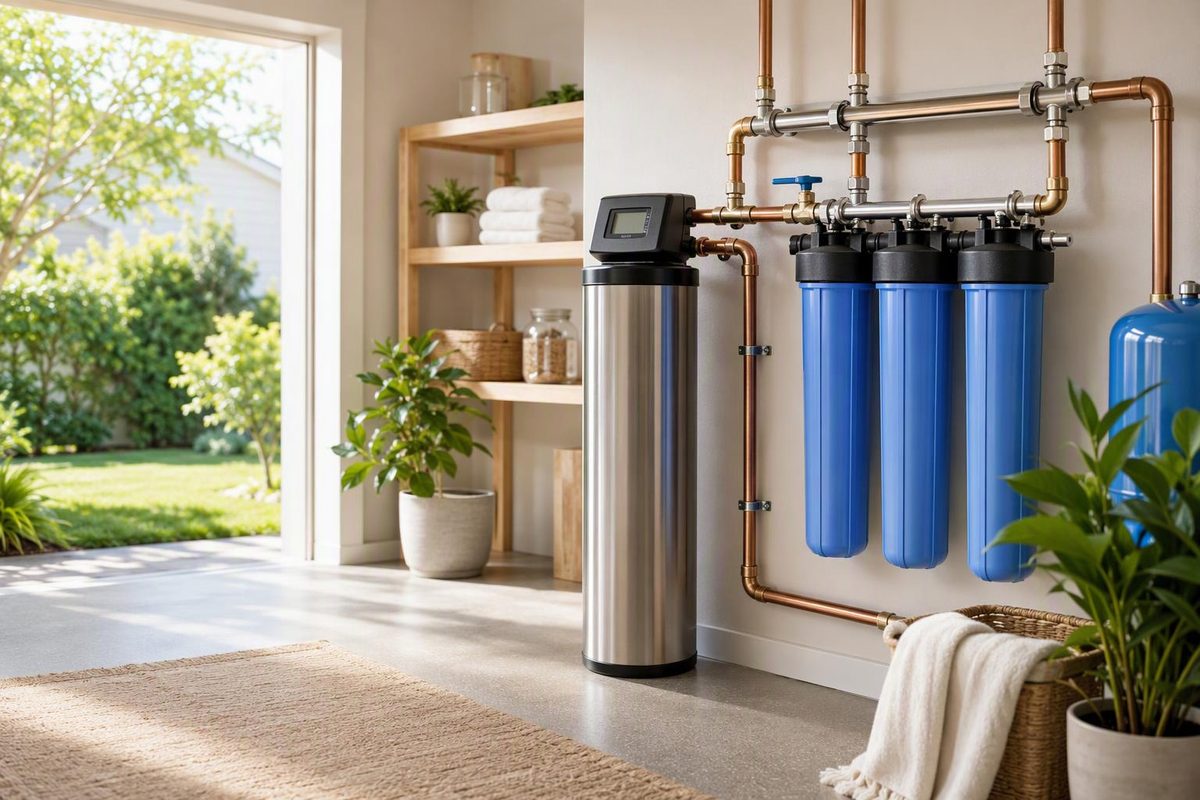
For the strongest documented contaminant claims among these picks, consider Aquasana HealthShield. For high-flow chlorine and sediment treatment, compare the Aqua-Pure AP903. For long main-tank life on chlorinated municipal water, consider Aquasana Rhino.
These systems are not interchangeable. HealthShield has manufacturer-reported WQA certification for specified PFAS, VOC and emerging-contaminant claims, but its rated treatment flow is 5.7 gallons per minute (GPM). The AP903 offers a 20 GPM intermittent peak flow, but its certified claims are aesthetic rather than health-related. Rhino has a long stated tank life, but its chlorine result is independent testing to NSF/ANSI 42—not whole-system certification to that standard.
This short list was checked September 28, 2026. “Best-rated” here means the closest match between a measured water problem and documented performance, not the highest retailer star average.
| Pick | Best fit | Performance evidence | Main limitation |
|---|---|---|---|
| Aquasana HealthShield | A measured PFAS or VOC problem when whole-home treatment is justified | Aquasana reports WQA certification to NSF/ANSI 53 and 401; 165,000 gal or about 2 years; 5.7 GPM rated, 11.2 GPM peak | Modest rated flow; chlorine and chloramine results are internal tests |
| Aqua-Pure AP903 | Municipal chlorine taste/odor and sediment where high peak flow matters | NSF/ANSI 42 certified; nominal 5 micron; 100,000 gal; tested at 10 GPM and intermittent peaks of 20 GPM | No certified lead, PFAS, hardness or microbial claim |
| Aquasana Rhino | Long-life municipal chlorine treatment | Independently tested to NSF/ANSI 42; 1,000,000 gal or 10 years; 7 GPM rated, 14.6 GPM peak | Regular pre/post-filter service; Standard 61 tank certification is not a reduction claim |
Strongest documented contaminant claims: Aquasana HealthShield
HealthShield is the most relevant of these three when a water report or laboratory test identifies a contaminant listed on its performance data sheet and there is a reason to treat water throughout the house. Aquasana reports that WQA certified the system to NSF/ANSI 53 and 401 for specified claims including five PFAS compounds, VOCs, BPA and ibuprofen. The stated capacity is 165,000 gallons or approximately two years (Aquasana HealthShield specifications).
The important constraint is flow. Published reduction results are based on a 5.7 GPM rated flow, although the listed peak is 11.2 GPM. Compare 5.7 GPM with the flow of fixtures likely to run simultaneously; faster flow can change reduction performance.
Keep certified and internal results separate. Aquasana says HealthShield is internally tested to reduce chlorine and chloramine. Those results may be relevant to taste and odor, but they do not carry the same third-party certification as its specified NSF/ANSI 53 and 401 claims.
Choose it when: testing identifies a contaminant on the exact model’s certified performance sheet and treatment at every tap is warranted.
Skip it when: the only complaint is chlorine taste or normal simultaneous demand exceeds 5.7 GPM. A point-of-use filter can be more economical when only drinking and cooking water require treatment.
High-flow chlorine and sediment pick: Aqua-Pure AP903
The Aqua-Pure AP903 is a simpler match for disinfected municipal water when the goals are chlorine taste and odor reduction plus sediment control. Its carbon-block cartridge has a nominal 5-micron rating and a 100,000-gallon stated capacity. The manufacturer says capacity was tested at 10 GPM and at intermittent peak flows of 20 GPM. The AP903 is certified to NSF/ANSI 42 for the reductions listed in its performance sheet (Aqua-Pure AP900 Series technical sheet).
“Nominal 5 micron” does not mean every 5-micron particle is captured. Micron labels alone are a poor comparison unless the rating method and efficiency are also stated; see nominal vs. absolute micron ratings.
The sanitary quick-change cartridge avoids opening a reusable housing or handling loose media. The tradeoff is dependence on a proprietary replacement cartridge. The manufacturer estimates approximately one year of cartridge life under most water-quality conditions, but consumption and sediment loading affect actual life.
The related AP904 adds scale-inhibition media. It does not remove calcium and magnesium as an ion-exchange softener does. If hardness is the main problem, compare a true softener rather than treating scale inhibition as equivalent to soft water; see water filter vs. water softener.
Choose it when: you have chlorinated municipal water, want high intermittent flow and accept proprietary cartridge replacement.
Skip it when: the target is lead, PFAS, nitrate, bacteria or hardness. NSF/ANSI 42 certification does not establish those reductions.
Long-life chlorine tank pick: Aquasana Rhino
Rhino is the lower-frequency main-tank option. Aquasana lists 1,000,000 gallons or 10 years, with a 7 GPM rated flow and 14.6 GPM peak flow. The company says the system was independently tested to NSF/ANSI 42 for up to 97% chlorine reduction, while the tank is WQA certified to NSF/ANSI/CAN 61 for material safety (Aquasana Rhino specifications).
That wording matters. Testing “to” a standard is not necessarily product certification by an accredited certifier. Standard 61 addresses the safety of materials in contact with drinking water; it does not establish that the system reduces a contaminant.
The long-lived main tank is not maintenance-free. Aquasana calls for replacement of the standard prefilter every 2 months and the post-filter every 6 months. Sediment-heavy water may require more frequent attention.
Choose it when: long main-media life matters and chlorine is the verified problem.
Skip it when: you need a certified health-contaminant claim or household demand exceeds the 7 GPM condition tied to published reduction testing.
How to judge a whole-house filter
NSF numbers identify standards, not scores. NSF/ANSI 42 covers specified aesthetic effects such as chlorine taste and odor, while NSF/ANSI 53 covers specified contaminants with health effects. Certification never means a filter removes everything; the exact model must carry the exact claim needed (NSF’s water-treatment standards guide).
Use this order:
- Identify the problem. Read the utility’s annual water-quality report or obtain an appropriate laboratory test. Taste, odor and appearance cannot establish safety.
- Match the exact claim. Check the model—not merely its media or components—in the certifier’s directory and performance data sheet.
- Size to treatment flow. Use the flow condition tied to published contaminant reduction, not peak flow alone.
- Price maintenance. Include proprietary cartridges, sediment prefilters, post-filters, UV lamps and installation.
- Plan service access. A bypass allows maintenance without shutting off the entire home. Backwashing systems also require a suitable drain.
Well water requires testing, not a generic winner
A carbon whole-house filter is not a universal well-water system. CDC recommends testing private wells at least annually for total coliforms, nitrate, total dissolved solids and pH, using a state-certified laboratory, plus locally relevant contaminants (CDC well-testing guidance). Iron, manganese, tannins, hardness, sediment and microorganisms can require different treatment steps.
Be careful with UV classes. Under NSF/ANSI 55, Class A systems are intended to inactivate or remove disease-causing microorganisms in contaminated water; Class B systems reduce non-disease-causing bacteria in water already considered disinfected (NSF standards guide). Do not treat an optional Class B UV unit as primary disinfection for a contaminated well. For a positive coliform result, start with treatment for coliform bacteria.
Whole-house disinfectant removal also has a tradeoff: CDC warns that removing chlorine or another residual disinfectant can permit more germ growth in household plumbing. Maintain the system on schedule and install whole-house treatment only when the water problem and exposure route justify it (CDC filter-selection guidance).