
House Water Filter: Whole-House or Kitchen Only?
Decide between whole-house and kitchen filtration, match treatment to your water problem, and check certified claims, flow, pressure and upkeep.
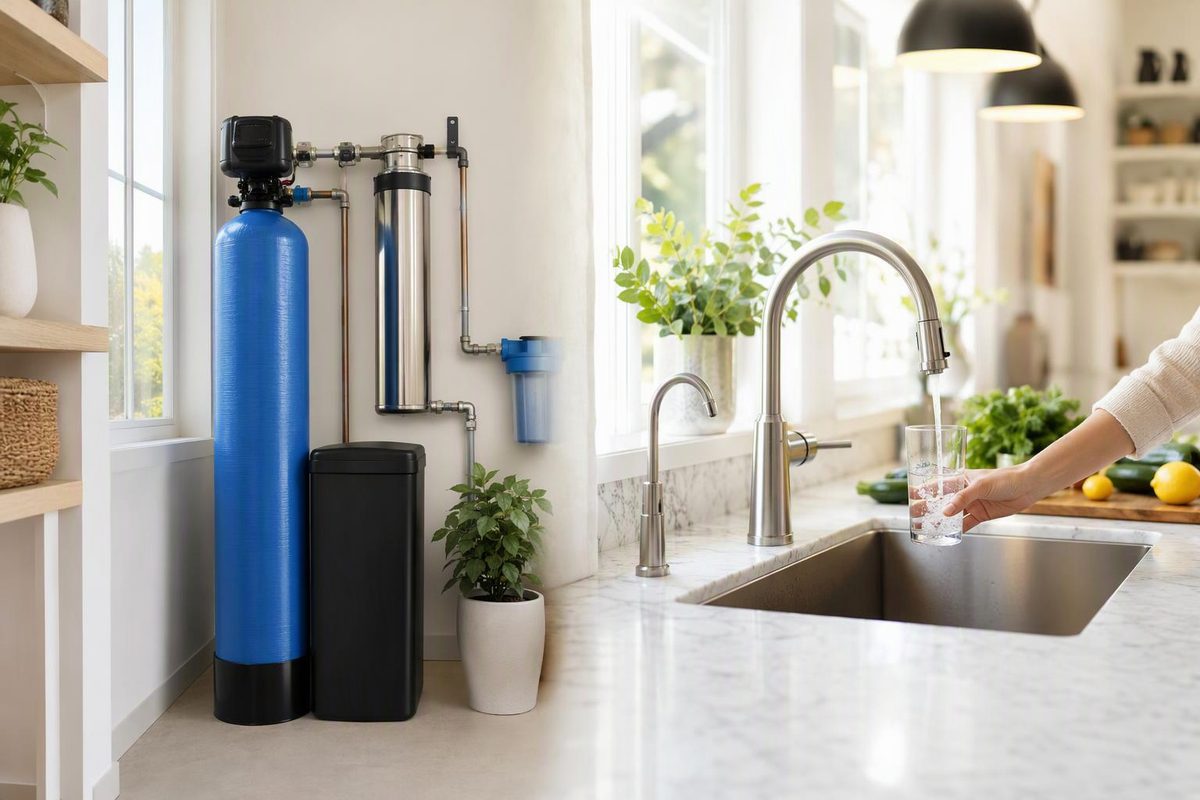
Choose a kitchen filter when you only need to treat drinking and cooking water. Consider whole-house treatment when the measured problem affects water throughout the home. A whole-house filter is not automatically safer or more effective: its treatment method must match the problem, and it cannot address contamination introduced downstream of it.
A point-of-use (POU) system serves one location, such as a kitchen faucet. A point-of-entry (POE) system treats most or all incoming household water. Those terms describe where treatment happens—not what it removes. CDC explains the distinction.
Identify the problem before choosing equipment
For a U.S. public water supply, start with your utility’s annual water-quality report. Use a household water test when the concern may originate in your plumbing or needs more specific investigation. For private wells, CDC recommends testing at least annually for harmful germs and chemicals, with advice from your health department on the appropriate tests. CDC’s filter-selection guidance
Taste, smell and clarity cannot establish safety. Conversely, if testing does not identify harmful contamination and you have no taste or household-use complaint, you may not need treatment.
Use the identified problem to narrow the treatment method:
| Problem | Treatment to investigate | Important limit |
|---|---|---|
| Suspended grit or sediment | A sediment cartridge with an appropriate micron rating | Particle capture does not establish dissolved-chemical reduction or disinfection. |
| Chlorine taste or odor | Activated carbon with a certified chlorine-reduction claim | A chlorine claim is not proof of chloramine reduction; look for that claim separately. |
| Hard-water scale and poor soap lather | An ion-exchange water softener | A softener treats calcium and magnesium hardness, not germs. |
| Lead in drinking water | A point-of-use filter certified for lead reduction | An inlet filter cannot catch lead added by plumbing downstream of it. |
| Fluoride or nitrate | Reverse osmosis with the specific reduction claim | Do not infer either claim from “RO” or a standard number alone. |
| Bacteria or other microbial contamination | Source investigation and an appropriate disinfection system | Ordinary taste-and-odor carbon filtration is not a substitute for disinfection. |
These distinctions follow CDC’s treatment overview, NSF’s contaminant-claim guide and the Portland Water Bureau’s explanation of downstream plumbing contamination. For hardness, see our fuller comparison of water filters and water softeners.
Treat only the water that needs treatment
A pitcher, faucet-mounted filter or under-sink system can be sufficient for a drinking-water taste complaint. Point-of-use treatment is also well placed for contaminants introduced inside the home: it treats water after that plumbing, just before use.
Whole-house treatment makes more sense when the problem needs addressing throughout the home—for example, hardness affecting fixtures and appliances. Certain volatile organic chemicals may also require treatment of bathing and cleaning water, not just drinking water. CDC recommends considering whole-home treatment for these broader exposures.
There is a trade-off with whole-house carbon: removing the disinfectant from incoming municipal water can allow more germs to grow in household plumbing. CDC flags this risk. That does not make all whole-house carbon unsuitable, but it is a reason not to install it reflexively for a kitchen-only taste preference.
Private-well treatment may require several coordinated steps rather than one cartridge. Use our well-water system testing and sizing guide when laboratory results identify multiple problems.
Check the exact certified claim
For each candidate, match the model and replacement cartridge to the certification listing and performance data. The important question is not merely “Is it certified?” but “Certified to reduce what?”
The main standards you will encounter are:
- NSF/ANSI 42: aesthetic reduction claims, such as chlorine taste and odor.
- NSF/ANSI 53: specific contaminants with health effects, such as lead.
- NSF/ANSI 58: reverse-osmosis systems, with model-specific reduction claims.
- NSF/ANSI 44: ion-exchange water softeners.
The numbers are not quality rankings, and certification under one standard does not mean reduction of every contaminant covered by it. NSF explicitly warns against that assumption.
Likewise, “5 micron” describes a particle rating, not a complete treatment capability. Check whether the rating is nominal or absolute and what efficiency is documented; our 5-micron filter guide explains why matching labels can conceal different performance.
Size a whole-house filter for simultaneous demand
Before buying a plumbed-in system, ask the installer to compare the household’s simultaneous water demand with:
- Rated service flow, in gallons per minute (GPM).
- The flow associated with the claimed contaminant reduction.
- Pressure drop at that flow, in pounds per square inch (PSI).
- Permitted inlet pressure and water-quality conditions.
- Any required backwash flow, drain connection and service clearance.
Do not substitute an advertised peak-flow number for rated service flow. For example, Pentair’s 2024 PC600-P manual lists 8 GPM rated service flow, 12 GPM peak flow, and 13 PSI pressure drop at 8 GPM. Those are three different specifications—not interchangeable measures of capacity. This is an illustration of what to inspect, not a product recommendation. Pentair installation and owner’s manual
Budget for replacement, not just installation
Request the cartridge or media replacement schedule, consumable costs, flushing or sanitizing instructions, and any salt, electricity or wastewater requirements before committing.
A filter’s documented performance applies over a specified service life or treated volume. Follow the manufacturer’s replacement instructions; do not extend use simply because the water still tastes acceptable. Filters can also clog early because of sediment loading, so lower flow warrants investigation rather than waiting for the calendar reminder. Portland Water Bureau’s maintenance guidance
Keep the model number, compatible cartridge number, installation date and replacement record together. That makes the next filter purchase a compatibility check rather than another guess.