
Best Sediment Filter for Well Water: 3 Picks by Sediment Type
Compare Rusco’s sand trapper, Pentek’s 5-micron depth cartridge and a reusable pleated option by sediment type, flow, housing fit and upkeep.
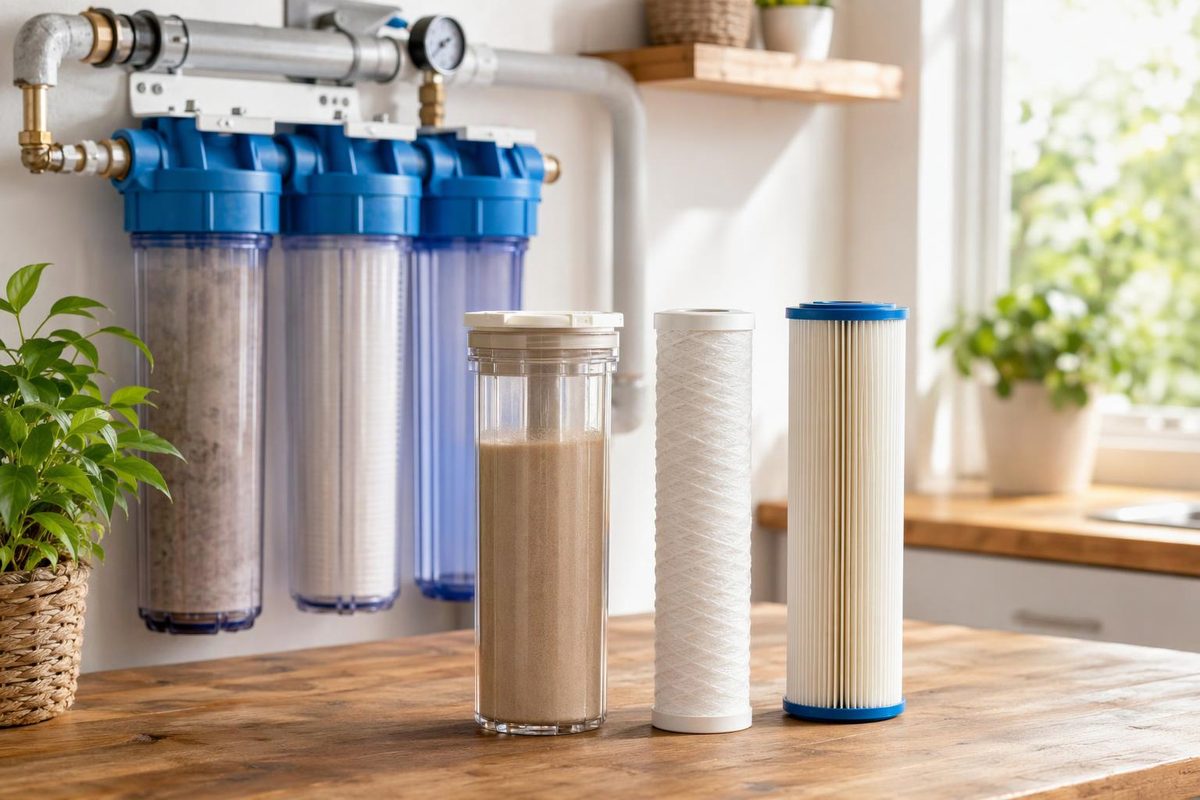
For fine suspended sediment, our pick from this shortlist is the Pentek DGD-5005-20 in a compatible 20-inch Big Blue housing. For recurring sand and grit, choose a Rusco Sediment Trapper first. For coarser sediment where reusable media matters more than fine filtration, consider the Pentek R30-20BB.
These are application-based recommendations from manufacturer specifications—not a hands-on ranking. A sandy well may need the Rusco ahead of the DGD cartridge rather than either filter alone.
The shortlist
| Pick | Best fit in a household well system | Rating and flow information | Main trade-off |
|---|---|---|---|
| Rusco 1-inch Sediment Trapper, with a screen selected for the grit | Flushable first stage for recurring sand and grit | 1–25 GPM published flow capacity; 100-mesh screen listed as approximately 150 microns | Requires a flushing location; this coarse screen is not fine-sediment filtration |
| Pentek DGD-5005-20 | Fine-sediment cartridge, alone under manageable loads or after a coarse prefilter | Nominal 5 microns; 4.50 × 20 inches; initial cartridge pressure drop below 1 PSI at 20 GPM | Budget for replacement cartridges and a separate housing |
| Pentek R30-20BB | Reusable cartridge option when nominal 30-micron filtration is sufficient | Nominal 30 microns; 4.50 × 20 inches; initial cartridge pressure drop below 1 PSI at 20 GPM | Coarser than the DGD; cleaning adds work and does not make it a 5-micron filter |
Published specifications checked November 4, 2026. Pentek’s pressure-drop figures describe the cartridges initially—not the complete installed system after sediment accumulates, nor a guaranteed whole-house service flow.
Best for recurring sand: Rusco 1-inch Sediment Trapper
The reason to choose the Sediment Trapper over a fine disposable cartridge is how it handles collected debris. Its element lets sediment settle in a lower reservoir, away from the screen, and a bottom ball valve allows sediment removal. The screen is reusable. That makes it a practical first-stage recommendation when the well repeatedly delivers sand that would otherwise load a cartridge. Rusco’s product brochure describes this arrangement.
Rusco lists a 100-mesh screen, approximately 150 microns, for grit, and a coarser 60-mesh, approximately 250-micron screen for fine sand. Match the screen to the particles you need to intercept rather than automatically ordering the smallest opening. These conversions and application labels come from Rusco’s listed screens, not a universal mesh-to-micron rule.
Check the connections before ordering: this model has 1-inch slip ports, not threaded ports. Its published dimensions are 14⅜ inches long by 5 inches wide. Allow additional working space and somewhere to discharge flushing water.
Consider the shorter standard Rusco Spin-Down if space is tight and you do not need the Trapper’s lower-reservoir arrangement: the 1-inch standard model is 11⅜ inches long and has the same published 1–25 GPM flow range.
Best for fine suspended sediment: Pentek DGD-5005-20
The DGD-5005-20 is our preferred cartridge here when you need finer capture than a coarse sand screen. It uses gradient-density polypropylene, with coarser filtration toward the outside and finer filtration inward. Pentair lists a nominal 5-micron rating and sizes it for Big Blue housings. The DGD specification sheet documents its construction and dimensions.
Use it as a candidate for fine particulate residue—not as a guaranteed cure for every cloudy well. If recurring sand is also present, put a suitable coarse screen ahead of it. Rusco’s installation instructions describe spin-down prefiltration ahead of cartridges to extend cartridge life.
Nominal 5 microns is not an absolute cutoff. Do not assume complete capture of every particle larger than 5 microns, or a microbial barrier. For the rating distinction, see nominal versus absolute 5-micron filters.
Also read the certification wording: the DGD sheet specifies NSF/ANSI 42 certification for material requirements only. That is not certification of contaminant-removal performance or proof that well water is safe to drink.
Best reusable coarse cartridge: Pentek R30-20BB
Choose the R30-20BB instead of the DGD when 30-micron filtration is adequate and you want reusable pleated polyester media. Pentair describes the media as reusable, with pleats intended to maximize dirt-holding capacity and extend the interval between changes or cleaning. Its specification sheet lists the R30-20BB at nominal 30 microns.
This is a maintenance preference, not a finer-filter upgrade. It is the wrong substitute if downstream equipment requires 5-micron filtration. Before buying for reuse, obtain cleaning and replacement instructions for your drinking-water application; the cited sheet does not provide a cleaning procedure or a guaranteed number of reuse cycles.
Checks that should decide the purchase
- Confirm the problem. Water that starts clear and later forms orange-brown particles may contain dissolved iron. A sediment cartridge alone is not the treatment for iron still in solution; Penn State Extension explains the distinction. Use our iron-filter selection guide if that matches your water.
- Size the whole assembly. Compare household simultaneous demand with the housing, cartridge, fittings and available pressure—not just the largest GPM number. Big Blue housings come in different lengths and port sizes; a cartridge recommendation is not a complete installation kit.
- Plan servicing before buying. Include isolation valves, cartridge-removal clearance and pressure measurement in the installation plan. Record pressure loss at a repeatable flow when clean, then use the equipment’s maintenance limits to judge loading. For the Rusco, follow its explicit instruction to install after the pressure switch; do not improvise around well-pump controls.
- Keep sediment removal separate from drinking-water safety. CDC recommends testing private-well water at least annually for harmful germs and chemicals, and considering additional testing after changes in color, taste or smell. Choose additional treatment from those results—not from clearer water alone. CDC’s filter-selection guidance explains why appearance cannot establish safety. Both Pentek specification sheets warn against use with microbiologically unsafe water or water of unknown quality without adequate disinfection before or after the system.