
Water Filters for Chloramine Need Exact-Model Evidence
Catalytic carbon is the common starting point. Decisive evidence is exact-model performance at a tested flow, concentration and capacity endpoint.
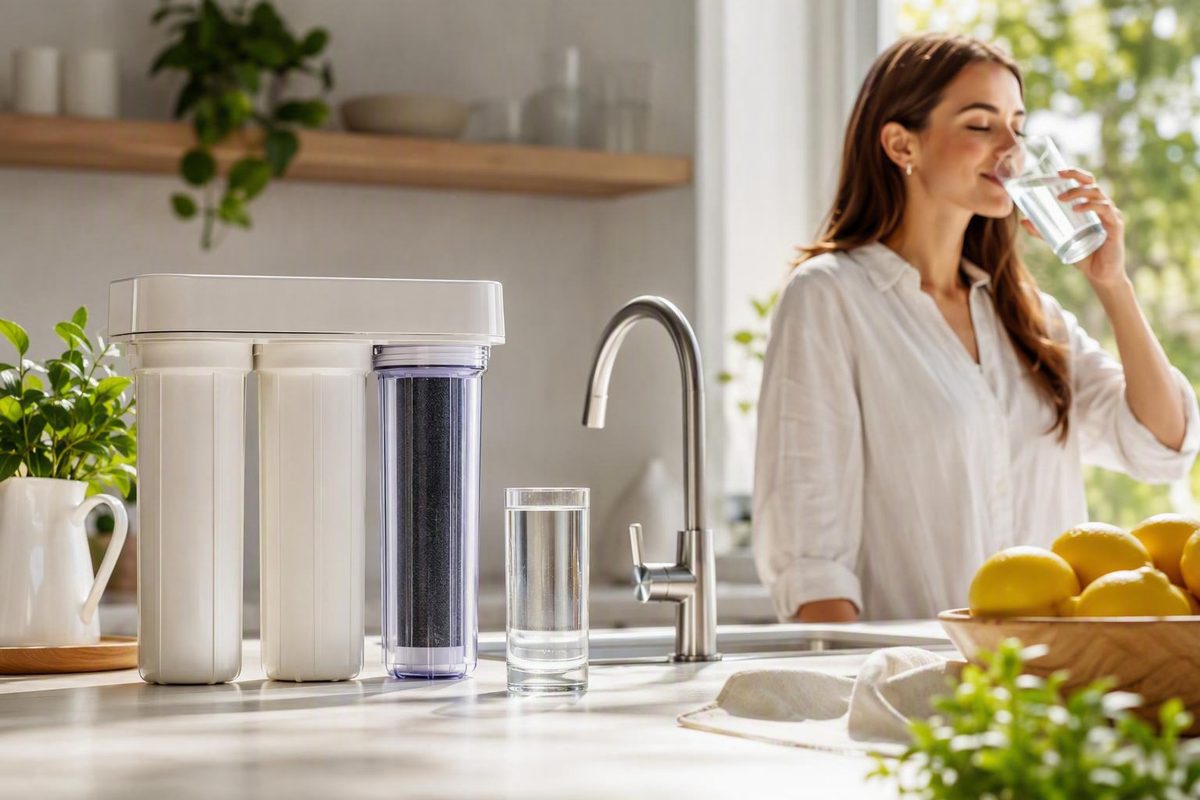
The short answer: start with the claim, not the filter category
If your water contains chloramine, catalytic carbon is the most common starting point among the products and seller guidance reviewed for this article. That market pattern is useful, but it does not prove that every catalytic-carbon filter will perform adequately. Media quantity, contact time, flow, incoming concentration, water chemistry, and cartridge condition can all affect results.
Look for an exact model with a chloramine-specific reduction claim. “Activated carbon,” “catalytic carbon,” “chlorine reduction,” “taste and odor,” and a micron rating are not substitutes for evidence that the model reduces chloramine under defined conditions.
Begin by deciding what water you want to treat:
- One drinking-water faucet: usually a point-of-use cartridge or under-sink system.
- An RO or RODI system: usually a compatible carbon stage installed upstream of the membrane.
- Every fixture: a point-of-entry cartridge or media-tank system sized for the home’s simultaneous demand.
The available evidence does not support a universal winner among water filters for chloramine. The product sources reviewed here are predominantly manufacturer and retailer pages, with inconsistent test conditions and few visible model-specific certification records or independent reports. This article is therefore a selection framework, not an independent product-performance ranking.
A defensible buying process has four steps:
- Confirm that chloramine is the disinfectant you need to address.
- Define the treatment location and required flow.
- Verify the exact model’s chloramine claim and test conditions.
- Plan for replacement, monitoring, sanitation, and long-term cost.
This claim-first approach matters because broad filter categories conceal major differences. Two cartridges may both say “catalytic carbon,” yet contain different amounts of media, operate at different flows, and reach their advertised capacities at different reduction endpoints.
Confirm that chloramine is actually the treatment target
Before shopping, review your water utility’s annual water-quality report—often called a Consumer Confidence Report—or contact the utility directly. Record whether it reports free chlorine, chloramine, or seasonal changes between disinfectants. If available, also record the reported concentration or range.
The CDC recommends identifying the substance of concern through water testing or a utility report and then choosing a filter whose label identifies that substance. It also notes that tap water may not need filtration when it does not contain the germs or chemicals a household is concerned about. The CDC explains this contaminant-first approach to choosing a home water filter.
Do not diagnose chloramine from a pool-like smell, unusual taste, cloudy glass, or another sensory observation. Taste, smell, and appearance cannot establish water safety, identify the disinfectant with certainty, or demonstrate a defined chloramine reduction. Water may taste better after carbon treatment without meeting a measurable treatment target.
For shopping purposes, free chlorine and chloramine are different claims. A filter advertised for “chlorine reduction” should not be assumed to cover chloramine. Likewise, a category page that discusses chloramine does not establish that every model on the page has been tested for it.
A useful note for your buying file is:
Utility disinfectant: Chloramine Reported concentration or range: __ Report date: _ Seasonal treatment changes: Other treatment targets: ___
Compare that information with the conditions behind a product claim. A filter evaluated at a lower incoming concentration or slower flow may not deliver the same result in your installation. If the seller publishes no challenge concentration, flow, or endpoint, you cannot make that comparison.
Confirming chloramine also helps prevent buying the wrong treatment for a different problem. Hardness, fluoride, nitrate, sediment, dissolved solids, metals, and microorganisms require their own treatment claims. A utility’s use of chloramine does not establish that chloramine is responsible for a particular taste, brewing problem, aquarium issue, or plumbing symptom.
Your objective determines the appropriate scope. A renter seeking better drinking and cooking water may reasonably choose one faucet. A homebrewer may need a modest flow at a dedicated sink. An aquarium or RODI user may prioritize dependable pretreatment at a slow production rate. A homeowner wanting treatment at showers and laundry connections is considering a much larger point-of-entry project.
Why catalytic carbon appears so often—and what the label does not prove
The manufacturers and retailers reviewed for this article repeatedly favor catalytic carbon for chloramine-oriented products. Their usual explanation is that catalytic carbon is activated carbon with modified surface chemistry intended to accelerate reactions involved in chloramine reduction. This remains vendor guidance, not independent proof that a particular cartridge or tank works at your required flow.
Vendor guidance also emphasizes that media type is only one variable. Carbon quantity, bed depth, water chemistry, temperature, flow, and contact time may affect performance. The Perfect Water Technologies comparison says standard activated carbon can reduce chloramine but generally needs more carbon and longer contact time, while catalytic carbon still requires adequate media mass and contact time. Its catalytic-carbon comparison also explains why iodine rating should not be treated as a direct chloramine-performance measure.
That supports a cautious interpretation of conflicting sales language:
- Some sellers describe conventional activated carbon as ineffective for practical chloramine treatment.
- Others say it can provide partial reduction when enough media and contact time are available.
The defensible conclusion is not that ordinary carbon does nothing. It is that a generic activated-carbon label does not establish adequate chloramine performance. If a conventional carbon model has credible chloramine-specific results at your intended flow, evaluate those results. If it has only a chlorine or taste-and-odor claim, do not infer the missing chloramine claim.
A micron rating answers a different question. A 0.5-, 1-, or 10-micron rating describes particle filtration under a stated or implied rating convention. It does not prove chemical reduction of dissolved chloramine. A carbon-block cartridge may combine particulate filtration and chemical treatment, but evidence for one function does not automatically establish the other.
Other shortcuts are equally weak:
- Chlorine capacity: Do not translate chlorine performance into chloramine capacity unless chloramine was separately tested under relevant conditions.
- Iodine number: This concerns aspects of carbon’s adsorption characteristics, not a complete measure of chloramine performance.
- Taste improvement: Better-tasting water is not a measured reduction percentage.
- Broad contaminant list: A long list does not disclose the test method, flow, endpoint, or whether every claim applies to the exact model.
- Carbon-block density: Construction may influence contact and pressure loss, but density alone is not a chloramine result.
- Micron size: Particle retention does not establish chemical reduction.
Treat “catalytic carbon” as a promising media description, not a pass/fail standard. The decisive evidence remains model-specific performance at a flow, concentration, and capacity endpoint relevant to your use.
Choose the treatment location: one tap, before RO, or the whole house
Treatment scope drives almost every subsequent decision: housing size, flow, plumbing changes, media volume, pressure loss, replacement cost, and maintenance responsibility.
| Treatment location | Typical purpose | Flow demand | Installation burden | Maintenance pattern | Evidence to verify |
|---|---|---|---|---|---|
| Under sink or dedicated faucet | Drinking, cooking, brewing, or another limited use | Based on the faucet or appliance | Usually modest; may require a housing, valve, dedicated faucet, and leak-safe mounting | Replace cartridges and sanitize the housing as directed | Chloramine reduction at the intended faucet flow, capacity endpoint, pressure drop, and cartridge compatibility |
| Before an RO or RODI system | Reduce chloramine upstream of the membrane and downstream stages | Based on the RO feed configuration, not only product-water output | Requires correct stage order, fittings, housings, and sufficient feed pressure | Carbon may require replacement before the membrane or DI resin | Chloramine claim for the carbon stage, tested feed flow, capacity endpoint, and replacement basis |
| Whole-house cartridge system | Treat incoming water before household fixtures | High and variable; based on simultaneous demand | Main-line plumbing, bypass valves, large housings, and service clearance | Recurring cartridge purchases; potentially frequent service at high use | Chloramine result at service flow, pressure drop, capacity, connection size, and replacement cost |
| Non-backwashing upflow tank | Whole-house treatment without routine backwash discharge | Based on peak demand and tank design | Main-line installation, bypass, and floor space; generally no backwash drain | Periodic media service or replacement | Chloramine performance at service flow, bed volume, channeling controls, pressure loss, and media-life basis |
| Automatic backwashing tank | Whole-house treatment with periodic bed cleaning and redistribution | Selected around peak household use | Drain, controls, programming, power where required, bypass, and additional space | Backwash cycles plus eventual media replacement | Chloramine performance, service and backwash flow, drain requirements, pressure loss, and media-life endpoint |
Point-of-use treatment is the narrowest option. It treats water delivered through a particular faucet, making it suitable for renters, small households, and users concerned mainly with drinking, cooking, coffee, or brewing. It does not treat showers, laundry, bathroom sinks, or other fixtures.
RO or RODI pretreatment needs special attention because sellers sometimes describe an entire system as handling chloramine without identifying which stage performs that function. Several vendors assign most chloramine reduction to upstream carbon rather than the reverse-osmosis membrane itself. Treat that as vendor guidance and verify the carbon prefilter’s exact claim, feed flow, and replacement interval.
For aquarium and RODI applications, do not assume that a drinking-water taste improvement is sufficient. Match the pretreatment stage to the actual feed rate and obtain application-specific monitoring guidance from the equipment manufacturer, utility, or a qualified laboratory. Detailed home-testing procedures are outside the evidence available for this article.
Aquatic Life’s collection illustrates add-on formats marketed to RO and RODI users, including standalone cartridges, carbon-block systems, and supplemental canisters. In the supplied listing snapshot, every displayed item was marked out of stock, and a two-cartridge ChloraGuard unit was marked discontinued. The Aquatic Life collection shows these configurations and seller-listed availability labels.
Whole-house cartridge systems can be relatively straightforward and may have a lower initial equipment price than some tank systems. Their limitations become more noticeable at high flow: undersized cartridges may restrict flow, while frequent replacements can make ownership cost much higher than the initial purchase price suggests.
Upflow tanks are marketed as avoiding a backwash drain and routine wastewater. That can simplify installation, but “no drain” says nothing about chloramine reduction at peak flow. Ask how the design maintains contact, limits channeling, and performs as the media ages.
Backwashing tanks add a control valve, drain requirement, programming, and higher initial cost. Vendors market them as offering lower pressure loss or longer media life than cartridge systems. These are seller-claimed design advantages, not universal results. A Clean Water Store overview distinguishes cartridge, upflow, and backwashing configurations while noting their different installation and flow trade-offs. Its configuration guide describes these seller-claimed differences.
Broader treatment is not automatically better. Whole-house treatment makes sense only when your objective requires water to be treated before showers, laundry, and other fixtures—and when you are prepared for the larger installation and maintenance obligations.
How to verify a chloramine claim before buying
A credible answer should apply to the exact model number, not merely the brand, media family, housing, or product category. Ask for:
- Exact model or SKU
- Chloramine named as the target substance
- Reduction percentage
- Incoming challenge concentration
- Tested flow rate
- Rated capacity
- Capacity endpoint—the reduction remaining at the rated capacity
- Laboratory name and report identifier
- Certification organization, standard, and exact claim
- Pressure drop at the tested or rated flow
- Replacement or media-service instructions
- Conditions or water-chemistry limitations
These fields work together. A large gallon figure has little comparative meaning when the seller does not disclose the incoming concentration, tested flow, and endpoint. One product might define capacity at a relatively high remaining reduction; another might continue counting gallons until substantially more breakthrough has occurred.
The same caution applies to “reduce” and “remove.” Neither word proves complete elimination. “Removes chloramine” may be informal marketing language rather than a quantified claim. Ask what percentage was achieved initially and what percentage remained at the stated capacity endpoint.
An NSF mark or reference to an NSF/ANSI standard is not enough by itself. The relevant question is whether the exact model’s certified contaminant-reduction claim specifically identifies chloramine. Search the certification organization’s database using the complete model number, and check whether suffixes, replacement cartridges, flow restrictors, faucet assemblies, or system configurations affect the listing.
If only a category page says “certified,” request the certifier, listing number, and scope. Certification for taste and odor, chlorine, cysts, or another substance must not be stretched into a chloramine claim.
Do not substitute the following for model-specific evidence:
- Star ratings or customer testimonials
- A report that the water tastes better
- A generic “premium carbon” description
- Certification for a different contaminant
- Certification of one component rather than the complete configuration
- A chlorine claim presented beside chloramine-oriented marketing
- A large advertised gallon capacity
- A broad substance list without separate conditions or results
Copy-and-send vendor questions
I am considering model [model number] for water containing approximately [utility-reported level] chloramine at [required flow] GPM.
- Has this exact model been tested specifically for chloramine reduction?
- What were the incoming concentration, pH, temperature, and tested flow?
- What initial reduction percentage was measured?
- What reduction percentage defined the capacity endpoint?
- At what gallon capacity was that endpoint reached?
- Which laboratory performed the test, and can you provide the complete report?
- Is the chloramine claim independently certified? If so, which database listing covers this exact model?
- What is the pressure drop when new and near replacement?
- What replacement schedule applies under my conditions?
- Does the claim require a particular housing, flow restrictor, pretreatment stage, or installation orientation?
A seller may legitimately lack some of these data. That does not prove the product is ineffective; it lowers the confidence you can place in the claim. A model-specific independent certification record is stronger than a complete manufacturer test report. A complete report is stronger than a quantified but undocumented claim, and a quantified claim is stronger than a generic media description.
Size for real flow, contact time, and cartridge compatibility
Commercial guidance for chloramine-oriented carbon filters consistently treats contact time as an important operating variable. Vendors warn that increasing flow can reduce water-carbon contact and may lead to earlier breakthrough. More media or a deeper bed may provide more treatment opportunity, but neither physical size nor media weight proves a result without relevant model-specific evidence.
For point-of-use treatment, compare the filter’s tested or specified flow with actual demand:
- A drinking faucet should remain usable at the treatment flow.
- A coffee maker, brewing setup, ice machine, aquarium, or RODI system may tolerate slower production.
- An RO feed stage must match the feed-water configuration, not merely the system’s product-water output.
- A cartridge that fits a standard housing may still be unsuitable if its claimed chloramine-treatment flow is much lower than the faucet can deliver.
Homebrewers should separate treatment performance from brewing-water composition. A chloramine claim does not establish control of hardness, alkalinity, dissolved solids, or other brewing variables. Confirm each additional treatment objective separately.
For whole-house treatment, estimate simultaneous peak demand, not just average daily use. Consider the fixtures and appliances that may operate together. Seller rules of thumb may help with preliminary shopping, but they are not independently validated designs for your home.
Ask two different flow questions:
- What is the system’s maximum plumbing or service flow?
- At what flow was the advertised chloramine result tested?
Those figures may not match. A housing can physically pass a high flow while the media delivers a lower chloramine reduction at that rate.
Compatibility deserves equal attention. “Ten-inch cartridge” does not guarantee a fit. Check:
- Actual cartridge diameter and length
- Slimline versus larger-diameter formats
- Standard 10-inch, 20-inch, or proprietary dimensions
- Big Blue or similar large-format housing requirements
- Gasket and end-cap design
- Housing pressure and temperature limits
- Inlet and outlet fitting sizes
- Required installation position
- Clearance to remove the sump and cartridge
- Whether the claim depends on a flow restrictor
The APEC FI-CHLORAMINE illustrates why these specifications must be read together. APEC lists catalytic granular activated carbon, dimensions of 2.80 by 9.80 inches, a nominal 10-micron rating, a specified flow of 0.1 GPM, an advertised capacity of 1,500 gallons, and a seller price of $25.95. These are listing claims rather than independent results; the page does not provide a chloramine challenge concentration, reduction percentage, endpoint, certification, or laboratory report. APEC lists the cartridge’s dimensions, flow, rating, capacity, and price on its product page.
The most consequential specification is not the familiar cartridge length or advertised capacity—it is the seller-listed 0.1 GPM flow. That is more consistent with slow point-of-use or upstream RO service than with an unrestricted kitchen faucet or whole-house application. The nominal 10-micron figure describes particulate filtration and does not substantiate chloramine reduction.
Sediment pretreatment may matter where particles could clog a carbon block, occupy spaces within a media bed, or increase pressure loss. Do not add it automatically. Base the decision on the water, cartridge instructions, available pressure, and overall system design.
For a tank system, request enough information to evaluate performance at peak flow. Tank diameter, media volume, bed depth, service-flow rating, and backwash requirements are more informative together than a single “up to” flow number. If the vendor cannot connect those specifications to a chloramine result, the system remains an unverified configuration rather than a demonstrated solution.
What the current product listings show—and what they leave unanswered
The supplied listing snapshots show a wide range of chloramine-oriented formats and seller prices. Because no common snapshot date or comparable independent test set was supplied, “current” should be read as “shown in the reviewed listings,” not as a guarantee of present price, stock, or specifications. Confirm all details before purchasing.
The table is an evidence-graded market sample, not a recommendation list.
Evidence-grade key
- Stronger: Exact model plus quantified chloramine result, disclosed challenge conditions and endpoint, and traceable independent certification or laboratory evidence.
- Limited: Exact-model specifications or claims are visible, but important test conditions or independent support are missing.
- Category-level: The listing establishes available formats, prices, or configurations but not exact-model treatment performance.
- Weak for performance comparison: Large performance or capacity claims appear without the conditions needed to compare them.
None of the reviewed examples reaches the “Stronger” grade based on the supplied evidence.
| Example or category | Details stated on the seller listing | Advertised performance | Evidence grade | Missing data |
|---|---|---|---|---|
| APEC FI-CHLORAMINE | Catalytic granular-carbon cartridge; 2.80 × 9.80 inches; nominal 10 microns; specified 0.1 GPM; seller price $25.95 | Up to 1,500 gallons; marketed for chloramine reduction and installation before RO | Limited: exact-model specifications are visible, but no independent treatment result is supplied | Chloramine percentage, challenge level, endpoint, laboratory, certification, pressure drop |
| Aquatic Life collection | Standalone cartridges, carbon-block systems, sediment-and-carbon combinations, and RO/RODI add-on canisters; every displayed item in the supplied snapshot was marked out of stock; one two-cartridge unit was discontinued | Marketed for chloramine reduction; selected products use catalytic-carbon or carbon-block cartridges | Category-level: formats and availability labels are visible, but comparable performance conditions are absent | Percentage, tested flow, challenge level, endpoint, pressure drop, certification |
| DiscountFilterStore collection | Slim 10-inch, larger-diameter 10-inch, and 20-inch formats using catalytic carbon or catalytic GAC; displayed cartridge prices ranged from $43.42 to $155.59; selected whole-house listings advertised capacities from 300,000 to 1,000,000 gallons | Product titles advertise chloramine reduction and large whole-house capacities | Weak for performance comparison: useful for observing formats and prices, not for validating treatment | Percentage, challenge level, service flow, endpoint, pressure drop, media-life basis, certification The retailer collection shows these seller-listed formats, prices, and capacities |
| Specialty-retailer whole-house categories | Cartridge packages listed from $419.95, backwashable catalytic-carbon systems from $915, and a premium system from $1,359 | Marketed as whole-house chloramine-treatment options | Category-level: configuration and seller price are visible, but exact-model evidence must be checked separately | Chloramine percentage, flow, challenge concentration, endpoint, pressure drop, operating cost, certification The retailer category shows this seller-listed price and configuration range |
Do not rank these examples by price, micron size, customer rating, number of listed contaminants, or advertised gallons. A million-gallon title is not inherently better than a 1,500-gallon cartridge claim when the systems have different media quantities, flows, endpoints, and undisclosed test conditions.
Price also omits plumbing, replacement media, drainage, electricity, service labor, monitoring, and possible pressure-loss effects. Keep product features and evidence quality in separate columns: a convenient housing or low price may be valuable, but it cannot compensate for an unsupported chloramine claim.
Maintenance, breakthrough, and whole-house plumbing hygiene
Carbon media is consumable. Commercial vendors describe chloramine breakthrough as gradual rather than an abrupt change from complete treatment to complete failure. Because the supplied evidence does not include an independent breakthrough study tied to the listed models, treat that as vendor guidance rather than a universal performance rule.
Do not wait for an obvious taste or odor to decide that a cartridge is exhausted. The CDC states that taste, smell, and appearance are not reliable indicators of water safety. It also warns that filters require timely maintenance and that removing a residual disinfectant throughout the home may allow more germs to grow in household plumbing. The CDC’s home-filter guidance covers both maintenance and whole-home disinfectant removal.
Use the manufacturer’s documented schedule as a starting point, then account for actual use, incoming concentration, seasonal utility changes, water chemistry, sediment loading, and any suitable post-filter checks. An advertised gallon rating is a conditional claim, not a guaranteed expiration date.
A practical maintenance routine includes:
- Record the installation date, exact cartridge model, and lot number if available.
- Save the manual, performance sheet, and certification record.
- Track estimated gallons or operating time.
- Keep replacement cartridges or media available before the expected service date.
- Inspect housings, fittings, drains, and bypass valves for leaks.
- Watch for an unexplained decline in pressure or flow.
- Follow the manufacturer’s sanitation instructions.
- Replace O-rings and seals as directed rather than reusing damaged parts.
- Confirm that replacement cartridges retain the original chloramine claim.
- Document post-filter measurements and the conditions under which they were taken.
- Recheck utility information for disinfectant or concentration changes.
Testing requires careful interpretation. A test that measures only free chlorine may not answer a chloramine question. If monitoring is part of your maintenance plan, ask the utility, equipment manufacturer, or a qualified laboratory what method is suitable for the disinfectant, concentration range, and application. The supplied evidence does not support detailed instructions for selecting or using a particular home test.
For brewing, aquarium, or RODI use, verification should match the sensitivity of the application. Do not assume acceptable taste establishes acceptable performance, and do not apply a household drinking-water claim to a specialized use without checking its conditions.
Whole-house treatment adds a plumbing-hygiene trade-off because it removes residual disinfectant before water moves through the home. Broader treatment at showers, laundry connections, and every faucet therefore comes with greater responsibility for sanitation, replacement, stagnation management, and equipment condition. A single-faucet system limits both the treatment scope and the amount of downstream plumbing without residual disinfectant.
Finally, do not treat catalytic carbon as universal treatment. A chloramine-oriented carbon stage should not be assumed to address:
- Hardness or scale-forming minerals
- Fluoride
- Nitrate
- Total dissolved solids
- Bacteria
- Viruses
- Every metal or organic chemical
Each additional target needs a matching claim and treatment process. Depending on the actual water problem, that may involve sediment filtration, ion exchange, reverse osmosis, disinfection, or another technology.
The useful conclusion is a purchase sequence rather than a product winner:
- Confirm chloramine through the utility report.
- Decide whether to treat one faucet, an RO or RODI feed, or the whole house.
- Calculate required flow, including simultaneous peak demand for point-of-entry treatment.
- Verify the exact model’s chloramine percentage, challenge concentration, tested flow, capacity endpoint, laboratory, and certification scope.
- Compare installation and annual ownership costs.
- Build replacement, monitoring, sanitation, and plumbing hygiene into the plan.
If the seller cannot provide the conditions behind an advertised capacity, treat that capacity as an unverified marketing claim—not a guaranteed service life.
Will a regular activated-carbon filter remove chloramine?
It may reduce some chloramine under favorable conditions, particularly with enough carbon and slow flow, but a generic activated-carbon description does not establish adequate performance. Vendor sources disagree on whether ordinary carbon is ineffective in practical use or simply less efficient than catalytic carbon. The defensible rule is to require chloramine-specific evidence for the exact model.
Catalytic carbon is commonly preferred because vendors say its modified surface chemistry accelerates chloramine-related reactions. Even then, sufficient media and contact time are still necessary. Do not infer chloramine performance from a chlorine rating, iodine number, taste claim, or micron size.
Does reverse osmosis remove chloramine?
Do not assume that an RO membrane itself has a chloramine-reduction claim. Residential RO and RODI vendors generally assign most chloramine reduction to carbon stages installed before the membrane. Mid Atlantic Water, for example, describes under-sink RO systems as relying on carbon prefilters for this function. Its carbon-versus-RO discussion explains that seller-described stage distinction.
Verify the exact upstream cartridge, its tested feed flow, and its replacement interval. “RO removes chloramine” is too broad when the supporting claim actually applies to an integrated system containing carbon pretreatment.
Does an NSF Standard 42 mark prove that a filter reduces chloramine?
No. A general NSF mark or Standard 42 reference does not, by itself, prove chloramine reduction. Look up the exact model in the certification organization’s database and confirm that the certified contaminant claim specifically names chloramine.
Also check whether the listing applies to the complete system or only one component, and whether the model suffix matches what you intend to buy. Certification for taste and odor, chlorine, or another substance must not be extended to chloramine without an explicit claim.
Is a whole-house chloramine filter better than an under-sink filter?
Neither is universally better. An under-sink filter is the narrower choice when the goal is drinking, cooking, or brewing water at one faucet. It does not treat showers, laundry, or other taps.
A whole-house system is appropriate when the objective genuinely requires treatment before water reaches every fixture. It must handle simultaneous demand, may require substantial plumbing work, and brings greater maintenance and plumbing-hygiene responsibility. Choose according to treatment scope, verified performance, pressure loss, ownership cost, and willingness to maintain the system—not the assumption that broader treatment is always preferable.
How long does a chloramine filter cartridge last?
There is no universal lifespan. Service life depends on the cartridge, media amount, incoming chloramine concentration, flow, water chemistry, total use, sediment loading, and the reduction endpoint used to define capacity.
For example, APEC advertises a capacity of 1,500 gallons for the FI-CHLORAMINE, but the listing does not disclose the chloramine challenge concentration, quantified reduction, or capacity endpoint. That figure is a seller-listed capacity rather than an independently verified replacement interval.
Use the manufacturer’s documented schedule, track actual use, and obtain suitable monitoring guidance when the application warrants it. Do not wait for the water to taste different before servicing the filter.