
Well Water Whole House Filter System: Test and Size
Use lab results, household peak flow, pump capacity and verified treatment claims to design a well-water system that fits the measured problem.
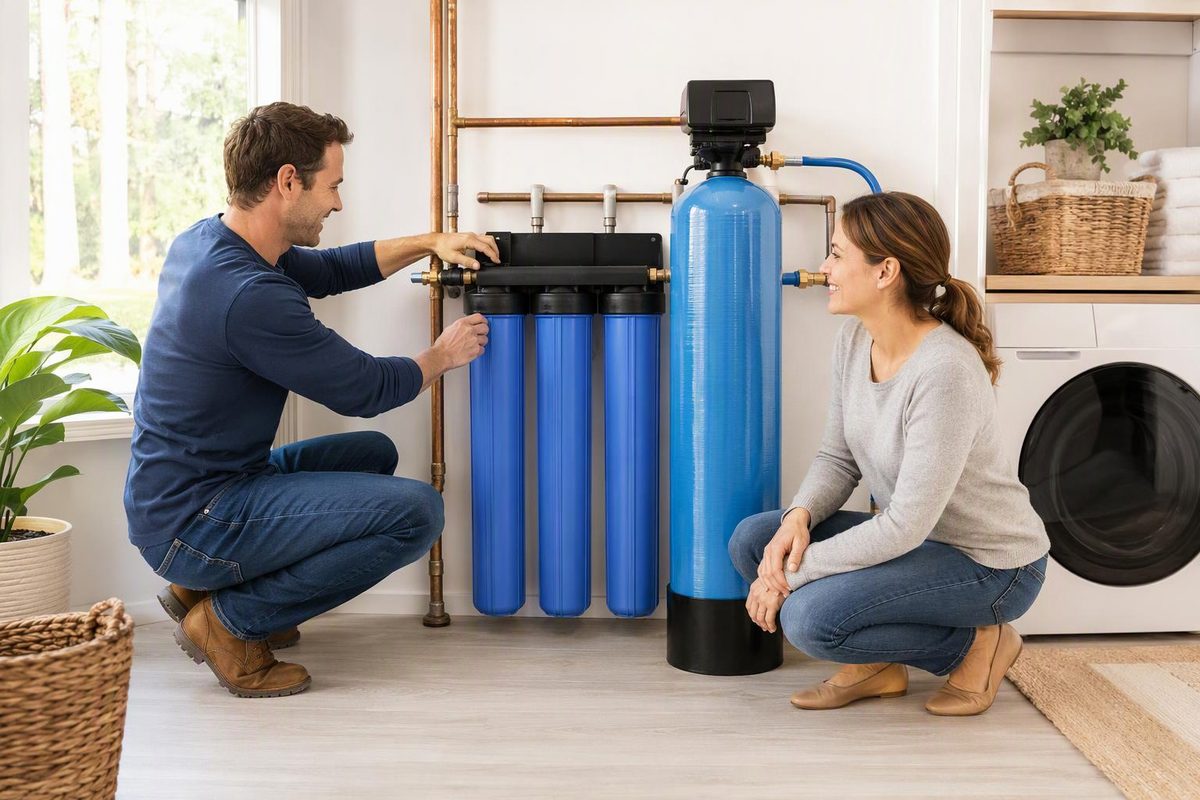
Choose a well water whole house filter system from laboratory results, peak household flow and the well pump’s capacity. No universal well-water filter removes sediment, iron, hardness, bacteria, nitrate and arsenic; the correct setup may be a treatment train rather than one multi-media cartridge.
Select the problem found in your water test to see the matching treatment and its main limitation.
Treatment Match From a Measured Result
Each treatment mechanism has a different job. Use numerical lab results before sizing equipment.
| Measured problem | Common approach | Main limitation |
|---|---|---|
| Sand, silt or rust | Spin-down separator, backwashing sediment filter or cartridge | Does not remove dissolved iron, nitrate, hardness or microbes |
| Iron or manganese | Oxidation plus backwashing filtration; a softener may handle some low-level dissolved iron | Media choice depends on concentration, pH, oxygen and iron form |
| Hardness | Ion-exchange softener | A softener is not a general contaminant filter |
| Recurring microbial risk | Source correction followed by properly sized UV or chlorination | UV needs clear, pretreated water and leaves no disinfectant residual |
| Hydrogen sulfide | Aeration, oxidation and filtration, or another method matched to the measured level | If odor occurs only in hot water, investigate the water heater first |
| Tannins | Specialized anion-exchange media, commonly after sediment and iron treatment | Iron and surface influence can also produce color; test first |
| Arsenic or nitrate | Exact-model point-of-use RO with the relevant claim, or contaminant-specific media | Ordinary sediment and carbon cartridges do not solve these dissolved contaminants |
| Treatable organics, taste or odor | Granular activated carbon | The exact chemical must be treatable by the media; carbon eventually exhausts |
Sources: EPA private-well guidance, Minnesota Department of Health and Penn State Extension. Final selection requires numerical test results and exact-model performance data.
Test the Raw Water First
Collect the sample before any existing treatment and use a drinking-water laboratory certified or accredited in your state. EPA advises private-well owners to test annually for total coliform bacteria, nitrate, total dissolved solids and pH. Test immediately after flooding, well repairs or a change in color, taste or odor. Ask the local health department which additional contaminants occur in the area (EPA).
For equipment design, obtain numerical concentrations—not merely “pass” or “fail”—for:
- Total coliform and E. coli
- Nitrate and nitrite
- pH, hardness, alkalinity and total dissolved solids
- Iron and manganese, with dissolved and total values when available
- Turbidity or suspended sediment if the water is cloudy
- Arsenic, lead and locally relevant contaminants
- Hydrogen sulfide when a sulfur odor is present
- Tannins when tea-colored water remains after particles settle
A smell or stain is a clue, not a diagnosis. Clear water that turns red or brown after standing suggests dissolved ferrous iron. Water that is red or yellow immediately contains ferric, or oxidized, iron. Treatment depends on the form, concentration, pH and other water chemistry (Minnesota Department of Health).
If testing confirms a microbial contaminant, follow the local health department’s instructions about drinking the water. Correct defects in the well or plumbing, disinfect as directed and retest. A UV unit is not a substitute for repairing a contamination pathway.
Match Each Result to a Treatment Mechanism
Sediment filtration, softening, oxidation, adsorption and disinfection solve different problems. Penn State’s treatment summary distinguishes these methods, notes that UV requires sediment-free water and explains that oxidizing filters for iron and manganese require backwashing (Penn State Extension).
A spin-down separator or sediment cartridge can capture particles, but it cannot remove dissolved iron, nitrate, hardness or microorganisms. Similarly, a softener addresses hardness and may handle some low-level dissolved iron, but it is not a general contaminant filter.
Iron and manganese treatment depends on their concentration, form, pH and oxygen conditions. A typical approach oxidizes dissolved material and then captures it in a backwashing filter. Hydrogen sulfide may require aeration, oxidation and filtration or another method matched to the measured level. If the odor occurs only in hot water, investigate the water heater before specifying whole-house treatment.
Tannins generally require specialized anion-exchange media, commonly after sediment and iron treatment. Iron and surface influence can also produce colored water, so test before buying tannin media. See the detailed guides to carbon filtration for wells, tannin treatment and coliform treatment when one of those results drives the design.
Not every health-related contaminant requires whole-house treatment. EPA’s filtration guide says point-of-use equipment is effective for many contaminants in consumed water. Point-of-entry treatment is appropriate for house-wide problems such as scale, staining and odor, as well as contaminants that can volatilize during showering (EPA).
An under-sink reverse-osmosis system with an explicit nitrate or arsenic reduction claim may therefore be more practical than whole-house RO, provided every source used for drinking, cooking and ice is treated. Ordinary sediment and carbon cartridges do not solve these dissolved-contaminant problems.
Size Every Stage for Peak Flow and Backwash
Record the following values before requesting quotes:
- Peak flow in gallons per minute: Estimate simultaneous demand from showers, toilets, laundry and appliances. Every component must pass that flow at usable pressure.
- Pump and well output: Record the pump model, pressure-switch range, pressure-tank size and any well-yield test. Treatment equipment cannot create flow the well or pump cannot supply.
- Service-flow rating: Obtain the continuous and peak gpm for each proposed tank under the relevant operating conditions. The most restrictive component limits the treatment train.
- Backwash requirement: Media tanks can require a higher short-term drain flow than their service flow. Verify that the pump can provide the manufacturer’s specified backwash rate and that the drain can accept it.
- Pressure loss: Request pressure-drop data at the intended gpm for clean and loaded filters. Port diameter alone does not establish usable flow.
- Treatment capacity: For exchange or adsorption media, obtain capacity at the tested concentration and expected daily use—not an unexplained gallon figure.
Do not select a sediment cartridge by micron number alone. “5 micron” may be nominal or absolute, and identically labeled cartridges can perform differently. See 5-micron filter ratings. Heavy or recurring solids generally favor a washable separator or backwashing filter over frequent disposable-cartridge changes.
Component Order Changes Treatment Performance
An illustrative treatment train is:
well → pressure tank → raw-water sample tap → coarse sediment control → oxidation/contact stage → backwashing iron filter → softener → carbon, if required → final UV → treated-water sample tap → house
This is not a universal prescription. Oxidation must precede the filter intended to capture oxidized iron. UV usually goes near the end so it receives clear, pretreated water. A softener, carbon tank or pH-adjustment stage may need a different position depending on the water chemistry and the manufacturer’s operating limits. Require the proposed order on the written design.
Include a bypass, isolation valves and pressure gauges around major stages where practical. For continuous chlorination, the feed control, dose, contact time, residual measurement and downstream filtration all matter; see the well-water chlorine injection guide.
Verify Exact Claims Before Buying
“Seven stage,” “removes 99%” and “designed for wells” are not useful without an exact contaminant claim and operating conditions. NSF explains that certification to a standard does not mean a device removes every contaminant. NSF/ANSI 42 covers aesthetic claims, 44 covers cation-exchange softeners, 53 covers specified health-effect reduction claims, and 55 covers UV systems. Under Standard 55, Class A systems are intended to inactivate microorganisms in contaminated water (NSF).
Check a certifier’s current listing for the exact model number and exact reduction claim, not merely a certification logo. NSF likewise advises checking both the standard and the named contaminant claim (NSF).
Ask each vendor for a written design stating:
- Raw-water results and design concentrations
- Treated-water targets
- Service and backwash rates in gpm
- Pressure drop at the design flow
- Consumables, regeneration chemicals and maintenance intervals
- Drain, electrical and plumbing requirements
- UV alarm, sensor and shutoff provisions, if applicable
- A treated-water retesting schedule
- Parts, labor and media warranties
After installation, test the treated water for the target contaminant and follow the equipment maker’s maintenance schedule. Sediment cartridges load, softeners need regenerant, media tanks require backwashing or regeneration, carbon exhausts, and UV lamps and sleeves need scheduled attention.
For arsenic treatment specifically, Minnesota health officials advise periodic treated-water testing to confirm that the system continues to work (Minnesota Department of Health).