
Water Filter for Coliform Bacteria: What Actually Works
By Erik Sandoval, water-treatment technician Updated August 29, 2026
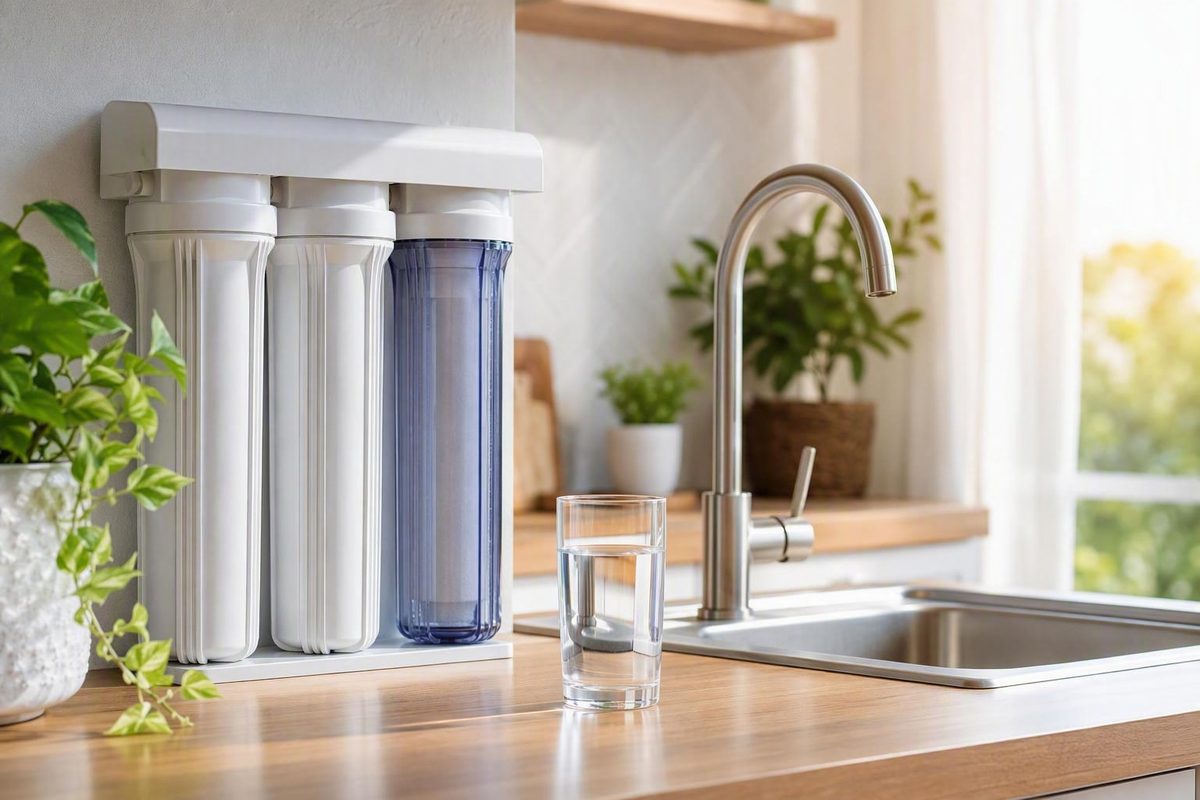
By Erik Sandoval, water-treatment technician Updated August 29, 2026
This guide is written primarily for private-well households. Laboratory instructions and local health-authority requirements control decisions about exposure, remediation, sampling, and clearance.
Positive coliform result? Take these steps before shopping
Urgent action: control exposure now
- Follow the instructions from the testing laboratory and your local or state health authority.
- While the result is being investigated, use commercially bottled water or properly boiled water for drinking, cooking, brushing teeth, making ice, and washing produce. Commercial remediation guidance specifically includes these potable uses when a well tests positive. Review the immediate precautions for a positive well-water result.
- If the result identifies fecal coliform or E. coli, contact your local health authority promptly. These findings are stronger evidence that the water has contacted human or animal waste. Mississippi State University Extension explains the distinction.
- Ask the health authority specifically about bathing, dishwashing, laundry, infant care, formula preparation, pets, and medically vulnerable household members. Advice can vary with the organism, possible exposure route, household vulnerability, and local rules.
- People with weakened immune systems should consult a healthcare provider, the health authority, and a qualified water-treatment professional. They should not change contaminated filters or handle potentially contaminated treatment media themselves, consistent with CDC filter-safety guidance.
- Do not rely on a pitcher, refrigerator cartridge, sediment filter, softener, or newly purchased treatment unit until the response plan and the unit’s performance have been verified.
Long-term equipment comes later
A complete response may include confirmation sampling, inspection and repair of the well, disinfection of the well and plumbing, sanitation of downstream equipment, installation of ongoing treatment, and laboratory retesting.
The short answer for buyers is that an ordinary carbon or sediment filter is not an adequate response. Depending on the laboratory result and the required treatment scope, suitable options may include a verified absolute-rated filter, ultrafiltration, nanofiltration, reverse osmosis, distillation, properly prefiltered UV, or professionally designed continuous chlorination. None removes the need to investigate how contamination entered.
Do not assume every non-drinking use is safe. An E. coli result, a person who may swallow bathwater, or an immunocompromised resident can change the recommendation. Obtain a use-by-use answer rather than applying a universal rule.
Most importantly, do not treat shopping as the first or only response. A new water filter for coliform bacteria cannot repair a cracked well cap, stop septic leakage, correct surface runoff, or sanitize contaminated plumbing.
A practical sequence is:
- Identify the result: total coliform, fecal coliform, E. coli, or another organism.
- Restrict exposure while following the laboratory and health authority.
- Confirm or expand testing as directed.
- Inspect and repair the contamination pathway.
- Disinfect and sanitize the affected system under site-specific instructions.
- Choose point-of-use or point-of-entry treatment if continuing protection is needed.
- Verify the exact model and microbial claim.
- Retest before relying on the supply and continue maintenance and periodic testing.
Understand what the laboratory result actually means
Total coliform is a broad indicator group containing bacteria from environmental as well as fecal sources. Many total-coliform organisms are not themselves harmful. Their presence still matters because it can reveal a pathway through which contamination—and potentially pathogens—entered the supply.
A positive total-coliform result does not automatically mean that E. coli is present or prove that the well contacted fecal matter. Fecal coliform and E. coli findings are more strongly associated with human or animal waste and therefore create greater concern.
You cannot clear water by looking at it, smelling it, or tasting it. Clear water may contain microorganisms, while cloudy or unusual-looking water may have a different sediment or mineral problem. Laboratory testing is required to establish whether coliform bacteria are present.
An initial positive result may also reflect contamination introduced while taking the sample. A dirty aerator, attached hose, faucet filter, unwashed hands, or contact with the inside of the sterile bottle or cap can compromise collection. That possibility can justify careful confirmation, but it does not justify continuing normal potable use while the result is investigated.
A concise confirmation-sampling checklist
Mississippi State University Extension recommends following the laboratory’s collection instructions, removing faucet attachments, washing hands, avoiding contact with the container interior, and sampling close to the well or at another directed location.
- Use the laboratory’s sterile bottle and follow its instructions exactly.
- Confirm which faucet or sampling location the laboratory wants.
- Remove aerators, screens, filters, swivel attachments, and hoses.
- Wash your hands.
- Sanitize or flush the sampling point exactly as instructed.
- Do not touch the inside of the bottle, cap, or bottle rim.
- Do not rinse a bottle that contains laboratory preservative.
- Fill the bottle to the specified level, close it promptly, and meet the laboratory’s storage and delivery deadline.
- Request the organism-specific analysis directed by the laboratory or health authority, including E. coli where appropriate.
Guides differ on whether confirmation sampling should precede shock disinfection. Sampling first may preserve information about the original condition and help identify collection contamination. More immediate disinfection may be directed when the organism or circumstances indicate a greater concern. Keep potable-use precautions in place either way and follow the sequence specified by the laboratory and local authority.
Use this result-based framework:
- Total coliform positive, E. coli negative or not yet tested: restrict potable exposure, seek confirmation and organism-specific testing, and inspect the well and sampling point.
- Fecal coliform or E. coli detected: contact the health authority promptly, investigate a fecal-contamination route, and follow its remediation and clearance instructions.
- Repeat result negative: ask whether the first result likely arose from sampling and whether inspection or additional monitoring remains appropriate.
- Repeat or recurring positive: treat it as evidence of an unresolved pathway, a contaminated system, or a possible need for continuing treatment.
Find and repair the route by which contamination entered
Treatment equipment is one part of remediation, not a substitute for source control. If runoff can still enter around the casing or a failed septic system continues to affect the well, treatment must compensate indefinitely—and one maintenance lapse can expose the household again.
Inspect the well, surrounding site, and recent work history for:
- A damaged, loose, incorrectly vented, or poorly sealed well cap
- Cracked casing, defective seals, or openings around electrical connections
- Soil sloping toward the well instead of draining away
- Ponding, nearby surface water, flooding, or recent heavy rain
- Animal pens, manure, wildlife activity, or agricultural runoff
- Septic-system leakage or failure
- An abandoned or poorly maintained nearby well
- A shallow well or one potentially influenced by surface water
- Recent pump, well, pressure-tank, or plumbing work
- Cross-connections or plumbing changes
- A contaminated sampling faucet or attachment
A licensed well professional may need to inspect the construction, casing, seals, drainage, pump components, and nearby risks. Structural and septic problems require correction; treatment alone does not remove their cause.
Shock chlorination is commonly used after corrective work to disinfect the well, pressure equipment, and household plumbing. It may produce only temporary improvement if the entry pathway remains open. Recurring positives after chlorination call for further investigation rather than indefinite repetition of the same procedure. A commercial remediation overview similarly separates source correction, system-wide disinfection, retesting, and longer-term treatment for persistent contamination.
Do not copy a chlorine concentration, contact time, flushing sequence, or disposal method from an unrelated well. Mississippi State University Extension recommends using qualified well professionals and checking equipment instructions because improper disinfection can create chemical-exposure risks or damage system components.
Under qualified guidance, the sanitation plan may need to cover:
- The well and pump components
- Pressure tanks and associated piping
- The water heater
- Storage or retention tanks
- Filter housings and bypass lines
- Reverse-osmosis storage tanks
- Hot and cold household plumbing
- Faucets, showerheads, appliance supply lines, and ice makers
The exact scope is system-specific. Other equipment may have to be isolated from strong disinfectant and sanitized separately according to its manufacturer’s instructions.
Do not resume untreated potable use merely because the water looks clear or no longer smells like chlorine. Those observations are not laboratory clearance. Resume use only after completing the required corrective work and obtaining the results specified by the laboratory or local authority.
Which treatment methods address bacteria—and which do not
The phrase “water filter for coliform bacteria” hides three different treatment functions:
- Physical removal: a barrier retains microorganisms while treated water passes through. Absolute-rated filters and suitable membrane systems work this way.
- Disinfection or inactivation: UV or chlorine acts on microorganisms rather than physically straining them from the water.
- Residual protection: a disinfectant remains in the water and continues acting downstream. Properly designed chlorination can provide a residual; UV and membranes do not.
The CDC identifies ultrafiltration, nanofiltration, reverse osmosis, distillation, and prefiltered UV among home treatment approaches that address bacteria. It also emphasizes that technologies differ in their capabilities and that the exact product label must cover the contaminants of concern. Compare the treatment categories in the CDC overview.
| Method | Mechanism | Typical location | Chemical-removal capability | Residual protection | Common operating needs | Principal concerns | Maintenance |
|---|---|---|---|---|---|---|---|
| Absolute-rated filtration | Physically retains organisms larger than the verified absolute pore limit | Point of use or specialized point of entry | Only claims supported by the exact filter and any added media | None | Secure installation; sediment control where required | Incorrect rating, bypass, damaged cartridge, poor seals | Cartridge replacement, housing sanitation, seal inspection |
| Ultrafiltration | Membrane barrier that can remove bacteria and parasites | Point of use or engineered point of entry | Generally limited unless combined with other treatment | None | Sediment and fouling control | Membrane damage, fouling, bypass, poor sanitation | Flushing or cleaning, cartridge service, seal checks |
| Nanofiltration | Tighter membrane barrier | Usually engineered point of use or point of entry | Some dissolved substances, depending on the exact membrane and claim | None | Adequate pressure and control of sediment, scale, and fouling | Membrane or seal failure, scaling, bypass | Pretreatment, membrane service, sanitation |
| Reverse osmosis | Pressure-driven membrane separation | Commonly one drinking-water outlet; whole-home designs require engineering | Some chemicals within the exact model’s claims and operating limits | None | Pretreatment suited to the water and membrane | Membrane damage, bypass, contaminated tank or downstream tubing | Cartridge and membrane service, tank and housing sanitation |
| Distillation | Boils water and condenses the vapor | Usually countertop or point of use | Many chemicals, but not every volatile compound | None | Scale management and regular cleaning | Scale and contamination of collection surfaces | Cleaning, descaling, energy use |
| UV | Germicidal light inactivates microorganisms under validated conditions | Often point of entry | None | None | Clear water, correct flow, power, and model-specific pretreatment | Excess flow, fouling, lamp or power failure, untreated downstream plumbing | Lamp and sleeve service, pretreatment, alarm checks |
| Continuous chlorination | Metered chemical disinfection with appropriate mixing and contact | Usually point of entry | May oxidize some other substances as part of a designed treatment train | Yes, when properly designed and maintained | Feed equipment, contact arrangement, chemical supply, monitoring | Feed interruption, inadequate contact, incorrect dosing, poor monitoring | Chemical handling, equipment service, residual monitoring |
Absolute is not the same as nominal
The CDC states that a filter with an absolute pore rating of 0.3 micron or smaller can remove bacteria. “Absolute” means every pore is at or below the stated size. A nominal or mean rating can include larger pores, so a nominal 0.3-micron cartridge is not equivalent. The exact product must also be installed without bypass and carry a claim appropriate to the intended use. See the CDC’s pore-rating explanation.
Do not infer dependable bacterial protection merely from the term microfiltration or an approximate pore-size graphic. The CDC describes microfiltration as only somewhat effective against bacteria, meaning some bacteria may pass. By contrast, its treatment summary identifies UF, NF, RO, distillation, and prefiltered UV as bacterial-treatment options. Their performance against viruses and chemicals differs, and actual performance remains product-specific.
Ordinary activated-carbon pitchers and refrigerator filters are mainly intended for concerns such as taste and odor unless the exact model states otherwise. Sediment cartridges and water softeners are not disinfection systems. None should be assumed to make coliform-positive water safe.
Whole-house carbon also requires design scrutiny when it removes chlorine or another disinfectant. Removing the residual at the home’s entrance can reduce downstream microbial protection. The actual risk depends on sanitation, plumbing conditions, water age, monitoring, and the design of the complete treatment system—not simply on the presence of carbon.
Whole-house UV, under-sink RO, or continuous chlorination?
Start by deciding where protection is needed.
A point-of-entry system treats most or all water entering the home. It is the relevant scope when treatment must cover showers, bathroom sinks, the water heater, appliances, and other outlets.
A point-of-use system protects only the connected faucet or appliance. An under-sink unit does not protect an unconnected ice maker, bathroom tap, shower, or hose bib.
There is no universal best choice. Use the result, water source, plumbing, household flow, other contaminants, and consequences of system failure to choose a treatment train—a sequence of treatment stages, each assigned a specific job.
| Situation | Approach to investigate | Why it may fit | Important limits |
|---|---|---|---|
| Recurring microbial contamination in otherwise clear well water | Correctly sized point-of-entry UV with required pretreatment | Treats incoming household water without continuous chemical addition | No chemical removal or residual; depends on flow, water clarity, maintenance, and power |
| Protection needed at one drinking and cooking faucet | Product-specific bacteria-rated RO, UF, or another suitable membrane | Provides a physical barrier at the selected outlet | Other outlets remain untreated; housings, tanks, tubing, and faucets must remain sanitary |
| Long plumbing runs, persistent downstream contamination, or a defined need for residual | Professionally designed continuous chlorination | A disinfectant residual can continue through downstream plumbing | Requires feed, contact, monitoring, chemical handling, and water-specific design |
| Microbial contamination plus an oxidation requirement | Professionally designed chlorination with appropriate downstream treatment | May combine disinfection with oxidation in one system | Suitability depends on laboratory results and chemistry; downstream carbon may remove the residual |
| Cloudy, colored, sediment-heavy, iron-rich, manganese-bearing, or scale-forming water | Correct those conditions before UV, then reassess | Reduces shielding and deposits on the UV sleeve | A bare UV chamber may not provide dependable treatment |
| Bacteria plus nitrate, arsenic, pesticides, hardness, or metals | Multistage treatment based on a complete laboratory result | Assigns each contaminant to a suitable treatment stage | A bacterial-treatment device does not automatically remove chemicals |
For clear well water with recurring microbial contamination, point-of-entry UV may be reasonable after source repair and suitable pretreatment. It should be sized for peak simultaneous flow—the highest flow when multiple fixtures operate together—not simply average daily use.
For one kitchen outlet, an RO or another membrane with a verified bacterial-reduction claim may be considered. The narrower scope can reduce equipment size, but it leaves the rest of the home untreated. That matters if exposure could occur through ice, toothbrushing at another sink, or accidental swallowing during bathing.
Continuous chlorination may warrant investigation when residual protection is explicitly required, plumbing is extensive, or downstream contamination makes one-pass UV treatment insufficient. It may also form part of a treatment train when oxidation is needed. Commercial UV-versus-chlorination guidance emphasizes these tradeoffs while noting that UV may require prior treatment for sediment, turbidity, iron, manganese, or hardness. Its numerical thresholds are vendor-specific, so use the manual and certification conditions for the exact model rather than applying another company’s limits. Review the vendor’s operational comparison.
Keep three jobs separate:
- Source repair closes the contamination pathway.
- Shock chlorination disinfects the well and plumbing after contamination or work.
- Ongoing treatment continuously treats water entering the home or reaching a selected outlet.
A household may need one, two, or all three. None automatically replaces the others.
UV and reverse-osmosis limitations that product pages often omit
UV is a disinfection process, not a physical filter. It does not remove chemicals, hardness, sediment, metals, or the physical material of inactivated microorganisms. It also provides no disinfectant residual after water leaves the chamber.
Cloudiness, color, suspended material, and deposits on the quartz sleeve can reduce the light delivered to microorganisms.
A technically suitable UV system can fail because of:
- Flow above the system’s validated treatment rate
- Inadequate delivered UV dose
- Low UV transmittance
- Cloudiness, color, or sediment that shields microorganisms
- Iron, manganese, hardness scale, or other deposits on the sleeve
- A dirty or damaged quartz sleeve
- An expired, failed, or incorrectly installed lamp
- An ignored intensity or fault alarm
- Incorrect plumbing, orientation, or flow control
- Power interruption
- Downstream plumbing that was never sanitized
Evaluate the exact model’s validated flow, monitoring arrangement, source-water limits, required pretreatment, and alarm or shutoff behavior.
The lack of residual protection creates a separate issue. Installation and corrective work therefore need a site-specific downstream sanitation plan.
RO and other membrane systems have different vulnerabilities:
- Damaged or incorrectly seated membranes
- Internal bypass or failed seals
- Neglected prefilters
- Poorly sanitized housings
- Contaminated storage tanks
- Biofilm or contamination in faucets and tubing
- Long stagnation
- Missed service intervals
- Incorrect plumbing connections
A commercial RO guide identifies membrane damage, inadequate maintenance, and contaminated storage tanks as routes by which bacteria may pass through or re-enter treated water. These observations do not establish that every RO system has a verified bacterial claim. See the manufacturer’s discussion of RO failure conditions.
RO may reduce bacteria at a treated outlet, but the term “reverse osmosis,” a membrane pore-size graphic, or a retailer’s percentage does not prove that a particular assembled system is suitable. The membrane, tank, postfilter, faucet, seals, tubing, and sanitation procedure must preserve treatment after the water crosses the membrane.
Failure-response checklist
If a critical treatment component fails:
- Restore exposure precautions. Use bottled or properly boiled water for affected potable uses while following laboratory and health-authority instructions. Commercial positive-result guidance applies the same precautions while treatment reliability is unresolved. Review the immediate-response guidance.
- Identify the affected period and outlets. Determine when the alarm, outage, feed interruption, or suspected damage began.
- For a UV alarm or lamp failure, stop relying on the unit. Follow its manual for checks of the lamp, sleeve, sensor, controller, flow condition, and pretreatment.
- After a power outage, do not assume electric UV or chemical-feed equipment operated unless verified backup power was available.
- For a chlorine-feed interruption, follow the system manual and qualified professional guidance to inspect the chemical supply, feed mechanism, contact equipment, and monitoring.
- For suspected membrane damage or bypass, isolate the unit and have its membrane, seals, housings, and plumbing inspected.
- Sanitize affected downstream components as directed. Restarting equipment does not necessarily correct contamination already present in tanks or plumbing.
- Collect laboratory samples at the specified locations.
- Do not clear the water solely because an alarm has reset. Resume reliance only after the required corrective work and test results.
The endpoint is laboratory verification. Lamp wattage, pore size, brand reputation, or placement in a retailer’s “coliform” collection is not a substitute for a post-treatment result.
How to verify a system before buying it
Begin with the problem, not the product page.
Buyer checklist
- What exactly did the laboratory report: total coliform, fecal coliform, E. coli, or something else?
- Was the result confirmed, and could collection contamination have affected it?
- What other microbial and chemical contaminants were detected?
- Have the well and surrounding contamination routes been inspected and repaired?
- Is treatment required at one outlet or throughout the home?
- Which fixtures and appliances must be covered?
- What is the household’s peak simultaneous flow?
- What are the water’s turbidity, color, sediment, iron, manganese, hardness, and other relevant operating conditions?
- Does the exact model carry an independently verified claim applicable to the organism and intended use?
- What pretreatment is mandatory?
- What happens during excessive flow, an outage, an expired consumable, or a fault?
- How will the equipment and downstream plumbing be sanitized?
- What testing will verify initial and continuing performance?
Check the exact model number, not merely the brand or product family. Compare the product label, installation manual, performance data sheet, and current listing in the applicable independent certification database.
A useful verification workflow is:
- Copy the complete model number from the product label or quotation.
- Search the certifier’s current directory for that exact model.
- Open the complete listing rather than relying on a retailer’s badge.
- Identify the named standard and the specific contaminant-reduction claim.
- Confirm the rated flow and operating conditions.
- Match performance-critical components such as the membrane, lamp, controller, flow restrictor, tank, and postfilter.
- Save the listing and performance sheet with the purchase records.
Certification names are commonly misunderstood. CDC guidance explains that:
- NSF/ANSI 42 primarily covers aesthetic effects such as taste and odor.
- NSF/ANSI 53 includes specific health-effects claims, such as cyst reduction.
- NSF/ANSI 58 applies to reverse-osmosis systems.
None of those standard numbers, standing alone, means that every certified product reduces coliform bacteria. The exact model’s listed claim remains decisive.
You may also encounter sellers describing a UV product as NSF/ANSI 55 Class A. Commercial guidance uses that designation for qualifying microbial-disinfection systems, but the label should not be treated as self-proving. Verify the current exact-model listing, stated claim, validated flow, operating conditions, pretreatment, monitoring, and included flow-control components. See the commercial source’s discussion of UV certification and operating limits.
For membrane products, require a product-specific bacterial or microbiological reduction claim. A generic RO designation or pore-size statement is insufficient. If the certification record covers only chemical or aesthetic reductions, do not expand that claim to bacteria.
For UV, check:
- Validated treatment flow and operating conditions
- Required upstream filtration or conditioning
- UV intensity monitoring
- Audible and visible alarms
- Flow control
- Automatic shutoff or another defined fail-safe response
- Behavior after power loss and restart
- Lamp-replacement requirements
- Quartz-sleeve cleaning and replacement
- Sensor maintenance
- Availability of correct replacement parts
For every system, ask: What happens to water delivery when treatment stops? A unit that sounds an alarm while continuing to pass water requires a different household response from one that automatically closes a valve.
Also determine who will sanitize the pressure tank, water heater, housings, RO tank, lines, faucets, and fixtures after installation. A technically suitable unit connected to contaminated plumbing can still yield a positive sample.
Compare lifecycle cost rather than sticker price. Include:
- Initial and follow-up laboratory testing
- Source repairs
- Pretreatment
- Installation and applicable permits
- Replacement cartridges
- UV lamps, sleeves, and sensors
- Membranes and storage-tank service
- Electricity
- Disinfectant and monitoring supplies
- Routine sanitation
- Professional maintenance
- Backup power or emergency water
Retailer collections, advertised percentages, prices, stock status, and gallons-per-minute listings do not independently establish coliform performance. Flow matters only when tied to the exact verified claim and operating conditions.
Retesting and maintenance are part of the treatment system
A system is not complete when the installer leaves. Its effectiveness depends on sanitation, consumable replacement, operating conditions, alarm response, and laboratory verification.
| When | Action |
|---|---|
| Immediately after corrective work, disinfection, or installation | Sanitize the specified equipment and downstream plumbing, then collect laboratory samples at the directed locations before relying on untreated water |
| After a repair or treatment failure | Restore precautions, correct the fault, sanitize as directed, and retest |
| At each manufacturer-directed service interval | Replace cartridges, lamps, membranes, seals, and other consumables; clean sleeves and service tanks as specified |
| Regularly between services | Check alarms, controller status, leaks, pressure, flow restrictions, chemical supply, and other system indicators |
| At least annually | Test private-well water through a qualified laboratory for coliform and other locally relevant contaminants |
| After triggering events | Retest after flooding, relevant heavy rain, well or plumbing work, unusual water changes, alarms, outages, suspected bypass, or treatment failure |
The at-least-annual testing recommendation is supported by university-extension and commercial laboratory guidance; the latter also recommends additional testing after well work, flooding, unusual water changes, or other warning events. See the well-testing guidance.
Post-remediation timing is jurisdiction-specific. The laboratory or local authority may specify when disinfectant has cleared sufficiently for representative sampling, which locations to sample, and whether more than one acceptable result is required. Do not substitute a fixed internet timetable for those instructions.
For UV systems, the maintenance plan should include:
- Manufacturer-directed lamp replacement
- Quartz-sleeve inspection and cleaning
- Sensor service where required
- Pretreatment cartridge or media service
- Intensity and fault-alarm checks
- Verification that the flow-control arrangement remains correct
- Inspection for deposits or fouling
- A defined response to power loss
- Backup water or power where appropriate
Do not use visible lamp glow as the sole performance check. Follow the model’s alarm, sensor, service, and replacement instructions.
For RO, UF, NF, and other membrane systems, include:
- Prefilter and postfilter replacement
- Membrane replacement or integrity assessment
- Housing and storage-tank sanitation
- O-ring and seal inspection
- Checks for bypass and leaks
- Flushing after extended stagnation
- Investigation of bacterial regrowth
- Verification at the treated faucet
Avoid substituting generic replacement parts unless compatibility and performance are established for the exact housing and certified configuration.
Keep a treatment log containing:
- Laboratory reports and sample locations
- Well inspection and repair notes
- Disinfection dates
- Installation and service records
- Cartridge, membrane, lamp, and seal part numbers
- Alarm and outage events
- Chlorine-feed interruptions or chemical refills
- Sanitation work
- Corrective actions
- Follow-up test results
A log can reveal patterns. Positives following heavy rain may point toward drainage or well-integrity problems.
It does not permanently certify the well, treatment unit, or plumbing.
The right response to coliform is therefore a verified process, not a generic cartridge: restrict exposure, interpret and confirm the result, repair and disinfect the water system, select treatment for the exact contamination and household coverage required, and prove ongoing performance through sanitation, maintenance, alarms, and repeat laboratory testing.
Will a Brita-style pitcher or refrigerator filter remove coliform bacteria?
Do not assume it will. Most pitcher and refrigerator filters use activated carbon mainly for taste and odor and are not designed to remove germs. Rely on an exact model only if its label and independent certification listing state an applicable microbial claim.
Does a positive total-coliform test automatically mean E. coli is present?
No. Total coliform includes environmental and fecal organisms, and many members of the group are not harmful. A positive result indicates a possible contamination pathway or compromised system, but specific fecal-coliform or E. coli testing is needed to establish those findings.
Is UV better than reverse osmosis for coliform bacteria?
Neither is universally better. Point-of-entry UV can treat most incoming household water when correctly sized, pretreated, maintained, and powered. Point-of-use RO can provide a physical barrier at a connected outlet when the exact system has an applicable claim and remains sanitary. UV has no chemical-removal capability or residual, while under-sink RO leaves unconnected outlets untreated.
What micron rating removes bacteria from water?
The relevant CDC threshold is the absolute rating described above, not a nominal or average rating. Pore size alone still does not prove that an assembled product is suitable. Verify the exact model’s microbial claim, seals, flow conditions, installation requirements, and maintenance instructions.
How soon should a well be retested after shock chlorination or treatment installation?
There is no universal interval. Disinfectant must not distort the sample, the affected system may need sanitation, and local rules may specify timing, sampling points, and the number of acceptable results required. Keep potable-use precautions in place and follow the laboratory, local health authority, qualified well professional, and equipment instructions.