
Best Chlorine Injection System for Well Water
Compare pulse-meter, pump-linked, flow-switch, and hydraulic dosing by flow, pressure, pump controls, contact time, filtration, and maintenance.
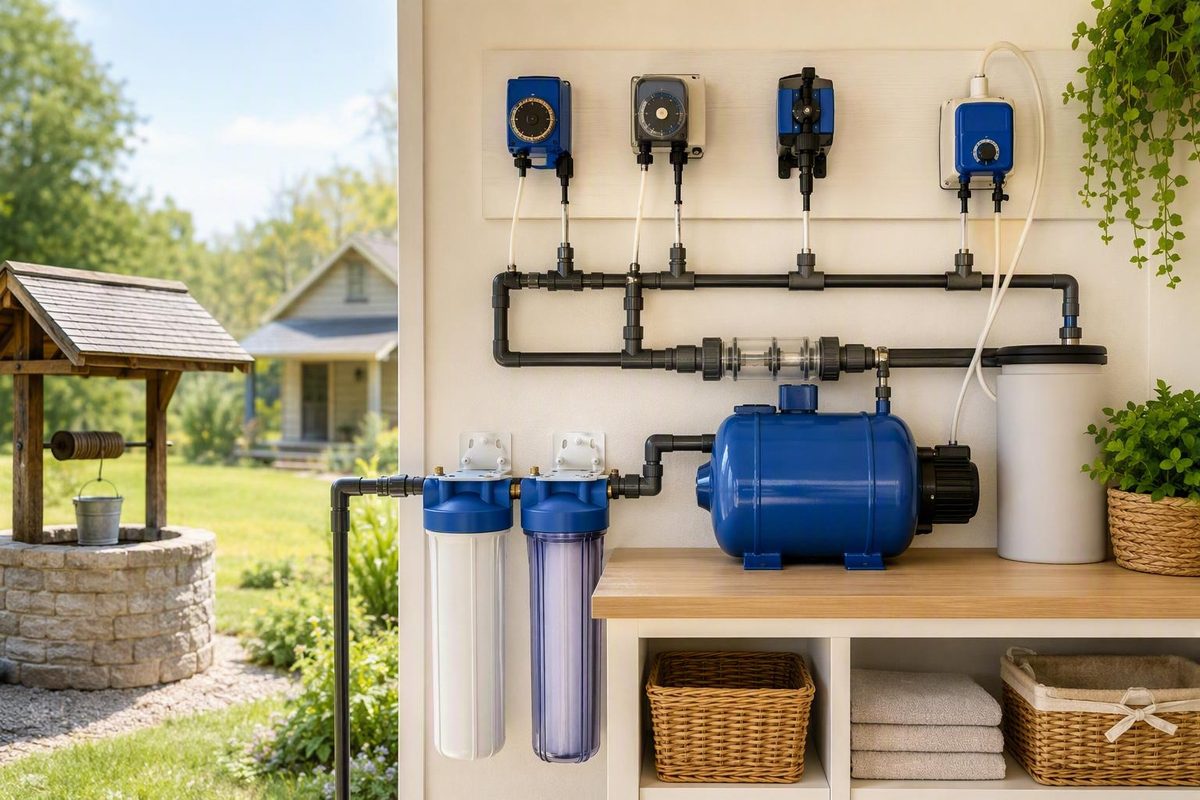
There is no evidence-backed “best” chlorine injection system for every private well. The available product evidence comes predominantly from manufacturers, retailers, and treatment vendors; it contains no independent head-to-head testing that would support a numerical ranking or universal winner.
The best fit is a complete treatment configuration that can dose across the home’s actual flow and pressure range, provide adequate mixing and effective contact time, capture oxidized solids, stop chemical feed when water stops, and remain practical to test and maintain.
In general:
- A pulse-meter or other flow-proportional system is the accuracy-first choice when demand varies.
- A metering pump interlocked with a conventional well pump can be a simpler, lower-cost arrangement when pump operation reliably tracks water production.
- A flow-switch system may suit a variable-speed or constant-pressure well.
- A hydraulic proportional injector may fit a site without electricity, provided its hydraulic requirements match the plumbing.
All prices, package contents, promotions, warranties, and return terms below were checked on September 4, 2026, and can change. Product specifications are vendor-reported unless stated otherwise.
The short answer: best choices by well-system scenario
Use this table as a starting point—not as a substitute for laboratory testing, flow measurement, and site-specific design.
| Well-system scenario | Best-fit starting point | Why it may fit | Main cautions |
|---|---|---|---|
| Variable household demand or injection after the pressure tank | Pulse-meter or other flow-proportional liquid injection | Feed follows measured water use rather than relying on pump runtime | Higher equipment cost; meters and sensors may foul |
| Conventional pressure-switch well with predictable pump output | Adjustable metering pump interlocked with the well pump | Simpler controls when pump runtime reliably represents water production | Requires correct electrical controls, flow synchronization, and protection against siphoning or no-flow dosing |
| Variable-speed or constant-pressure well | Flow-switch activation or proportional metering | Does not assume well-pump runtime accurately represents household flow | A basic flow switch may activate a fixed feed rate rather than proportioning the dose |
| No electricity at the treatment location | Hydraulic proportional injector | Uses water pressure and flow to operate | Must match the site’s flow, pressure, temperature, pipe size, and acceptable hydraulic effects |
| Rusty, sandy, or sediment-heavy water | Pretreatment plus serviceable controls | Can reduce fouling of meters, switches, and injection hardware | Requires inspection and cleaning based on actual conditions |
| Persistent coliform or E. coli, a damaged well, or possible surface-water influence | Investigate and correct the source first | Treatment cannot repair a defective or contaminated source | Seek qualified well and local health guidance before relying on treatment |
Vendor guidance presents pulse-meter proportional dosing as the accuracy-first arrangement when water demand varies or injection occurs after the pressure tank. The tradeoffs are higher cost, more control complexity, and potential meter or sensor fouling in water containing rust, sand, or sediment.
For a conventional pressure-switch well, a liquid metering pump can run when the pressure switch energizes the well pump. This can be practical when pump runtime corresponds predictably to a known volume of water. It should not be assumed to work correctly where variable-speed operation breaks that relationship.
At a no-power site, the Dosatron D40WL3000NAF is a plausible candidate rather than an overall winner. Dosatron lists non-electric hydraulic proportional operation, a flow range of 2.2–40 GPM, pressure range of 2.2–116 PSI, dosing ratio of 1:3000–1:800, 1.5-inch NPT connection, and maximum water temperature of 104°F. Those specifications still must fit the installation, and separate mixing, contact, filtration, and testing equipment may be needed.
Recurring E. coli, evidence of septic intrusion, surface-water influence, or damage to the well cap or casing requires investigation of the contamination route. A vendor well-water guide likewise warns that chlorination alone is not a complete substitute for correcting contamination or securing an uncontaminated source.
What chlorine injection can—and cannot—do
“Chlorination” can describe several different treatment objectives:
- Continuous microbial control: applying a controlled dose during normal water use.
- Oxidation: converting dissolved iron, manganese, or hydrogen-sulfide-related material into forms that can be separated.
- Control of iron or sulfur bacteria: suppressing organisms and slime associated with odor, staining, and fouling.
- Shock chlorination: a temporary high-concentration procedure following a contamination event, well work, or plumbing work.
These are not interchangeable applications. They can require different chemical concentrations, feed capacities, contact periods, monitoring, and follow-up treatment. A continuous-feed setting should not be repurposed into a shock procedure using a generic online recipe.
A basic liquid-injection arrangement normally includes:
- A chemical solution tank
- A metering pump or hydraulic injector
- Chlorine-compatible suction and discharge tubing
- An injection valve or check valve
- Activation or proportional-control hardware
- A mixing and contact stage
- Sampling points for residual testing
Chlorine’s operational distinction from UV and ozone is its ability to leave a measurable residual in the plumbing. That residual indicates that some disinfecting capacity remains after chlorine demand has been met. It does not prove that every pathogen was inactivated or that the source itself is microbiologically safe.
For iron, manganese, or sulfur treatment, chlorine generally performs an oxidation step. The resulting particles still need to be captured. Injection alone does not physically remove ferric iron, oxidized manganese, sulfur-related particles, silt, or biological debris.
The Clean Water Store chlorination guide states that normal chlorination rates do not inactivate every virus, cyst, or worm. It also identifies dose, pH, temperature, contact time, organic content, and chlorine demand as treatment variables. Because this is retailer guidance rather than public-health or independent engineering evidence, it should be used as design context—not as proof that a particular setting makes water safe.
Chlorine demand is the chlorine consumed by bacteria, hydrogen sulfide, soluble metals, organic matter, and other reactive impurities before a residual remains. Two homes with the same flow can consequently need different feed rates.
Not every well needs continuous chlorination. Begin with a defined objective supported by appropriate laboratory testing. Odor, staining, slime, or apparently clear water cannot reliably identify the contaminant or establish microbiological safety.
Comparison of four named chlorine injection packages
The table normalizes what each seller discloses. The linked column headings identify the source for the specifications beneath them. “Not provided” means the cited listing does not supply enough information to support that field; it does not prove that the feature is absent.
| Feature | Dosatron D40WL3000NAF | SpringWell Chemical Injection System | US Water Systems 410-CLBOOST | WECO CJECT-100MT |
|---|---|---|---|---|
| Price as displayed | Not provided | $1,194 sale price | $1,195 sale price | $2,125 |
| Dosing architecture | Hydraulic, water-powered proportional injector | Automatic flow-sensor control | Electronic proportional control | Water-meter proportional control with peristaltic pump |
| Stated flow | 2.2–40 GPM | Conflicting statements: “up to 12+ GPM” and “30 GPM service” | Not provided | Up to 20 GPM |
| Stated pressure | 2.2–116 PSI | 10–150 PSI | Not provided | 15–80 PSI operating range |
| Power | No electricity | Not provided | Electronic; electrical details not provided | 110 VAC, 60 Hz, GFCI-protected outlet |
| Connection | 1.5-inch NPT | 1 inch | Not provided | 1-inch MNPT meter and mixer |
| Solution-tank size | Not included with the listed injector | 35 gallons | 15 gallons | 35 gallons |
| Included components | Injector, 6-foot suction hose, weighted strainer, bracket, and guide | Flow-controlled injection package and solution tank; complete component list not provided | Pump, water meter, solution tank, and eight 8-ounce bottles of granular chlorine | Tank, peristaltic pump, water meter, injection tee, check-valve feeder, static mixer, suction strainer, and pre-wired cables |
| Warranty | Not provided | Advertised lifetime warranty, subject to current terms and exclusions | Two years for the pump and solution tank | Not provided |
| Stated certification | NSF/ANSI/CAN 61 and 372 | Not provided | Included chlorine stated to be NSF/ANSI 60 certified | Not provided |
| Important unknowns | Price, reservoir, installed pressure loss, contact requirements, and site-specific performance | Dosing range, electrical requirements, certification, contact requirements, and unresolved flow conflict | Supported flow, dosing range, pressure, connections, and contact requirements | Dosing-output range, contact time, warranty, and drinking-water certification |
Dosatron D40WL3000NAF
The D40WL3000NAF’s distinguishing feature is proportional chemical feed without electricity. Its published operating envelope is broad relative to the other disclosed listings, but it requires a 1.5-inch connection and sufficient line pressure and flow.
The manufacturer lists NSF/ANSI/CAN 61 and 372 certification. Those designations concern component health effects and lead content, not whether an installed treatment train achieves a required pathogen reduction. A chemical reservoir, mixing, effective contact volume, downstream filtration, and sampling points may still be required.
Conditional label: A plausible no-power or higher-flow candidate when its connection and hydraulic requirements fit.
SpringWell Chemical Injection System
SpringWell lists a 35-gallon tank, automatic flow-sensor control, 1-inch connection, 10–150 PSI operating range, and a displayed sale price of $1,194. The listing also advertises a lifetime warranty and six-month return program, both subject to current conditions and exclusions.
The significant unresolved issue is flow capacity. The same page states both “up to 12+ GPM” and “30 GPM service” without explaining whether these refer to different operating conditions. Obtain written clarification before sizing around either figure.
Conditional label: A lower-priced 35-gallon consumer package, pending clarification of flow capacity, dosing output, power requirements, and contact-stage needs.
US Water Systems 410-CLBOOST
US Water Systems lists a $1,195 electronic proportional package containing a water meter, injection pump, 15-gallon solution tank, and granular chlorine. The seller states two-year warranties for the pump and tank and attributes NSF/ANSI 60 certification to the included treatment chemical—not to the complete injection system.
The listing does not provide a supported flow range, dosing range, operating pressure, connection size, or contact-tank requirement. Those are essential sizing inputs.
Conditional label: A compact electronic package for buyers who obtain the missing hydraulic and dosing data before purchase.
WECO CJECT-100MT
WECO lists proportional operation up to 20 GPM, a 35-gallon tank, peristaltic pump, water meter, injection hardware, static mixer, 1-inch connections, and a 15–80 PSI operating range. The displayed price is $2,125, and the listing requires 110-V, 60-Hz power from a GFCI-protected outlet.
It is the most component-inclusive of these four listings, but it is not necessarily a complete treatment train. Retention and downstream filtration may still be required. The seller warns against DIY installation because of chemical and overdose hazards.
Conditional label: A more component-inclusive professional package for applications within the seller’s stated flow and pressure limits.
Why sticker prices do not rank these systems
The prices are not directly comparable. One listing is an injector without a solution tank; another includes treatment chemical; another includes a static mixer. Tank sizes, controls, connection sizes, power requirements, warranty coverage, and disclosed operating limits differ.
None of the displayed prices establishes total installed cost. Contact tanks, filters, plumbing, electrical work, drainage, testing, commissioning, and professional labor may be additional.
Seller-hosted reviews are anecdotal. They may reveal questions to ask, but they do not establish typical efficacy, reliability, or ease of installation.
Test and measure before choosing equipment
A responsible quotation begins with a worksheet rather than a product page.
| Input | What to record | Why it matters |
|---|---|---|
| Treatment objective | Disinfection, oxidation, odor control, bacteria control, or temporary response | Determines dosing, contact, filtration, and monitoring needs |
| Laboratory results | Relevant contaminants and water chemistry | Identifies the actual problem and chlorine-demanding substances |
| Peak household demand | Measured or calculated simultaneous flow | Establishes the maximum treatment flow |
| Well-pump output | Actual GPM across its operating range | Determines whether pump-linked dosing can track water production |
| Operating pressure | Low and high pressure during cycles | Must remain within equipment limits |
| Pump details | Conventional, variable-speed, or constant-pressure; horsepower and voltage | Guides activation and electrical design |
| Water temperature | Seasonal operating range | Affects reaction and disinfection performance |
| Installation space | Dimensions, drainage, access, and environmental conditions | Determines feasible tank and service layout |
| Electrical service | Voltage, circuit access, and applicable GFCI availability | Determines powered-equipment compatibility |
| Existing equipment | Pressure tank, filters, softener, UV, storage, and required backwash flow | Determines sequence and hydraulic constraints |
Relevant testing can include total coliform, pH, alkalinity, hardness, iron, manganese, and total dissolved solids. Depending on odor, slime, color, turbidity, and site conditions, testing may also include E. coli, iron bacteria, hydrogen sulfide, tannins, and turbidity. Ask an appropriate laboratory or local authority which containers, preservation methods, and sampling procedures apply.
pH and temperature are treatment variables. Commercial chlorination guidance says effectiveness declines as pH rises and that colder water may require more concentration or contact time. These relationships are reasons to obtain a site-specific design—not permission to select a generic dose.
Bathroom count is only a rough sales proxy. It does not establish actual peak flow, pump output, pressure variation, chlorine demand, or the feeder’s required turndown.
A preliminary metering-pump relationship supplied by retailer guidance is:
Required solution feed (gallons/day) = flow (GPM) × desired dose (ppm) × 1,440 ÷ solution strength (ppm)
When flow is entered in gallons per minute and both concentrations are expressed consistently in parts per million, the result is solution gallons per day. “Solution strength” must represent the available chlorine concentration on the same mass basis as the desired dose.
This is only a preliminary calculation. The desired dose must be justified for the application, the pump must be capable of delivering the calculated output at operating pressure, and actual output must be calibrated. Final adjustment depends on measured free-chlorine residual after the intended contact period and, where disinfection is the objective, appropriate follow-up water testing.
Do not purchase from an odor description, stain color, bathroom count, or seller quiz alone. Different contaminants can produce similar symptoms, and many microbiological or chemical problems cannot be identified by sight or smell.
Choose the dosing and activation method
The control architecture determines how closely chemical feed follows water movement.
| Method | Activation | Best-fit situation | Advantages | Main limitations |
|---|---|---|---|---|
| Well-pump-circuit activation | Metering pump runs with the well pump | Conventional pressure-switch well with predictable output | Lower control complexity | May misdose if runtime does not track water volume; electrical work and no-flow protection require attention |
| Flow-switch activation | Water movement starts the metering pump | Constant-pressure or variable-speed well | Responds to actual movement without assuming pump runtime equals household use | Activation may still produce a fixed feed rate; switch can foul |
| Pulse-meter proportional dosing | Meter pulses vary feed with measured volume | Variable demand or injection after the pressure tank | Closest match to measured use | Higher cost, control complexity, and meter maintenance |
| Hydraulic proportional dosing | Water pressure and flow drive the injector | No-power site with compatible hydraulics | No electrical supply; proportional operation | Limited by flow, pressure, temperature, connection size, and hydraulic effects |
Well-pump-circuit activation
In this arrangement, the chemical pump runs when the pressure switch powers the well pump. Vendor diagrams commonly show injection before the pressure tank for this configuration.
It can be practical when the well pump delivers a predictable rate. Its weakness is synchronization failure: if the chemical pump runs without corresponding water movement, or pump runtime does not represent the treated volume, chemical can be overfed or underfed.
Electrical work on a well-pump circuit may involve hazardous voltage. A qualified electrician or pump contractor should determine the controls and how dosing is prevented when water is not moving.
Flow-switch activation
A flow switch starts the metering pump when water moves. This can suit constant-pressure and variable-speed wells because activation does not rely directly on well-pump runtime.
Activation alone is not necessarily proportional control. If the chemical pump feeds at one rate whenever the switch is on, the resulting dose can change as household flow changes. Rust, sand, and sediment may also obstruct the switch, making pretreatment or more frequent cleaning necessary.
Pulse-meter proportional dosing
A pulse water meter measures actual volume and signals a compatible pump to vary chemical feed. Vendor guidance treats this as the accuracy-first configuration when flow varies or injection occurs after the pressure tank.
Accuracy still depends on calibration, meter condition, pump turndown, solution strength, and operation within the meter’s minimum and maximum flow limits. It also costs more than a basic pump-linked arrangement and adds components that may require service.
Hydraulic proportional dosing
A water-powered injector uses line pressure and flow to draw and meter chemical without electricity. It can address a real installation constraint, but “non-electric” does not mean “works anywhere.”
Confirm minimum and maximum flow, operating pressure, temperature, connection size, dosing-ratio range, pressure effects, bypass requirements, and access for service.
Peristaltic versus diaphragm pumps
Peristaltic pumps move solution by squeezing flexible tubing. Commercial equipment guidance describes them as self-priming and serviceable for low- to medium-flow applications, with the pump tube serving as a wear component. Their pressure capability may be limiting.
Diaphragm pumps can suit higher-pressure or more tightly controlled applications. They can support broader automation but may be harder to prime, while their check valves can foul with solids or scale.
Neither design is automatically superior. Compare:
- Required discharge pressure
- Minimum and maximum output
- Turndown
- Chemical compatibility
- Duty cycle
- Priming behavior
- Replacement-part availability
- Local service competence
Every proposed architecture should be reviewed for flow synchronization, no-flow shutdown, injection check-valve function, anti-siphon protection, chemical compatibility, service isolation, and a practical way to detect an empty solution tank.
Injection location is configuration-dependent. Pump-linked and flow-switch arrangements are often shown injecting before the pressure tank, while proportional-meter systems can inject after it. The correct location is where the controls, hydraulics, mixing, contact stage, and equipment instructions work together.
Build the complete treatment train
An injector is only one part of a possible treatment train:
Well → pressure tank and/or flow measurement
     → chlorine injection
     → static mixing
     → baffled contact or retention tank
     → sediment or multimedia filtration
     → optional activated carbon
     → household plumbing
Sampling points should permit residual testing after the intended contact period and, where applicable, before and after activated carbon. The pressure tank and flow meter may move relative to the injection point according to the selected control method.
Mixing and contact time are central to disinfection and oxidation. A larger chemical pump cannot compensate for inadequate mixing, hydraulic short-circuiting, or water leaving the contact stage too quickly.
Nominal tank capacity is not the same as effective contact volume. Tank baffling, inlet and outlet geometry, accumulated solids, and actual peak flow affect usable retention. A preliminary relationship is:
Required effective volume (gallons) = peak flow (GPM) × required contact time (minutes)
The nominal tank then must be selected using a defensible baffle factor or other hydraulic-performance data. Guessing that factor can materially overstate effective contact time.
Commercial guidance is inconsistent on contact time. Some vendor material suggests approximately 5–10 minutes under suitable conditions, while Novo Water specifies a minimum of 20 minutes in its full-line chlorination guidance. Neither figure is a universal target. The appropriate requirement depends on the organism or oxidation objective, dose, residual, pH, temperature, mixing, tank hydraulics, and applicable local requirements.
After contact, a sediment or multimedia filter can capture oxidized iron, manganese, sulfur-related particles, silt, and other suspended material. Confirm that the well and drain can support the filter’s required backwash flow without unacceptable pressure loss.
Activated carbon can reduce residual chlorine taste and odor after treatment. It also removes downstream disinfectant residual. Its placement therefore represents a deliberate tradeoff between taste and residual protection. A sampling point before carbon can help distinguish chlorination performance from downstream dechlorination.
Laboratory results may indicate a need for pH correction or contaminant-specific pretreatment. Have a qualified designer verify the sequence, effective contact volume, pressure loss, backwash capacity, drainage, injection protection, and applicable plumbing or health requirements.
Installation, commissioning, and safety checks
Concentrated hypochlorite, pressurized plumbing, and electrical circuits create exposure, leakage, corrosion, and overdose hazards. The evidence does not support treating every chlorination package as an appropriate DIY installation.
A commissioning process should include:
- Confirm actual flow and pressure. Measure operating extremes rather than relying only on nominal pump ratings.
- Verify compatibility. Check the selected chemical against the tank, pump, tubing, seals, injection hardware, and downstream materials.
- Prime the feeder. Follow the model-specific procedure.
- Check for leaks and siphoning. Inspect under static and flowing conditions.
- Calibrate actual output. Measure delivered solution rather than trusting the dial alone.
- Run water through the intended contact stage.
- Measure free-chlorine residual at designated sampling points.
- Adjust carefully and repeat the test.
- Arrange follow-up bacteriological testing when microbial control is the objective.
Calculated feed settings are starting estimates because source chemistry, temperature, household flow, chlorine demand, and chemical strength vary.
Ask the installer to document how the system addresses:
- Feed during no-flow conditions
- Injection check-valve function
- Siphoning
- Backflow
- Isolation for service
- Required GFCI protection
- Empty-solution-tank detection
- Accidental control changes
- Chemical storage and spill response
- Freezing, heat, and physical damage
Commercial safety guidance recommends gloves, goggles, chemical-resistant clothing, training, and proper chemical storage when handling chlorine solution. Follow the product label and applicable local requirements, and keep treatment chemicals secured away from children and incompatible materials.
Do not rely on generic instructions to use “bleach,” “pool chlorine,” pellets, powder, or granules. The supplied vendors disagree on preferred formulations. Verify that the exact chemical is suitable for drinking-water treatment, that its concentration is known, and that it contains no unwanted fragrances, stabilizers, preservatives, or other additives.
Certification scope also matters:
- NSF/ANSI 60 applies to drinking-water treatment chemicals.
- NSF/ANSI/CAN 61 addresses health effects associated with drinking-water system components.
- NSF/ANSI 372 addresses lead-content compliance.
These designations do not prove that a complete installed chlorination system will disinfect a particular well. Performance still depends on dose, demand, residual, mixing, contact time, hydraulics, source conditions, and maintenance.
Use qualified water-treatment, plumbing, electrical, and well professionals as the work requires. For bacterial contamination, obtain appropriate local health guidance and investigate the source rather than using continuous dosing to conceal a defective or vulnerable well.
Maintenance and the real cost of ownership
Advertised package price is only one part of the budget. A complete estimate may include:
- Injector or metering-pump package
- Solution tank
- Water meter, flow switch, or controls
- Static mixer
- Baffled contact tank
- Sediment or multimedia filter
- Optional activated carbon
- Plumbing and protective devices
- Electrical work
- Drainage and backwash provisions
- Permits or inspections where applicable
- Initial and follow-up laboratory testing
- Free-chlorine test equipment
- Treatment chemical
- Professional design, installation, commissioning, and service
The three priced packaged systems in the comparison display prices from $1,194 to $2,125. This is not an installed-cost range: the packages differ in tank size, controls, included hardware, chemical supply, and undisclosed or omitted treatment stages. Current prices must be rechecked before purchase.
Maintenance checklist
Set service intervals from the equipment manuals, chemical use, measured performance, and observed water conditions:
- Monitor solution level and chemical condition.
- Test free-chlorine residual at designated points.
- Confirm feeder calibration against actual output and flow.
- Inspect for water and chemical leaks.
- Clean the injection point as required.
- Inspect check valves and anti-siphon devices.
- Clean flow switches, meters, strainers, and sensors.
- Drain accumulated solids from the retention tank.
- Backwash or service particulate filters.
- Service activated carbon according to measured performance.
- Inspect tubing, seals, fittings, and the solution tank for degradation.
- Confirm interlocks and no-flow shutdown behavior.
- Record readings, adjustments, chemical additions, and repairs.
For model-specific maintenance, Dosatron lists an annual injection-seal kit for the D40WL3000NAF. SpringWell describes routine replenishment of the chlorine-and-water mixture. Peristaltic tubing and diaphragm components should be serviced according to condition, duty, chemical strength, and manufacturer instructions rather than an invented universal schedule.
Clean Water Store suggests replacing liquid solution approximately every one to two months. That is a seller recommendation, not a guaranteed interval. Actual frequency depends on tank size, concentration, chemical stability, chlorine demand, and household water use.
Common failure modes include:
- Clogged injection hardware
- Fouled flow sensors or pulse meters
- Worn pump tubing or diaphragm components
- Loss of prime
- Empty solution tanks
- Scale, rust, sand, or sediment accumulation
- Degraded or incompatible materials
- Siphoning
- Chemical feed continuing without water movement
- Calibration drift or unauthorized setting changes
When comparing quotations, request the following in writing:
- Exact included components and exclusions
- Supported minimum and maximum flow
- Pump-output range and turndown
- Operating-pressure range and pressure loss
- Activation and no-flow protection method
- Permitted chemical types and solution strengths
- Contact-tank assumptions and effective volume
- Filter backwash requirements
- Replacement-part availability and lead times
- Model-specific warranty and exclusions
- Expected consumables without unsupported guarantees
- Required service clearance
- Commissioning, training, and emergency support
The available evidence does not provide comparable annual costs for chemicals, electricity, labor, or replacement parts. A universal annual total would therefore be misleading.
When chlorine injection is not the right first answer
A positive coliform or E. coli result should prompt an investigation, not only an equipment purchase. Potential issues to examine include well-cap and casing condition, drainage around the well, recent flooding or repairs, septic-system proximity, and possible surface-water influence.
The Clean Water Store well-chlorinator guidance specifically says that the contamination source should be found and stopped and warns that chlorination alone is not a fully safe substitute where a well is influenced by surface water. This is still vendor guidance; local health and qualified well professionals should direct the response.
Shock chlorination is temporary. Continuous chlorination is controlled dosing during ongoing use. They involve different concentrations, procedures, and restrictions. Follow local health-department or qualified well-professional guidance instead of adapting a manufacturer’s generic shock range to an untested well.
UV may be an alternative or complement where avoiding chlorine taste and chemical replenishment is important. It does not leave a disinfectant residual in household plumbing. Suitability and any required pretreatment should be determined from the water analysis and equipment requirements.
Ozone is another no-residual option, but it requires application-specific design. The supplied evidence does not establish that it is categorically better or lower-maintenance than chlorination.
Chlorination may also be the wrong first treatment where the primary issue is:
- Mineral loading better addressed by contaminant-specific filtration
- Low pH and corrosive water
- Turbidity that interferes with dependable treatment
- A damaged well or poor surface drainage
- A plumbing or pressure-system defect
- An odor whose source has not been identified
Potential disadvantages include recurring chemical handling, chlorine taste or odor, corrosion from overfeed, and possible disinfection byproducts where chlorine reacts with organic matter. Activated carbon can reduce taste and residual but also removes downstream residual protection.
Whatever treatment is selected, use post-treatment bacteriological testing and ongoing monitoring to evaluate it. A chlorine reading is a process-control measurement, not the final verdict on water safety.
Frequently asked questions
Is proportional chlorine injection worth the extra cost for a private well?
Often, but not always. It is most defensible when household flow varies substantially, the well uses variable-speed or constant-pressure controls, or injection occurs after the pressure tank. Because feed follows measured volume, proportional control can maintain a more consistent dose than a fixed-rate pump triggered only by runtime.
The premium may not be justified for a conventional well with stable output if a properly interlocked metering pump can be calibrated accurately. Include meter maintenance, minimum-flow limits, sensor fouling, and replacement-part costs in the decision.
Do I need a contact tank after a chlorine injection system?
Frequently, particularly for disinfection or oxidation, but the requirement is application-specific. The injector introduces chemical; it does not ensure adequate mixing or reaction time.
Do not size a contact tank from nominal gallons alone. Use measured peak flow, the required contaminant-specific contact time, and defensible hydraulic or baffle-performance data. Conflicting vendor recommendations—from approximately 5–10 minutes to at least 20 minutes—show why a universal tank target is inappropriate.
Can chlorine injection remove iron, manganese, and rotten-egg odor?
Chlorine can oxidize dissolved iron, manganese, and hydrogen-sulfide-related material under suitable conditions. It can also be used to control organisms associated with slime or odor.
The resulting particles require retention and downstream filtration. Results depend on pH, chlorine demand, temperature, mixing, contact time, and contaminant concentration. Testing is necessary because rotten-egg odor alone does not prove hydrogen sulfide or bacteria are the cause.
Should chlorine be injected before or after the pressure tank?
Either location can be appropriate. Pump-linked and flow-switch systems are often shown injecting before the pressure tank, while pulse-meter proportional systems can measure household use and inject after it.
Choose the location from the control method, actual hydraulics, equipment instructions, pressure, mixing, contact stage, and safeguards. Do not relocate an injection point according to a generic rule without evaluating the complete treatment train.
Does NSF certification prove that a chlorinator will disinfect my well water?
No. NSF/ANSI 60 applies to treatment chemicals, while NSF/ANSI/CAN 61 and NSF/ANSI 372 address component health effects and lead content.
Those standards do not verify that a particular installation delivers the necessary dose, overcomes chlorine demand, mixes correctly, provides effective contact time, prevents no-flow dosing, or achieves the intended microbial result. Commission the system through calibrated output and residual testing, then use appropriate laboratory retesting to evaluate the treatment objective.
The bottom line
The best chlorine injection system for well water is the configuration that fits tested chemistry, measured flow and pressure, pump controls, effective contact requirements, downstream filtration, and the owner’s maintenance capacity.
A pulse-meter proportional system is generally the accuracy-first option for variable demand. A pump-linked metering system can be a simpler fit for a conventional well with predictable output. A hydraulic proportional injector can suit a compatible no-power installation. None is universally best.
Compare complete installed configurations rather than pumps or sticker prices. Verify missing specifications in writing, commission the feeder from measured output and residual, and continue appropriate water testing. Where contamination indicates a damaged or vulnerable source, source correction and qualified professional or health-authority guidance take priority over equipment selection.