
Backwashing Sediment Filter for Well Water: Size and Operate It
Match sediment media to your well water, check service and backwash flow, budget drain water, and set a cleaning schedule that keeps the bed working.
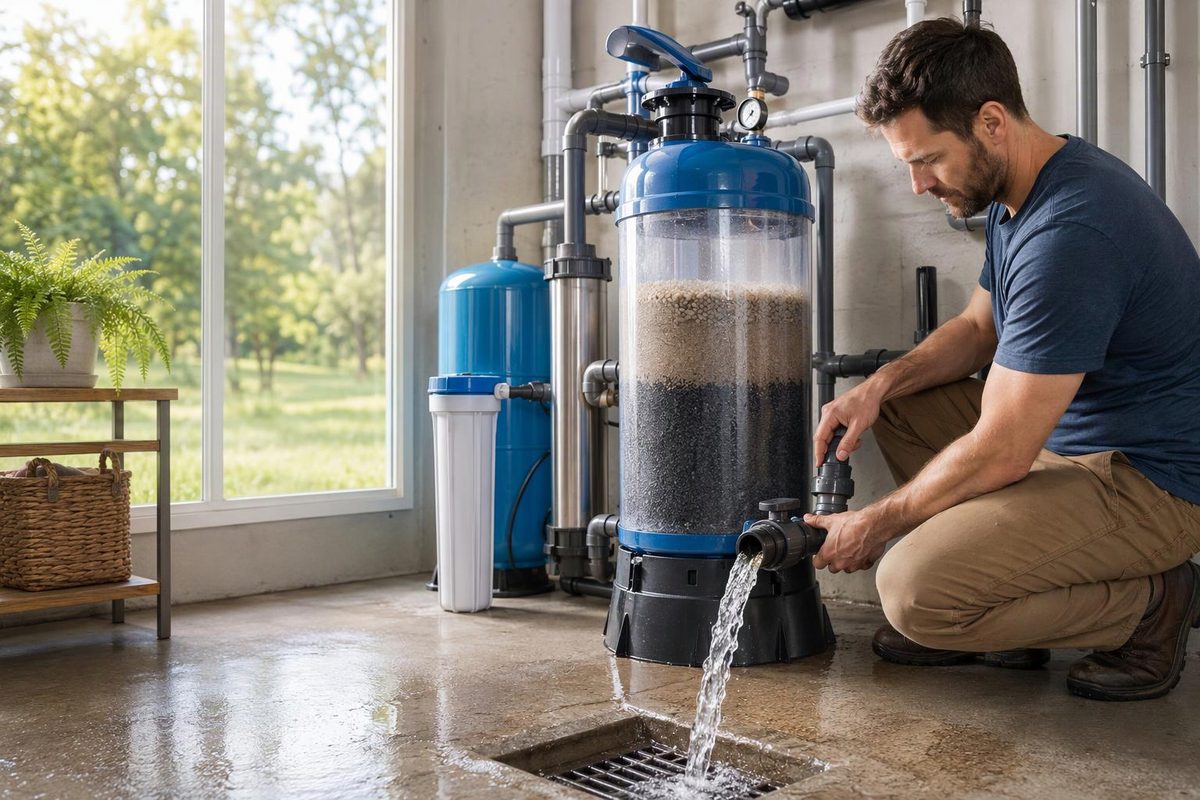
Choose a backwashing sediment filter only when its media matches your particles and your well can supply its required cleaning flow. Household service flow and backwash flow are separate requirements: a tank that passes enough water for showers may still fail to clean itself properly.
This guide covers granular-media tanks with a backwashing control valve, not flushable screens. During service, water travels down through the bed, which traps suspended particles. Backwashing reverses the flow, lifting and expanding the media and carrying sediment to the drain. A rinse follows before the filter returns to service. The Clean Water sediment-filter manual describes that bed-cleaning process.
Confirm that sediment is the treatment problem
A media tank is worth considering when suspended dirt or silt repeatedly loads your existing filters. But brown water alone does not establish that sediment filtration is sufficient.
Water that emerges clear and turns reddish-brown after standing can contain dissolved ferrous iron. That needs an iron-treatment approach, not simply a finer sediment bed. The Minnesota Department of Health also warns that iron can quickly plug sediment filters. Use laboratory results to distinguish the problem; see its iron forms and treatment guidance and our well-water iron-filter selection guide.
Ask a laboratory or treatment specialist to characterize persistent cloudiness and check iron when staining accompanies it. Keep drinking-water safety testing separate: Clack states that its sediment media do not remove or kill bacteria and require adequate disinfection for microbiologically unsafe water or water of unknown quality. Clear water is not proof of safe water. Clack media instructions
Compare the media—not just the tank size
Two similarly named media illustrate why a generic “sediment tank” specification is inadequate. These are specification examples, not a ranking of complete systems.
| Manufacturer specification | Filter-Ag | Filter-Ag Plus |
|---|---|---|
| Typical suspended-solids reduction | 20–40 microns | 5 microns or less |
| Published service flow | 5 gpm/ft² of bed area; higher rates may be used | 6–15 gpm/ft²; intermittent peak of 20 gpm/ft² |
| Published backwash flow | 8–10 gpm/ft² | 14–18 gpm/ft² |
| Bed depth | 24–36 inches | 24–48 inches; 36 inches identified as optimal |
| Freeboard—the empty space above the bed | 50% of bed depth | 50% of bed depth |
Sources: Clack Filter-Ag specifications and Filter-Ag Plus brochure.
These are typical media performance claims, not absolute particle cutoffs. Do not interpret “5 microns or less” as a guarantee that every particle of that size will be removed. Clack notes that incoming water quality and required outlet quality affect operating parameters.
The finer-performing medium also needs substantially more backwash flow per square foot. Ask the supplier to specify the complete system’s service rating, expected pressure loss, media quantity, bed depth and drain-flow requirement for your water—not merely its valve’s maximum flow.
Check both flow requirements before buying
Service flow: can it supply the house?
Give the supplier your expected simultaneous demand, such as showers running alongside a washing machine. Use the system’s filtration rating at an acceptable pressure loss, not an unrestricted valve-flow figure.
A larger-diameter bed provides more filtration area, but it also needs more cleaning water. Increasing tank diameter is therefore not a free solution to low household pressure.
Backwash flow: can the well clean the bed?
For a round tank, the screening calculation is:
Bed area (ft²) = π × [internal bed diameter in inches ÷ 12]² ÷ 4
Backwash flow (gpm) = bed area × media backwash rate (gpm/ft²)
Using a 10-inch internal bed diameter gives approximately 0.545 ft². From the Clack rates above, calculated backwash demand is:
- Filter-Ag: approximately 4.4–5.5 gpm.
- Filter-Ag Plus: approximately 7.6–9.8 gpm.
These are sizing illustrations, not instructions for choosing a drain-flow restrictor. Have the supplier confirm the required flow for the actual tank, media and water temperature; Clack’s brochure includes temperature-dependent bed-expansion curves.
Before ordering, have the well’s available flow checked at operating pressure for the proposed cycle duration. Do not substitute pump horsepower, static pressure or a brief burst from the pressure tank for that check. After installation, verify the actual drain discharge during backwash. The Clean Water troubleshooting instructions recommend timing a bucket fill:
Measured gpm = collected gallons × 60 ÷ elapsed seconds
Use a safe collection arrangement and preserve the drain air gap. Repeat the measurement later in the cycle if delivery may decline. If the well cannot meet the specified flow, resolve that mismatch before buying; a cartridge sediment-filter setup may be more practical.
Plan the drain and start-up
A common well-water layout places the sediment tank after the pressure tank, as shown in the Clean Water installation instructions. Confirm its position relative to any oxidation or other treatment stages with the system designer.
Provide a bypass, accessible inlet and outlet shutoffs, and a downstream sampling point. Route the drain according to the valve manual and local plumbing requirements, with an air gap to prevent a sewer or septic backup from cross-connecting to the filter. Sediment-filter piping guidance
Budget discharge volume as well as flow. A hypothetical 8 gpm × 10-minute backwash uses 80 gallons, before adding rinse water. Confirm that the approved discharge destination can accept both the instantaneous rate and total cycle volume.
Follow the exact media-loading and start-up instructions, including any required gravel support bed. Do not fill the tank to the top: freeboard allows bed expansion. Clack calls for Filter-Ag to soak overnight before backwashing; Filter-Ag Plus requires a gravel support bed and saturation before its initial backwash. Complete the system’s specified backwash and rinse before judging outlet clarity.
Set the schedule, then verify recovery
Start with the complete system’s recommended settings—not a universal daily or weekly schedule. For example, the Clean Water 7500-REV2.5 sediment-filter instructions specify a 10-minute backwash and eight-minute fast rinse. That manual covers a Turbidex-media configuration; its durations are not defaults for the Clack media above or every other sediment tank.
Schedule cleaning away from other large water demands. Record inlet and outlet pressure at the same household flow when the bed is clean, then compare subsequent readings and outlet clarity.
- Pressure loss grows between washes: check whether the cleaning interval is too long for sediment loading and water use.
- Pressure does not recover after washing: measure backwash discharge before simply adding more cycles. Inadequate flow cannot be corrected by frequency alone.
- Cloudiness persists despite adequate cleaning: have the supplier reassess particle size, service flow and treatment chemistry.
The 7500-REV2.5 maintenance guidance recommends more frequent washing when sediment causes pressure loss and specifies media replacement every four to six years for that system, sometimes longer. Treat that as model-specific guidance, not a universal lifespan: automatic backwashing replaces routine cartridge changes, not all future servicing.