
Best-Rated Whole-House Water Filters by Water Problem
Compare verified whole-house options for chlorine, sediment, hardness and well-water microbes, with certified flow, capacity and maintenance limits.
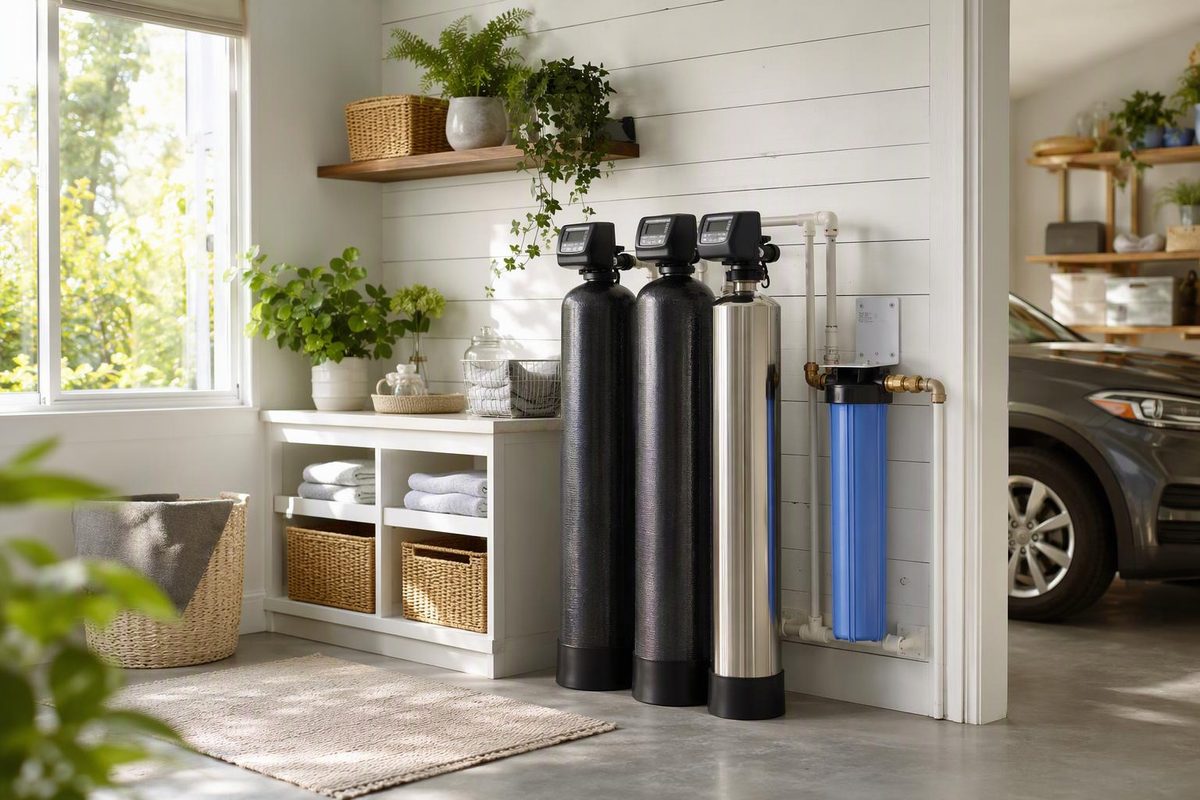
For city water disinfected with free chlorine, the Solventum Aqua-Pure AP903 is the strongest general cartridge pick. The exact system and AP917HD cartridge are certified to NSF/ANSI 42 for chlorine taste and odor reduction and nominal Class III particulate reduction at 10 gallons per minute (gpm), with a 100,000-gallon service cycle. That listing does not certify it for chloramine, lead, PFAS, nitrate, hardness or bacteria.
There is no responsible best overall system for every home. A whole-house filter, also called a point-of-entry system, must match the water problem, provide enough treated flow and remain practical to maintain. Customer star ratings establish none of those points.
Choose your water source, confirmed problem and peak demand; the tool returns the defensible shortlist match.
Whole-House Treatment Matcher
Select the measured or confirmed problem rather than the product category you were considering.
Aqua-Pure AP903
For confirmed free chlorine on city water, it has NSF/ANSI 42 chlorine taste and odor and nominal Class III particulate claims at 10 gpm.
Peak demand is unknown. Do not assume the certified reduction claim applies above 10 gpm; the cited 20 gpm figure is system flow, not certified treatment flow.
Sources: current NSF listings and manufacturer documentation cited in the accompanying article. Testing and certification apply only to the named models, claims and flow rates.
Shortlist by Water Problem
| Best fit | System or treatment | Verified basis and flow | Important limit |
|---|---|---|---|
| Free-chlorine taste and odor plus sediment | Aqua-Pure AP903 | NSF/ANSI 42 claims at 10 gpm; 100,000-gallon cycle | No cited chloramine or health-contaminant claim |
| Longer-life, higher-flow chlorine treatment | Aquasana Rhino Max Flow | Independently tested for up to 97% chlorine reduction at 14 gpm; 1,000,000 gallons or 10 years | Complete chlorine claim is testing, not product certification |
| Verified microbial problem in well water | VIQUA PRO10 Class A UV | NSF/ANSI 55 Class A; 10 gpm at 40 mJ/cm² | Does not remove sediment, hardness or chemicals |
| Calcium and magnesium hardness | Properly sized NSF/ANSI 44 softener | Exact-model hardness, capacity and efficiency certification | Carbon and scale inhibition do not soften water |
| Visible sediment without a dissolved-contaminant problem | Large-format sediment housing | Exact cartridge efficiency and pressure-drop data | A micron number alone does not establish efficiency or life |
These are different treatments, not interchangeable versions of one appliance.
The AP903 Is the Starting Pick for City Chlorine
The current NSF listing for the AP903 and AP904 identifies the AP917HD replacement element for the AP903 and records a 100,000-gallon service cycle at 10 gpm. It lists chlorine reduction, taste and odor reduction, and nominal Class III particulate reduction. That exact-model listing is better evidence than packaging that says only that a component contains NSF-certified media.
Solventum’s AP900-series specifications state a 5-micron rating, 1-inch connections, a 100,000-gallon capacity and system flow up to 20 gpm. The manufacturer’s detailed AP900-series specification sheet gives a 25–125 psi operating range and a 40–100°F water-temperature range. It describes cartridge life as approximately one year under most water conditions, although actual life varies with water quality and use.
Do not interpret the 20 gpm hydraulic figure as a 20 gpm certified contaminant-reduction claim. The NSF listing records the claims at 10 gpm. A household whose simultaneous demand exceeds that rate cannot assume the same reduction performance merely because water can pass through the housing faster.
Confirm whether the utility uses free chlorine or chloramine. Neither the cited NSF listing nor the product specification establishes chloramine reduction for the AP903.
Choose the AP904 only if you also want its scale-inhibition media. That feature may limit deposits in some applications, but it does not remove calcium and magnesium as a softener does. If scale, poor soap performance or measured hardness is the complaint, compare the mechanisms first; filters and softeners have different treatment targets.
The Rhino Max Flow Trades Certification for Capacity
The Aquasana Rhino Max Flow is more attractive when higher tested flow and infrequent main-tank replacement matter more than certification of the complete chlorine-reduction claim. Aquasana reports up to 97% chlorine reduction at 14 gpm, a 14.5 gpm peak flow, and a 1,000,000-gallon or 10-year main-tank life.
Its product documentation distinguishes independent testing to NSF/ANSI 42 from WQA certification of the Rhino tank to NSF/ANSI/CAN 61. NSF/ANSI/CAN 61 concerns the health effects of drinking-water-contact materials. It does not, by itself, verify chlorine reduction.
The 14.5 gpm peak rating also should not be substituted for the chlorine claim tested at 14 gpm. If the home’s estimated simultaneous demand exceeds 14 gpm, the cited evidence does not establish the claimed chlorine performance at that higher rate.
A decade-long tank rating does not mean a maintenance-free decade. Aquasana specifies replacement of the standard pre-filter every 2 months and the post-filter every 6 months. Its published incoming-water limits include iron below 0.3 mg/L, manganese below 0.05 mg/L, hardness below 7 grains per gallon, tannins below 0.1 mg/L and turbidity below 1 NTU. Test a private well rather than assuming it falls within those limits.
A Microbial Well Problem Calls for Class A UV
Private wells are not regulated, treated or monitored under the federal rules that cover public systems. CDC advises testing at least annually for total coliform bacteria, nitrate, total dissolved solids and pH, adding locally relevant contaminants and using a state-certified laboratory (CDC well-testing guidance).
If harmful germs or chemicals are detected, CDC advises using bottled water or another safe source and contacting the local health or environmental department about next steps. A carbon filter is not a substitute for that response.
For a professional specifying whole-house UV, the VIQUA PRO10 is a defensible 10 gpm option. The NSF listing identifies it as a point-of-entry system certified to NSF/ANSI 55 for Class A disinfection performance. VIQUA rates it at 10 gpm at 40 mJ/cm².
NSF says Class A UV systems are intended to inactivate or kill bacteria, viruses and cysts in contaminated water. Class B systems reduce non-disease-causing bacteria in water that is already disinfected (NSF standards guide).
UV does not identify how contamination entered a well, and it does not remove dissolved chemicals, hardness or sediment. It needs power and incoming water that meets the equipment’s requirements. If coliform is the concern, start with the complete testing and treatment sequence, not a generic carbon bundle.
Whole-House Carbon Does Not Solve Every Contaminant
Do not buy either carbon system above as the default answer for the following problems.
Hardness Requires Ion Exchange
Cation exchange removes calcium and magnesium ions by exchanging them for sodium or potassium ions. Regeneration consumes salt and water, so compare certified capacity and efficiency for the exact model (EPA softener guidance).
A scale-inhibition cartridge is not equivalent to a softener. It may alter deposit formation in supported applications, but it does not remove the hardness minerals.
Health Contaminants Require Named Claims
Lead, PFAS, nitrate, arsenic and fluoride require an explicit reduction claim for the exact model. NSF/ANSI 42 primarily covers aesthetic effects. NSF/ANSI 53 covers listed health-effect filtration claims, while NSF/ANSI 58 covers reverse-osmosis systems and their listed claims.
Certification to a standard does not mean a product reduces every contaminant addressed somewhere within that standard. Check the standard, named reduction claim, exact model and rated flow in a certifier’s current listing.
A certified kitchen system may be more economical when only drinking and cooking water require treatment. See when whole-house softening and point-of-use RO solve separate problems.
Well-Water Staining and Odors Need Testing
Iron, manganese, sulfur odor and tannins require treatment selected from a water test and the chemistry involved. Carbon may be one stage in a designed system, but it is not a substitute for diagnosis.
The AP900 documentation also says not to use the system on microbiologically unsafe water or water of unknown quality without adequate disinfection before or after it.
Four Checks Determine Whether a System Fits
- Identify the problem. For city water, read the utility’s annual Consumer Confidence Report. It identifies the source and regulated contaminants detected, but a tap test may still be appropriate when the concern could originate in household plumbing (EPA CCR guidance). Test private wells through a state-certified laboratory.
- Estimate peak flow. Determine which fixtures may run together and compare their demand with the flow at which the treatment claim was certified or tested—not merely an advertised maximum. A 20 gpm system-flow figure does not turn a 10 gpm certified claim into a 20 gpm claim.
- Check installation limits. Confirm pipe size, dynamic pressure, clearance, drainage or power requirements, freeze protection and provision for bypassing the equipment during service. The AP903 specifications, for example, establish particular pressure and temperature limits rather than universal installation limits for every system.
- Price the maintenance path. Include cartridges, UV lamps and sleeves, softener salt, regeneration or backwash water, and professional labor. Confirm that replacement parts remain available for the exact model.
The defensible winners are narrow: AP903 for certified free-chlorine taste, odor and particulate reduction at 10 gpm; Rhino Max Flow for higher-flow free-chlorine treatment with a less complete certification story; Class A UV for an identified microbial risk; and a properly sized softener for hardness. A ranking that treats them as interchangeable products is rating brands rather than treating water.