
Ultraviolet Water Filtration: What UV Does and Doesn’t Do
Learn what UV water treatment does, when it fits a home system, and why prefiltration, certification, flow limits and maintenance matter.
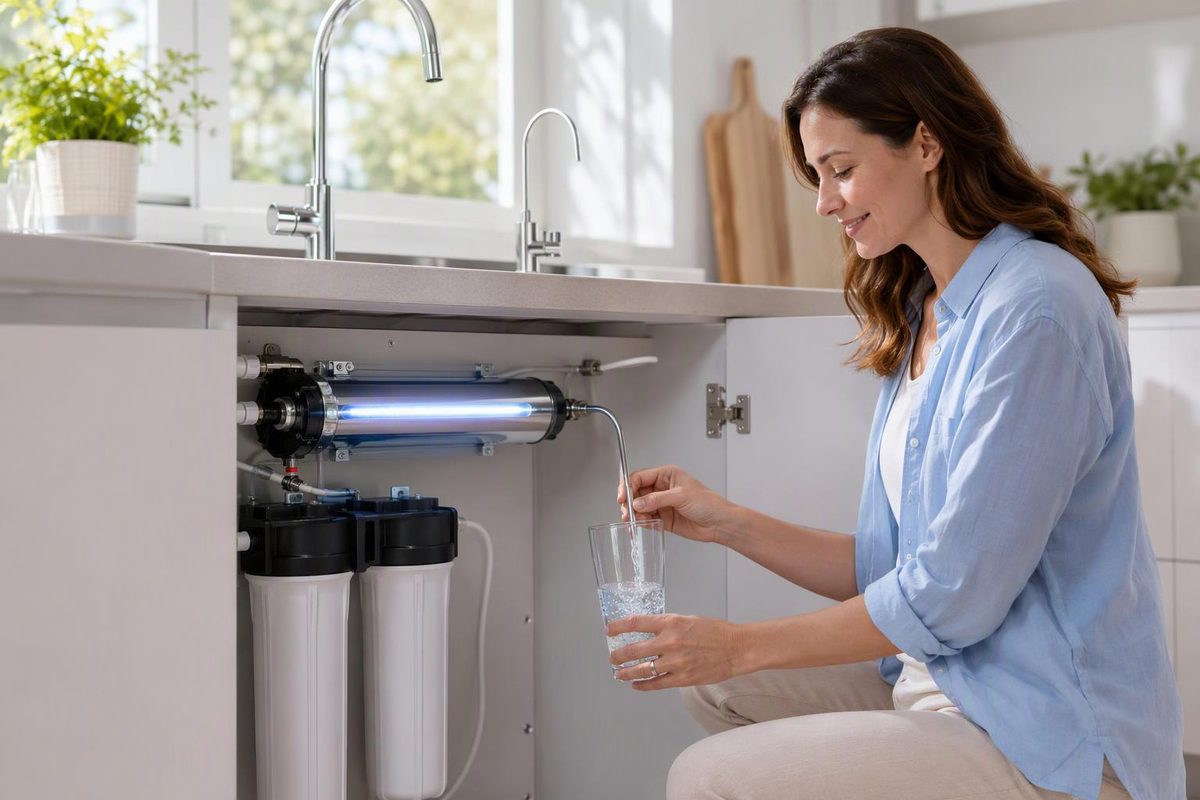
Ultraviolet water treatment disinfects water; it does not physically filter it. Equipment sold as “ultraviolet water filtration” uses UV light to inactivate microorganisms that receive sufficient exposure. It does not, by itself, remove sediment, dissolved chemicals or hardness minerals. A combined filter-and-UV system performs separate jobs through its separate stages. NSF explains this distinction, and CDC recommends prefiltration to improve UV treatment.
UV is worth considering when the problem is microbial safety—not simply unpleasant taste, scale in a kettle or an unsuitable brewing-water mineral profile.
What UV treats—and what needs another method
| Water problem | What UV alone does | What to check instead or alongside it |
|---|---|---|
| Bacteria, viruses and protozoan parasites | Can inactivate susceptible organisms under the system’s specified conditions | Exact-model disinfection certification, feed-water requirements and rated flow |
| Sand, silt and cloudy water | Does not capture particles; particles can shield microorganisms from light | Sediment filtration before UV |
| Chlorine taste or odor | Is not a substitute for a taste-and-odor filter | Carbon filtration with the relevant certified claim |
| Lead, nitrate, fluoride or other dissolved chemicals | Does not provide chemical removal | Treatment with a documented claim for the measured contaminant |
| Hardness and scale | Does not soften water | A softener where hardness reduction is needed |
These are different treatment tasks, not different grades of “purification.” CDC’s home-treatment guide separates UV disinfection from chemical removal and softening; NSF’s standards guide identifies the roles of carbon filtration and softeners.
For coffee and homebrewing, that means UV is a microbial-control stage, not a way to adjust mineral content or remove chlorine. If those are your concerns, start with carbon water filter selection or the appropriate mineral treatment rather than adding UV.
Do you need it at home?
Start with the water source and evidence of a problem. For public-supply water, review your utility’s annual water-quality report. For a private well, obtain laboratory testing rather than judging safety by appearance or taste. CDC recommends testing private-well water at least annually for harmful germs and chemicals and consulting the health department about appropriate tests. If the water contains neither, additional treatment may not be necessary. CDC’s selection guidance explains these starting checks.
A UV unit can treat one drinking-water outlet or the household supply. The choice is whether you need disinfection at a particular tap or throughout the home—not whether a larger lamp sounds more powerful. For the broader installation decision, see whole-house versus kitchen-only treatment.
Check Class A versus Class B
Under NSF/ANSI 55, the classes serve different purposes:
- Class A: systems intended to inactivate bacteria, viruses and cysts in contaminated water, within their specified operating conditions.
- Class B: supplemental treatment to reduce non-disease-causing bacteria in already disinfected drinking water.
A Class B unit is not a substitute for Class A treatment of microbiologically unsafe water. Verify the exact model and class in the certifier’s listing; a general “NSF certified” label does not establish the claim you need. NSF describes the two classes and the limits of certification.
Neither class makes chemical contamination disappear, and the standard is not intended for water with obvious contamination. Class A certification is not permission to treat any source as drinking water. ANSI explains the standard’s scope.
What makes a UV system work reliably?
Water passes through a chamber containing a UV source, commonly a lamp protected by a quartz sleeve. Performance depends on how much light reaches the organisms and how long they are exposed. Suspended particles, colored water and deposits on the sleeve can reduce effective exposure. UV is therefore often installed as the final treatment stage, after the filtration or conditioning it needs. UMass and Cape Cod Cooperative Extension explain the arrangement.
Before buying, check three things in the model’s manual:
- Feed-water limits. Look for requirements covering turbidity, iron, manganese, hardness and UV transmittance—the proportion of UV light that passes through the water. Clear-looking water is not enough to establish compatibility.
- Maximum treatment flow, in gallons per minute or liters per minute. Match the applicable disinfection rating to simultaneous household demand, not average daily consumption. Do not assume every advertised flow figure represents the same treatment conditions.
- Failure controls. Ask what happens during lamp failure or loss of power. Does the equipment merely sound an alarm, or does it also stop water delivery?
For example, VIQUA’s S-series manual specifies feed-water limits and a preceding 5-micron sediment filter, and gives different flow ratings for different UV-dose conditions. Those are model-specific requirements, not universal specifications for all UV equipment. The manual identifies its NSF-certified SV5Q-PA and SV8Q-PA models as Class B, not Class A.
Maintenance is part of the treatment
A working indicator or visible glow does not prove adequate UV output. Follow the manufacturer’s replacement interval, clean the quartz sleeve as instructed, maintain upstream filters and respond to alarms. As one example, the VIQUA manual specifies lamp replacement after 9,000 hours of continuous operation—approximately one year—and explains that mineral coating on the sleeve reduces performance.
UV also leaves no disinfectant residual to protect water after it leaves the chamber. It cannot be relied on to disinfect contaminated downstream plumbing or storage. Follow the system’s commissioning and sanitation instructions, and verify treatment with laboratory testing after installation. Extension guidance covers downstream sanitation and testing.
If microbial safety depends on UV, do not continue drinking water passed through an inoperative or bypassed unit. Use a known-safe supply until the fault is corrected and the manufacturer’s restart and sanitation procedures are completed. The VIQUA manual’s bypass and restart instructions illustrate why restoring power alone is not enough. Keep those procedures, replacement-part numbers and maintenance dates beside the system—not just in the purchase receipt.