
Carbon Water Filter: Uses, Limits and How to Choose
Match a carbon water filter to chlorine, chloramine or a tested contaminant. Check certified claims, flow, capacity and replacement needs.
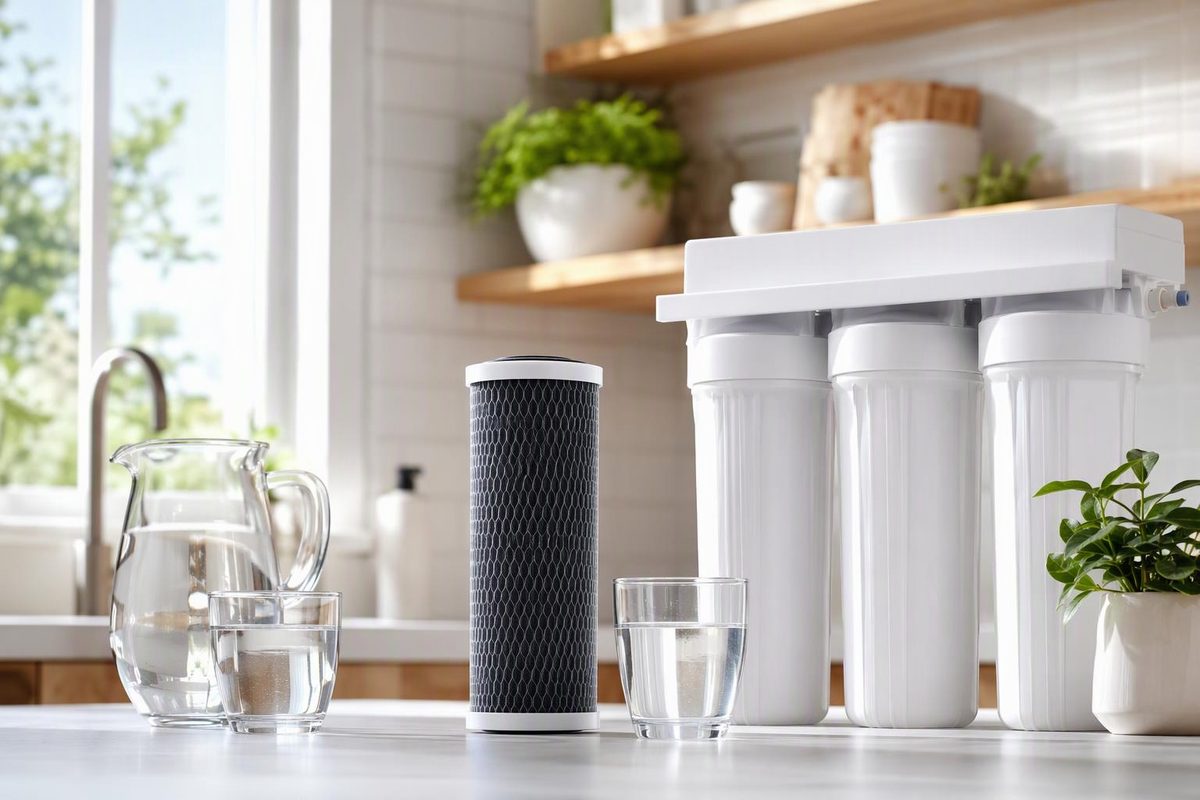
A carbon water filter is a good starting point for chlorine taste and odor—not a general-purpose purifier. For chloramine, lead or another specific contaminant, choose an exact system with a verified reduction claim. Ordinary activated carbon does not soften water or reliably remove fluoride, nitrate, bacteria or viruses. University of Nebraska–Lincoln Extension explains these treatment limits.
Start with your utility’s water-quality report or a laboratory test, then match the filter to the identified problem. Taste and smell alone cannot establish water safety. CDC’s filter-selection guidance recommends this problem-first approach.
What carbon can—and cannot—treat
Activated carbon has a porous surface that holds certain dissolved substances through adsorption. Its performance depends on the carbon, contaminant, amount of media and contact time. That is different from a sediment screen catching particles by size. Nebraska Extension describes both mechanisms.
| Water problem | Is carbon a suitable starting point? | What to verify |
|---|---|---|
| Chlorine taste or odor | Yes | Exact-model chlorine reduction claim, flow and capacity |
| Chloramine | Sometimes; use a system designed for it | A separate chloramine claim—not just chlorine reduction |
| Lead or particular organic chemicals | Only with matching system-level evidence | Certification naming the contaminant |
| Hardness and scale | No, not ordinary carbon alone | Softening or another treatment appropriate to the equipment |
| Fluoride or nitrate | No, not ordinary carbon alone | A treatment system with the specific reduction claim |
| Bacteria or viruses | Not ordinary carbon treatment | Appropriate microbial treatment or disinfection |
These limits apply to carbon itself. A cartridge containing carbon plus other media may do more, but its complete system must substantiate those additional claims. Nebraska Extension notes that lead-reduction filters commonly use another medium alongside carbon. NSF likewise warns that certification to a standard does not mean a filter removes every contaminant.
Granular carbon, carbon block and catalytic carbon
Granular activated carbon (GAC) uses carbon granules. Carbon block uses bonded carbon in a cartridge and can also provide particle filtration; Pentair’s ChlorPlus cartridges are one example. Neither label, by itself, establishes contaminant reduction, capacity or usable flow.
Catalytic carbon is worth considering for chloramine, but the media name is not the purchase decision. A filtration supplier’s technical guidance on brewing applications identifies carbon type and contact time as key to chloramine removal. Require performance evidence for the actual system you will install; see our guide to water filters for chloramine.
A micron rating describes particle filtration, not dissolved-chemical removal. “1 micron” therefore cannot substitute for a chlorine, chloramine or lead claim. For particle-filter comparisons, check nominal versus absolute ratings.
Read the claim, flow and capacity together
For a U.S. household filter, check three things before buying:
- Certification and named claim. NSF/ANSI 42 covers aesthetic effects such as chlorine taste and odor; NSF/ANSI 53 covers health-related contaminant reduction. Look up the exact system and replacement element in the NSF drinking-water treatment directory. Chlorine and chloramine appear as separate claims. A standard number alone is not enough.
- Treatment flow. Read the flow attached to the reduction claim in gallons per minute (gpm) or liters per minute (L/min), rather than relying on a housing’s maximum flow.
- Capacity for your target. A cartridge’s chlorine capacity may be very different from its chloramine capacity.
For example, Pentair’s 2025 ChlorPlus specification sheet lists the ChlorPlus 10 at more than 100,000 gallons for chlorine taste and odor at 1.0 gpm, but 800 gallons for chloramine at 1.0 gpm or 2,000 gallons at 0.5 gpm. These are manufacturer-internal test estimates, not independent certification claims. The tests also use different inlet concentrations and breakthrough endpoints; they do not establish zero disinfectant in the outlet water.
The practical lesson: do not apply a large chlorine-capacity number to chloraminated water, or assume slower flow makes an unverified cartridge suitable.
Choose where to filter
For drinking water, coffee and brewing-water preparation, start by considering a point-of-use filter at the kitchen or filling point. It treats only the water needed for that task. Compare installation choices in our under-sink system guide.
Whole-house carbon makes sense when the treatment need extends beyond that outlet. CDC cautions that removing chlorine or other disinfectants throughout the home can allow more germs to grow in the plumbing. Its guidance distinguishes point-of-use from whole-home treatment.
For coffee and homebrewing, carbon filtration alone does not reset the water’s mineral profile. Calcium and magnesium remain, so improved taste does not mean reduced hardness or protection from equipment scale. If mineral composition is the problem, evaluate it separately from disinfectant removal.
Replace on schedule—not when the water tastes bad
Follow the manufacturer’s replacement limits, including both treated volume and elapsed time where specified. Record the installation date and estimate usage, including brew-day fills. A capacity-based planning calculation is:
Days to rated volume = capacity in gallons ÷ filtered gallons per day
That calculation does not override a shorter time limit or unsuitable feed-water conditions.
Reduced flow may indicate clogging, but normal flow does not prove the carbon still has treatment capacity. Nebraska Extension explains that contaminant breakthrough can occur before a pressure change. Sediment pretreatment can help prevent premature clogging, but it cannot restore exhausted adsorption capacity. Maintenance guidance supports both distinctions.
Follow the system’s flushing and cleaning instructions, and use the specified compatible replacement. For health-related treatment, use appropriate water testing to check performance rather than waiting for a taste or odor change.