
Water Filtration for Rainwater: Match Treatment to the Use
Choose rainwater filtration by intended use and water tests. Compare screens, sediment filters, carbon, UV and RO, plus sizing and maintenance checks.
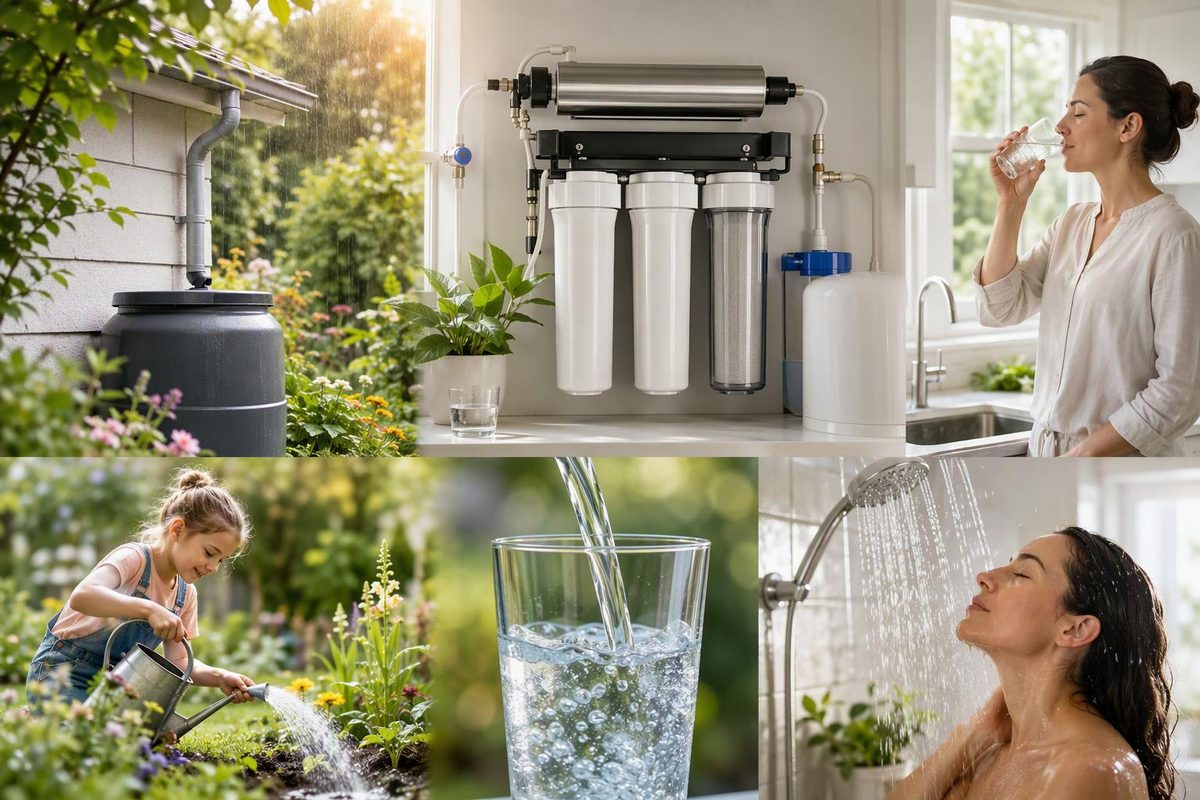
For rainwater used to water ornamental plants, start with debris screening and filtration matched to the irrigation equipment. For drinking, cooking or brewing, a sediment filter alone is not enough: assess the collection system, test the water, and select treatment for the germs and chemicals that could be present.
Clear rainwater is not necessarily safe. It can collect airborne contaminants, animal droppings and chemicals from roofing, gutters, pipes or storage materials. Where possible, CDC recommends public-system tap water or bottled water rather than rainwater for drinking and cooking. See its rainwater health guidance.
Choose treatment by the job
| Job | Treatment to consider | Important limit |
|---|---|---|
| Keep leaves and insects out of storage | Gutter guards and inlet screens | Screens do not establish drinking-water safety. |
| Reduce grit and suspended particles | Sediment cartridge or washable screen filter | Particle removal is not the same as disinfection or dissolved-chemical removal. |
| Improve taste or odor | Activated carbon, when the problem matches its performance claims | Ordinary taste-and-odor carbon filters are not microbial purifiers. |
| Reduce a measured chemical contaminant | A filter or reverse-osmosis system with the specific reduction claim | Neither “carbon” nor “RO” means every chemical is removed. |
| Control disease-causing microorganisms | A suitably validated disinfection or purification system, with required pretreatment | UV needs suitable incoming water and electricity; it does not remove chemicals. |
These distinctions follow CDC’s guidance on filter selection and home water treatment methods.
Check an RO unit’s permitted feed-water quality before choosing it for tank water. NSF/ANSI 58 certification alone is not a bacteria- or virus-treatment claim: NSF lists total dissolved solids reduction as required, with specific chemical and cyst-reduction claims optional. See NSF’s explanation of RO certification.
Rainwater used for bathing also needs a health assessment; it should not automatically be grouped with garden watering. Water used for coffee, beer or other beverages belongs in the drinking-water category before you make any flavor adjustments. For irrigation, use the equipment manufacturer’s required mesh or micron rating rather than choosing a drinking-water treatment package by default.
Keep contamination out before adding cartridges
A filter lasts longer when the collection system keeps unnecessary debris out. Inspect and clean the roof catchment, gutters and screens; repair damaged parts; and keep storage protected from animals and insects.
A first-flush diverter sends the initial roof runoff away from the tank. That runoff tends to carry the greatest load of dirt, germs and chemicals, especially after dry weather. It improves source quality but does not make the remaining water potable. Size the diversion for the contributing roof area rather than assuming one fixed volume suits every installation. CDC explains first-flush diversion and collection maintenance.
For drinking-water collection, also check material suitability. NSF evaluates rainwater catchment components and explains that tanks and plumbing can be assessed under NSF/ANSI/CAN 61 for drinking-water contact. That is a materials-safety check, not proof that the stored water is safe. See NSF’s rainwater collection guidance.
Keep rainwater plumbing separate from safe piped drinking water, with backflow protection and connections approved for your local installation. Check local collection and plumbing requirements before making changes.
For potable use, test before choosing the treatment train
Ask your health department and a qualified drinking-water laboratory which microbial and chemical tests fit your catchment, storage and surroundings. Roofing or plumbing metals may be relevant; nearby smoke or other pollution can change the assessment.
CDC recommends testing private well or rainwater supplies at least annually for harmful germs and chemicals, and considering additional testing when color, taste or smell changes. Local advice may require more frequent checks. CDC’s testing and filter-selection guidance also directs readers to state-certified laboratories.
Have the treatment design specify commissioning and ongoing testing at the treated outlet, not just in the tank. A tank result helps identify the source problem; an outlet result helps check the water actually supplied for use. Set that schedule with your health department and treatment specialist; annual source testing is not a substitute for monitoring disinfection performance.
What a UV-based arrangement can look like
An illustrative arrangement is:
Protected collection and storage → pump → sediment pretreatment → any required chemical treatment → UV → sanitary distribution to use
This is not a universal recipe. The order and equipment must suit the water test results and each device’s feed-water requirements.
For microbial treatment, distinguish NSF/ANSI 55 Class A from Class B. NSF describes Class A systems as inactivating or killing bacteria, viruses and cysts in contaminated water; Class B systems provide supplemental reduction of non-disease-causing bacteria in already disinfected drinking water. Verify the exact model’s certification and operating limits. NSF explains the treatment standards.
UV selection should include:
- Treatment capacity at the highest flow the system will deliver.
- Pretreatment that meets the unit’s water-quality requirements.
- UV-intensity monitoring and an alarm.
- A safety control that prevents untreated delivery during low UV intensity or power failure.
UV leaves no disinfectant residual, so downstream plumbing and storage can recontaminate treated water. Western Australia’s Department of Health recommends locating UV close to use and testing treated water, and describes these UV operating and safety checks.
Check micron rating, flow and upkeep
Do not buy a “5-micron rainwater filter” as if that label established potability. Check whether the rating is nominal or absolute, what removal performance is documented, and which pretreatment rating the next device requires. Our 5-micron filter guide explains the rating distinction.
Before buying, record peak flow in L/min or gpm, operating pressure, allowable pressure loss, cartridge dimensions, replacement availability and ongoing costs. For chemical treatment, match the exact model and cartridge to the required certified reduction claim—not merely a standard number or a compatible housing. NSF explains why specific claims matter.
Build maintenance into the design: accessible screens, serviceable housings, a way to track filter pressure loss, and the manufacturer’s cartridge-change, sanitation, UV-lamp and sleeve-cleaning procedures. If a disinfection alarm activates, stop using that supply for drinking and investigate; changing a sediment cartridge is not proof that microbial treatment has been restored.