
Sediment Filter for Rainwater: Choose and Configure the Stages
Choose rainwater sediment filters by particle load, micron rating and delivery flow. Plan coarse-to-fine stages, housing fit and maintenance.
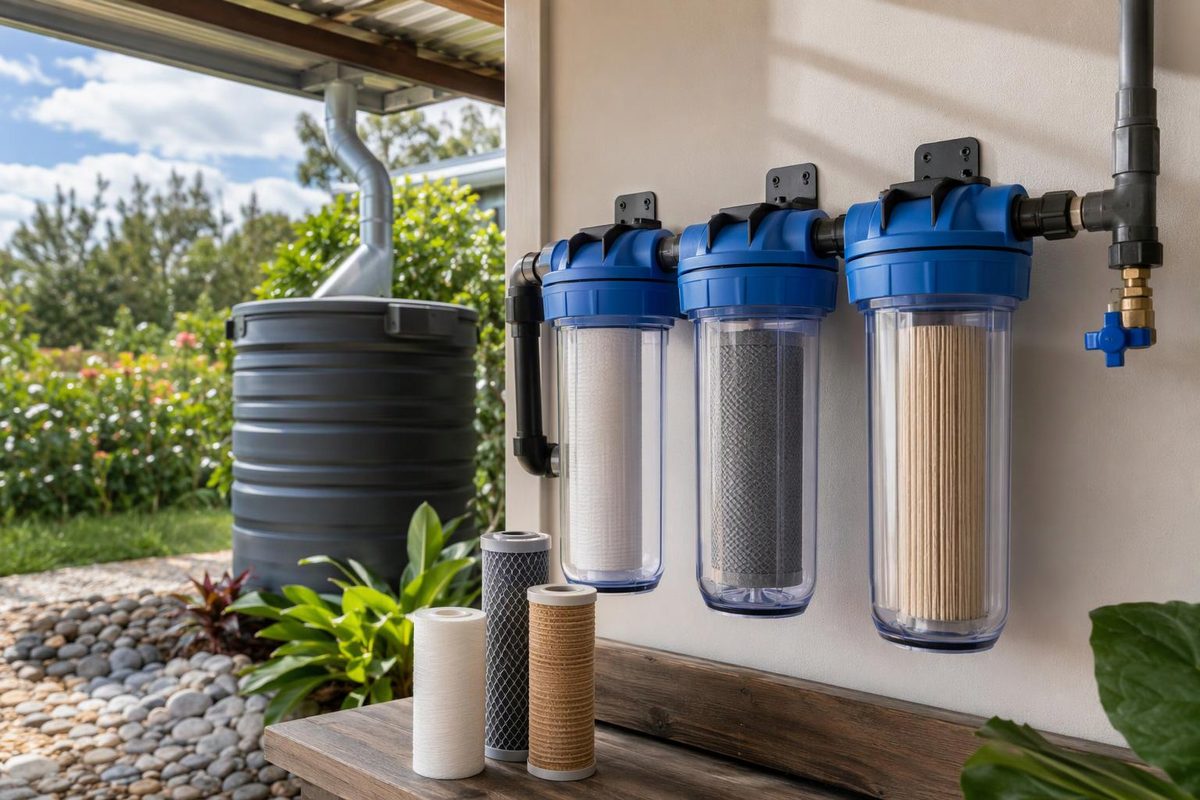
Choose the final sediment-filter rating to protect the equipment using the rainwater, then add a coarser stage only if the particle load warrants it. Keep roof debris out before storage rather than asking a fine cartridge to handle everything. For pumped tank water, have the installer confirm cartridge placement relative to the pump and controller against their installation instructions.
Sediment filtration addresses particles. It does not establish that rainwater is safe for drinking, coffee or brewing. CDC advises testing rainwater used for drinking, cooking or bathing and choosing treatment for the germs and chemicals present. See the broader rainwater treatment guide for that separate decision. CDC rainwater guidance
Start with the tank, not the micron label
Roof dust, leaves and animal debris can arrive with runoff, while sediment accumulates in storage. Before buying another housing:
- Clean and repair gutter, rainhead and tank-inlet screens.
- Check that the first-flush diverter drains or resets as its design requires.
- Inspect the tank for accumulated sludge.
- Check where the outlet draws water. Avoid drawing directly from the sediment layer.
Australia’s Your Home guide recommends an outlet 100 mm above the tank bottom or a floating outlet for drinking-water collection. Treat that as a tank-design reference, not a substitute for the tank manufacturer’s instructions or local requirements. Its first-flush guidance also explains how diverting initial runoff reduces material accumulating in storage. Your Home rainwater guide
A finer cartridge is not the first fix when the tank continually supplies sludge.
Select the filter type by what reaches the outlet
| What reaches the filter | Type to consider | Configuration decision |
|---|---|---|
| Coarse grit or visible particles that settle | Washable screen or spin-down filter | Use as an optional coarse stage before a finer cartridge; provide access for flushing and cleaning. |
| Suspended particles with a manageable load | Pleated sediment cartridge | Consider a large-area cartridge. Wash it only if the exact model is designated reusable. |
| Mixed coarse and fine particles | Gradient-density polypropylene cartridge | Consider a cartridge combining coarse outer filtration with finer inner filtration, or separate coarse-to-fine housings. |
| Persistent fine cloudiness | Filtration selected from testing and downstream requirements | Do not assume a coarse screen—or a cartridge’s micron label—will meet a turbidity requirement. |
These are mechanisms, not brand rankings. For example, Pentair’s R Series uses reusable pleated polyester to maximize dirt-holding capacity; its DGD Series combines two gradient layers. Neither description establishes that every pleated cartridge is washable or that every depth cartridge performs identically.
For a screen stage, use the coarsest opening that removes the troublesome particles. Rusco recommends this approach and identifies stepped filtration as one option for excessive sediment loads. An unnecessarily fine screen can become another frequent cleaning job. Rusco selection guidance
Decide whether you need one stage or two
One cartridge: Consider this when protected storage supplies a modest particle load and the cartridge meets the next device’s pretreatment specification.
Coarse stage → final cartridge: Consider this when larger particles repeatedly load the final cartridge. The coarse stage should intercept a meaningful portion of the debris, not simply duplicate the final stage.
20 µm → 5 µm: This is a documented stepped-filtration example in the cited VIQUA UV owner’s manual. Its troubleshooting guidance calls for turbidity testing when sediment may be passing through pretreatment. It supports the staging approach—not a universal rainwater specification or a recommendation to use those UV models on untreated rainwater. Follow the requirements of the actual downstream system. VIQUA owner’s manual
For irrigation, get the required filtration rating from the emitter or sprinkler manufacturer. Do not install a 5 µm prefilter merely because the supply comes from a rainwater tank.
Also check nominal versus absolute ratings. A nominal rating can allow some particles larger than the stated size through; an absolute pore-size specification is different. Compare documented removal performance rather than treating two “5 micron” labels as equivalent. CDC filter-selection guidance Our 5-micron rating guide explains the comparison in more detail.
Size the housings for delivery flow, not tank volume
Tank capacity does not determine cartridge flow capacity. Record:
- Peak simultaneous demand, in L/min or gpm—not daily consumption.
- Available delivery pressure and the pressure needed at the most demanding outlet.
- Pressure loss at that flow through each clean filter, plus allowance for loading.
- Exact cartridge length, diameter and end-seal design, matched to the housing.
- Housing pressure and temperature limits, port connections and installation environment.
Filters reduce pressure and flow; pump selection must account for those losses. A gravity-fed tank needs particular care because its available pressure may already be low. Your Home pump and filter guidance
Provide isolation valves, clearance to remove the bowls, and a suitable discharge route for any flushing stage. Ask the installer to include pressure measurement before and after the cartridges. For staged systems, an intermediate measurement helps identify which stage is loading. The filter-housing guide covers compatibility checks.
Use pressure loss and inspection to guide upkeep
Record the clean-filter pressure difference at a repeatable flow. Compare later readings at that same flow. Follow both the manufacturer’s loading-related service criteria and its scheduled replacement interval; good flow does not cancel a time-based change requirement. For example, Puretec’s Hybrid G/R manual specifies cartridge replacement every six months for those systems—not for every rainwater cartridge. Puretec Hybrid manual
If flow falls while filter pressure loss rises, inspect the loaded stage. If a replacement clogs quickly after storms, return to the screens, diverter and tank sediment before buying an even finer cartridge. If cloudiness persists after replacement, check seating and seals, then reassess the particle-removal requirement rather than assuming the new cartridge solved it.
Before opening a housing, isolate the water supply and relieve pressure according to its instructions. Follow the specified cleaning procedure for reusable elements; replace disposable cartridges rather than improvising washing. Follow housing sanitation and flushing instructions as well. Puretec cartridge-service instructions
CDC emphasizes regular filter maintenance to prevent germs growing in filters: restored flow is not proof of safe water. CDC maintenance guidance