
Sediment Filter: Choose the Micron Rating, Size and Type
Match a sediment filter to sand, silt or rust. Check micron ratings, housing fit, flow and maintenance—and know what sediment filtration cannot remove.
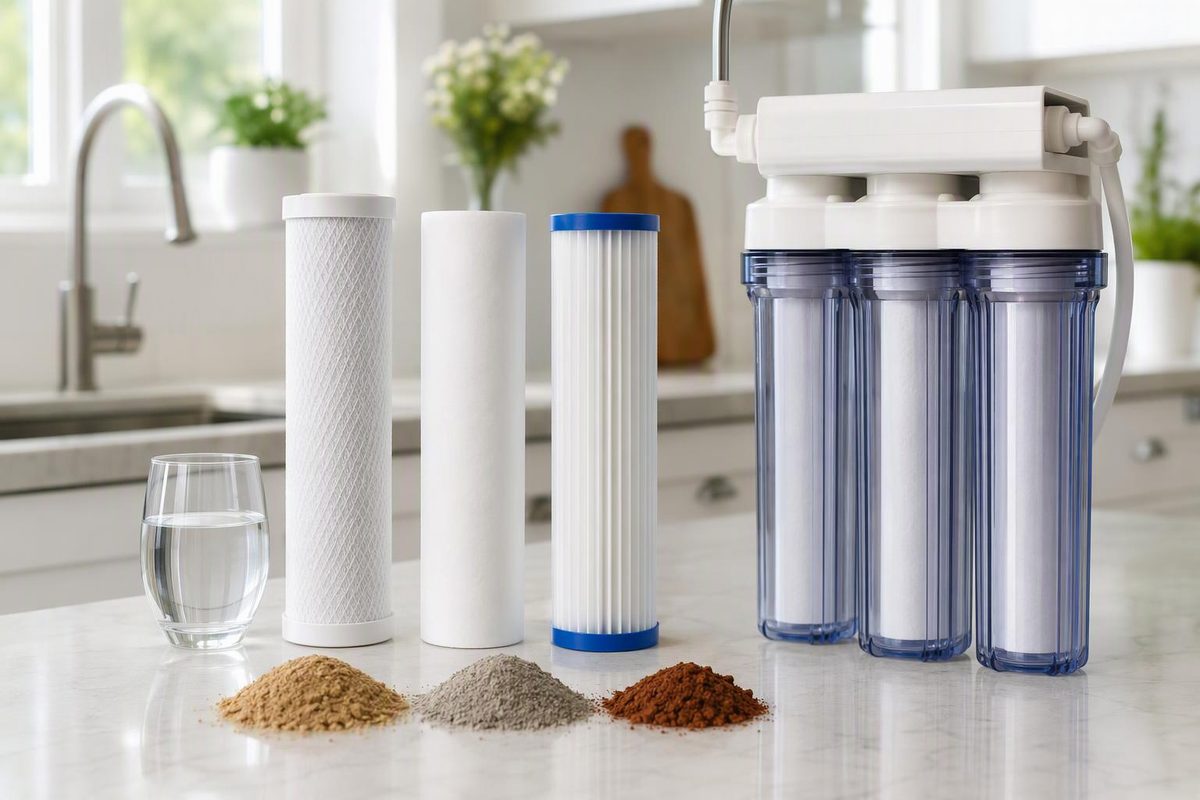
A sediment filter removes suspended particles, such as sand, silt, loose scale and insoluble iron. Choose the coarsest rating that captures the particles you need removed while meeting any downstream equipment requirement. A finer cartridge is not automatically better: small pores and heavy sediment loads can cause frequent clogging. University of Nebraska–Lincoln Extension explains this trade-off.
Before buying, identify three things: where the particles originate, how fine they are, and how much water must pass through the filter at once.
Confirm that sediment is the problem
A sediment cartridge traps solids on its surface or within its fibers. It does not, by itself, effectively remove dissolved minerals, nitrate or many other dissolved contaminants. Ordinary sediment cartridges are also not a reliable treatment for microbial contamination. Dissolved iron may need oxidation first, followed by filtration of the resulting particles. UNL Extension distinguishes these uses and limits.
Make a few comparisons before choosing treatment:
- One faucet or every faucet? A problem confined to one outlet warrants checking that fixture before adding a whole-house filter.
- Hot water only or hot and cold? Particles found only in hot water warrant investigating the heater and hot-water plumbing; an incoming-water filter may miss their source.
- Visible grains or persistent haze? A screen that catches sand may still pass much finer suspended material.
For white flakes, use the identification steps in white particles in water before assuming they are incoming sediment.
Do not judge safety by clarity. CDC recommends reviewing your utility’s annual water-quality report or testing private-well water; changes in well-water color, taste or smell are additional reasons to test. Clear water can still contain harmful germs or chemicals.
Choose the micron rating by the job
One micron (µm) is 0.001 mm. A lower number indicates finer filtration, but the rating method matters too.
| Filtration job | Selection approach | Main limitation |
|---|---|---|
| Visible sand or coarse grit | Consider a flushable screen; select its opening size from the manufacturer’s specifications | Finer silt may pass through |
| General suspended sediment | Compare particle size with available cartridge ratings; 20 and 25 µm are examples, not default recommendations | These ratings can pass finer silt |
| Finer particles or a specified prefilter duty | Compare finer cartridges, such as 5 µm, checking nominal versus absolute ratings and equipment requirements | Heavy solids loads may require a coarse stage first |
| Haze remaining after ordinary filtration | Test or characterize the material before moving to progressively finer cartridges | Very fine clay or dissolved material may need a different process |
Pentair’s catalog includes 5, 20 and 25 µm sediment cartridges. The available rating is only a starting point: UNL Extension gives broad particle ranges of 50 µm to 2 mm for sand, 2–50 µm for silt, and 0.2–2 µm for clay. This variation explains why “sediment” alone does not identify the right filter. Particle size and solids concentration both affect selection.
Nominal is not an absolute cutoff. Some particles larger than a nominal rating can pass through. Ask for the manufacturer’s retention efficiency and test method rather than comparing micron numbers alone. CDC explains nominal and absolute pore sizes; our 5-micron filter guide covers that comparison in more detail.
For equipment protection, follow the exact system manual. For example, Pentair’s PUV7 and PUV14 UV systems require an upstream 5 µm nominal sediment filter. Their troubleshooting instructions also describe a 20 µm stage followed by 5 µm when stepped filtration is needed. That is a model-specific requirement, not a rule for every UV system. See the Pentair manual.
Match the filter type, housing and flow
A flushable spin-down screen is worth considering when coarse sediment would otherwise consume disposable cartridges. It still needs flushing and access for service. Rusco’s installation guidance emphasizes both.
A pleated cartridge offers substantial surface area. A depth cartridge, such as spun polypropylene, captures particles within its thickness. Pentair’s catalog illustrates both constructions, including pleated polyester and gradient-density polypropylene. Do not assume every pleated cartridge is washable; check the exact product instructions. See the Pentek cartridge specifications.
Before ordering, check:
- Cartridge diameter, actual length and end-seal design against the housing’s approved replacements.
- Housing and cartridge pressure and temperature limits.
- Pressure drop, in psi or bar, at your expected flow in gallons per minute (gpm) or liters per minute (L/min).
- Clearance to remove the housing and space to collect spilled water.
A cartridge’s clean pressure-drop figure is not the complete assembly’s performance: the housing also introduces resistance. Pentair publishes separate housing and cartridge figures. Size a whole-house installation for simultaneous fixture use—not just the flow from one kitchen faucet.
Placement depends on the treatment sequence. Incoming sediment often needs removal before sensitive equipment, but particles formed by an oxidation stage need filtration afterward. UNL Extension describes both uses. Follow the complete system design rather than a universal “sediment first” diagram.
Replace by condition and the manual
Record the installation date and, where inlet and outlet gauges are fitted, the clean-filter pressure difference while water is flowing. Compare later readings at a similar flow. Increasing resistance or declining filtered flow calls for inspection, but supply-pressure changes can also cause low flow, as Pentair’s troubleshooting instructions note.
Follow the manufacturer’s replacement interval and pressure-drop limit; there is no reliable universal “every three months” schedule for all sediment filters. Sediment concentration can make gallon-capacity estimates poor predictors of actual service life. UNL Extension discusses these maintenance limits.
Before opening a housing, isolate the water supply and relieve pressure as its manual directs. Follow its cleaning, O-ring, cartridge-seating and flushing instructions, then restore flow slowly and check for leaks. Pentair’s replacement procedure illustrates why these details matter.
For coffee and brewing water, treat sediment removal as particle control, not mineral-profile adjustment or chlorine treatment. If your real goal is scale control, taste adjustment or changing dissolved salts, choose that treatment separately rather than buying a finer sediment cartridge.