
Filter Housing: Choose the Right Size, Ports and Pressure Rating
Identify a water filter housing by model, cartridge size, port threads and operating limits. Compare housing types and avoid mismatched replacement parts.
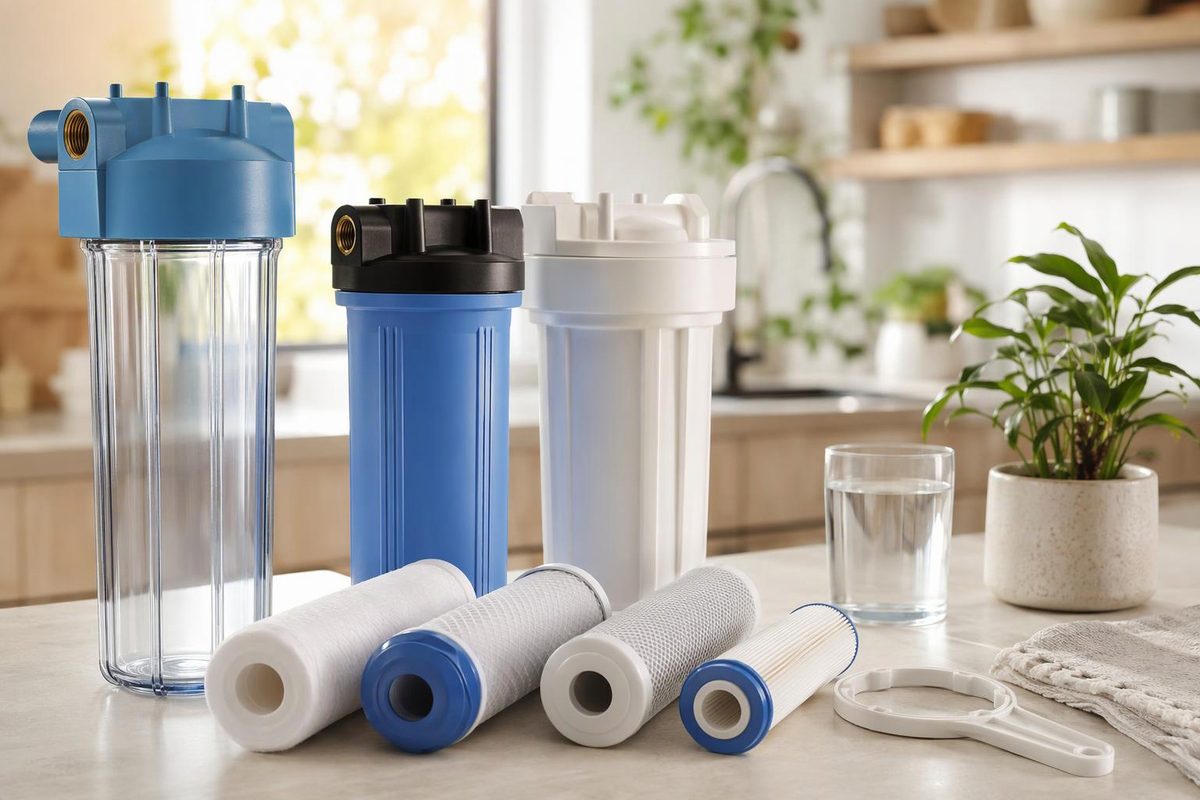
Choose a filter housing by its model number, accepted cartridge dimensions, inlet/outlet connections and pressure–temperature limits—not its color or advertised “10-inch” size alone. If you are replacing only the bowl, head or seal, order the manufacturer-approved part for that exact housing.
In a conventional reusable cartridge housing, the pressure-containing assembly consists of a head with inlet and outlet ports, a removable bowl (also called a sump), and a sealing O-ring. The cartridge inside does the treatment. Buying a larger housing does not, by itself, provide better chlorine, sediment or contaminant removal.
Identify what you need to replace
Before ordering, record the brand and part number from the head, bowl or system label. Photograph the markings and pipe connections. Separate these three purchases:
- Complete housing: head, bowl and seal; check whether a bracket, wrench and cartridge are included.
- Replacement bowl or head: confirm the exact approved part number. Matching cartridge capacity is not enough to establish that two housing components belong together.
- O-ring: use the model-specific size and material rather than choosing by appearance. Pentair lists different O-ring part numbers for its Slim Line, Standard and Big Blue families in its housing catalog.
If you need the filter element rather than the container, see the separate guide to cartridge filters.
Compare housing families, then check the exact model
These Pentek examples illustrate common differences; the dimensions and connections are not universal specifications for every brand.
| Housing family | Offered length classes | Inlet/outlet ports | Selection cue |
|---|---|---|---|
| Traditional Slim Line | 5, 10 or 20 inches | 1/4, 3/8 or 1/2 inch NPT | Compact, low-flow applications such as under-sink or RO pre/post-filtration |
| Traditional Standard | 10 or 20 inches | 3/4 inch NPT | Check its cartridge diameter range and whether the cap supports bracket mounting |
| Big Blue heavy-duty | 10 or 20 inches | 3/4, 1 or 1-1/2 inches NPT | Larger cartridge capacity for high-flow or heavy-sediment applications |
Sources: Pentair’s Slim Line, Standard and Big Blue product pages.
For a complete replacement, match both the port size and connection type in the documentation to your plumbing fittings. The examples above use NPT threaded ports; do not select a fitting by its inch size alone.
Length is only one measurement. Pentair’s Traditional Standard housings accept cartridges 2-1/2 to 2-7/8 inches in diameter; Big Blue accepts cartridges up to 4-1/2 inches in diameter. A “10-inch” label therefore does not establish cartridge compatibility. Check the specified cartridge length, diameter and sealing arrangement in the model documentation. (Pentek catalog; Big Blue specifications)
Also distinguish cartridge size from the housing’s outside dimensions. For example, Pentek’s 1-inch-port #20 Big Blue, part 150233, measures up to 23.22 × 7.45 inches (590 × 189 mm). Allow additional space below and around it to remove the bowl and use the wrench—not just enough room to mount it. (Specification sheet)
Check pressure, temperature and usable flow
Read the rating for the exact housing, not a similar-looking product. Pentair rates its Big Blue heavy-duty housings for 40–100°F (4.4–37.8°C), with maximum pressures of 100 psi (6.9 bar) for the 10-inch version and 90 psi (6.2 bar) for the 20-inch version. Those are housing limits, not suggested operating targets. Keep every component within its own limits. (Pentair specifications)
For brewing-water preparation, this temperature range means the example housing belongs on the cold-water side; it is not an appropriate container for hot wort.
Port diameter alone does not establish usable treatment flow. Pentair lists an initial pressure drop of 1 psi at 15 gpm for part 150233, but that housing figure is not a cartridge’s contaminant-reduction rating. Check the selected cartridge’s rated service flow and pressure loss as well as the housing data. (Big Blue specification sheet)
A certification mark also needs context. Pentair’s specification sheet identifies specific Big Blue part numbers, including 150233, as certified to NSF/ANSI 42 for material and structural integrity requirements. That statement does not establish a chlorine or health-contaminant reduction claim for whatever cartridge you install. (Certification statement)
Make the housing serviceable
A clear bowl allows visual inspection of the cartridge; it does not verify treatment performance. Choose clear or opaque construction only after checking operating limits and material compatibility. Pentair offers both in its Standard housing range.
Plan for a supported mounting location, access to shut off the water, and a way to release trapped pressure before opening. A pressure-relief button is not a substitute for isolating the supply. Clean Water Systems’ installation handbook requires bracket support for its housings and instructs owners to shut off the supply before releasing pressure. It also warns against freezing.
Check the housing’s replacement interval separately from the cartridge schedule. That same supplier recommends replacing its bowl every five years; use your own manufacturer’s interval rather than treating five years as a universal rule. For the cartridge-change procedure and post-service leak checks, follow the whole-house filter replacement guide.