
Reverse Osmosis: How It Works and When It’s Worth It
Its value depends on your water problem, the exact system’s verified performance, and whether you accept its water use, installation and upkeep.
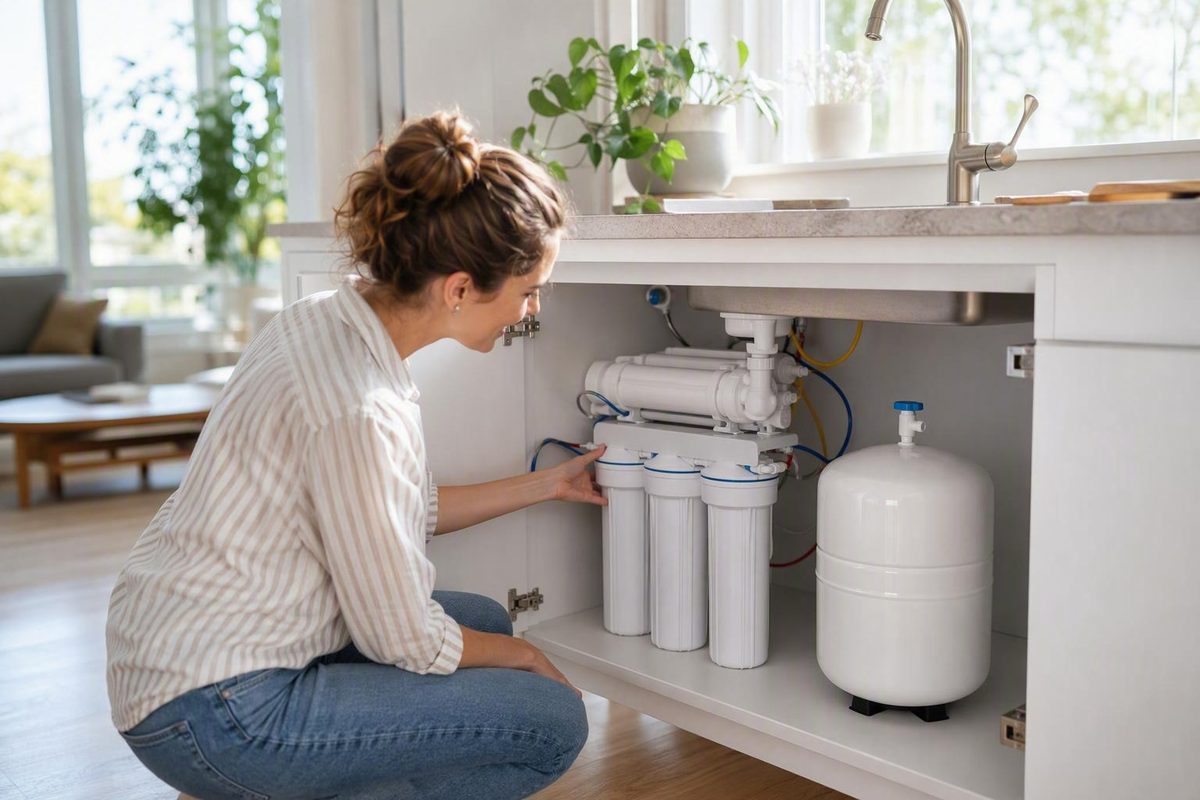
A practical guide to cleaner water without the RO hype
Reverse osmosis can be an effective way to treat drinking water, but it is not a universal upgrade for every tap or contaminant. Its value depends on a specific match: the problem in your water, the verified performance of the exact system, and your willingness to accept its water use, installation needs, and maintenance.
For a homeowner, renter, homebrewer, or beverage enthusiast, the useful question is not “Is reverse osmosis the best filter?” It is “Does this particular RO system address what I need to change better than a simpler option?”
The short decision rule: consider RO when you need to reduce dissolved substances that basic sediment or carbon filtration does not reliably address. If your concern is limited to particles, chlorine taste, or odor, a simpler and less water-intensive filter may be enough.
What reverse osmosis is—and the short answer on how it works
Reverse osmosis, usually shortened to RO, is a pressure-driven separation process. Feedwater enters a housing containing a semipermeable membrane. Pressure pushes some water through the membrane as treated water, called permeate, while the remaining flow exits as concentrate or brine, carrying a higher concentration of rejected material. The EPA describes point-of-use RO using these same two-stream terms.
The “reverse” part makes more sense when compared with natural osmosis. In osmosis, water moves through a semipermeable membrane in the direction that tends to equalize concentration differences. An RO system applies pressure to drive water in the useful treatment direction: toward the permeate side, while much of the dissolved material remains in the concentrate stream.
It is tempting to picture the membrane as an extremely fine kitchen sieve, but that analogy is incomplete. RO is not simply mechanical size screening. Separation also depends on how water and dissolved substances interact with, dissolve in, and diffuse through the membrane material. Size matters, but so do chemical properties and transport behavior. That is why “only water molecules pass through” is inaccurate shorthand: permeate is not chemically perfect water, and rejection differs among substances and operating conditions.
Household RO normally uses crossflow. Instead of forcing all feedwater into a dead-end membrane, water moves across the membrane surface. Some becomes permeate, while the continuing concentrate flow carries rejected material away. This sweeping action helps limit rapid accumulation on the membrane, though it does not eliminate fouling or scaling.
Two terms are especially useful when comparing performance:
- Recovery is the share of feedwater converted into permeate. If four gallons enter and one gallon becomes treated water, recovery is 25%.
- Salt rejection describes how effectively the membrane reduces dissolved salts under defined conditions. It is often estimated by comparing feedwater and permeate total dissolved solids, or TDS.
These measurements describe different outcomes. A system can have strong salt rejection but low recovery, producing low-TDS water while sending a comparatively large concentrate stream to the drain. Raising recovery reduces reject volume, but it also concentrates minerals more heavily on the feed side and can increase scaling risk under unsuitable water conditions.
Inside a typical household RO system
A multistage RO system is a treatment train, not a stack of interchangeable filters. Each component has a different job, and the membrane remains the principal dissolved-solids separation stage.
A common sequence looks like this:
- Sediment prefilter: Captures particles such as dirt, sand, rust, and pipe debris, reducing the load on downstream components.
- Carbon prefilter: Addresses chlorine, taste, odor, and some organic compounds. Suitable carbon pretreatment can also protect chlorine-sensitive membranes.
- RO membrane: Performs the main separation of dissolved salts and other substances the membrane is capable of rejecting.
- Storage or direct-delivery equipment: Stores treated water or delivers it on demand, depending on the design.
- Post-carbon filter: Polishes taste and odor shortly before dispensing.
This is a typical arrangement rather than a universal design. Some systems use multiple sediment or carbon cartridges; others combine media in one replaceable element. A general RO treatment-train overview from Veolia similarly distinguishes sediment filtration, carbon pretreatment, membrane separation, and post-carbon polishing.
Several less-visible components make the process work:
- The drain line carries concentrate away.
- The flow restrictor controls concentrate flow to maintain the operating conditions intended for the membrane.
- An automatic shutoff valve stops production when a storage tank is full and the required pressure conditions are met.
- A storage tank accumulates water because many conventional membranes produce permeate relatively slowly.
- A dedicated faucet dispenses treated water without routing it through the regular mixed-water tap.
- A booster pump, when approved for the system, raises or stabilizes feed pressure.
- Pump-equipped or tankless systems may use electric controls and sensors rather than relying entirely on plumbing pressure.
Optional stages are worthwhile only when they serve a defined purpose. A remineralization cartridge can alter taste and pH. Specialty media may target a particular substance. A booster pump may help a system operate within its required pressure range. Additional microbial treatment may be considered only as part of a design specifically validated for that purpose.
None of these additions automatically makes a unit better. Likewise, “five-stage,” “six-stage,” or “seven-stage” tells you how a seller counts components—not whether the unit is certified to reduce lead, arsenic, nitrate, fluoride, PFAS, or another named contaminant. Two carbon cartridges can add two stages to a product description without changing the membrane’s fundamental role.
What RO can reduce—and what may need another treatment step
Reverse osmosis is particularly relevant to dissolved substances that pass through ordinary particle filters. Depending on the membrane, complete treatment train, feedwater, and operating conditions, point-of-use RO can reduce dissolved salts, TDS, and selected contaminants.
The EPA says point-of-use systems can potentially reduce contaminants including lead, arsenic, PFAS, volatile organic compounds, bacteria, and viruses. “Potentially” is crucial: this is not a promise that every system handles every substance. Performance depends on the exact model, membrane, feedwater chemistry, pressure, condition, maintenance, and contaminant-specific claim.
| Concern | Likely role of RO | Possible complementary stage | What the buyer must verify |
|---|---|---|---|
| Sediment, sand, or rust | Not the membrane’s primary job | Sediment prefilter | Particle rating, capacity, and replacement schedule |
| Dissolved salts and TDS | Core membrane application | Pretreatment where scaling or fouling is a concern | Rated reduction and required operating conditions |
| Lead, arsenic, nitrate, fluoride, or PFAS | May be reduced by a suitable system | Contaminant-specific media in some designs | Certification for the exact named contaminant |
| Chlorine taste or odor | Commonly addressed before or after the membrane | Activated carbon | Carbon capacity and the exact chlorine claim |
| Chloramine | Depends largely on suitable carbon treatment | Carbon selected for chloramine service | Exact claim and required operating conditions |
| VOCs, solvents, or pesticides | Performance varies; RO alone may be insufficient | Suitable carbon or specialty media | Named-chemical reduction claims |
| Bacteria and viruses | A suitable intact membrane may act as a barrier | A validated microbial treatment process where needed | Exact microbial claim and system requirements |
| Dissolved gases | May not be reliably addressed by the membrane | Treatment selected for the identified gas | Suitability for the specific gas and application |
Chlorine and chloramine illustrate why stage-specific thinking matters. Their treatment is commonly assigned to carbon pretreatment rather than the RO membrane. Carbon can also protect membranes that are sensitive to oxidants. A generic carbon stage, however, does not prove that a system has adequate capacity or verified performance for every disinfectant.
Some dissolved gases, solvents, pesticides, and VOCs may also require suitable carbon or another treatment method. A broad statement that “RO removes chemicals” hides these distinctions.
Microbial claims require particular caution. A membrane may act as a barrier, but a household RO unit should not automatically be treated as a validated disinfection system. The system’s design, condition, seals, downstream storage, sanitation, and exact certified claims all matter. When microbial safety is a known concern, do not infer safety from the presence of an RO membrane or from a low TDS reading; follow treatment guidance specific to that hazard and water source. Commercial guidance discussing RO limitations likewise distinguishes a membrane barrier from a validated disinfection process and notes that complementary treatment may be necessary.
For residential systems, NSF/ANSI 58 is associated with reverse-osmosis treatment, but the standard name alone is not a contaminant checklist. A TDS-reduction claim does not automatically establish reduction of lead, arsenic, fluoride, nitrate, or PFAS.
Before buying, identify the organization that certified the exact product and search that certifier’s official product listing. Match the complete model number—not merely the brand or product family—to each contaminant claim.
The real tradeoffs: reject water, pressure, output, taste, and scaling
RO cannot continuously retain dissolved material without carrying it away. The concentrate stream performs that operational job. Calling all concentrate “wastewater” can obscure why it exists, but changing the name does not erase the household water-use impact: in a conventional installation, that stream goes to the drain.
According to the EPA, a typical point-of-use RO system may discharge five gallons or more of reject water for each gallon treated, while some inefficient units may discharge as much as 10 gallons per gallon treated. A WaterSense-labeled point-of-use system must discharge no more than 2.3 gallons for each gallon of treated water. WaterSense-labeled products are independently certified against the EPA’s applicable efficiency and performance criteria.
To show what those ratios mean, suppose a household produces exactly one gallon of permeate per day:
- At a 5:1 drain-to-treated ratio, annual reject volume is
5 × 365 = 1,825 gallons. - At 2.3:1, annual reject volume is
2.3 × 365 = 839.5 gallons, or about 840 gallons.
These are arithmetic examples based on the EPA ratios, not estimates of typical household consumption. Actual volume depends on how much RO water the household draws and how the system performs under local conditions.
Always check which direction a ratio is written:
- 5:1 drain-to-pure means five gallons go to the drain for every gallon delivered.
- 2:1 pure-to-drain means two gallons are delivered for each gallon drained. Expressed the other way, that is 0.5:1 drain-to-pure.
A larger number can therefore indicate better or worse efficiency depending on the label. Convert all claims to one format before comparing products.
Pressure and output
Applied pressure drives membrane production. Inlet pressure, water temperature, feedwater composition, membrane condition, and restrictions in tubing or cartridges can all affect actual output.
A gallons-per-day rating is therefore not a promise of instantaneous faucet delivery. Conventional under-sink units often compensate for gradual membrane production by filling a pressurized storage tank between uses.
Tankless systems use a different footprint and delivery arrangement, but “tankless” does not by itself establish better contaminant reduction, efficiency, flow, or reliability. Compare the exact model’s production conditions, faucet flow, drain ratio, noise, power requirements, and maintenance instructions.
Recovery and scaling
Higher recovery means more feedwater becomes permeate, reducing drain volume. The tradeoff is a more concentrated reject stream. Hardness minerals and other scale-forming substances can accumulate at the membrane surface if the recovery, pretreatment, and feedwater chemistry are not compatible.
The useful recovery rate is therefore not automatically the highest advertised number. It is one the complete system can sustain under the actual feedwater conditions while meeting its performance and service-life requirements.
Taste and mineral reduction
RO reduces many dissolved minerals along with unwanted dissolved substances. Some people prefer the resulting neutral profile; others find it flat. That distinction can matter in coffee, tea, brewing, and other beverage applications where users may want to build a controlled mineral profile.
A remineralization cartridge can change taste and pH, but it should be treated as an optional formulation choice—not proof of better hydration or a universal health requirement. Homebrewers who begin with low-mineral RO water should measure and adjust it for the intended recipe rather than assume untreated RO water is automatically ideal.
Do not assume concentrate is suitable for plants, pets, cleaning, or another reuse. It contains rejected substances at a higher concentration than the feedwater. Without knowing the feedwater composition, system recovery, and intended use, its suitability cannot be presumed.
When RO makes sense—and when a simpler filter may be enough
Choose treatment around a defined water-quality concern, not a desire for the largest stage count or lowest possible TDS.
Begin by writing down what you want to change:
- visible sediment;
- chlorine taste or odor;
- dissolved salts or sodium;
- lead;
- arsenic;
- nitrate;
- fluoride;
- PFAS;
- a specific organic compound;
- or another identified concern.
If the problem is sand, rust, or suspended particles, sediment filtration directly addresses particles. If the issue is chlorine taste or odor, activated carbon may solve it without an RO concentrate stream. Carbon can also address some organic compounds, although performance depends on the media, capacity, operating conditions, and exact contaminant.
RO becomes more relevant when the goal involves dissolved substances that basic sediment or carbon filtration does not reliably address. Carbon and RO are not necessarily competitors: carbon is commonly used to protect the membrane and treat compounds outside the membrane’s strongest role.
The EPA does not recommend RO for every application because a less water-intensive treatment method may be sufficient. That is an important check against “maximum treatment” thinking. More treatment is not inherently better if it consumes more water, costs more to maintain, or removes minerals without solving the original concern.
Combined whole-house carbon and under-sink RO is one possible design, not a universal prescription. Whole-house carbon may be considered when suitable carbon treatment is wanted throughout the home, while point-of-use RO serves drinking and cooking water. Installing both without a defined need can add cost and maintenance without a proportional benefit.
Hardness, iron, heavy sediment, chlorine, and chloramines can create pretreatment considerations. The appropriate response depends on the water and the membrane manufacturer’s requirements. Do not prescribe a generic softener, iron filter, or carbon configuration without confirming need and compatibility.
A disciplined sequence is more reliable than a product ranking:
- Define the concern. Separate taste preferences from a specific contaminant concern.
- Review reliable information about the water. Use available water-quality documentation and testing appropriate to the situation.
- Identify the treatment role. Decide whether the need concerns particles, taste and odor, dissolved substances, or a microbial hazard.
- Verify the exact model. Confirm a certified claim for each named contaminant rather than relying on brand-level marketing.
- Compare ownership demands. Include reject water, pressure, output, space, filter availability, sanitation, and service requirements.
How to evaluate an RO system without falling for stage-count marketing
The most useful comparison begins with one sentence: “I need to reduce ___.” Every specification should be evaluated against that blank.
Start with certified reductions
Look for independent certification tied to the exact model and exact contaminant. Likewise, certification for TDS reduction does not establish certified reduction of lead, arsenic, fluoride, PFAS, nitrate, or VOCs.
Ignore “removes up to 99%” unless the seller identifies the substance, test conditions, exact product, and basis of the claim. One percentage cannot describe every contaminant.
The practical verification process is:
- Record the complete model number, including any suffix.
- Identify the certifying organization named in the product documentation.
- Search that organization’s official product directory.
- Confirm that the listing matches the complete model number.
- Read the individual performance claims and any operating conditions or replacement requirements.
- Save the listing and current manual before purchase.
If the model cannot be matched to an official listing, ask the seller for the listing—not merely a certificate logo or test summary.
Understand what WaterSense adds
For point-of-use RO, the EPA WaterSense label adds an efficiency screen and baseline performance requirements. Labeled products are independently certified against EPA criteria, must discharge no more than 2.3 gallons for each gallon treated, must meet baseline TDS-reduction requirements, and must meet a minimum membrane-life requirement of at least one year. Additional contaminant-reduction claims associated with the labeled system must also be certified rather than assumed. These requirements are summarized on the EPA’s point-of-use RO page.
WaterSense does not mean every labeled system reduces every contaminant. It provides useful information about efficiency and baseline performance; named-contaminant listings still control the treatment decision.
Compare formats functionally
- Storage-tank under-sink systems produce permeate gradually and store it for faster dispensing. They require space for the tank and model-specific tank checks.
- Tankless under-sink systems may reduce storage footprint and produce water on demand, but some require electricity, pumps, controls, and adequate instantaneous production.
- Countertop systems can suit renters or kitchens where permanent plumbing changes are impractical. Reservoirs, batch operation, electrical requirements, and cartridge designs vary.
- Direct-flow systems emphasize ongoing production rather than stored volume, making actual flow under household conditions especially important.
Do not compare gallons per day alone. That number describes rated production under specified conditions; it is not the same as faucet flow, storage volume, or guaranteed production in every home.
Buying checklist
Before purchasing, obtain the current certification listing, specification sheet, manual, replacement schedule, and warranty for each candidate. Then ask:
- Is the exact model independently certified for each contaminant I care about?
- What does its general certification cover—and what does it not cover?
- What is the tested drain-to-treated ratio or recovery?
- Is an efficiency claim written as drain-to-pure or pure-to-drain?
- What feed-pressure and water-quality conditions are required?
- Is a booster pump required, optional, or prohibited?
- What is the rated production capacity, and under what conditions was it measured?
- What faucet flow or stored delivery should I expect?
- Are replacement cartridges and membranes readily available?
- Are the filters proprietary?
- What replacement conditions control service: time, volume, indicator, or measured performance?
- What plumbing, faucet, drain, and electrical changes are required?
- Will the tank and cartridges fit the intended space?
- Does the system produce pump, flushing, or drain noise?
- What does the warranty cover?
- Which maintenance tasks are required to preserve the warranty?
- Which tasks are approved for the owner, and which require service?
- What will replacement parts, water, electricity, and service cost for this exact model?
Normalize figures yourself. Convert all efficiency claims to the same ratio direction, distinguish production rate from faucet flow, and calculate recurring costs from the model’s actual replacement schedule and current replacement-part prices.
Stage count, alkaline cartridges, discounts, retailer ratings, and capacity claims can describe a product. None substitutes for verified treatment performance. Without consistent certification records, manuals, lifecycle costs, and comparable operating data, there is no sound basis for naming one universal “best” RO system.
Maintenance: filters, membranes, tanks, and performance checks
The current manual for the exact model is the controlling maintenance source. Systems differ in cartridge design, membrane chemistry, tank arrangement, sanitation compatibility, electronics, and replacement indicators. Generic schedules are useful only for preliminary budgeting.
Vendor guidance commonly places prefilter and postfilter replacement somewhere around 6–12 months, while estimates for many under-sink membranes range from roughly two to five years. For example, Culligan says many filters are replaced within a year and gives a general membrane estimate of three to five years, while emphasizing that timing depends on the system and volume treated in its RO maintenance guidance.
These ranges are not universal. Aquasana’s guidance for one specific system calls for several components every six months and its membrane after 12 months under stated conditions, demonstrating why the exact manual must override a general interval. Water chemistry, use, pressure, temperature, pretreatment, and cartridge capacity can all affect service life.
Follow the first applicable trigger in the manual, whether that is elapsed time, treated volume, indicator status, measured decline, or another stated condition.
What to monitor
Routine visual and functional checks can identify developing problems:
- water around housings, fittings, valves, or the tank;
- cracked, kinked, abraded, or discolored tubing;
- worn or loose-looking accessible components;
- unusual pump, valve, vibration, or draining sounds;
- lower faucet flow or longer tank refill time;
- persistent changes in taste or odor;
- operation or draining that continues after the tank should be full;
- performance readings outside the manufacturer’s specification.
Sediment and carbon prefilters are protective components. If they become overloaded, pressure reaching the membrane may fall. If carbon is no longer providing the protection required by an oxidant-sensitive membrane, the membrane may be damaged. Replacing only the membrane without investigating the cause can lead to another early failure.
Storage-tank care is model-specific. Some manuals require periodic draining or pre-charge checks, but there is no universal tank-pressure setting. Measure or adjust pressure only in the condition specified by the manufacturer—often with the water side empty—and use the exact model’s target and procedure.
Sanitation without a universal bleach recipe
A manufacturer may recommend sanitation during scheduled service, after prolonged disuse, or following a contamination event. The approved chemical, concentration, dose, contact time, disassembly sequence, component compatibility, and flushing procedure can vary substantially.
Published vendor procedures demonstrate that variation: some present sanitation as routine owner maintenance, while others recommend professional service; product-specific bleach amounts also differ. Aquasana, for example, publishes a specific dose and flushing procedure for one system, which should not be transferred to another model. Follow the exact current manual rather than adapting a generic bleach recipe. See the manufacturer’s model-specific maintenance example.
Model-approved cartridge replacement and visual inspection may be reasonable owner tasks. Persistent leaks, electrical or pump faults, drain modifications, uncertain sanitation, damaged pressure-containing parts, or recurring performance failures are reasons to stop and use the manual’s service process or a qualified professional.
Troubleshooting low flow, bad taste, leaks, and constant draining
One symptom can have several causes. Do not assume every problem means the membrane has failed.
| Symptom | Possible causes | Appropriate first checks |
|---|---|---|
| Slow faucet flow | Clogged prefilters, low tank charge, low inlet pressure, cold feedwater, fouled membrane, kinked tubing, closed valve | Confirm accessible valves are open, inspect tubing, check service dates, and follow manual-approved pressure or tank checks |
| Tank refills slowly | Low pressure, cold water, clogged pretreatment, fouled membrane, flow restriction | Compare behavior with the manual and inspect accessible tubing and prefilter status |
| Bad taste or odor | Exhausted post-carbon filter, stale stored water, overdue sanitation, source-water change, contaminated dispensing area | Follow the approved flushing procedure, confirm replacement dates, and inspect the faucet area |
| High permeate TDS | Membrane wear or fouling, damaged seal, poor seating, insufficient pressure, inconsistent measurement | Retest consistently, review recent service, and compare results with the model’s specification |
| Constant draining | Pressure problem, automatic-shutoff fault, flow-restrictor issue, tank problem, impaired membrane production | Confirm valve positions and use the manual’s troubleshooting sequence |
| Leak at a fitting or housing | Damaged fitting, improperly seated tubing, worn O-ring, cracked housing, excessive pressure | Stop use as directed by the manual and inspect only accessible parts without overtightening |
| Pump or electronic fault | Power loss, sensor fault, pump failure, control problem | Check the approved power connection and displayed error code; do not bypass controls |
For a significant leak, follow the system manual’s emergency shutdown procedure. That commonly means stopping the feedwater and relieving pressure before service, but the correct valve sequence and depressurization steps depend on the installation. Do not overtighten plastic housings or improvise with unapproved sealants, tubing, or fittings.
Continuous draining is not a diagnosis by itself. Replacing random parts can conceal the actual pressure or installation problem.
Using TDS to estimate rejection
A handheld TDS meter can help track membrane performance when samples are collected consistently. A common estimate is:
Rejection (%) = 100 × (feed TDS − permeate TDS) ÷ feed TDS
For feedwater at 300 ppm and permeate at 30 ppm:
100 × (300 − 30) ÷ 300 = 90%
This calculation compares the measured dissolved-solids readings; it does not identify which substances make up those readings. Salt rejection and recovery are distinct performance measures, as explained in the technical overview of RO recovery and rejection.
Use comparable samples and allow the system to operate under its normal conditions. A sudden change can flag a membrane, seal, pressure, or measurement issue, but the result must be compared with the manufacturer’s specification.
TDS is not a contaminant-identification test. It cannot tell you whether lead, arsenic, PFAS, nitrate, VOCs, bacteria, or viruses are present. It also cannot verify a named-contaminant certification or establish microbiological safety.
Escalate the problem through the manufacturer’s service process or a qualified professional when there is a persistent leak, unexplained continuous draining, electrical or pump trouble, recurring contamination concern, damaged pressure-containing equipment, or performance that remains outside specification after routine service.
Beyond the kitchen sink: where else reverse osmosis is used
Household point-of-use RO is only one scale of the technology. The same broad principle—pressure-driven membrane separation—appears in municipal, industrial, water-reuse, food-and-beverage, aquarium, and desalination systems, but the equipment and operating conditions differ substantially.
Applications include:
- preparing boiler feedwater;
- reclaiming wastewater for reuse;
- preparing aquarium water before controlled conditioning;
- concentrating juice and dairy products;
- concentrating maple sap;
- dealcoholizing beer;
- producing process water for manufacturing;
- treating brackish water or seawater.
Municipal RO is generally one stage in a larger treatment system. Pretreatment protects membranes from solids, fouling, and scaling, while downstream conditioning or disinfection may be required before distribution or use. These applications and the membrane-transport basis of RO are summarized in a broader reverse-osmosis technical overview.
Seawater desalination requires substantially higher pressure and energy than fresh- or brackish-water treatment because of seawater’s salt concentration and osmotic pressure. Seawater plant figures should therefore never be applied to an under-sink product comparison. A kitchen unit and a desalination plant share a separation principle, not directly comparable operating conditions.
Frequently asked questions
Does reverse osmosis remove fluoride, lead, arsenic, or PFAS?
A suitable RO system can reduce these contaminants, but not every unit has verified performance for all four. Check the exact model’s official certification listing for separate fluoride, lead, arsenic, and PFAS claims. A general NSF/ANSI 58 reference, TDS claim, or broad removal percentage does not automatically cover each substance.
If the contaminant is known or suspected, base the purchase on the exact named claim and its stated operating conditions—not on the word “RO” alone.
How much water does a reverse-osmosis system send down the drain?
It varies widely. The EPA says a typical point-of-use unit may send five gallons or more to the drain for each gallon treated, while some inefficient units may send up to 10 gallons. A WaterSense-labeled unit must send no more than 2.3 gallons to the drain per gallon treated.
Compare every product using the same ratio direction. Pure-to-drain is the inverse of drain-to-pure, so two similar-looking numbers can describe very different efficiencies.
Is reverse osmosis better than an activated-carbon filter?
Not categorically. The technologies perform different jobs.
Activated carbon commonly addresses chlorine, taste, odor, and certain organic compounds. RO is generally more relevant to dissolved salts and selected dissolved contaminants that carbon does not reliably reduce. Carbon is also commonly installed before an RO membrane, so the technologies can be complementary.
If the only goal is improving chlorine taste or odor, carbon may be the simpler, less water-intensive choice. If the concern is a dissolved contaminant addressed by a certified RO system, RO may be the better fit.
How often should RO filters and membranes be replaced?
Use the schedule and performance criteria in the current manual for the exact system. For rough budgeting, many vendor guides place common prefilters and postfilters around six to 12 months, while estimates for many under-sink membranes fall around two to five years. Product-specific instructions can be substantially shorter or longer.
Actual timing depends on water quality, treated volume, pressure, temperature, pretreatment, cartridge capacity, and system design. Taste or flow changes can prompt inspection, but they do not replace the required schedule or performance checks.
Does RO water need to be remineralized?
Not automatically. RO reduces dissolved minerals, which can make the water taste flatter to some people. A remineralization stage may alter taste and pH, and beverage makers may adjust minerals for a particular recipe.
The supplied evidence does not establish remineralization as a universal health or hydration requirement. Treat it as a taste, pH, or formulation choice unless a qualified professional has identified a specific dietary or water-chemistry need.
The final decision rule is straightforward: use reverse osmosis when a defined water-quality goal matches the independently verified capabilities of a specific system—and when the household accepts its reject water, pressure, space, installation, and maintenance requirements. If the goal is limited to sediment, chlorine taste, or odor, a simpler and less water-intensive filter may be sufficient. Compare exact contaminant certifications, WaterSense efficiency where applicable, current manufacturer instructions, and ongoing upkeep—not stage count or sweeping purification claims.