
Under-Sink Water Filter System: Choose by Water Problem
Compare carbon and RO under-sink filters by certified claims, faucet setup, flow, cabinet fit and replacement costs—not stage counts.
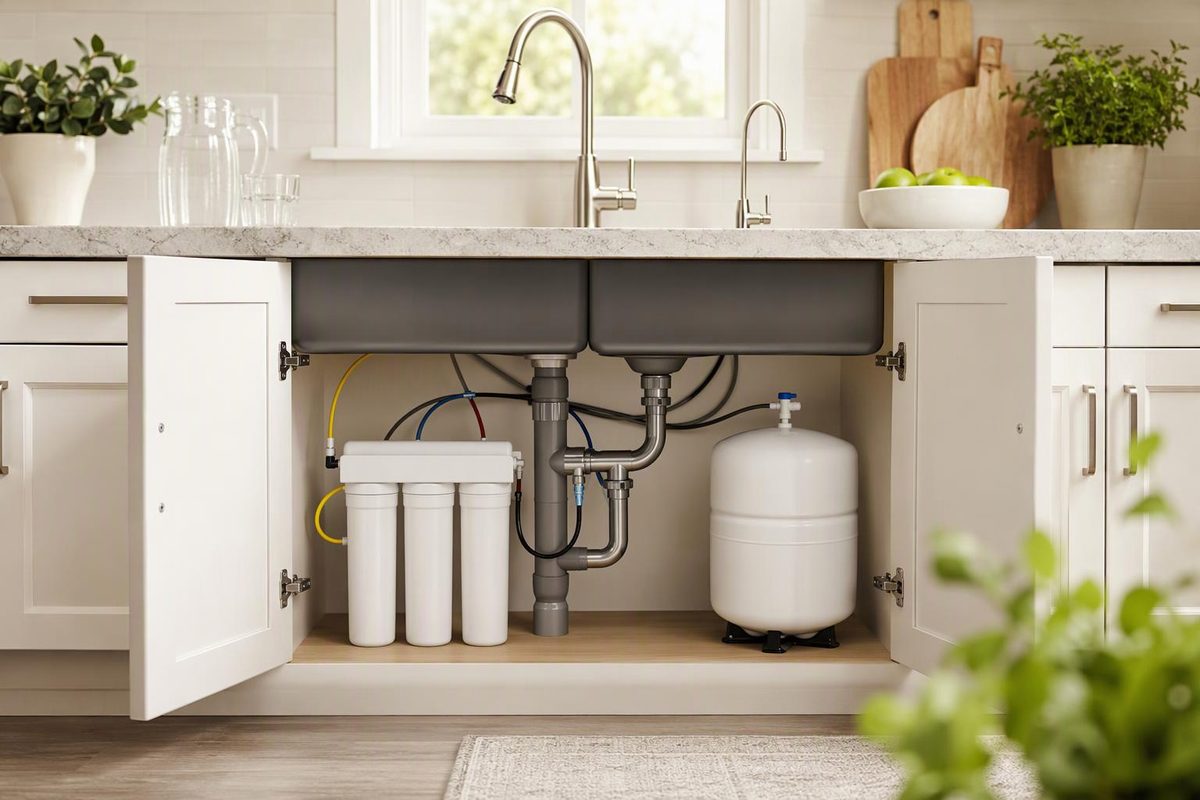
For chlorine taste alone, start with a carbon-based under-sink filter carrying a chlorine-reduction claim. For dissolved salts or fluoride, consider reverse osmosis (RO) with the relevant documented reduction claim. For lead or another health-related contaminant, choose by the exact model’s certification—not by its stage count or whether it uses RO.
An under-sink water filter system treats water at the kitchen outlet it serves, not throughout the house. It fits drinking, cooking and kettle-filling needs; it will not solve scale or contamination at unrelated fixtures. If those are your concerns, first compare whole-house versus kitchen-only treatment.
Identify what needs treating
For utility water, review the latest annual water-quality report and ask whether the disinfectant is chlorine or chloramine. For private-well water, start with laboratory testing rather than a taste-based filter purchase. CDC recommends testing well water at least annually and notes that taste, smell and appearance do not reliably establish safety. Water without harmful germs or chemicals may not need filtration. CDC’s filter-selection guide
| Water problem or goal | Treatment to investigate | Evidence to require |
|---|---|---|
| Chlorine taste or odor | Carbon-based filtration | Explicit chlorine taste-and-odor reduction claim under NSF/ANSI 42 |
| Chloramine-treated water | A filter specifically rated for chloramine | Chloramine reduction—not merely chlorine reduction |
| Lead or another identified health-related contaminant | A filter or RO system certified for that substance | Exact contaminant claim, matching model and replacement cartridge |
| Fluoride, nitrate or dissolved salts | RO with applicable claims | Fluoride or nitrate/nitrite claim as needed; TDS reduction alone is not a substitute |
| Visible sediment | Mechanical filtration, sometimes ahead of other treatment | Particle rating, service flow and a plan to identify the sediment source |
The NSF certification search separates chlorine from chloramine claims and lists individual RO claims, including fluoride, nitrate/nitrite and total dissolved solids (TDS).
Do not assume a conventional kitchen carbon filter softens water. Hardness treatment is a separate function. RO can reduce calcium and magnesium in the water it delivers. CDC’s treatment overview Incoming hardness must still fit the system’s operating limits: excessive hardness can scale an RO membrane, as the Pentair FreshPoint manual explains.
If testing finds microbial contamination, do not treat an ordinary carbon or RO purchase as a disinfection plan. For example, that Pentair manual warns against use on microbiologically unsafe or unknown-quality water without adequate disinfection and states that the system does not protect against disease-causing bacteria.
Choose the faucet arrangement
There are two separate decisions: what treatment you need and which outlet should deliver it.
Direct-connect filtration sits in the existing faucet’s cold-water supply. It avoids a second dispensing faucet, but cold water used for rinsing and washing also passes through the cartridge. Include that use when estimating cartridge life, and check whether the rated flow suits your main faucet.
Dedicated-faucet filtration branches from the cold supply and sends treated water to a separate drinking-water tap. This keeps routine washing on the original faucet but requires an available sink hole or an approved way to add one.
Under-sink RO adds a reject-water drain connection. Tank-based designs also need storage-tank space. For example, Pentair’s FreshPoint GRO-575B/GRO-575M manual specifies a cold-water feed, separate faucet, drain plumbing and tank. Pentair RO installation manual
Renters should obtain permission before modifying plumbing or cabinetry. For an RO installation, use the model’s manual alongside our under-sink RO setup guide, especially for faucet and drain connections.
Verify claims before comparing features
NSF/ANSI 42 addresses aesthetic effects such as chlorine taste and odor; 53 covers health-related reduction claims; 58 covers RO systems. These numbers are not quality rankings, and certification to a standard does not mean a system reduces every contaminant covered by it. NSF’s standards explanation
For each candidate, match:
- The complete system model and specified replacement cartridge.
- The contaminant-reduction claim in the certifier’s listing.
- The rated capacity and flow in the performance data sheet.
- The permitted feed-water conditions in the installation manual.
Check certification of the complete system rather than relying on a claim that its filter media was tested. A micron rating describes particle filtration, not blanket dissolved-chemical removal; see nominal versus absolute filter ratings.
Measure space and usable output
Measure cabinet height, width and depth around the disposal, drain trap and supply hoses. Then add cartridge-removal clearance, access to shutoff valves, and tank space where applicable.
Clearance is model-specific. Aquasana’s AQ-MF-1 direct-connect manual requires 3 inches beyond the cartridge base for replacement. It also specifies cold-water installation and an operating pressure range of 10–125 psi. Those limits should not be transferred to another model. AQ-MF-1 owner’s manual
Compare flow in US gallons per minute (gpm) or liters per minute (L/min). As a calculation example, at 0.6 gpm, filling a 1-gallon container takes about 100 seconds; collecting 5 gallons of brewing water takes roughly 8.3 minutes, assuming that flow is maintained. This is not the AQ-MF-1’s flow rating.
For RO, distinguish faucet delivery from water production and tank storage. Pentair’s GRO-575B/GRO-575M manual lists a 3.2-gallon maximum tank capacity, but describes storage of up to 2.1 gallons of water. Do not treat a tank’s nominal size as its usable draw volume. Pentair RO manual
RO also consumes reject water. As of October 2026, EPA states that WaterSense-labeled point-of-use RO systems must discharge no more than 2.3 gallons per gallon treated. Use that label as an efficiency check while still verifying your required contaminant claims. EPA WaterSense guidance
Budget for replacements—and what you brew
Before buying, price the complete replacement set, membrane where applicable, installation work and RO water/sewer use. Estimate cartridge changes from filtered volume and the manufacturer’s time limit, replacing at whichever limit is reached first when both apply. Acceptable taste does not prove that health-related reduction remains effective.
Keep a record of cartridge part numbers, installation dates and replacement deadlines. Follow the manual’s flushing, cleaning and leak-check instructions after installation and servicing. CDC emphasizes regular maintenance to preserve performance and prevent germ growth. CDC maintenance guidance
For brewing, taste improvement and mineral adjustment are different tasks. Removing disinfectant does not establish a suitable mash-water profile: calcium, magnesium and alkalinity affect mash pH. MoreBeer’s brewing-water primer explains those roles. RO changes that mineral starting point, so select it deliberately rather than assuming more filtration automatically makes better brewing water.