
Is Reverse Osmosis Worth It for Maple Syrup?
Output can fall from 6 GPH to 3 GPH as Brix rises and miss the processing deadline. The useful benchmark is measured cold-sap permeate, not nominal GPD.
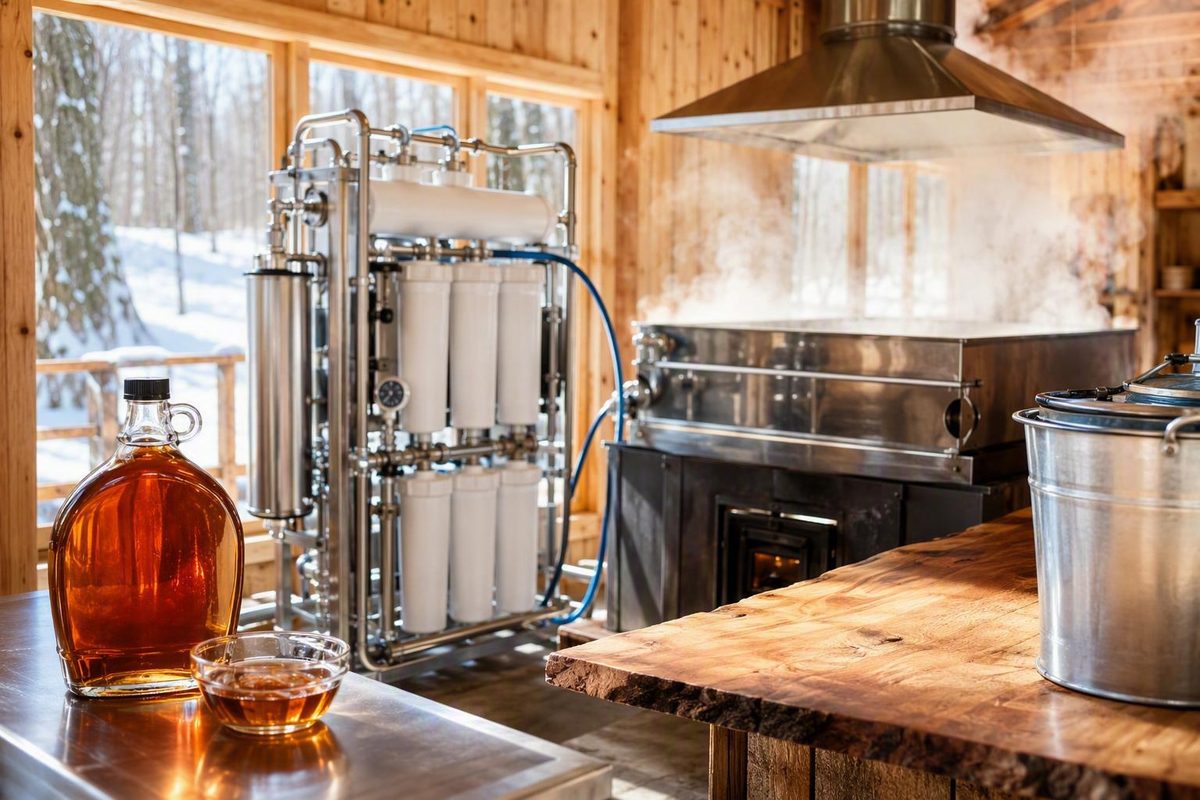
Reverse osmosis can make a long maple boil much more manageable, but membrane labels are poor predictors of real-world sap performance. A system rated for hundreds of gallons per day on warm water may remove water far more slowly from cold, increasingly concentrated maple sap.
The practical way to evaluate reverse osmosis for maple syrup is to work backward: calculate how much water must be removed, determine how many operating hours are available, and compare that requirement with measured permeate production under similar conditions. That approach is more reliable than choosing equipment by tap count, nominal membrane capacity, or an unqualified fuel-savings claim.
What reverse osmosis does in maple syrup production
A maple reverse-osmosis system uses pressure to move part of the water in raw sap through a semipermeable membrane. The process creates two outlet streams:
- Permeate: the water-rich stream that passes through the membrane.
- Concentrate: the sugar-rich sap that remains on the feed side of the membrane.
The concentrate is retained for boiling. This reverses the practical priority of a household drinking-water system, where permeate is normally the desired product and the concentrated stream goes to a drain. Maple producers keep the concentrated sugars and other retained sap constituents, then finish that concentrate with heat, as explained in this overview of maple RO operation.
The essential terms are straightforward:
- Feed sap is the raw or partially concentrated sap entering the system.
- Membrane is the selective barrier through which much of the water can pass under pressure.
- Permeate is the water-rich output.
- Concentrate is the sweeter output retained for further processing.
- Pressure is the force applied to drive water through the membrane against the opposing osmotic pressure.
- Recovery is the fraction of feed volume removed as permeate. If 100 gallons of feed produces 60 gallons of permeate, observed recovery is approximately 60%.
- Crossflow is the movement of concentrate along the membrane surface. Sufficient crossflow helps carry retained material away from the surface.
- Brix is a practical measure of dissolved solids commonly used to approximate sugar concentration in sap and syrup. For simplified planning, 2 Brix is treated as approximately 2% dissolved sugar by mass.
Raw sap near 2 Brix and finished syrup near 67 Brix are useful orientation figures, not universal values for every tree, run, or jurisdiction. Sap sugar changes with weather, season, trees, and collection conditions. Finished-density rules also vary; for example, the University of Maine manual identifies a Maine-specific range of 66 to 68.9 Brix at 68°F rather than establishing a rule for all jurisdictions (University of Maine Cooperative Extension).
RO is therefore a pre-concentration step, not a substitute for making syrup. The concentrate still must be heated to the appropriate finished density. The evaporator also performs functions that a membrane does not reproduce, including controlled finishing through heat.
Removing water before the evaporator reduces the volume that must be boiled. Depending on the actual concentration achieved and the evaporator, that can reduce boiling load, fuel consumption, and operator time—or allow an existing evaporator to handle more daily sap. It is especially useful when collection capacity has outgrown boiling capacity.
Those gains are not free. RO adds a pump, electrical demand, pressure-bearing plumbing, prefilters, membranes, cleaning work, storage procedures, and eventual component replacement. It also shifts some labor from tending the evaporator to filtering, monitoring, flushing, cleaning, and troubleshooting.
Calculate the sap volume left to boil
A simplified sugar mass balance provides a useful first estimate of how much concentrate will remain:
Concentrate volume ≈ Feed volume × Starting Brix ÷ Target Brix
The calculation assumes that the sugar mass remains in the concentrate and treats Brix and volume in a simplified way. Actual measurements can differ because of temperature effects, instrument error, sugar leakage, dissolved-solids behavior, liquid retained in equipment, spills, and other process losses.
For 100 gallons starting at 2 Brix:
| Target concentration | Calculation | Approximate concentrate left | Approximate permeate removed |
|---|---|---|---|
| 4 Brix | 100 × 2 ÷ 4 | 50 gallons | 50 gallons |
| 8 Brix | 100 × 2 ÷ 8 | 25 gallons | 75 gallons |
| 12 Brix | 100 × 2 ÷ 12 | 16.7 gallons | 83.3 gallons |
The pattern produces a useful planning rule: when sugar mass is treated as constant, doubling Brix approximately halves liquid volume. Raising 2 Brix sap to 4 Brix leaves about half the original volume. Doubling again from 4 to 8 Brix leaves about half of the remaining volume, or one-quarter of the original feed.
Here is a second example that can be adapted to a particular run:
- Feed volume: 60 gallons
- Starting concentration: 2.5 Brix
- Target concentration: 7 Brix
60 × 2.5 ÷ 7 = 21.4
The idealized result is approximately 21.4 gallons of concentrate, so about 38.6 gallons of permeate must be removed.
Be precise about what a percentage describes. If 100 gallons becomes 25 gallons, total liquid volume has been reduced by 75%. In the simplified calculation, 75 gallons have left as water-rich permeate. That is not the same as saying the resulting concentrate contains only 25% water; it still consists mostly of water.
Volume reduction also does not produce an identical percentage reduction in fuel cost or elapsed boiling time. The evaporator must still warm and finish the concentrate accurately. Pan design, heat loss, evaporator efficiency, batch size, fire management, and startup and shutdown practices all affect the final result.
During operation, measure all three streams rather than relying only on a refractometer:
Feed volume ≈ Concentrate volume + Permeate volume
A substantial unexplained difference can indicate inaccurate container readings, liquid retained in housings and tubing, overflow, or a leak. Combining a volume balance with starting and ending Brix gives a much clearer view of performance than any single gauge reading.
Why rated GPD is not maple-sap throughput
A membrane marked “100 GPD” or “150 GPD” is not promising to process that amount of maple sap per day. Residential ratings generally describe permeate production from water under specified pressure, temperature, and water-quality conditions.
Maple sap is a different feed. It is cold during much of the season, contains sugar and other dissolved material, and becomes progressively more concentrated. Lower temperature reduces water movement through the membrane. Rising sugar concentration increases osmotic pressure, so the applied pressure must overcome a larger opposing force. Permeate production therefore commonly declines as a batch approaches its target Brix.
High gauge pressure alone does not prove that the system has enough capacity. A restrictive valve, clogged prefilter, narrow tubing, or undersized pump may produce high indicated pressure while supplying inadequate feed flow. The membrane needs an appropriate combination of pressure and crossflow within the documented limits of the pump, membrane, housing, tubing, and fittings.
Actual output is influenced by:
- Sap temperature
- Starting and ending Brix
- Membrane area and type
- Pump output at operating pressure
- Feed and concentrate flow
- Recovery per pass
- Plumbing diameter and restrictions
- Prefilter condition
- Membrane fouling and age
- Number and arrangement of membrane housings
- Gauge location and accuracy
Field reports illustrate the range but are not interchangeable specifications. Cornell Small Farms described one small unit operating at roughly 55–60 psi that removed approximately 4.5–5 gallons of water per hour and raised sap from about 2 Brix to 4–5 Brix. The same author later reported approximately 15 gallons of permeate per hour from a three-membrane system operating at 250 psi, with concentrate reaching about 12 Brix. These were observations from the author’s particular equipment and operating conditions, not guaranteed output figures for other systems (Cornell Small Farms).
A separate hobbyist account reported that four nominal 150-GPD membranes processed roughly 120–140 gallons of sap near 40°F to approximately 7%–8% sugar over 24 hours. The author also reported substantially higher throughput with warmer sap and lower throughput below 40°F. Those results remain configuration-specific observations rather than standardized tests (Mattatuck Madness Maple Syrup).
These examples show that small systems can be useful. They do not establish what another build will produce. Pressure, feed flow, sap temperature, composition, membrane selection, plumbing, valve adjustment, and target Brix were not standardized across the examples.
The most useful performance figure is therefore not nominal GPD. It is:
Measured gallons of permeate removed per hour at a stated sap temperature, starting Brix, target Brix, pressure, recovery, and membrane configuration.
Without those conditions, a throughput number is difficult to apply.
Choose between DIY, packaged hobby, and commercial RO
DIY, packaged hobby, and commercial systems solve different problems. A low purchase price can come with a high assembly and troubleshooting burden. A more complete machine can reduce fabrication work but add freight, electrical, plumbing, space, and proprietary maintenance requirements.
| Equipment tier | Captured or historical price | Typical assembly burden | Documented operating examples | Electrical or infrastructure needs | Maintenance burden | Evidence limitations |
|---|---|---|---|---|---|---|
| DIY residential-membrane build | About $300–$450 in one historical hobbyist account (source) | High: component selection, assembly, leak testing, flow adjustment, and fault diagnosis | Four 150-GPD membranes reportedly handled 120–140 gallons of roughly 40°F sap to 7%–8% in 24 hours | Pump power, protected electrical supply, containers, plumbing, work surface, and freeze protection | Owner manages filters, flushing, cleaning, repairs, and storage | Individual field report; price and output are neither current nor standardized |
| Packaged hobby unit | $799 on a captured vendor page (source) | Lower, but not necessarily setup-free | Vendor claims about 8 gallons of raw sap processed per hour and removal of half the water | Outlet, feed and collection containers, stable work area, and suitable operating conditions | Prefilter and membrane care remain necessary; priming and access can matter | Vendor claims and anecdotal customer reviews |
| Small commercial machine | Captured listings from about $2,900–$3,600 upward | Usually less owner fabrication, though installation may be substantial | Model-specific claims vary with membranes, pumps, pressure, and recirculation | May involve 120 V or 240 V power, freight, plumbing, tanks, floor space, and freeze-protected housing | Model-specific wash routines, filters, preservation, consumables, and service | Retail listings rather than matched independent tests |
DIY residential-membrane systems
DIY builds offer flexibility and often the lowest initial cash outlay. They also require the owner to select a pump, verify its output at operating pressure, match membranes and housings, choose tubing and valves, assemble connections, route both outlet streams, flush new components as instructed, locate leaks, and establish workable concentrate flow.
The approximately $300–$450 figure above comes from one historical hobbyist build estimate. It may omit tools already owned, shipping, spare filters, replacement fittings, electrical protection, containers, controls, gauges, and subsequent price changes.
A retail bundle containing membranes and housings is not a complete maple RO system. A working installation also needs a suitable pump, prefilter and housing, gauge, flow-control valve, tubing, fittings, mounting arrangement, and separate containers or tanks. A membrane’s drinking-water rating or salt-rejection claim does not establish the suitability of the complete assembled system for maple production.
Packaged hobby systems
A packaged hobby unit reduces component selection and fabrication. One captured Vermont Evaporator Company product page listed a price of $799 and claimed that its Sugar Cube ZB processed about 8 gallons of raw sap per hour while removing half the water. Both the price and performance statement are vendor-specific captured claims, not independent test results.
Convenience should not be interpreted as effortless operation. Reviews on the same page include anecdotal reports of leaks, difficult fittings, cramped filter access, priming trouble, and setup involving power, containers, and a work surface. Other reviewers described the unit favorably. Neither group establishes a representative failure or satisfaction rate.
Commercial machines
Commercial listings commonly show larger membrane formats, frames, higher-capacity pumps, flow controls, and—in some models—recirculation. Bascom Maple Farms listed a small 110 V machine at $2,900 on its captured catalog page, with freight quoted separately (Bascom Maple Farms).
Smoky Lake Maple Products separately listed one small system starting at $3,600, with larger models rising substantially from there. The listed models varied in membrane size, pump capacity, voltage, pressure, and recirculation features (Smoky Lake Maple Products).
Starting price is not installed cost. Depending on the machine and site, additional costs may include freight, taxes, tanks, plumbing, electrical work, freeze protection, controls, filters, cleaning products, preservation supplies, and replacement parts.
The available evidence does not support a credible ranking among equipment tiers. There are no matched independent tests comparing throughput, final Brix, energy use, cleaning time, reliability, membrane life, or total ownership cost.
Before buying, obtain written answers for:
- Starting and target Brix used for the quoted performance
- Sap temperature used for the test or estimate
- Feed pressure and feed flow
- Permeate-removal rate, not merely total feed rate
- Required concentrate flow and expected recovery
- Membrane type, size, quantity, and arrangement
- Electrical voltage, current, and plug requirements
- Cleaning, rinsing, preservation, and storage procedures
- Documentation for the intended food-contact use
- Warranty and service terms
- Freight cost and delivery method
- Every included and excluded component
Size a system from daily sap volume—not tap count alone
Tap count is a rough description of an operation, not a capacity calculation. Daily yield per tap varies with weather, collection method, vacuum, tree conditions, sugar concentration, and run timing. Storage capacity and boiling schedules matter just as much.
Start with five inputs:
- Daily gallons of sap collected
- Starting Brix
- Desired target Brix
- Available RO operating hours
- Measured permeate-removal rate under comparable cold-sap conditions
Use the mass-balance formula to estimate concentrate volume, then subtract concentrate from feed to find the required permeate removal.
Sizing worksheet
| Input or result | Your figure |
|---|---|
| Daily feed volume | ___ gallons |
| Starting Brix | ___ |
| Target Brix | ___ |
| Calculated concentrate: feed × starting Brix ÷ target Brix | ___ gallons |
| Required permeate: feed − concentrate | ___ gallons |
| Available operating time | ___ hours |
| Required average permeate rate: required permeate ÷ hours | ___ gallons/hour |
Suppose an operation collects 120 gallons at 2 Brix and wants to reach 8 Brix:
120 × 2 ÷ 8 = 30 gallons of concentrate
Required permeate removal is:
120 - 30 = 90 gallons
If the operating window is 18 hours:
90 ÷ 18 = 5 gallons of permeate per hour
The system must average approximately 5 gallons of permeate per hour over the entire batch—not merely during the first hour on dilute sap. A machine that begins at 6 gallons per hour but declines to 3 gallons per hour as Brix rises may miss the processing deadline.
Add capacity margin for colder sap, falling output near the target Brix, filter changes, flushing, cleaning, setup, shutdown, and unusually productive runs. The appropriate margin depends on how costly or disruptive it would be to carry unprocessed sap into the next day.
Operation can be arranged in several ways:
- One pass: Feed enters once, and concentrate goes directly to storage or the evaporator. The achievable Brix depends on configured recovery and membrane capacity.
- Repeated batch passes: Concentrate is collected and run through the system again. This can suit small operations, although every pass adds handling and permeate production may decline as Brix rises.
- Recirculation: Concentrate returns to a feed or recirculation loop until the target is reached. This maintains movement through the system but requires suitable plumbing, controls, and monitoring.
Trying to remove the maximum possible water in one pass can reduce concentrate flow and increase fouling risk. There is no universal recovery setting: it must come from the membrane and system instructions, supported by measured feed, concentrate, and permeate flow. An archived troubleshooting discussion illustrates how an undersized feed pump and restricted concentrate path can coexist with a high pressure reading, but its participant recommendations are experiential rather than universal engineering specifications (MapleTrader discussion).
Anyone without experience assembling pressurized fluid equipment should consider a complete machine or qualified assistance. A hobby schematic can illustrate component relationships, but the supplied evidence does not establish a universally safe design for every pump, membrane, housing, fitting, or operating pressure.
Core components and a measured operating workflow
Documented small maple RO systems commonly use this functional chain:
- Feed container
- Pressure-rated pump
- Five-micron prefilter
- Pressure gauge
- Membrane housings and membranes
- Concentrate-control valve
- Pressure-compatible tubing and fittings
- Separate permeate and concentrate outlets
- Separate collection containers
The five-micron prefilter appears in documented hobby and commercial examples, but it should not be treated as the only possible specification. Filter material, housing compatibility, capacity, and replacement criteria must fit the actual system.
The feed container holds filtered sap and should support a consistent supply to the pump. The pump must provide the needed flow at operating pressure; maximum pressure by itself is not enough. Where available, use the pump curve to evaluate output at the intended operating point.
The prefilter catches suspended debris before it reaches the membrane. The pressure gauge reports pressure only at its installation point, so its location should be recorded. A reading upstream of a restricted filter is not equivalent to pressure at the membrane inlet.
The membranes and housings provide separation area. Adding nominal membrane capacity does not correct insufficient feed flow. In a series arrangement, later membranes receive more concentrated sap and may produce less permeate.
The concentrate-control valve establishes resistance and helps regulate concentrate flow. Documented hobby systems report that a needle valve permits finer adjustment than a ball valve. Adjustment must remain within the supplier’s limits for the complete system.
Before operation, verify the permitted pressure and temperature for every housing, fitting, tube, valve, pump, gauge, and membrane. Do not infer the limits or food-contact suitability of the complete wetted path from a single component listing. Follow the suppliers’ instructions for flushing new membranes or components; at least one documented hobby system notes that its membranes arrived with preservative that had to be flushed before sap processing.
Batch operating workflow
Use the equipment and membrane instructions as the controlling procedure. A general measurement-oriented workflow is:
- Filter the feed sap.
- Measure and record feed volume, temperature, and Brix.
- Confirm that feed, permeate, and concentrate lines are routed correctly.
- Set the concentrate outlet as directed rather than starting against an unintentionally closed path.
- Prime and start the pump according to its instructions.
- Bring the system gradually into its documented operating range.
- Collect permeate and concentrate separately.
- Record pressure, stream volumes, and elapsed time at regular intervals.
- Recheck concentrate Brix instead of estimating it from pressure or time.
- Stop at the planned endpoint or prepare for another approved pass.
- Flush and clean according to the system and membrane instructions.
A useful performance log looks like this:
| Field | Record |
|---|---|
| Date and batch | |
| Membrane configuration | |
| Feed temperature | |
| Starting Brix | |
| Ending Brix | |
| Feed volume | |
| Permeate volume | |
| Concentrate volume | |
| Gauge location and pressure | |
| Run time | |
| Prefilter condition | |
| Leaks or priming issues | |
| Flush or cleaning action |
Calculate average permeate production as:
Permeate GPH = Measured permeate gallons ÷ Run time in hours
Calculate observed recovery as:
Recovery percentage = Permeate volume ÷ Feed volume × 100
Fresh permeate can be retained for prompt flushing when the equipment instructions permit, but it should not be described as sterile or assumed suitable for indefinite storage.
Cleaning, sanitation, storage, and pressure safety
RO does not compensate for old, warm, or dirty sap. University of Maine Cooperative Extension advises filtering incoming sap, keeping it cool, processing it promptly, keeping filters clean, and following the RO manufacturer’s cleaning process and frequency. The same manual identifies microorganisms, bacteria, and yeast as threats to syrup color and flavor.
Inspect the prefilter according to operating condition rather than assuming one fixed gallon interval will fit the entire season. Falling flow, changing pressure across the filter, visible loading, or deteriorating sap clarity are reasons to check the filter and follow the supplier’s service criteria.
Cleaning chemistry must be model-specific. Cleaner or sanitizer identity, concentration, pH, temperature, contact time, wash direction, and rinse cycle should come from:
- The RO system instructions
- The membrane instructions
- The chemical product label
- Any certification requirements that apply to the operation
Do not copy an incomplete hobby recipe involving chlorine, peroxide, acid, alkali, heated water, or preservatives. Compatibility varies among membranes, seals, housings, pumps, and fittings. Use only products and procedures expressly permitted for the equipment.
Rinse thoroughly after cleaning, sanitizing, or off-season preservation. University of Maine Extension recommends checking rinse-water pH as one way to confirm that membrane soap has been removed before processing more sap. It also directs operators to follow sanitizer-label rinse requirements and manufacturer wash procedures (University of Maine Cooperative Extension).
Fresh permeate can be useful for prompt flushing and equipment cleaning when collected and handled appropriately. Carman Brook Farm, for example, reports retaining permeate to flush RO lines and membranes later the same day; that is a farm-specific operating practice, not evidence that permeate is sterile or indefinitely storable (Carman Brook Farm).
For off-season storage, follow four principles: clean, rinse, preserve, and store according to the membrane and equipment suppliers’ instructions. Protect equipment from freezing where trapped liquid could damage components, following the manufacturer’s winterization procedure.
Pressure, electrical, and chemical precautions
- Follow the system and component instructions before operating or servicing pressure-bearing equipment.
- Switch off the pump and use the documented depressurization procedure before opening a housing or connection.
- Do not exceed the specified pressure or temperature of any component.
- Keep electrical equipment and connections arranged for the wet operating environment as directed by the equipment manufacturer.
- Follow chemical labels for protective equipment, handling, mixing restrictions, and rinsing.
- Stop using leaking, cracked, or otherwise damaged pressure-bearing components and consult the supplier.
- Confirm the intended food-contact use of the complete wetted system.
- Identify any electrical, food-production, certification, or disposal requirements that apply in the operating jurisdiction rather than assuming another producer’s rules apply.
Expect downstream maintenance to change as well. University of Maine Extension states that RO concentrate can accelerate niter accumulation in evaporator pans, requiring more frequent attention to pan cleaning or draw-off practices.
Troubleshoot low flow, poor concentration, leaks, and quality concerns
Troubleshooting should begin with measurements, not an automatic pressure increase. Record temperature, Brix, feed flow, concentrate flow, permeate flow, gauge location, prefilter condition, and valve position before changing the system.
| Symptom | Possible causes | What to check |
|---|---|---|
| High indicated pressure, low permeate flow | Cold sap; high Brix; inadequate pump feed flow; restricted concentrate path; loaded prefilter; fouling; restrictive tubing; misleading gauge location | Measure sap temperature and all stream flows; inspect the prefilter; compare pump output with its curve; verify concentrate flow and gauge location; follow supplier fouling checks |
| Output falls gradually during a batch | Increasing osmotic pressure as sap concentrates; changing temperature; expected decline near target Brix | Compare current Brix and temperature with earlier readings; calculate permeate GPH at intervals |
| Output drops abruptly | Loss of feed; clogged filter; suction-side air; moved valve; obstruction; fouling | Stop and inspect feed level, prefilter, suction path, valve positions, plumbing, and supplier troubleshooting instructions |
| Concentrate Brix stays low | Excess concentrate flow or bypass; incorrect routing; measurement error; membrane problem; target too high for one pass | Verify routing and settings; measure all stream volumes; check refractometer technique; assess whether another approved pass is required |
| Sugar appears in permeate | Membrane not seated; seal failure; damaged membrane; plumbing error; rejection outside supplier limits | Stop processing and follow the supplier’s inspection and rejection-test procedure |
| Active leak | Incomplete tube insertion; damaged tubing; seal or thread problem; cracked housing; excessive pressure; incompatible component | Shut down and depressurize as instructed; inspect the connection and component ratings; replace defective parts before restarting |
| Pump loses prime | Low feed level; suction-side air leak; pump placement; clogged prefilter; incorrect priming | Restore feed, inspect suction connections, and follow the pump manufacturer’s priming procedure |
| Prefilter clogs rapidly | Cloudy sap; collection debris; dirty storage vessels; delayed processing; unsuitable or overloaded cartridge | Assess sap clarity, collection cleanliness, storage time, housing condition, and filter selection |
| Off-flavor or quality concern | Old or warm sap; dirty equipment; cleaning or preservative residue; poor storage; unrelated evaporator issue | Hold the batch; review handling and sanitation records; verify rinsing; inspect the rest of the process |
A gradual decline in permeate flow as Brix rises can be expected. An abrupt decline is more likely to indicate a lost feed supply, clogging, valve movement, air ingestion, or another fault. Comparing current readings with previous batch logs helps distinguish the two.
If sugar is detected in permeate, do not continue merely because the concentrate is becoming sweeter. Stop and investigate membrane seating, seals, membrane damage, line routing, and the supplier-defined rejection check.
Do not normalize active leaks. Stop the pump, isolate power, use the documented depressurization procedure, and inspect the system. Repeatedly tightening a damaged housing is not a substitute for replacing the defective component.
Flavor claims require similar restraint. The available producer accounts and commercial commentary do not establish that RO universally improves or harms maple syrup’s flavor, aroma, color, grade, or mineral profile. Sap condition, sanitation, concentration target, evaporator operation, finishing, and storage can all affect the result.
Stop and consult the system, pump, or membrane supplier when pressure, temperature, chemical exposure, damaged housings, electrical faults, or persistent sugar rejection falls outside documented limits.
The final decision rule is simple: calculate how much water must be removed, divide it by the available processing window, and compare that requirement with measured cold-sap permeate output. Choose a system that can complete the work with operating margin. Disciplined measurement, adequate feed flow, conservative operation, manufacturer-directed cleaning, and complete rinsing matter more than headline GPD or unqualified savings claims.
Frequently asked questions about maple RO
Can I use a household drinking-water RO system for maple sap?
Possibly, but not necessarily in its original under-sink configuration. Small drinking-water membranes have been used to pre-concentrate sap, but the assembled system needs suitable feed pressure and flow, prefiltration, compatible pressure-bearing plumbing, concentrate-flow control, separate outlets, and materials appropriate for the intended process.
Do not remove or alter treatment stages merely by guesswork. Nominal GPD will not equal cold-sap performance, and a small pump may produce pressure without adequate feed flow. Cornell’s account of adapting small RO equipment also cautions that operators without suitable mechanical ability may be better served by completed equipment or qualified assistance.
How many gallons of sap can a small maple RO process per hour?
There is no reliable universal rate. “Gallons of sap processed” can also be misleading because a machine might pass a substantial feed volume while removing relatively little permeate.
Compare systems by gallons of permeate removed per hour under stated conditions. One Cornell field account reported approximately 4.5–5 gallons of permeate per hour from a low-pressure setup and about 15 gallons per hour from a later three-membrane, 250 psi configuration. Those observations used different equipment and concentration targets and should not be treated as universal specifications (Cornell Small Farms).
A packaged hobby-system vendor separately claims approximately 8 gallons of raw sap processed per hour. That is a different measure from permeate production and must be interpreted using the vendor’s stated starting concentration, target concentration, temperature, and water-removal assumptions.
How many times should maple sap pass through an RO system?
As many approved passes as are needed to reach the chosen Brix without exceeding the system’s pressure, temperature, flow, recovery, or concentration limits. Some small operators collect concentrate and run it through again. Other systems recirculate concentrate, while some machines are designed around a specified one-pass result.
Measure Brix and stream volumes after each pass. Expect permeate production to decline as concentration rises. Do not aggressively restrict concentrate flow merely to avoid another pass; the system’s required crossflow and documented operating limits take priority.
Can RO permeate be reused to flush and clean maple equipment?
Fresh permeate can be useful for prompt flushing and cleaning when the equipment instructions permit it. Keep it in a clean container, protect it from contamination, and use it according to the operation’s handling procedure.
Do not describe permeate as sterile or assume it can be stored indefinitely. If a cleaning or sanitizing procedure requires potable water, a specified temperature, or a labeled rinse, follow that requirement rather than substituting permeate automatically.
Does reverse osmosis change the flavor of maple syrup?
The available evidence does not support a definitive universal answer. Some operators report no identifiable difference, while others express preferences about syrup made from sap concentrated to different levels. These accounts are not controlled sensory trials and may be influenced by sap condition, sanitation, evaporator operation, concentration target, finishing technique, storage, or commercial perspective.
Treat flavor as something to evaluate within a controlled production process rather than as a guaranteed benefit or defect of RO. Keep batches comparable, record starting and target Brix, use consistent boiling and finishing practices, and assess finished syrup without knowing which treatment each sample received when practical.