
Water Filter vs Water Softener: Problems Each Treats
A kitchen RO unit does not control scale in a water heater, shower, dishwasher, laundry connection, or any other fixture it does not serve.
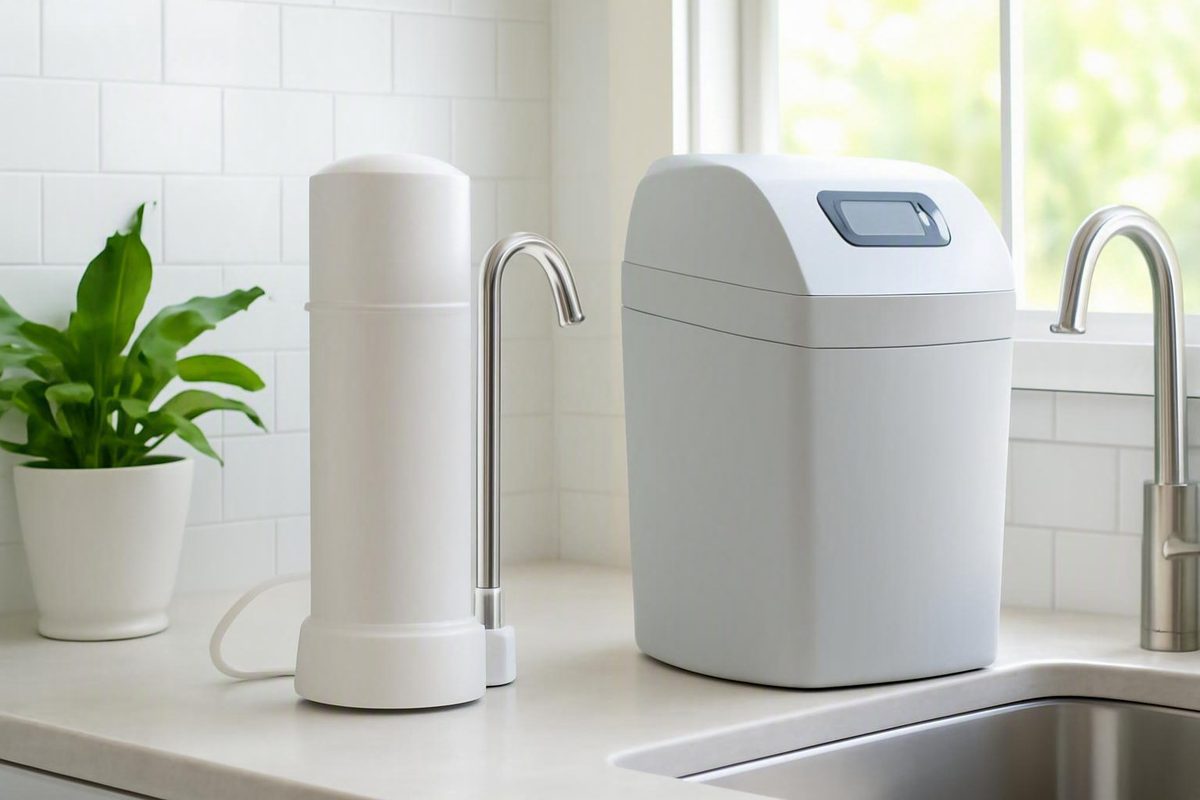
The short answer: hardness calls for softening, contaminants call for targeted filtration
A conventional water softener primarily removes the calcium and magnesium associated with hard water. A water filter or other water-treatment device addresses selected particles, chemicals, tastes, odors, dissolved substances, or microorganisms according to the technology used and the exact product’s documented performance.
Neither is universally better. They solve different problems.
That leads to three practical outcomes:
- Filter only: Testing identifies a filtration concern, but hardness is acceptable.
- Softener only: Measured hardness is causing scale or related household problems, with no separate filtration concern.
- Both: The water has troublesome hardness and a separately confirmed contaminant, particle, taste, odor, or microbial issue.
A conventional softener should not be relied on to remove chlorine, lead, PFAS, bacteria, sediment, or other unrelated drinking-water contaminants. Conversely, most ordinary filters do not remove enough dissolved calcium and magnesium to control hardness throughout a home. These are distinct treatment functions, and any contaminant claim must be verified for the exact model rather than inferred from the product category (Aquasana’s comparison of filters and softeners).
| Comparison point | Conventional water softener | Water filter or treatment device |
|---|---|---|
| Primary target | Dissolved calcium and magnesium responsible for hardness | Selected particles, chemicals, tastes, odors, dissolved substances, or susceptible microorganisms |
| Treatment process | Usually ion exchange using resin, followed by periodic brine regeneration | Technology-specific: particle capture, carbon adsorption, membrane separation, UV inactivation, or specialized media |
| Typical installation scope | Commonly whole-house because hardness affects plumbing and fixtures throughout the home | Point-of-use or whole-house, depending on where treatment is needed |
| What it does not reliably treat | Chlorine, lead, PFAS, bacteria, sediment, and unrelated contaminants | Unless specifically designed for it, whole-home hardness and scale |
| Routine upkeep | Replenish salt or potassium, check brine operation, and maintain the control system | Replace or service cartridges, media, lamps, prefilters, or membranes as specified |
| Notable tradeoffs | Adds sodium or potassium to treated water, needs drainage, and creates regeneration discharge | May reduce flow; media can exhaust; some technologies require electricity or drainage; reverse osmosis produces reject water |
“Water filter” is a broad label. Sediment cartridges, activated-carbon tanks, reverse-osmosis membranes, and ultraviolet units do not perform the same job. UV, for example, is a microbial inactivation process rather than a physical filtration process.
Start with the outcome you need:
- Remove hardness minerals: Consider conventional ion-exchange softening.
- Reduce a named contaminant: Find a system with documentation for that substance.
- Trap visible particles: Consider sediment filtration after investigating their source.
- Address a microbial finding: Evaluate a treatment process specifically documented for microbial inactivation.
- Control scale without removing hardness: Consider conditioning, recognizing that the water remains hard.
- Address multiple confirmed problems: Use compatible treatment stages rather than expecting one device to do everything.
What a conventional water softener actually does
Hard water contains elevated concentrations of dissolved minerals, principally calcium and magnesium. These minerals are associated with white scale, spots on glassware, deposits on fixtures, soap scum, weak lather, and residue in water-using equipment.
Hardness may be reported in grains per gallon, abbreviated GPG, or in milligrams per liter as calcium carbonate. Those units help compare a water result with equipment specifications, but no single number creates a universal obligation to buy a softener. Hardness occurs on a spectrum, and whether treatment is worthwhile depends on the measured level, the household effects, and the owner’s priorities (Consumer Reports’ guide to hard water and softeners).
How ion exchange works
A conventional salt-based softener normally includes a resin tank and a brine system. The process works in stages:
-
Hard water enters the resin tank. Water flows through a bed of ion-exchange resin.
-
The resin captures hardness ions. Calcium and magnesium are exchanged for sodium ions—or potassium ions when potassium chloride is used.
-
Softened water leaves the tank. With much of the calcium and magnesium removed, the treated water is less likely to produce characteristic hardness deposits.
-
The resin reaches its working capacity. It cannot continue exchanging ions indefinitely.
-
The system regenerates. Concentrated brine passes through the resin, displacing accumulated calcium and magnesium and restoring sodium or potassium to the exchange sites.
-
Regeneration water is discharged. The system rinses and returns to service.
The intended results are less scale, spotting, soap scum, and mineral residue, along with improved soap lather. Those changes do not demonstrate that an unrelated drinking-water contaminant has been removed.
Salt-based softeners also create an ongoing ownership burden. They need installation space, a suitable drain, regeneration cycles, replenishment salt or potassium, and periodic checks. If hardness begins appearing after treatment, the equipment or its salt supply may need attention.
Because ion exchange replaces calcium and magnesium with sodium or potassium, the treated water contains more of the replacement ion than the untreated supply. The amount is not universal. Anyone managing a medically prescribed sodium restriction should discuss the household’s measured water and treatment plan with an appropriate clinician rather than relying on a general online estimate (Consumer Reports on sodium and softened water).
A softener is therefore best understood as a plumbing-wide hardness appliance. It can be valuable when measured hardness is causing enough scale and cleaning trouble to justify the space, salt, drainage, and maintenance. It is not a substitute for contaminant testing or contaminant-specific treatment.
What a water filter does depends on the technology
“Water filter” is an umbrella term, not one treatment method. A broad list of substances that filters may address must never be interpreted as a list that every filter removes.
The useful question is:
What process does this exact model use, what named substance is it documented to address, under what operating conditions, and for what rated capacity?
Technology matrix
| Technology | Main function | Commonly considered for | What it should not be confused with |
|---|---|---|---|
| Sediment filtration | Physically traps suspended particles | Sand, silt, rust flakes, dirt, and other visible material | Removal of dissolved hardness or dissolved chemicals |
| Activated carbon | Adsorbs selected substances onto carbon media | Chlorine-related taste and odor and some chemicals, depending on design | Universal contaminant removal, softening, or microbial treatment |
| Reverse osmosis | Uses pressure to move water through a semipermeable membrane | Many dissolved substances and some hardness at the treated fixture | Proof that every contaminant is removed or whole-house softening |
| Ultraviolet treatment | Exposes water to UV energy to inactivate susceptible microorganisms | An appropriately identified microbial concern | Removal of dissolved chemicals, salts, hardness, or particles |
| Specialized media | Uses a process selected for a named water-quality problem | Particular substances supported by the media and system documentation | A generic solution that works regardless of water chemistry |
These technologies perform different functions, as commercial treatment overviews also acknowledge (APEC’s overview of filtration technologies).
Sediment filtration
Sediment filters trap suspended material such as sand, silt, dirt, and rust. Performance depends on the filter design, particle characteristics, flow, water use, and loading.
A sediment cartridge may improve clarity or protect downstream equipment from particles. It ordinarily does not remove dissolved calcium and magnesium, so it should not be expected to stop whole-home hardness scale.
Filtration also does not automatically correct the source of the particles. Rust may be associated with plumbing, while sand or silt may originate in a well or supply system. Source investigation and particle treatment are related but separate tasks.
Activated carbon
Activated carbon is commonly used for chlorine-related taste and odor and selected chemicals. Water contacts the carbon media, where particular substances are adsorbed.
Capability varies by carbon type, system design, flow, water conditions, contaminant concentration, and remaining media capacity. A small faucet cartridge and a large whole-house carbon tank should not be assumed to provide equivalent treatment simply because both contain carbon.
Carbon is also not an ordinary hardness solution. It generally does not remove enough calcium and magnesium to soften a home.
Reverse osmosis
Reverse osmosis, or RO, uses pressure to move water across a semipermeable membrane. Depending on the membrane, system design, feed water, and maintenance, it can reduce many dissolved substances and some hardness at the treated tap. Exact claims are model-specific.
RO is commonly used at a point of use, such as a dedicated drinking-water faucet. It requires cartridge and membrane service, sufficient operating pressure, and a route for reject water.
A large marketing list is not proof that a particular RO system addresses every substance on that list. The exact model’s documentation must name the relevant reduction claim.
Ultraviolet treatment
UV treatment exposes water to ultraviolet energy to inactivate susceptible microorganisms. It does not physically remove dissolved chemicals, salts, hardness minerals, or suspended particles.
Its purpose is therefore different from sediment capture, chemical adsorption, or hardness removal. A UV unit should be evaluated as a microbial treatment device rather than as a universal “purifier.”
How to verify an exact-model claim
Before buying, ask for documentation that identifies:
- The complete model number
- The named substance or treatment claim
- Whether the documentation applies to the complete system rather than only one component
- Rated capacity
- Required flow and pressure
- Conditions under which the claim applies
- Replacement or service instructions
- How the owner will know when service is due
Keep the treatment terms separate. A particle may be trapped, a chemical concentration reduced, a susceptible microorganism inactivated, hardness minerals removed, or scale formation inhibited. Those outcomes are not interchangeable.
Treat household clues as prompts for testing, not diagnoses
White scale, spotted glassware, soap scum, weak lather, and chalky mineral residue are common clues associated with hardness. When several appear together, a hardness test is a sensible next step.
Other observations are less specific. Taste, odor, color, staining, dry-feeling skin, and low pressure can have multiple causes. They do not identify a particular contaminant or prove which treatment technology is appropriate.
For example:
- A chlorine-like odor may prompt investigation of the water supply and possible carbon treatment, but odor alone does not identify the right carbon system.
- A sulfur-like odor does not establish one source or one treatment.
- Orange or reddish staining can justify further investigation but does not prove that an ordinary sediment filter or softener will solve the problem.
- Visible particles may originate in source water, plumbing, a water heater, or disturbed supply lines.
- A microbial concern cannot be evaluated reliably by appearance or taste.
- Low pressure may reflect plumbing, a pressure-system problem, loaded treatment equipment, scale, or another cause.
- Discoloration may be temporary or may originate in the supply or building plumbing.
Commercial symptom guides likewise connect scale and weak lather with hardness while recommending confirmation through testing (Comfort Experts’ hardness symptom and testing guide). The useful part of a symptom is that it tells you what to investigate—not what to buy.
If you receive municipal water
Begin with the water utility’s Consumer Confidence Report. Compare that information with the concern at your home’s tap.
A system-wide report may not explain a problem created after water enters a building. If an issue appears at only one fixture or only in hot water, investigate that distinction before purchasing whole-house equipment.
If you use a private well
A private well may have more than one water-quality issue. The appropriate testing depends on the concern and the conditions at the property. For unresolved or safety-related questions, use testing appropriate to the named concern rather than relying solely on a seller’s demonstration or a limited screening kit; commercial well-water guidance also recommends laboratory-grade characterization before treatment selection (NH Tap’s testing-first comparison).
A basic field kit may provide preliminary hardness information. It should not be treated as proof that every possible water-quality concern is absent.
Pre-purchase information checklist
Collect the following before requesting proposals:
- Water source: municipal supply or private well
- Measured hardness and its units
- Any named substance found by testing and its reported concentration
- Whether the issue occurs at every tap, one fixture, or only with hot water
- Visible particle characteristics
- Relevant taste, odor, staining, or microbial test results
- Expected household flow needs
- Existing pressure or plumbing limitations
- Available installation space, drainage, and electricity
- Current treatment equipment and maintenance history
When low pressure, particles, or discoloration could originate in plumbing or the water source, investigate that possibility first. Adding a filter may change the symptom without identifying why it occurred.
A test-first decision guide: filter, softener, or both
Turn the water filter vs water softener decision into two separate questions:
- Is measured hardness causing an unacceptable scale or household problem?
- Has testing identified another substance or condition that requires treatment?
Answering them separately prevents all water-quality concerns from being treated as one problem.
Scenario 1: Hardness only
If testing confirms hardness and the practical problem is scale, spotting, soap scum, or poor lather, consider a whole-house ion-exchange softener.
“Consider” matters. Hard water does not create a universal obligation to buy equipment. Decide whether its effects justify the installation space, salt or potassium, regeneration discharge, and maintenance.
The selected unit must also fit the household’s required capacity and flow. A universal sizing rule is not appropriate across every home and product.
Scenario 2: Acceptable hardness with chlorine taste or odor
If hardness is acceptable but the household objects to chlorine-related taste or odor, an activated-carbon system with appropriate documentation may fit the objective. A conventional softener would target the wrong substance.
Scope depends on where treatment is wanted. A point-of-use device may be enough for one drinking-water tap, while a whole-house objective requires equipment intended for the home’s broader flow.
Scenario 3: Particles without hardness
If water contains sand, silt, rust, or other suspended material but is not objectionably hard, investigate the source and evaluate suitable sediment filtration.
Select the filter according to the identified particle problem, required flow, rated capacity, and acceptable pressure. Do not assume that every sediment cartridge performs the same way.
Scenario 4: A drinking-water concern at one tap
When testing identifies a substance and the goal is to treat drinking and cooking water at one location, compare point-of-use products documented for that substance.
Whole-house equipment may be unnecessary when the treatment objective is limited to one faucet. Conversely, a point-of-use unit cannot treat fixtures it does not serve.
Do not select a product because it is labeled “advanced,” “premium,” or “multi-stage.” Match the exact model’s documented claim to the named concern.
Scenario 5: Hardness plus a separately confirmed contaminant
If a home has troublesome hardness and a separate contaminant concern, both softening and filtration may be justified. One system should not be forced to perform a job it was not designed to do.
For example, whole-house softening could address plumbing-wide scale while a documented point-of-use system addresses a named drinking-water concern at the kitchen sink.
Scenario 6: A private well with multiple findings
A private well with hardness plus sediment, iron, odor, manganese, or a microbial finding should not be treated as a simple choice between one generic filter and one softener.
Ordinary inline filters and softeners have limited, distinct roles. Commercial service guidance similarly cautions that well water with several problems may require more than either device alone (National Water Service’s inline-filter and softener comparison).
Base the proposal on the actual findings and the documentation for each proposed treatment stage. A packaged filter-softener bundle is not proof that every identified issue has been addressed.
Scenario 7: A renter or space-limited household
If the concern is limited to drinking water, point-of-use treatment may be more practical than permanent whole-house equipment. It avoids the tanks, drainage, and plumbing changes associated with many whole-house systems.
Renters should still match the product to the water result. Portability does not make a filter universal, and an under-sink or countertop device cannot correct hardness throughout a building.
Final feasibility screen
Before committing, confirm:
- Required flow
- Expected pressure loss
- Rated treatment capacity
- Available plumbing and installation space
- Drainage needs
- Electrical requirements
- Consumable availability and cost
- Maintenance responsibilities
A treatment process can be appropriate in principle but still be a poor purchase if it cannot supply the needed flow, fit the site, or receive timely service.
Reverse osmosis and salt-free conditioners: two commonly confused alternatives
Reverse osmosis and salt-free conditioning are often presented as alternatives to conventional softening. Each can serve a purpose, but neither should automatically be treated as an equivalent whole-house softener.
Can reverse osmosis soften water?
Point-of-use RO can reduce many dissolved substances and some hardness in the water delivered by one fixture. In that limited sense, water from the RO faucet may contain less calcium and magnesium.
That is not the same as whole-house softening. A kitchen RO unit does not control scale in a water heater, shower, dishwasher, laundry connection, or any other fixture it does not serve.
Follow the exact model’s stated feed-water and maintenance requirements rather than assuming that every installation needs the same pretreatment.
RO also creates a reject-water stream and requires cartridge and membrane service.
Choose RO when its documented performance matches a named point-of-use objective—not simply because an advertisement lists many substances.
Is a salt-free conditioner a softener?
A salt-free conditioner is intended for scale control. Instead of removing calcium and magnesium through conventional ion exchange, it aims to alter how hardness minerals behave so they are less likely to form adherent scale.
Conditioned water is therefore not conventionally softened water. It may still test as hard because the calcium and magnesium remain present. Commercial descriptions of the technology likewise distinguish scale inhibition from hardness-mineral removal (LifeSource’s explanation of conditioning versus softening).
Frame the choice around the desired result:
- Want calcium and magnesium removed? Consider conventional ion-exchange softening.
- Want scale inhibited while retaining hardness minerals? Evaluate a conditioner’s documented performance.
- Want a named drinking-water substance reduced? Choose contaminant-specific treatment.
- Want more than one outcome? Multiple compatible stages may be needed.
Do not assume a salt-free system is maintenance-free, universally effective, environmentally superior, or suitable for every water condition unless the exact product’s documentation supports those claims. It is equally misleading to judge a conditioner as a failed softener when it was not designed to produce a low hardness reading.
Whole-house versus point-of-use treatment—and how combined systems fit together
Whole-house treatment, also called point-of-entry treatment, is installed on the incoming supply to serve most or all fixtures. Point-of-use treatment serves a specific location, such as an under-sink unit or dedicated drinking-water faucet.
Treatment scope should follow where the problem matters.
Hardness affects water heaters, showers, dishwashers, laundry connections, and fixtures throughout a home. That is why conventional softening is normally considered whole-house treatment. A device at the kitchen sink cannot control scale elsewhere.
A drinking-water concern may have a narrower objective. If treatment is wanted only for drinking and cooking water, a point-of-use system may avoid processing water used for toilets, laundry, or outdoor cleaning. If the objective covers most fixtures, point-of-use treatment will not provide that scope.
Examples of combined treatment trains
A combined design might include:
- Sediment filtration where particles are confirmed
- Whole-house hardness treatment for plumbing-wide scale
- Point-of-use RO for a verified dissolved drinking-water concern
- Specialized treatment documented for another named finding
- UV where an identified microbial concern calls for an appropriate inactivation process
These are examples of functions, not a universal installation order.
Sequence depends on the water conditions and the requirements of the exact components. One stage may be used to protect another, but the correct arrangement cannot be determined from a generic slogan such as “filter first” or “softener first.”
For a multi-stage system:
- Confirm that every component is intended for the water it will receive.
- Check the required flow and pressure for the complete arrangement.
- Follow each manufacturer’s installation and service instructions.
- Make sure required drainage and electricity are available.
- Preserve practical access for cartridge changes, salt filling, and other service.
- Use qualified design assistance when the findings or proposed system are complex.
Plan bypasses deliberately
Some households choose not to treat outdoor faucets or irrigation water. Others may retain an untreated kitchen cold-water line when sodium addition is a concern.
These are options, not universal requirements. The decision depends on the treatment objective, plumbing layout, outdoor demand, and drinking-water preference. Clearly document which fixtures receive treated water.
Compare the ownership burden before buying
The purchase is only the beginning. Filters and softeners remain useful only when their service requirements are understood and followed.
Routine work for a conventional softener
Typical responsibilities include:
- Replenishing sodium chloride or potassium chloride
- Checking the brine tank and salt condition
- Confirming that regeneration occurs
- Keeping the required drain path functional
- Investigating unexpected hardness after treatment
- Servicing the equipment when needed
Regeneration creates discharge containing salts and captured hardness minerals. Chloride discharge is a wastewater concern, and restrictions on salt-based softeners or their discharge exist in some locations. Check the applicable local requirements before installation.
Routine work for filters and other treatment devices
Maintenance depends on the technology:
- Sediment cartridges require cleaning or replacement as they load with particles.
- Carbon cartridges or media must be serviced before exhausted capacity compromises the intended performance.
- RO systems need prefilter, postfilter, and membrane attention according to the model.
- UV equipment requires the service specified by its manufacturer.
- Specialized media may require replacement or other model-specific maintenance.
Service frequency depends on equipment design, water use, water conditions, contaminant or particle loading, and rated capacity. A universal replacement schedule can be too early for one system and too late for another.
RO systems discharge reject water. Used cartridges, membranes, lamps, or media also eventually require disposal. Those tradeoffs should be compared with softener salt use and regeneration discharge, but neither category is automatically preferable. The relevant comparison is between systems capable of meeting the actual objective.
Buyer checklist
Before accepting a quote, obtain clear answers to these questions:
- Water results: What was tested, when, and by whom?
- Treatment objective: Is the system removing hardness, reducing a named substance, trapping particles, inactivating microorganisms, or inhibiting scale?
- Installation scope: Which fixtures will receive treated water?
- Documented claim: Does the complete model have documentation for the named concern?
- Capacity: How is capacity defined, and what service is required when it is reached?
- Flow: Can the system support expected household demand?
- Pressure: What operating pressure is required, and how will the equipment affect flow?
- Installation needs: Does it require drainage, electricity, additional space, or a dedicated faucet?
- Consumables: Which salts, cartridges, lamps, media, or membranes must be purchased?
- Service: Can the owner perform routine maintenance, or is a technician required?
- Performance checks: How will the household know when service is due or treatment is no longer effective?
- Warranty: What equipment, labor, water conditions, and maintenance obligations are covered?
- Local requirements: Are restrictions relevant to the proposed softener or its discharge?
- Failure mode: Could the treatment claim lapse without an obvious change in taste, odor, or appearance?
Avoid universal claims about purchase prices, annual savings, equipment life, or payback. Installed and operating costs vary with capacity, plumbing, drainage, electrical work, labor, water use, and consumables.
The cheapest system is not economical if it treats the wrong problem, cannot provide the required flow, lacks documentation for its claim, or will not be maintained correctly.
Frequently asked questions
Will a water softener make my drinking water safer?
Not by default. A conventional softener removes calcium and magnesium through ion exchange. It is not broad protection against lead, PFAS, chlorine, bacteria, sediment, or other unrelated contaminants.
Whether additional treatment is warranted depends on the water results. If testing identifies a concern, choose a system with a documented claim for that named substance. Improved lather or reduced scale does not prove that contaminants have been removed.
Can a water filter remove calcium and magnesium or stop hard-water scale?
Some technologies can reduce hardness in limited applications. Point-of-use reverse osmosis, for example, can reduce some calcium and magnesium at the fixture it serves.
Most ordinary sediment and carbon filters do not remove enough dissolved calcium and magnesium to solve plumbing-wide hardness. A salt-free conditioner may inhibit scale, but that is different from removing the hardness minerals.
Do I need both a water filter and a water softener?
Only when there is both a hardness problem worth treating and a separate filtration or treatment concern.
A softener alone may be sufficient for confirmed hardness and scale. A suitable filter may be sufficient when hardness is acceptable but a named substance, chlorine-related taste or odor, or sediment needs treatment. Use both when the water results establish both categories of problems.
Is a salt-free water conditioner the same as a water softener?
No. A conventional ion-exchange softener removes calcium and magnesium and replaces them with sodium or potassium. A salt-free conditioner aims to inhibit scale without removing those hardness minerals.
Conditioned water can therefore continue to produce a hard-water test result. Choose conditioning for documented scale inhibition and conventional softening when hardness removal is the objective.
Can reverse osmosis replace a whole-house water softener?
Usually not. A typical point-of-use RO system treats one fixture. It may reduce some hardness in water from that faucet, but it does not protect the water heater, showers, dishwasher, laundry equipment, or other plumbing from scale.
A household with plumbing-wide hardness and a separate point-of-use drinking-water concern may use both technologies, provided each has a defined purpose and the installation meets the products’ requirements.
The bottom line: Choose a conventional softener when measured hardness is causing scale problems worth treating. Choose a filter or treatment device documented for a named substance when filtration or inactivation is the goal. Use both only when testing confirms both categories of problems. Decide where treatment is needed, verify the exact model’s claim, and account for maintenance and discharge before buying. Do not diagnose water from appearance, taste, odor, or household symptoms alone.