
Well Pump Sediment Filter: Placement, Flow and Pump Protection
Place a well-water sediment filter without isolating pump controls. Compare household filtration, tank protection and pump-intake sand separation.
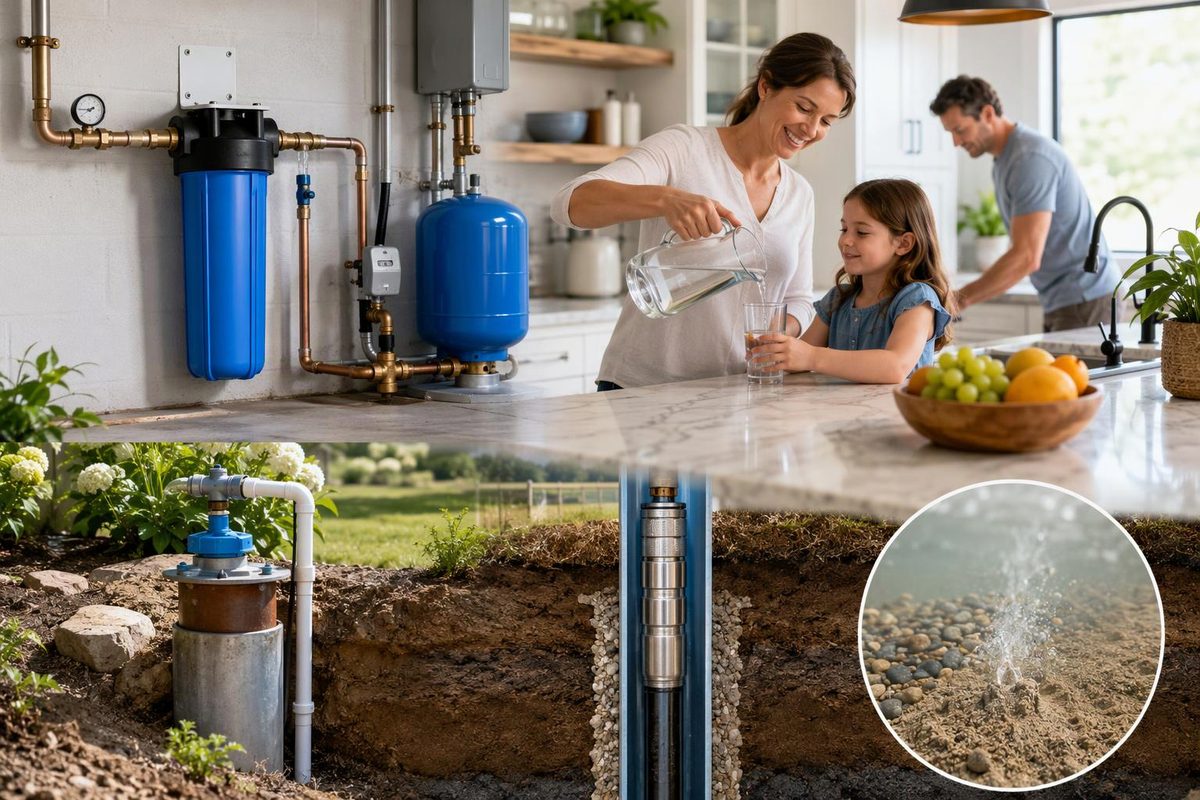
For a conventional submersible well pump with a pressure tank and pressure switch, install an ordinary sediment cartridge filter after the pressure tank’s connection to the house supply—not between the pump and tank. That keeps a clogging cartridge out of the path between the pump and its pressure controls. Boshart’s installation guidance explicitly warns against the upstream arrangement.
Also separate two jobs: a household sediment filter catches particles after they have passed through the pump. It cannot protect the pump’s internal components from incoming sand. A compatible downhole sand separator is one option for separating sand before it reaches the pump intake.
Keep the filter downstream of the tank and controls
A typical arrangement is:
Well pump discharge → tank tee with pressure-tank connection, pressure switch, gauge and relief valve → sediment filter → downstream treatment and household plumbing
The tank usually connects through a tee; this does not mean that all household water passes through the tank vessel. Keep the tank and pressure switch close together as specified by the equipment manufacturer. Amtrol’s Well-X-Trol instructions recommend locating the tank as close as possible to the pressure switch to reduce friction-loss and elevation effects.
An ordinary cartridge installed before that assembly creates a specific failure risk:
- Water use lowers tank pressure, so the switch starts the pump.
- A clogged cartridge restricts water reaching the tank.
- Pressure rises on the pump side, but the downstream switch may not sense enough pressure to stop the pump.
- The relief valve at the tank tee may also be isolated from that excessive pressure.
Boshart warns that this arrangement can damage both the pump and filter. A relief valve downstream of the obstruction is not a substitute for correct filter placement.
If your installation uses a jet pump, variable-speed controller, remote pressure sensor or unusual tank arrangement, have a well professional check the control layout before moving components. Do not relocate the pressure switch simply to make an upstream filter fit.
Which equipment protects what?
| Your goal | Appropriate approach | Placement distinction |
|---|---|---|
| Keep sand and silt out of fixtures and downstream treatment | Sediment cartridge; a flushable screen stage first when coarse sediment loads are heavy | Ordinary household filtration belongs downstream of the tank/control assembly |
| Keep settleable sand out of the pressure tank | A purpose-built centrifugal separator whose instructions approve that location | Some screenless separators are designed for installation between pump and tank |
| Keep abrasive sand from entering a submersible pump | A compatible downhole pump-protection separator | Separates sand before water reaches the pump intake |
The upstream separator exception is device-specific
A screenless centrifugal separator is not interchangeable with a cartridge housing or a screened spin-down filter. For example, the LAKOS SandMaster installation guide specifically requires installation between the pump and pressure tank, with the check valve before the separator and the pressure switch between the separator and tank.
That approval applies to the specified separator—not to any product advertised as a “sand filter.” Follow its flow range, purging and pressure-monitoring instructions. It still receives water after the pump, so it does not remove sand before that sand reaches the pump’s internal components.
For intake protection, LAKOS’s SUB-K guidance describes downhole centrifugal separation before the pump intake. Selection requires checking well inside diameter, pump flow range, water level, pump depth and pump/motor dimensions. This is a well-system compatibility decision, not a cartridge swap.
Size the household filter for flow, not pump horsepower
Choose a downstream cartridge by peak simultaneous demand in gallons per minute (GPM). Pump horsepower, tank gallon capacity and daily water consumption do not establish the cartridge’s required service flow.
Check the cartridge’s published pressure drop at that demand, then select a compatible housing and connections. Allow capacity for sediment loading: a clean cartridge’s flow rating does not describe its performance after it has accumulated solids. Boshart’s selection guide recommends determining the cartridge type and flow requirement before choosing the housing.
There is no pump-specific “best” micron rating. Match particle capture to the sediment and downstream equipment’s requirements. With heavy sand loads, a coarse flushable stage before the cartridge can reduce cartridge loading; keep this household arrangement downstream of the tank and controls. Boshart’s screen-filter guidance describes this coarse-to-fine pairing. For cartridge comparisons, see our sediment-filter guide.
Do not apply “bigger is better” indiscriminately to centrifugal separators. They operate within specified flow ranges; LAKOS says to size its SandMaster by system flow rather than pipe size.
Monitor restriction without changing pump settings
Install service isolation valves—and a bypass if appropriate—around the downstream filter, without isolating the pump from its tank and controls. Leave access for bowl removal and screen purging.
Pressure gauges immediately before and after the filter make restriction easier to track. Record both readings with a clean cartridge while water is flowing, then compare later readings at a similar flow. The difference is the filter’s pressure drop. Follow the cartridge manufacturer’s replacement threshold and time limit rather than waiting until household flow nearly stops. Boshart’s pressure-differential method explains this monitoring approach.
If household flow deteriorates and the measured pressure drop across the filter has increased, check filter restriction before blaming the pump. Those gauge readings alone do not diagnose the entire well system. Rapid pump cycling, failure to reach shutoff pressure or newly heavy sand production calls for a well-system inspection—not a higher pressure-switch setting.
Before opening a housing, isolate it and release trapped pressure according to its instructions. Boshart’s cartridge-replacement instructions describe shutting off the supply and relieving housing pressure before removing the bowl.
Sediment removal does not establish drinking-water safety: test the well and select any contaminant treatment separately. Boshart’s selection guidance warns that ordinary filtration does not make microbiologically unsafe water safe.