
Whole-House Reverse Osmosis Water Filter: When It Fits
Decide whether whole-house RO fits your water, then check daily output, peak flow, storage, reject water, plumbing compatibility and upkeep.
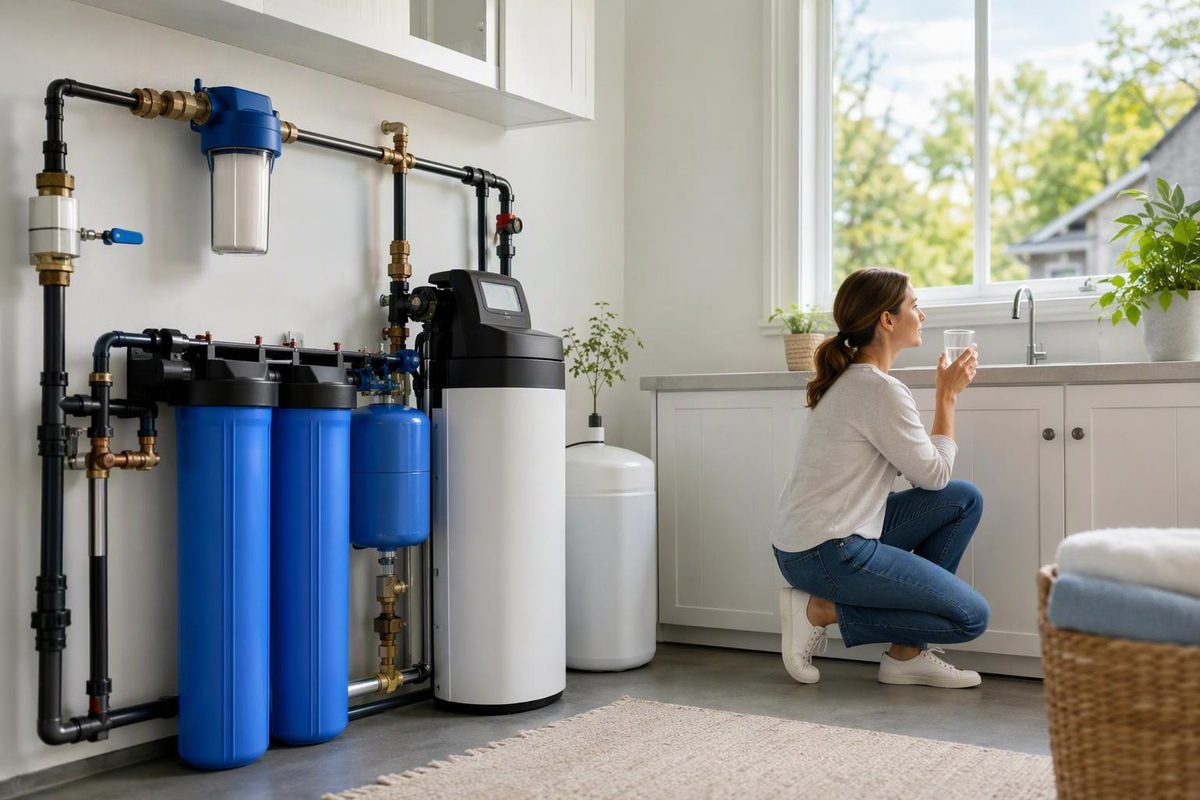
Whole-house reverse osmosis is worth evaluating when a measured dissolved-contaminant problem warrants treatment throughout the home—not simply because you want better drinking water. For a kitchen-only concern, point-of-use treatment is usually the more practical starting point. EPA advises matching treatment to the water’s intended use and avoiding oversized systems; whole-house treatment processes water for showers, laundry and toilets as well as drinking. EPA’s selection guide
A whole-house RO installation is not just a larger cartridge filter. A storage-based system must produce enough treated water each day, store enough for demand peaks and deliver that water at usable pressure.
First decide whether RO belongs at the main inlet
Start with your utility’s Consumer Confidence Report or a state-certified laboratory test for a private well. Get additional household testing where the report cannot answer the concern. Identify the contaminant and its concentration before choosing treatment. EPA water-quality guidance
| Measured problem or goal | Starting point to compare | Why whole-house RO may be unnecessary |
|---|---|---|
| Sediment or grit | Sediment filtration | Suspended particles do not by themselves establish a need for dissolved-solids reduction. |
| Chlorine taste or odor | Carbon filtration with a verified chlorine-reduction claim | Taste adjustment does not require RO throughout the house. |
| Hardness and scale | Whole-house ion-exchange softener | A softener directly targets calcium and magnesium hardness. |
| A drinking-water contaminant that an RO model is verified to reduce | Point-of-use RO | Treating kitchen water may meet the goal without treating every fixture. |
| Dissolved salts or multiple dissolved contaminants, with a demonstrated need for treatment at all fixtures | Professionally designed whole-house RO | Laboratory results and required finished-water quality must drive the design. |
These distinctions follow EPA’s treatment comparison and NSF’s explanation of filtration and softening standards.
A TDS reading alone is not a safety assessment. Total dissolved solids is an aggregate measurement, not identification of a particular contaminant. NSF/ANSI 58 requires TDS reduction testing, while claims such as nitrate, lead and fluoride reduction are optional. Verify the exact claim rather than interpreting a low TDS number as proof of safe water. NSF/ANSI 58 requirements
For hardness plus a separate drinking-water concern, compare whole-house softening with kitchen RO before specifying whole-house RO.
What the installation needs beyond the membrane
A storage-based arrangement can include pretreatment, an RO module, an atmospheric storage tank and a repressurization pump. Post-treatment may include water-chemistry adjustment and disinfection, depending on the design.
For example, US Water Systems’ Defender installation instructions describe a sediment prefilter, membrane feed pump, tank-level controls, storage tank, delivery pump and downstream UV unit. That is an example of a complete system architecture, not a universal equipment list or product recommendation. Manufacturer installation instructions
Three design checks matter:
- Protect the membrane. Pretreatment must match the feed water and membrane limits. Sediment can foul membranes; chlorine can damage thin-film-composite membranes; hardness may require softening or another engineered scale-control approach. University of Nebraska–Lincoln Extension
- Check finished-water chemistry and plumbing compatibility. RO-treated water can be more corrosive than untreated water. Have the designer evaluate pH, alkalinity and downstream materials, and specify any needed stabilization rather than assuming a generic remineralization cartridge solves the problem. Extension’s plumbing warning
- Specify microbial protection separately. Do not assume an RO membrane replaces a well-disinfection plan or protects stored water indefinitely. Extension warns against relying on household RO alone for microbiologically contaminated feed water. Extension guidance
Main-inlet treatment cannot remove lead added by plumbing downstream of it. If lead comes from in-home pipes or solder, treatment as close to the drinking-water faucet as possible is the better approach. Whole-house RO also needs particular care because changes in water chemistry can increase metal leaching. Michigan State University Extension’s lead and corrosion guidance
Size daily production, storage and peak flow separately
Gallons per day (GPD) is not fixture flow in gallons per minute (GPM). A large daily-production number does not establish that a system can supply simultaneous showers and appliances.
Ask for three separate figures:
- Expected production at your actual feed conditions, in gallons/day or gallons/hour—not just the nominal rating. Temperature, pressure, dissolved-solids concentration and membrane condition affect production. Extension’s performance explanation
- Usable stored volume, in gallons, accounting for operating water levels and the required reserve.
- Delivery-pump flow at the required pressure, in GPM at psi, including downstream treatment pressure losses.
A hypothetical example shows the distinction: 1,440 GPD equals 1 GPM averaged over 24 hours. If the RO module were producing continuously at 1 GPM while household demand reached 8 GPM for 20 minutes, the tank would supply 140 gallons of the deficit: (8 − 1) × 20. That excludes reserve and is not a recommended tank size.
The installer should account for time when production stops, including pretreatment regeneration or backwash, and check how quickly storage recovers between demand peaks. Confirm that the source can sustain the required feed flow. For well-specific testing and pump checks, see well-water whole-house system sizing.
Calculate reject water from the proposed recovery
Recovery is the share of incoming water that becomes treated water:
Recovery (%) = treated-water volume ÷ feed-water volume × 100. Extension definition
At an assumed 50% recovery, producing 300 gallons/day requires 600 gallons/day of feed and generates 300 gallons/day of reject water. At 75% recovery, the same output requires 400 gallons/day of feed and produces 100 gallons/day of reject water. These are arithmetic examples, not promised operating rates.
Request the proposed recovery for your water, plus flushing and pretreatment water use. Confirm an acceptable drain route and, where relevant, septic-system capacity; RO reject water adds hydraulic load. Extension wastewater guidance
Do not apply kitchen-system efficiency claims to whole-house equipment. EPA’s WaterSense RO specification covers point-of-use systems; its limit of 2.3 gallons of reject water per gallon treated is not a whole-house performance guarantee. EPA WaterSense
What a complete quote should contain
Ask for a written proposal covering:
- Feed-water test results, operating limits and target finished-water concentrations.
- Evidence supporting each contaminant-reduction claim for the proposed equipment and conditions.
- Pretreatment, actual production, usable storage and delivery flow at pressure.
- Reject-water disposal, electrical work and plumbing modifications.
- Startup testing, tank sanitation, filter and membrane service, and any UV maintenance.
- Alarm behavior and what happens during low water level, power loss or treatment failure.
- Installed cost and annual allowances for consumables, water, electricity and service.
“NSF-certified components” is not proof that the entire installation reduces your contaminant. NSF/ANSI 58 addresses point-of-use RO systems and components; verify what the certification actually covers and require evidence for the whole-house design. NSF’s scope and claims
Set maintenance intervals from the manufacturer’s instructions and actual water conditions. Include treated-water testing for the target contaminant—not only a TDS check—and a sanitation plan. Filters, membranes and treatment units need ongoing attention to remain effective. EPA maintenance guidance
If the only water requiring RO is for drinking, cooking or filling a brew kettle, compare an under-sink RO system before committing to storage, pumps and maintenance for the entire house.