
Under-Sink Reverse Osmosis Water Filter: Fit, Flow and Upkeep
Compare tank and tankless under-sink RO filters by usable output, feed limits, cabinet fit, reject water and upkeep—including brewing needs.
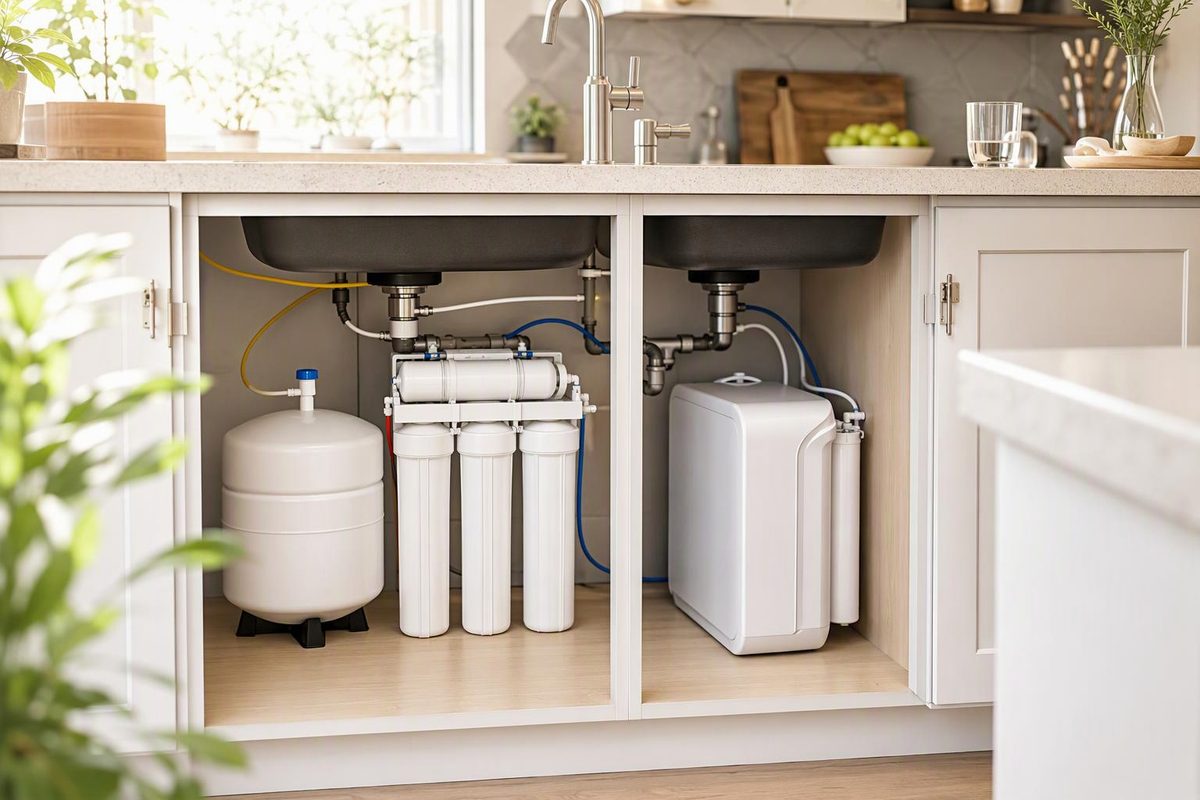
For an under-sink reverse osmosis water filter, compare usable tank volume or sustained production flow, feed-water limits, installation space and service costs. A large gallons-per-day rating or a long list of filtration stages does not answer those questions.
RO uses pressure to push water through a membrane, producing treated water and a separate concentrated reject-water stream. A kitchen unit treats the outlet it serves, not the rest of the house. EPA explains the process and point-of-use limits.
Confirm the treatment before comparing hardware
RO makes sense when you need low-mineral water or an exact system has a verified reduction claim for a contaminant in your supply. Start with your utility’s water-quality report or appropriate laboratory testing for private-well water. Taste and appearance alone do not establish safety. CDC’s filter-selection guidance explains that distinction.
If chlorine taste is your only complaint, compare carbon filtration first. Our under-sink filter comparison covers the carbon-versus-RO decision.
For RO, match the complete system model and specified replacement cartridges to the certifier’s listing and performance data sheet. NSF/ANSI 58 requires total dissolved solids (TDS) reduction; lead, fluoride, nitrate/nitrite and other contaminant claims are optional. A Standard 58 badge alone does not establish all those reductions. NSF lists the required and optional claims.
Tank or tankless: compare the water you can actually draw
A tank system stores treated water for immediate use. A tankless system produces it on demand, typically with a booster pump. Neither format is automatically better: stored volume matters for large draws; production flow matters when you keep the faucet running. EPA describes both configurations.
| Buying check | Tank system | Tankless system |
|---|---|---|
| Filling a kettle or brewing vessel | Check usable stored water and refill time | Check sustained treated-water flow |
| Cabinet space | Allow room for the filter assembly and tank | Allow room for the housing, tubing and cartridge removal |
| Electricity | Verify whether the selected model has a powered pump | Verify outlet and power requirements |
| Refrigerator connection | Check delivery pressure as the tank empties | Check manufacturer approval and any required pressure-storage accessories |
Tank size is not usable water capacity. APEC’s ROES-50 manual says its nominal 4-gallon tank holds approximately 2.5 gallons of water at 50 psi incoming pressure and 1.9 gallons at 40 psi. Those figures are model-specific, but illustrate why “4-gallon tank” is not a promise of a four-gallon draw. APEC provides the pressure-capacity table.
Likewise, gallons per day (GPD) is a production rating under specified conditions, not a guarantee at your sink. Waterdrop’s G3P800 manual rates maximum production at 800 GPD, measured at 30 psi dynamic feed pressure and 77°F water. Arithmetic converts that to about 0.56 US gallons/minute, or nine minutes for five US gallons at the rated pace—not a measured household fill time. Ask for output at your actual pressure and water temperature. The manual states the test conditions.
Check feed limits, cabinet space and connections
Read the whole manual, including warranty conditions, for permitted pressure, temperature, TDS, hardness and source-water requirements. Waterdrop’s G3P800 manual, for example, lists municipal tap water, TDS below 750 ppm and hardness below 7 grains per gallon among its warranty conditions. Its broad operating-pressure range does not establish compatibility with every water supply. See the model’s specifications and warranty conditions.
Do not treat an ordinary kitchen RO unit as a complete solution for unsafe well water. APEC’s ROES-50 instructions prohibit use with microbiologically unsafe or unknown-quality water without adequate disinfection before or after treatment. That operating restriction matters more than a general claim about what RO membranes can remove.
Measure around the disposal, drain trap and existing hoses rather than treating the cabinet as an empty box. These examples distinguish installation space from housing dimensions; they are not product rankings.
| Example | Published space or dimensions |
|---|---|
| APEC ROES-50 with tank | About 17 in L × 6 in W × 18 in H for the assembly, plus 11 in diameter × 18 in H for the tank |
| Waterdrop WD-G3P800 tankless | Housing: 18.12 in L × 5.67 in W × 17.72 in H; additional service clearance still needed |
Sources: APEC installation manual and Waterdrop installation manual.
Confirm a cold-water feed, accessible shutoff, compatible supply adapter, faucet mounting hole and permitted drain connection. Check local plumbing requirements for an air gap rather than assuming the supplied drain saddle is sufficient. Powered models also need an appropriate receptacle. Both manuals specify cold-water connection; Waterdrop notes that some installations require separately purchased air-gap accessories.
Compare reject water in the same direction
Write every ratio as reject water : treated water. “3:1” is ambiguous unless the seller identifies which stream comes first.
As of October 9, 2026, EPA says WaterSense-labeled point-of-use RO systems must discharge no more than 2.3 gallons of reject water per gallon treated. That is an independently certified efficiency benchmark, not a replacement for checking your contaminant claim. EPA states the label requirements.
For five gallons of treated water:
- 2:1 reject-to-treated: 10 gallons rejected; 15 gallons total feed.
- 1:3 reject-to-treated: about 1.7 gallons rejected; 6.7 gallons total feed.
These are calculated examples, not promises for a particular unit. Compare the system’s documented efficiency rating, not just membrane recovery or an unlabeled marketing ratio. The ROES-50 manual distinguishes whole-system efficiency from membrane recovery.
Budget for service—and your brewing water
Before ordering, price the exact prefilters, postfilter, membrane and any remineralization cartridge over five years. Add installation, sanitation, water/sewer charges and electricity where applicable. Replacement schedules are not universal: APEC specifies 6–12 months for ROES-50 prefilters, with earlier replacement potentially needed on sediment-heavy well water. Its manual explains the schedule and membrane-protection role.
Keep a service record and follow the model’s flushing, sanitation and leak-check instructions. Use TDS measurements to monitor mineral-reduction performance, not as proof that a particular hazardous contaminant is absent: TDS reduction and contaminant-specific claims are separate requirements. Our RO filter-changing guide covers safe isolation and replacement.
For homebrewing, size the unit for the full water volume your recipe requires, not just finished beer volume. RO provides a low-mineral starting point, not necessarily mineral-free water; brewing salts and mash-pH adjustment may still be needed. Brew Your Own explains brewing with RO water. Before adding a remineralization stage for coffee or beer, ask for its documented output chemistry—“alkaline” alone does not tell you the mineral profile you will brew with.