
Best RO Water Filter System: Two Picks by Installation
Compare AquaTru Classic and Waterdrop G3P800 by contaminant claims, usable output, feed-water limits, replacement costs and brewing needs.
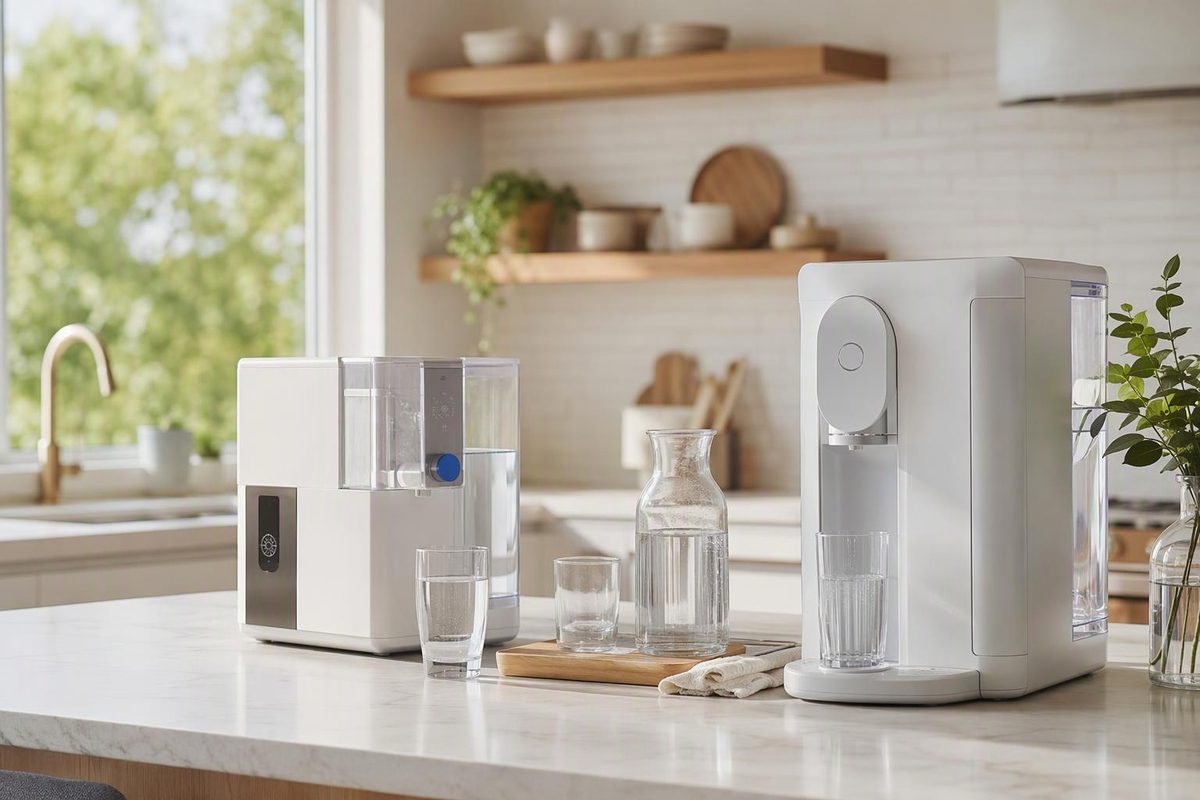
Shortlist AquaTru Classic when you need reverse osmosis without plumbing changes; shortlist Waterdrop G3P800 when you want tankless, under-sink output for repeated bottle or vessel filling. Neither is the best choice for every water problem. The deciding factors are the exact contaminant claim, your incoming water and how much treated water you need at once.
These are specification-based recommendations, not a hands-on test ranking. Prices below are U.S. manufacturer offers displayed on October 29, 2026.
First, decide whether you need RO
RO separates feed water into treated water and a concentrated reject stream. It is worth considering when you need dissolved-solids reduction or a verified claim for a specific contaminant. If ordinary filtration meets your treatment needs, RO adds water waste unnecessarily—a distinction EPA makes in its RO selection guidance.
Do not buy on “NSF/ANSI 58” alone. Under that standard, TDS reduction is required; lead, fluoride and nitrate/nitrite reduction are optional claims. Match the model and replacement elements to the claim you actually need, rather than counting filtration stages. NSF explains the required and optional claims here.
If you are still deciding between carbon filtration and RO, use our under-sink filter selection guide.
The two-system shortlist
| System | Best fit | Useful size/output detail | Main trade-off | Displayed purchase price |
|---|---|---|---|---|
| AquaTru Classic, standard VOC filter | No plumbing changes; manually filled countertop use | 0.75-gallon treated-water tank; 12 × 14 × 14 inches, W × D × H | Requires an outlet, refilling and tank cleaning | $475 |
| Waterdrop G3P800 | Tankless under-sink use; repeated vessel filling | Advertised 800 GPD maximum; approximately 18.1 × 5.7 × 17.7 inches, L × W × H | Requires electricity, feed and drain connections, and a dedicated faucet | $759 advertised with checkout code |
Prices exclude tax and installation. Allow additional space for tubing, filter removal and lifting countertop tanks—not just the unit dimensions. For installation details beyond this shortlist, see our countertop RO buying checks or under-sink RO guide.
AquaTru Classic: the no-plumbing pick
The Classic fits a rented kitchen where plumbing changes are not an option. Its current IAPMO NSF/ANSI 58 listing names models AT2000 through AT2050 and includes lead, fluoride and nitrate/nitrite reduction, among other claims.
Its feed-water limits matter more than the contaminant count:
- Maximum TDS is 1,500 mg/L.
- Maximum hardness is 10 grains per gallon, approximately 171 mg/L as calcium carbonate; AquaTru advises softening first above that level.
- Sulphide, iron and manganese must each be below 0.1 mg/L.
- Use only municipally treated water or another supply known to be microbiologically safe.
These are selected limits from the Classic owner’s manual, not a complete feed-water assessment. This is not a stand-alone treatment plan for an untested well.
The daily inconvenience is handling water. The same manual requires discarding concentrate before every refill and washing both tanks weekly. Its performance sheet gives replacement capacities of 600 gallons for the pre-filter and VOC filter, and 1,200 gallons for the RO membrane; water quality can shorten filter life. The sheet also gives a 54 GPD production rating, but the treated-water tank holds only 0.75 gallon. Classic performance data.
For a recurring-cost reference, AquaTru’s optional standard-filter subscription displays $79.88 for year one and $127.84 for year two, then repeats that cycle—about $104 per year averaged over two years, before tax. That is a subscription offer, not the cost of buying cartridges individually, and higher usage may require extra replacements. Current Classic purchase options.
Choose it for drinking and modest kitchen use, rather than frequent large-volume brewing-water collection.
Waterdrop G3P800: the tankless-output pick
The G3P800 suits a kitchen where you can install permanent connections and want output without repeatedly filling a feed tank. Its manual specifies municipal tap water, 14.5–87 psi feed pressure and 41–100°F water temperature. The 800 GPD rating is measured at 30 psi dynamic pressure and 77°F—not every household’s conditions. Do not treat it as a complete well-water treatment system. The supplied faucet is non-air-gap; check local requirements, since the manual notes that additional air-gap accessories may be needed. Waterdrop installation manual.
Its published performance sheet separates a table of IAPMO-certified claims from additional testing. The certified-claim table includes TDS, fluoride and several PFAS claims. Lead and nitrate appear in the additional testing section, not that certified-claim table; do not treat them as equivalent evidence when either is your purchase reason. Confirm the current certifier listing for the exact model before buying for contaminant treatment. G3P800 performance data.
For upkeep, the current product page lists CF, CB and RO replacement prices of $29.99, $29.99 and $139.99. Their stated limits are six months/550 gallons, twelve months/1,100 gallons and twenty-four months/2,200 gallons, respectively. Using the time intervals gives about $160 per year annualized, before optional mineral cartridges, tax or shipping. Replace sooner if the gallon limit or the exact cartridge’s instructions require it. Current replacements and prices.
Water waste and brewing change the decision
Waterdrop advertises a 3:1 treated-to-drain ratio, equivalent to approximately 0.33 gallon rejected per gallon treated. AquaTru publishes 75% efficiency. These figures are not a side-by-side household water-use test. For independently certified efficiency, look for the WaterSense label: labeled point-of-use RO systems must reject no more than 2.3 gallons per gallon treated. Do not assume either shortlisted model carries that label. EPA WaterSense requirements.
For brewing, size around the total water requirement, not finished beer volume. Ten gallons is equivalent to about fourteen full Classic treated-water tanks. Waterdrop’s 800 GPD rating converts to approximately 0.56 GPM, or eighteen minutes for ten gallons at rated production conditions—not a guaranteed kitchen fill time.
RO can provide a low-mineral starting point for deliberate brewing-salt additions, as Brew Your Own explains. A generic remineralizing cartridge is not a substitute for a measured brewing-water recipe. For espresso, check the machine manufacturer’s water requirements before choosing the finishing cartridge.
Finally, a low TDS display does not prove contaminant safety: NSF specifically notes that dissolved minerals do not establish the presence or absence of lead. Match the treatment claim to your water results rather than relying on that display.