
Sulfur Smell in Water: Find the Source Before Choosing a Fix
Trace rotten-egg water odor to a drain, water heater, plumbing or well, then choose testing and treatment that address the actual source.
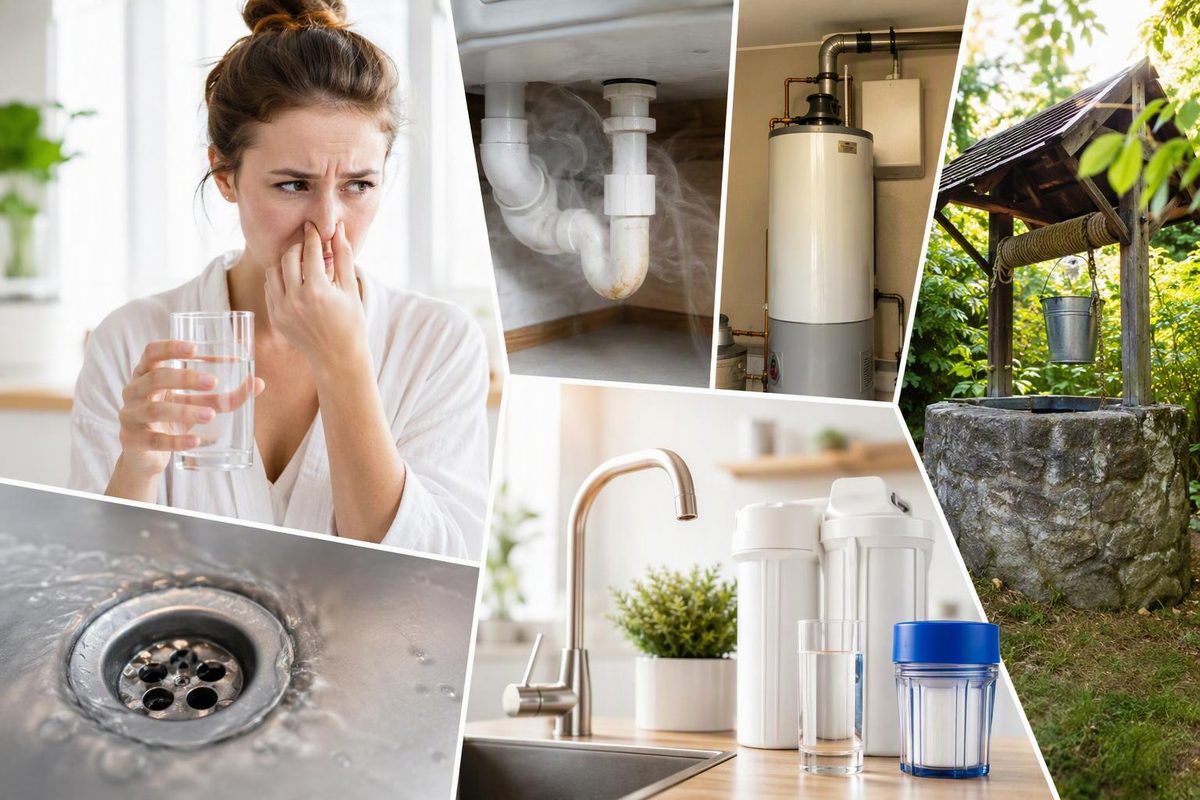
A sulfur or rotten-egg smell in water usually points to hydrogen sulfide (H₂S). It can come from natural groundwater chemistry, sulfur bacteria in a well or plumbing, or reactions inside a water heater. But an odor noticed at the sink may actually come from the drain—not the tap water. Minnesota Department of Health and UGA Extension identify these different sources.
Locate the odor before buying a filter. A heater problem needs heater service; a drain problem needs drain cleaning; persistent hydrogen sulfide in the incoming water may need whole-house treatment.
First, separate the water from the drain
Fill a clean glass with cold water, move away from the sink, and gently swirl it before checking for odor. Repeat with hot water separately. If the water in the glass does not smell but the sink area does, the drain is a likely source. Organic debris in drains can support bacteria that produce sulfurous odors. UGA Extension recommends this glass test.
Next, compare several faucets after the plumbing has been unused for a few hours. Note whether the odor affects hot water, cold water or both, and whether it disappears after a few minutes of running water.
| What you notice | What it points toward | Next step |
|---|---|---|
| Sink smells, but water carried away in a glass does not | Drain buildup rather than the water supply | Clean, disinfect and flush the drain using a plumbing-compatible method |
| Only hot water smells at multiple faucets | Water heater bacteria or an anode-related reaction | Arrange water-heater service |
| Water smells at only one faucet | That fixture or its supply piping | Investigate locally before treating the whole house |
| Odor fades after running water | Growth or stagnation within household plumbing | Investigate the plumbing; clearing the smell does not establish drinking-water safety |
| Hot and cold water smell at multiple faucets, even after flushing | Incoming water, well system, or a combination of source and plumbing problems | Test private-well water; contact the provider if using public water |
These are diagnostic clues, not proof of a particular cause. The pattern-based checks come from UGA Extension and the Minnesota health department.
Is sulfur-smelling water safe to drink?
Smell alone cannot establish safety. Sulfur bacteria themselves are not considered harmful, and most rotten-egg odor problems do not reflect the water’s sanitary quality. However, sewage or other pollution can occasionally produce hydrogen sulfide. Minnesota’s health department recommends testing an affected private well for coliform bacteria and nitrate, not just hydrogen sulfide. Many other contaminants have no detectable smell. See its testing guidance.
If contamination is suspected, use an alternative safe water supply for drinking and beverage preparation while seeking advice from your local health department. On public water, report a persistent source-water odor to the utility, especially if neighbors notice it too. UGA Extension advises contacting the provider or health department.
Hydrogen sulfide released into air can also be dangerous at high concentrations. Do not enter a well pit or enclosed well house to investigate an odor; that work requires professionals using appropriate safety precautions. Minnesota’s gas-safety warning is separate from its drinking-water guidance.
Match the fix to the source
Hot water only: service the heater
A water heater can support sulfur bacteria, and its magnesium anode can help convert sulfate in the water into hydrogen sulfide. A plumber can assess disinfection and flushing, along with a manufacturer-compatible replacement anode.
Do not simply remove the anode and leave the tank unprotected. It protects against corrosion; removal can shorten heater life. Nor should you raise the heater temperature as an improvised odor treatment: heat treatment carries scalding risks and needs manufacturer or professional guidance. Minnesota explains the heater mechanisms and precautions.
Well, plumbing or softener bacteria: disinfect the affected system
Well and plumbing disinfection may reduce sulfur-bacteria odor, but established growth can require additional cleaning by a well contractor. For a softener or other treatment device, obtain disinfection instructions from its manufacturer or installer rather than applying a generic bleach dose. Minnesota provides this source-specific guidance.
Shock chlorination is not necessarily a permanent fix: sulfur bacteria and odor can return. Recurring odor warrants reassessment rather than repeated treatment without identifying the source. Penn State Extension describes this limitation.
Persistent hydrogen sulfide in groundwater: measure before selecting treatment
Ask the testing provider how to collect the sample. Hydrogen sulfide testing must be done on-site or with a chemically stabilized sample; an ordinary mailed sample may not preserve it adequately. Penn State’s sampling guidance makes this distinction.
Treatment options include:
- Activated carbon for low concentrations. Both Minnesota and Penn State identify roughly below 1 mg/L as a range where conventional activated carbon may work. That is a selection guideline, not a guarantee for any cartridge; capacity and replacement needs vary.
- Oxidizing media or catalytic carbon. These require conditions appropriate to the particular media, including adequate backwashing and, for catalytic carbon, dissolved oxygen.
- Aeration or chemical oxidation with filtration. Aeration releases the gas and needs safe venting. Continuous chlorine injection oxidizes hydrogen sulfide; the system must also address reaction time, particles and any unwanted chlorine residual.
These options and their limitations are described by Minnesota and Penn State. For the equipment decision, see our guides to carbon filters for well water and chlorine-injection system selection.
A kitchen filter will not address odor at showers or other untreated taps. For recurring source-water odor, choose treatment for the measured hydrogen sulfide level and household flow—not merely a product labeled “taste and odor.” Odor removal and drinking-water safety remain separate checks.