
How Much Does a Reverse Osmosis System Cost?
Compare countertop, under-sink and whole-house RO costs, installation allowances, replacement filters and a worked five-year ownership budget.
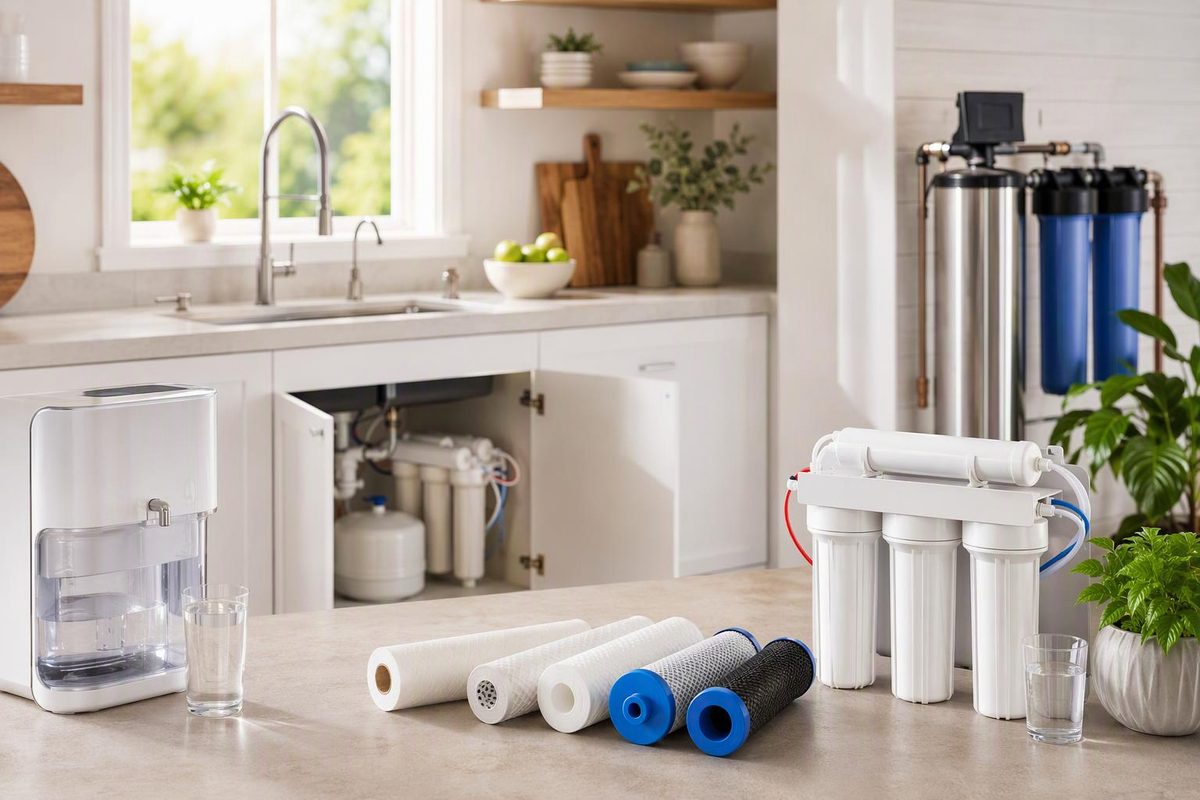
Budget roughly $300–$950 installed for an under-sink reverse osmosis system, based on HomeGuide’s published cost estimates. A manually filled countertop unit avoids plumbing labor. Whole-house RO is a several-thousand-dollar project, not simply a larger kitchen filter. HomeGuide also estimates $50–$250 per year for maintenance; budget water, electricity and any service charges separately.
The useful comparison is equipment + installation + five years of upkeep, rather than the advertised system price alone. All amounts below are in U.S. dollars; prices were checked November 1, 2026. Published ranges are starting allowances, not local quotes.
Purchase and installation costs by system type
| System type | Equipment budget | Installation and total-cost context |
|---|---|---|
| Countertop RO | HomeGuide estimates $200–$450 for portable/countertop systems; AquaTru Classic is listed at $475 | A manually filled unit needs no plumbing installation. |
| Under-sink RO with a tank | $150–$350 | HomeGuide estimates $300–$700 installed. |
| Tankless under-sink RO | $300–$600 | HomeGuide estimates $450–$950 installed; premium models can exceed this range. |
| Whole-house RO | Several thousand dollars; configuration matters | HomeGuide estimates $4,800–$8,000 installed, but that is not a reliable ceiling for a complete project. |
The broad ranges come from HomeGuide’s RO cost breakdown. The AquaTru Classic listing confirms its $475 price and no-plumbing setup. These figures do not cover every available model.
Whole-house quotes need closer scrutiny. For example, US Water Systems lists a factory-direct price of about $10,772 for its Defender configuration with 4,000 gallons per day (GPD) production, no storage tank selected and a SCALA 1 delivery pump—before site installation. Storage and treatment upgrades change the price. That manufacturer listing illustrates why an advertised RO equipment price and a finished whole-house project are not interchangeable.
If you only need treated water for drinking, cooking or preparing beverages, price a point-of-use system first. Use our whole-house RO guide when treatment at every fixture is actually the goal.
What can increase the installation bill?
For a straightforward under-sink installation, allow roughly $100–$350 for labor: Aquasure estimates $100–$300, while HomeGuide estimates $150–$350. Local rates and extra work can put a quote above those allowances.
Ask the installer to separate these items:
- Faucet work: an existing suitable hole versus drilling the sink or countertop.
- Feed and drain connections: any plumbing alterations beyond the supplied fittings.
- Electrical access: a suitable outlet where a powered system requires one.
- Pressure correction or pretreatment: equipment needed to meet the selected system’s feed-water limits.
- Commissioning: flushing, leak checks and any agreed water testing.
DIY installation can remove the labor charge, but not the cost of missing fittings, tools or corrective work. Check the under-sink installation requirements before treating the equipment price as your complete budget.
Recurring costs: filters, membrane, water and power
Replacement filters are model-specific
Do not assume a package labeled “annual replacement set” includes the RO membrane. Budget each part using its price and the manufacturer’s replacement interval or capacity limit, whichever comes first.
For a concrete example, the Waterdrop G3P600 listing shows these one-time-purchase prices:
| Replacement | Listed price | Maximum listed life |
|---|---|---|
| CF filter | $29.99 | 6 months or 550 gallons |
| CB filter | $29.99 | 12 months or 1,100 gallons |
| RO membrane cartridge | $109.99 | 24 months or 2,200 gallons |
At the time limits, that is about $145 per year averaged over a two-year replacement cycle, excluding service labor, optional mineral cartridges and utilities. The membrane creates a larger bill in its replacement year; the average is not an annual invoice. Higher use can bring forward replacements.
Confirm the exact parts before buying with our RO replacement-filter compatibility guide.
Water use adds an operating cost
RO produces both treated water and reject water. EPA says WaterSense-labeled point-of-use systems must discharge no more than 2.3 gallons per gallon treated; inefficient systems can discharge much more.
To estimate the variable water charge:
Annual feed-water gallons = treated gallons per day × 365 × (1 + reject gallons per treated gallon).
Be careful with ratio direction. Waterdrop’s advertised 2:1 pure-to-drain ratio means 0.5 gallon rejected per gallon treated. At that ratio and 2 treated gallons per day, the calculation gives 1,095 feed-water gallons per year. With an illustrative combined variable water/sewer rate of $15 per 1,000 gallons, the charge is about $16 per year, including about $5.50 for reject water. This is a ratio-based estimate, not measured household consumption; use your own utility’s billing rules and rate.
Powered pumps, heating and cooling features add electricity costs. Include service visits separately from cartridge prices.
A worked five-year budget
Using the G3P600’s listed $439 sale price, an assumed $200 installation charge, and replacements due through month 60:
| Expense | Five-year amount |
|---|---|
| System, assuming initial filters are included | $439.00 |
| Installation allowance | $200.00 |
| 10 CF replacements | $299.90 |
| 5 CB replacements | $149.95 |
| 2 RO membrane replacements | $219.98 |
| Equipment, installation and replacement total | $1,308.83 |
This calculation holds today’s prices constant, assumes the time limits govern replacement and includes the filters due at month 60. It excludes tax, shipping, water, electricity, service calls, optional treatment stages and repairs—not because they are free, but because they depend on the purchase, installation and use.
For competing quotes, request the same five-year itemization. A lower purchase price is only a saving if the replacement parts, service obligations and operating costs do not erase it.