
Alkaline Water Filter: What It Changes and What It Doesn’t
Choose an alkaline water filter by mineral media, certified treatment claims, RO compatibility and upkeep—not the highest advertised pH.
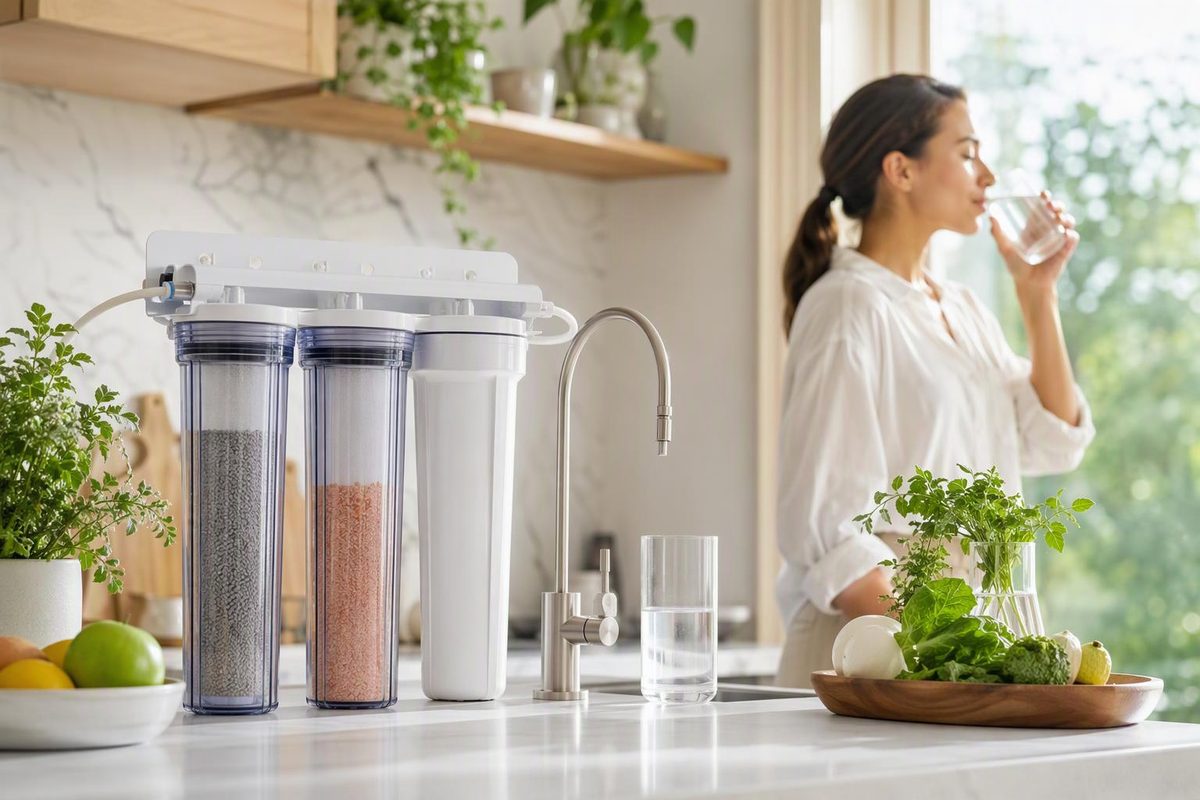
An alkaline water filter changes water chemistry; a higher pH does not prove contaminant removal. If you want to adjust the taste of reverse-osmosis water, a compatible remineralization cartridge may fit. If you need lead, PFAS or another contaminant reduced, choose the system for that specific certified claim first.
Also distinguish pH from alkalinity. pH indicates how acidic or basic water is; above 7 is basic, or alkaline. Alkalinity measures its capacity to neutralize acid. Two waters with similar pH need not have the same buffering capacity—a useful distinction when making coffee or beer. EPA explains the difference.
What does an alkaline filter actually do?
Read the media description, not just the word “alkaline.” A mineral cartridge may contain calcium carbonate, magnesium-containing media or a blend. These materials adjust the water rather than simply capture material from it.
For example, the iSpring FA15 contains mineral balls, calcite and Corosex. Its manufacturer describes it as an RO remineralization cartridge that adds calcium and magnesium. As of October 28, 2026, the stated change is 0.5–0.8 pH units, with a typical 10–20 ppm increase in total dissolved solids (TDS). Those are manufacturer specifications, not a guarantee of a particular final pH on your water. FA15 product description
An electric water ionizer is a different treatment approach: alkaline water can be produced through an electrochemical reaction. Do not assume an ionizer and a mineral cartridge are interchangeable, or that the pH-adjustment mechanism establishes filtration performance. Poison Control describes how alkaline water is produced.
Match the purchase to the problem
| Your goal | What to look for | What the alkaline label cannot establish |
|---|---|---|
| Reduce chlorine taste or odor | A filter with a certified chlorine taste-and-odor reduction claim | Whether that claim is included |
| Adjust the mineral taste of existing RO water | A compatible post-RO remineralization cartridge | Whether you will prefer the result |
| Reduce a health-related contaminant | Exact model and replacement cartridge with the relevant certified reduction claim | Removal based on pH alone |
| Prepare water for coffee or homebrewing | Measured mineral content, hardness and alkalinity suited to the equipment or recipe | A suitable brewing profile from one pH number |
For U.S. filter shopping, NSF/ANSI 42 covers aesthetic claims such as chlorine taste and odor, 53 covers health-effect contaminant reduction, and 58 covers RO systems. Certification to one of these standards does not mean a system reduces every contaminant covered by it. Verify the particular reduction claim, not just the standard number or logo. NSF’s guide to treatment standards
If contaminant treatment is the main job, start with our under-sink filter selection guide. Treat alkaline remineralization as a separate preference, not a substitute for that treatment.
Is the health premium justified?
Do not pay extra on the assumption that alkaline water prevents disease or provides superior everyday hydration. Mayo Clinic’s guidance, published in Hancock Health’s medical library, says alkaline water is not better than plain water for most people and that proposed disease-prevention benefits need more research. That does not rule out a taste preference; it separates preference from a medical benefit. The guidance also flags safety concerns, particularly for people with kidney disease—ask your clinician before making alkaline water a routine choice if that applies to you.
Check compatibility and output before buying
For an add-on cartridge, confirm:
- Approved system fit: Ask whether the RO manufacturer permits that cartridge and configuration. If you rely on certified treatment claims, confirm with the manufacturer or certifier that the proposed setup is covered; do not rely on physical fit alone.
- Connections and clearance: Match tubing size, connector type, cartridge dimensions and room to disconnect it during replacement.
- Operating limits: Check permitted pressure, temperature and service flow. Ask what feed-water conditions support the advertised pH change.
- Replacement supply: Identify the exact cartridge code, capacity and time limit before installation.
After installation and the specified flushing, compare water before and after the alkaline stage using a calibrated pH meter suitable for the samples. If minerals are part of the goal, also measure hardness and alkalinity, keeping the report units visible—commonly mg/L as CaCO₃. A pH measurement answers only the pH question; it does not identify the added minerals or verify contaminant reduction.
For coffee and beer, don’t chase the highest pH
For coffee, compare the treated water’s hardness and alkalinity with your machine’s water requirements rather than selecting the highest-pH cartridge. For example, La Marzocco’s Linea Classic maintenance checklist calls for pre- and post-filtration testing and lists separate limits for hardness, alkalinity and pH. Use your own machine’s requirements, not another model’s limits.
For homebrewing, choose adjustments for the recipe and mash, not for an “alkaline” drinking-water label. WaterOne’s brewing guidance explains that hardness and alkalinity affect mash pH, while sodium, chloride and sulfate are important flavor ions. Brewers may adjust water with salts and acids for different beer profiles. WaterOne’s homebrewing reference
If you need repeatable brewing water, ask whether the system provides a manufacturer-approved collection point before remineralization. Our under-sink RO guide covers the wider system-fit decision.
Maintenance: use the exact cartridge’s limit
There is no universal alkaline-filter replacement interval. As one concrete example, iSpring lists the FA15 service life as six months or 1,500 gallons, whichever comes first, as of October 28, 2026. Follow your own cartridge’s current instructions rather than transferring that interval to another model. FA15 specifications
Finally, do not confuse a drinking-water cartridge with a whole-house acid neutralizer. Watts’ CAL-100 systems use dissolving calcite and backwashing to treat acidic supply water toward neutral pH. A cartridge serving one drinking faucet is not a solution for acidic water throughout the plumbing. If whole-house pH correction is the actual problem, evaluate it as a separate treatment project.