
Aquasana Rhino Whole House Water Filter: Fit, Flow and Upkeep
Compare Aquasana Rhino chlorine and chloramine models, rated flow, certification limits, installation needs and replacement schedules.
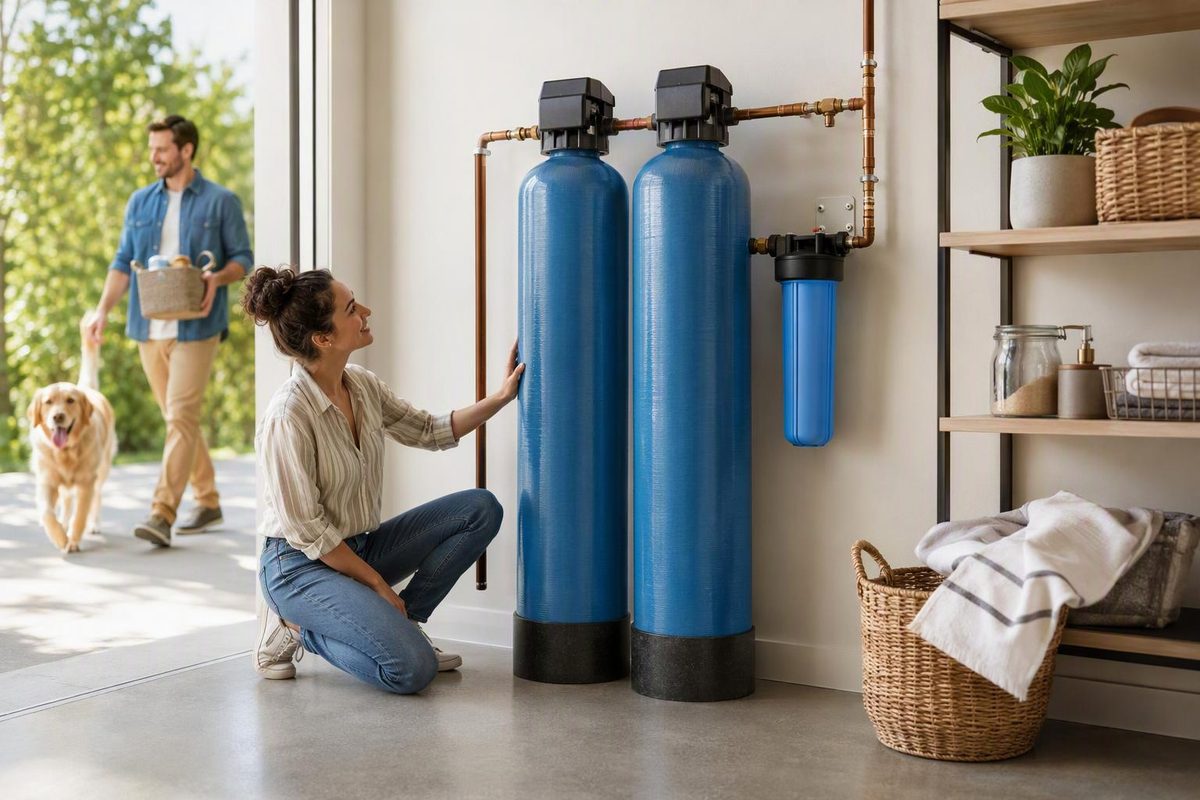
The standard Aquasana Rhino WH-1000 is a whole-house chlorine-reduction filter rated at 7 gallons per minute (gpm), with a main-tank capacity of 1,000,000 gallons and an advertised lifespan of up to 10 years. It is worth considering when you want chlorine reduction throughout a home—not merely at the drinking-water faucet. Its published performance sheet documents free-chlorine reduction, not comprehensive contaminant removal. Aquasana specifications; performance data
Before choosing one, establish whether your utility uses chlorine or chloramine, estimate simultaneous household flow, and identify any separate hardness or drinking-water concerns. The Rhino name covers several systems; their specifications are not interchangeable.
Choose the disinfectant claim first
The standard Rhino contains activated carbon and copper-zinc KDF media. Aquasana offers separate Chloramines models with catalytic carbon for chloraminated water. Ask your utility which disinfectant it uses rather than choosing by taste alone. Aquasana’s media and model guidance
These three options illustrate the important differences in the range as of October 25, 2026. Reduction percentages below are Aquasana’s advertised claims based on independent testing, not our own tests.
| Model | Advertised reduction claim | Rated treatment flow | Advertised peak flow |
|---|---|---|---|
| Rhino WH-1000 | Up to 97% chlorine | 7 gpm | 14.6 gpm |
| Rhino Max Flow WH-1010 | Up to 97% chlorine | 14 gpm | 14.5 gpm |
| Rhino Chloramines Max Flow WH-1021 | Up to 83% chloramine; 97% chlorine | 10 gpm | 12 gpm |
Sources: standard Rhino, Rhino Max Flow, and Chloramines Max Flow. Aquasana also lists a Chloramines model, WH-1011, in its manuals directory.
The WH-1000’s 97% headline is not a minimum for every sample throughout its life: its performance sheet reports overall reduction above 97.4%, but 92.82% at the 1,000,000-gallon sample. Actual performance may vary from laboratory results. WH-1000 test results
Size against rated treatment flow, not peak flow. Aquasana states that its reduction testing is based on rated flow and that results vary at other flows. The standard Rhino’s 14.6-gpm peak figure does not establish its stated chlorine reduction at that flow. Flow specifications
For an installation quote, give the plumber your likely overlapping demands—showers, faucets and appliances—and ask for expected pressure loss through the complete configuration. The WH-1000 performance sheet lists a 23-psi pressure drop under test conditions. Do not assume that drop will be identical in your home, but account for it rather than relying on a promise of “no noticeable” pressure change. WH-1000 test data
What the certification does—and does not—cover
The WH-1000 manual makes an important distinction: the system is independently tested to NSF/ANSI 42 for specified reduction claims, while the tank is WQA-certified to NSF/ANSI/CAN 61 for materials safety. It explicitly says WQA has not certified the contaminant reductions. Rhino owner’s manual
NSF/ANSI/CAN 61 evaluates materials’ health effects; it is not proof that a filter removes contaminants from incoming water. Likewise, certification to a treatment standard does not cover every contaminant. NSF’s materials-safety explanation and consumer standards guide
If your concern is lead, PFAS, arsenic or fluoride, require an explicit claim for that substance on the exact model. Do not extend the standard Rhino’s chlorine results to those concerns. A targeted under-sink water filter system may be the more appropriate purchase when only drinking and cooking water need treatment.
Treat the optional upgrades as separate decisions:
- Salt-Free Water Conditioner: Aquasana markets it for scale prevention. If your objective is reducing measured calcium and magnesium hardness, compare an ion-exchange softener rather than assuming conditioning and softening are equivalent. Aquasana conditioner manual; NSF’s softener explanation
- UV: The city-water Rhino’s advertised UV upgrade is NSF/ANSI 55 Class B. NSF describes Class B as treatment for non-disease-causing bacteria in disinfected drinking water, not the Class A category for contaminated water. Do not select that upgrade as the sole answer to a contaminated private well. Also check its separate flow rating: the AQ-UV-SF performance sheet gives a Class B certified flow of 6 gpm, below the WH-1000’s 7-gpm chlorine-treatment rating. Aquasana UV performance data; NSF UV classes
Installation and maintenance to budget for
For the WH-1000, the manual specifies cold-water installation before the water heater, an operating range of 20–100 psi and 40–90°F, and an estimated minimum of 50 inches of height clearance and 44 inches of floor space. Additional components can require more room. Protect the system from sunlight and freezing, and include initial tank flushing in the installation plan. Installation requirements
The ten-year description applies to the main tank—not every component. Water conditions and use rates can shorten its functional life. WH-1000 manual
| WH-1000 component | Manufacturer replacement schedule |
|---|---|
| Standard 20-inch pre-filter | Every 2 months; sooner if flow decreases |
| Optional low-maintenance pre-filter | Every 6 months; sooner if flow decreases |
| 10-inch post-filter | Every 6 months; sooner if flow decreases |
| Pre/post-filter housings | Every 5 years |
| Optional UV lamp | Every 12 months |
Sources: WH-1000 maintenance instructions and UV replacement schedule.
With standard cartridges, that means budgeting roughly six pre-filters and two post-filters per year. If flow declines after previously satisfactory operation, inspect the sediment pre-filter first. Before opening a housing, isolate the system and relieve pressure; the manual specifies silicone grease for the O-ring, not petroleum jelly. Filter-change instructions
Owners of older EQ-600 or EQ-1000 systems should use the model-specific manual and confirm housing compatibility before ordering replacements. Aquasana lists those separately from WH-series systems in its manuals directory.
For coffee and homebrewing
Use the documented chlorine or chloramine reduction as a starting point, not proof that the outlet water meets your brewing requirements. An 83% chloramine reduction claim is not a zero-residual claim. Check the relevant disinfectant residual at the brewing outlet and measure hardness and alkalinity separately before deciding whether additional treatment is needed.
If the only goal is better brewing water, compare kitchen-only treatment before paying to filter showers and laundry. Our whole-house versus kitchen-only guide helps make that scope decision.