
RO Membrane Filters: GPD, Rejection and Replacement
Match an RO membrane by fit, GPD and operating limits; then use comparable TDS readings and the system manual to judge replacement.
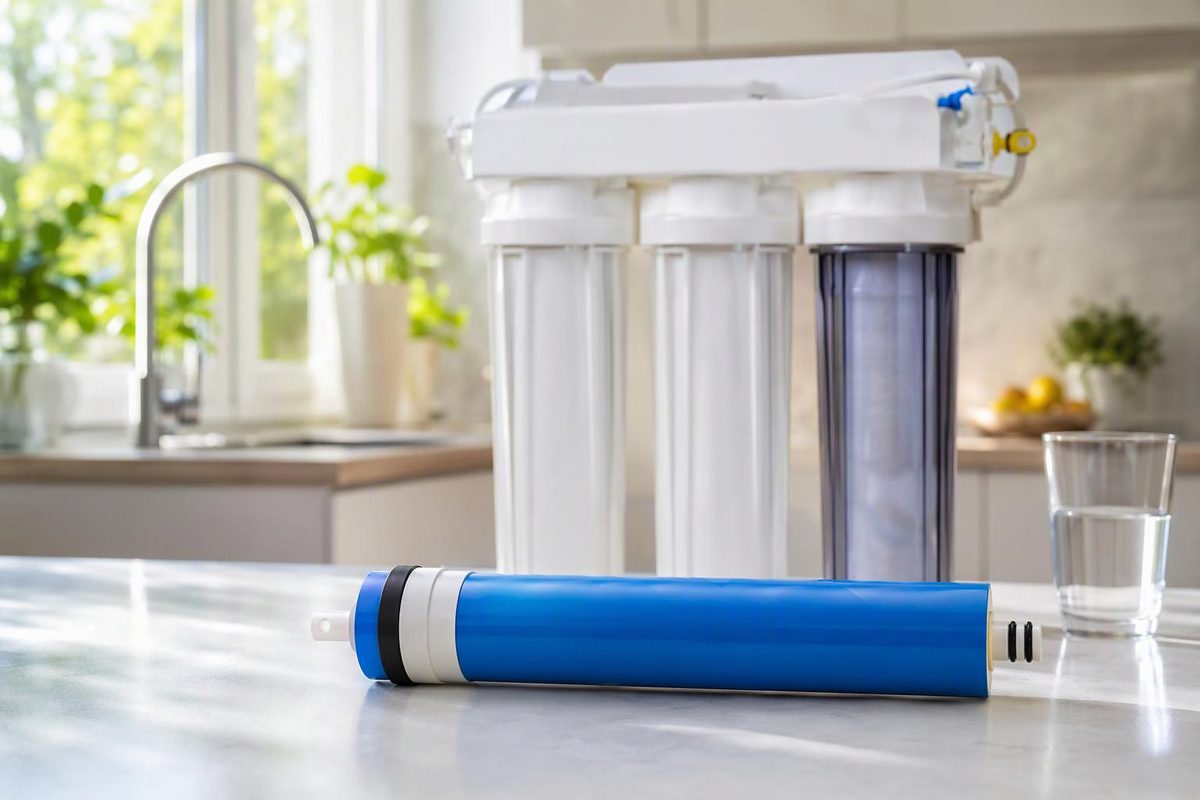
An RO membrane filter is the semipermeable element at the center of a reverse-osmosis system. For a replacement, match the system model, membrane part number, physical format, rated gallons per day (GPD) and required operating pressure. Do not select one from a “0.0001-micron” description alone.
A higher-GPD membrane is not automatically an upgrade. The housing, flow restrictor, pump, storage tank and certification apply to a system assembled with particular components. If the original element is unavailable, obtain a documented cross-reference from the system or membrane manufacturer.
What the membrane does
Feed pressure moves some water through the membrane as treated water, or permeate. The remaining water carries rejected dissolved material to the drain as concentrate. Sediment and carbon cartridges normally sit upstream; a carbon postfilter may polish taste after the storage tank.
This distinction matters when ordering a replacement filter set: the sediment and carbon cartridges are not the RO membrane, and a package described as “five-stage” may not contain every replacement component.
RO can reduce dissolved salts and certain contaminants that ordinary sediment filtration does not address. CDC lists lead, copper, chromium, chloride and sodium among the chemicals RO can remove, while advising consumers to check the system label for its specific chemical claims (CDC). The membrane also is not a substitute for a whole-house softener: an under-sink unit treats only the water routed through it and does not control scale elsewhere in the home. See water filter vs. water softener for that distinction.
Specifications that decide whether a membrane fits
| Specification | What to verify | Why it matters |
|---|---|---|
| System and element number | Exact model and current replacement part | Similar-looking elements or proprietary cartridges may not interchange |
| Format and dimensions | Length, diameter, connection style and seal arrangement | The element must seal correctly inside its housing |
| Rated production | GPD or L/day at stated test conditions | Capacity changes with pressure, temperature and feed-water chemistry |
| Rejection | Typical and minimum salt-rejection figures | This describes separation performance, not daily output |
| Feed limits | Pressure, temperature, pH, chlorine, hardness and sediment limits | Operation outside the limits can lower output or damage the membrane |
| Certification | Exact complete-system listing and named contaminant claims | A membrane component does not transfer every claim to an altered system |
| Drain-flow requirement | Compatible flow restrictor or system configuration | Reject flow affects recovery, scaling risk and treated-water production |
GPD is a laboratory rating, not guaranteed faucet output
For example, DuPont rates one residential 1812-format membrane at 50 GPD (189 L/day) and 99% typical stabilized salt rejection, but those figures use specified conditions: 50 psi, 77°F (25°C), 500 ppm sodium bicarbonate feed and 15% recovery. Its data sheet also allows individual-element permeate flow to vary from 15% below to 25% above the nominal figure (DuPont FilmTec TW30-1812-50HR data sheet).
Cold water and low net driving pressure generally mean slower production. Therefore, compare GPD ratings only when the test conditions are reasonably similar. A 100-GPD label does not establish that an existing 50-GPD system can accept the element or deliver twice as much water.
Rejection is not the percentage of incoming water saved
Two percentages are easily confused:
- Salt rejection describes how much of a test solute the membrane keeps out of the permeate.
- Recovery describes how much feed water becomes permeate rather than concentrate.
A membrane advertised with 98% or 99% salt rejection is not claiming 98% or 99% water recovery. Actual system contaminant reduction can also differ by contaminant, operating conditions and complete-system design.
Check the complete system’s certified claims
NSF/ANSI 58 covers point-of-use RO systems and includes requirements for material safety, structural integrity, total dissolved solids (TDS) reduction, efficiency, recovery and consumer information. TDS reduction is required, but claims for lead, nitrate/nitrite, fluoride, arsenic and other individual contaminants are optional (NSF).
Consequently, “certified to NSF/ANSI 58” does not by itself mean the system is certified to reduce every contaminant listed in the standard. Verify the exact system model in the certifier’s current listing and read its performance data sheet for the contaminant that concerns you. This is particularly important for a health-related decision such as lead reduction by RO.
Component certification is not the same as complete-system certification. Changing membrane capacity, restrictor size or other specified parts can put the assembled system outside the configuration that was tested.
Protect the membrane with the correct pretreatment
The prefilters are functional protection, not optional stages. Sediment can foul the element, while oxidants can damage some common thin-film composite membranes. The cited DuPont element has a free-chlorine tolerance below 0.1 ppm and calls for residual free chlorine to be removed before it reaches the membrane.
Replace sediment and carbon cartridges on the system manufacturer’s schedule or sooner when documented water conditions require it. Do not wait for the RO membrane to fail before servicing the carbon stage. For one Watts under-counter model, the manual recommends six-month sediment and carbon changes and a 2–3 year membrane interval, while explicitly noting that life varies with local water and use (Watts FMRO4G-ERP manual). Those intervals belong to that model, not every RO system.
Use TDS trend, not age alone, to investigate performance
A handheld conductivity/TDS meter can help track changes in general membrane performance. Using readings taken under comparable conditions:
TDS rejection (%) = (feed-water TDS − permeate TDS) ÷ feed-water TDS × 100
If feed water measures 300 mg/L and direct membrane permeate measures 15 mg/L, calculated rejection is 95%.
Treat that result as a diagnostic indicator, not a contaminant safety test. A TDS meter estimates the total concentration of conductive dissolved material; it does not identify lead, nitrate, PFAS or another specific substance. Remineralization stages also raise faucet TDS intentionally, so test at the sampling point specified by the manufacturer.
Investigate before condemning the membrane:
- Low flow with normal rejection: Check feed pressure, water temperature, clogged prefilters, tank pressure and valves.
- Rising permeate TDS: Confirm the readings, then check membrane seating, O-rings, bypass leakage, the drain restrictor and pretreatment history.
- Bad taste with stable rejection: Inspect the carbon postfilter, storage tank and sanitation history.
- Fast scale or short membrane life: Test hardness and other scaling constituents; do not assume a higher-capacity membrane fixes the feed-water problem.
Replace the membrane when the exact system manual calls for it, when measured performance falls below that model’s specified limit, or when damage or fouling cannot be corrected. After installation, follow the manufacturer’s sanitizing, flushing and discard instructions before drinking the water.
When buying a complete new unit rather than an element, efficiency deserves equal weight with contaminant claims. EPA says a typical point-of-use RO unit may send 5 gallons or more to drain per gallon treated, while a WaterSense-labeled model must use 2.3 gallons or less of reject water per gallon treated and meet independently certified performance criteria (EPA WaterSense).