
Portable Water Filter: Choose by Water Source and Treatment Claim
Choose a portable water filter for tap water, camping or travel by checking microbial protection, certified claims, bottle fit and maintenance.
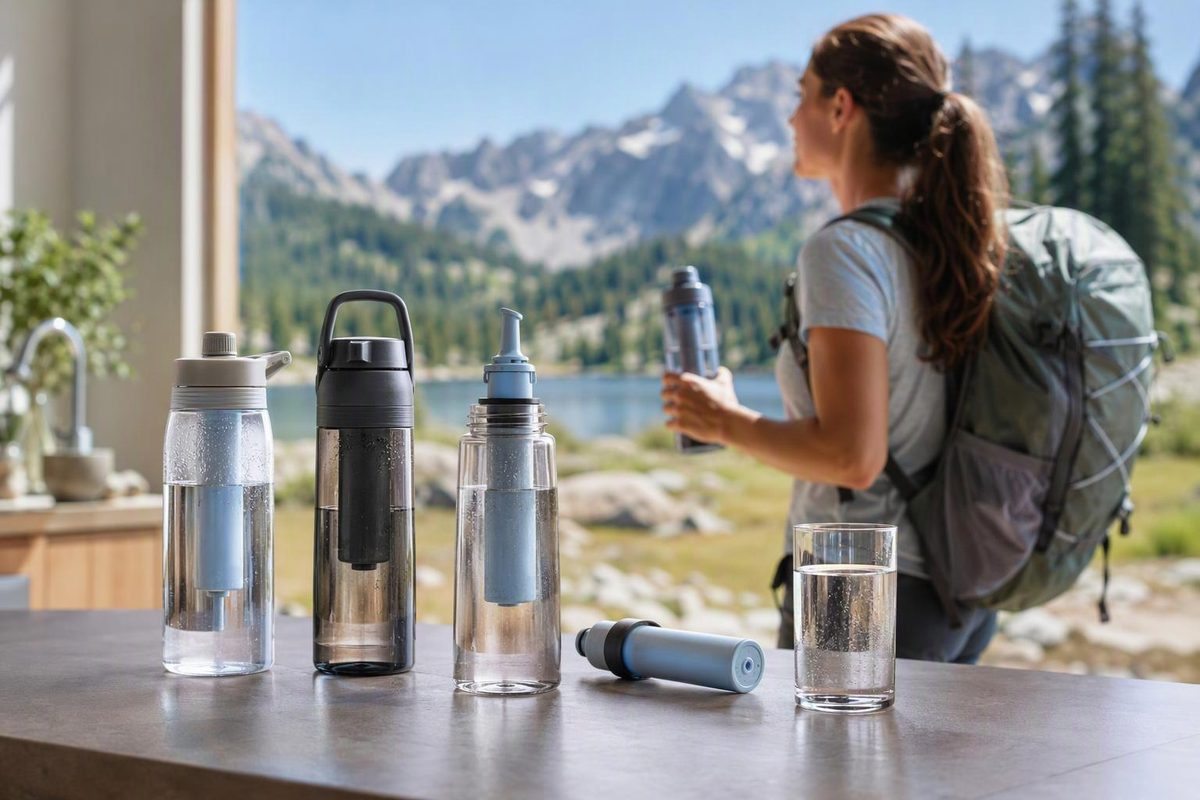
Choose a portable water filter by what is in the source water—not by how small the filter is. A carbon bottle for chlorine taste, a camping microfilter for bacteria and parasites, and a purifier with demonstrated virus reduction solve different problems.
For water of uncertain microbial safety, CDC recommends boiling; the next best option is filtering and then disinfecting the filtered water. Clear-looking stream water can still contain disease-causing germs. CDC’s camping and travel guidance explains the treatment limits.
Match the treatment to the source
| Water source or problem | What to look for | What not to assume |
|---|---|---|
| Microbiologically safe tap water with chlorine taste | A bottle or pitcher with a certified chlorine taste-and-odor reduction claim under NSF/ANSI 42 | Better taste does not prove microbial protection. |
| Fresh surface water where bacteria and parasites are the concern | A filter with an absolute pore size of 0.3 µm or smaller, with documented bacteria and parasite performance | A typical microfilter does not reliably remove viruses. |
| Questionably treated tap water, poor sanitation, or surface water near substantial human activity | A purifier with documented bacteria, virus and parasite reduction—or filtration followed by suitable disinfection | A “travel” label does not establish virus protection. |
| Tap water with a measured chemical contaminant | A model certified for that specific contaminant, within its stated capacity and operating limits | Neither a micron rating nor a general certification badge proves chemical reduction. |
The pore-size guidance comes from CDC. Its 2026 Yellow Book specifically advises virus treatment where human activity or poor sanitation increases the risk. NSF explains why certification must match the individual reduction claim.
Suspected fuel, toxic chemicals or radioactive contamination calls for a different water source, not an improvised filter-and-tablet solution. Boiling and disinfecting cannot make that water safe. Follow local health-department advice. CDC emergency guidance
Read the performance claim before comparing features
Absolute microns are not nominal microns
A filter rated 1 µm absolute can remove parasites such as Giardia and Cryptosporidium, but that rating does not establish virus or complete bacteria removal. CDC specifies 0.3 µm absolute or smaller for bacteria and parasites. CDC’s portable-filter guidance
An absolute pore-size rating describes the maximum pore size. A nominal or mean pore-size rating can allow larger pores; it is not interchangeable with an absolute rating. CDC explains pore ratings. For more on rating terminology, see nominal versus absolute filtration.
“Purifier” needs evidence
For a one-device microbial treatment system, look for documented reduction of bacteria, viruses and parasites, rather than relying on the product name. NSF P231 is a protocol for microbiological water purifiers. NSF/ANSI 42 addresses aesthetic claims such as chlorine taste; NSF/ANSI 53 addresses specific health-related contaminants. Neither number alone establishes comprehensive microbial treatment. NSF standards and protocols
Match the exact model and cartridge to the certifier’s listing. If a product claims NSF certification, use the NSF product database to check its listed reductions. If the claim is only “tested to” a protocol, ask for the test report and verify any claimed certification separately. CDC notes that EPA does not independently test manufacturers’ purifier claims. CDC Yellow Book
Choose a format that produces the water you need
Once the treatment claim fits, compare how you will collect and dispense water:
- Drink-through bottle or straw: Check whether it can supply a separate cooking bottle or kettle, not just water you drink through the mouthpiece.
- Squeeze system: Check bag durability, bottle-thread compatibility and whether cleaning tools are included.
- Gravity system: Check whether you have somewhere to hang the reservoir and whether it connects to your clean-water container.
- Pump system: Check intake-hose reach, cleaning requirements and the effort needed for your daily volume.
Compare the complete kit weight, not just the filter element. Include reservoirs, hoses, adapters and cleaning equipment. Treat advertised flow as a starting point: suspended particles eventually clog filters and require maintenance. CDC’s treatment comparison
Compatibility is model-specific. For example, Sawyer specifies 28 mm bottle threads for its Squeeze and offers adapters for hydration packs. That does not mean every portable filter fits every bottle. Sawyer Squeeze specifications
Keep the filter—and the clean side—usable
Practice collection, treatment and cleaning before leaving. Keep untreated-water bags and intake hoses separate from clean bottle mouths and outlets; filtration does not prevent recontamination during storage. CDC Yellow Book
Follow the exact model’s cleaning and storage instructions. Sawyer, for example, recommends backwashing before first use, when flow diminishes, before prolonged storage and when returning to use. It also recommends replacing a previously wetted filter if freezing is suspected, because freeze damage cannot be definitively checked in the field. These instructions should not be generalized to every filter design. Sawyer maintenance guidance
Choose a backup that still works if the filter fails. For boiling, CDC specifies a rolling boil for 1 minute, or 3 minutes above 6,500 ft, followed by cooling. For cloudy water, first let particles settle or strain them through a clean cloth, then boil the clear water. CDC emergency instructions
Disinfectant tablets or drops are not automatically a complete substitute for a failed filter: chlorine and iodine do not reliably kill Cryptosporidium. If relying on chemical treatment alone, choose a product with documented coverage for the relevant parasites as well as bacteria and viruses, and follow its dose and full contact time. Chlorine dioxide tablets can kill Cryptosporidium when used as instructed. CDC treatment limits
For camp coffee, separate safety from water chemistry
A camping microfilter is not automatically a brewing-water treatment system. Sawyer states that dissolved salts, fluoride and chlorine pass through its Squeeze, Mini and Micro filters. Do not expect those models to adjust hardness or remove chlorine taste simply because they remove microbes. Sawyer filtration limits
Start with safe water. If chlorine taste is the remaining problem, choose a model with that specific reduction claim. If mineral adjustment matters for your coffee, plan the brewing-water supply separately rather than buying a finer camping microfilter.