
Spin-Down Sediment Filter With Auto Flush: Setup and Upkeep
Compare integrated and retrofit auto-flush options, plan a safe drain, set the flushing interval and recognize when the screen still needs cleaning.
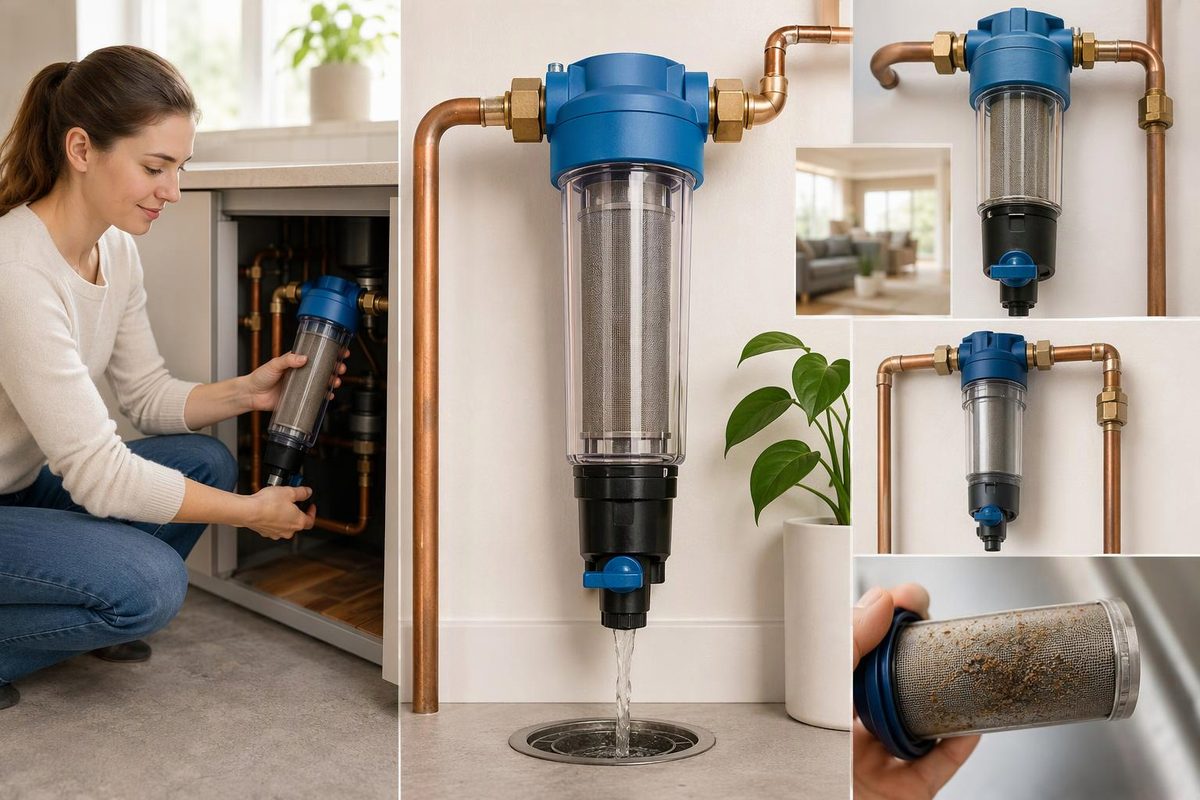
A spin-down sediment filter with auto flush automates opening and closing the sediment drain. Choose it when loose sediment needs frequent purging and you can provide a reliable, permanent discharge route. It saves valve-opening chores; it does not guarantee that a blocked screen will clean itself.
The key buying checks are filter compatibility, flushing interval, cycle duration, power supply and drainage. If you are still choosing the screen rating or housing size, start with the general spin-down filter guide. Automation is a separate decision from filtration fineness.
Integrated filter or retrofit valve?
There are two practical routes: buy a filter with its matching controller, or add an approved timed purge valve to an existing filter.
| Route | Published example | What to check |
|---|---|---|
| Filter supplied with an auto-flush module | iSpring WSP50ARB has a touch-screen controller; its product page lists a preset of 15 seconds every 15 days | Confirm the supplied controller, screen rating, power options and whether any scraper requires manual operation |
| Separate timed valve | Rusco AFV has an adjustable cycle interval of 1 minute–14 days, but a fixed 7-second discharge | Confirm compatibility, drain fittings, power access and whether the fixed duration clears your sediment load |
These are configuration examples, not comparative performance rankings. Specifications checked November 6, 2026, come from the iSpring WSP50ARB product page and Rusco’s AFV flyer, revised December 2024.
Do not assume an add-on controller is universal. For example, iSpring specifically lists its AFMWSP50ARB module as compatible with WSP50ARB and WSP100ARB. Rusco offers an AFV installation kit with 1/2-inch fittings and reinforced tubing; the kit does not include a filter. Check the iSpring module compatibility listing and the Rusco flyer before ordering parts.
Also distinguish the interval between flushes from how long the valve stays open. A controller may let you change one without changing the other. A scheduled flush is not evidence that the controller detects screen blockage.
Plan the drain before buying
An unattended purge needs somewhere to discharge every time—not a bucket that someone must remember to empty.
- Provide an approved indirect drain connection. Do not push the discharge hose into a waste pipe and seal it in place. The 2024 Uniform Plumbing Code’s treatment-unit provision calls for air-gap discharge; IAPMO’s training explanation describes the contamination risk from a backed-up drain. Have the installer follow the locally adopted requirements.
- Use the specified fittings and tubing. Check the purge-port connection separately from the main inlet and outlet sizes. Secure the discharge line and leave room to service the valve and bowl.
- Check the complete assembly’s operating limits and feed-water requirements. A valve’s pressure rating does not raise the filter housing’s rating. Confirm that all components suit the installation. The linked WSPARB manual specifies municipal tap water at 40–100°F; for well water, confirm suitability of the exact model with the manufacturer before purchase.
- Provide suitable power and access. The WSPARB manual lists an adapter or three AA batteries and requires a dry indoor location. The Rusco AFV flyer lists an AC power adapter. Ask what happens after a power interruption, whether settings are retained and how to operate the valve manually.
The WSPARB installation manual also requires an upright housing, correct flow-arrow orientation and reliable drainage. Follow the installation sequence for the exact model rather than borrowing another filter’s valve sequence.
Set the schedule by observing a full cycle
Do not treat the factory preset as a maintenance recommendation for every water supply. iSpring’s product page lists 15 seconds every 15 days, while its linked WSPARB manual recommends flushing at least weekly for 30 seconds, depending on incoming water quality. If your supplied instructions and controller differ, confirm the appropriate setting with the manufacturer.
Commission the automatic function while you are present:
- Trigger a manual cycle. Watch the discharge, check for leaks and confirm that the valve closes completely.
- Inspect the bowl and screen afterward. Determine whether the cycle removes the loose sediment or leaves substantial accumulation.
- Observe loading between cycles. During the first weeks, inspect often enough to catch buildup before the next programmed purge. Shorten the interval if necessary, within the controller’s permitted range.
- Verify a scheduled cycle. A successful manual test does not establish that automatic mode is enabled or that its timer is set correctly.
To estimate flushing water use, measure a supervised cycle using a suitable container without restricting the outlet. Do not compromise an installed air-gap connection to collect the water. Gallons per cycle × cycles per month = monthly discharge. For example, a measured 2 gallons per cycle with one daily flush uses about 60 gallons in a 30-day month. That is an illustration, not a product specification.
When automatic flushing is not enough
If the drain opens but flow remains reduced, inspect the screen rather than repeatedly increasing flush frequency. Rusco’s user guide distinguishes purging separated solids under system pressure from removing particles wedged in the screen with a soft brush.
A scraper does not necessarily eliminate hands-on work either: the WSPARB manual instructs the owner to turn its scraper knob three or four times while draining. Its maintenance instructions still require shutting off the supply, releasing pressure, removing the assembly and cleaning it when needed.
If a cycle produces no discharge, check power, controller mode and the discharge route without loosening pressurized fittings. If water continues running after the cycle should have ended, stop unattended operation, use the appropriate water shutoff and have the valve serviced. Keep periodic checks of the screen, seals, drain and power supply on the maintenance list—even when scheduled purging works reliably.