
Filtered Coffee Caffeine per Cup: Range & Factors
Published estimates span 70–175 mg per 230–250 ml; use 95–145 mg for planning, then adjust for grounds, bean species, volume and recipe.
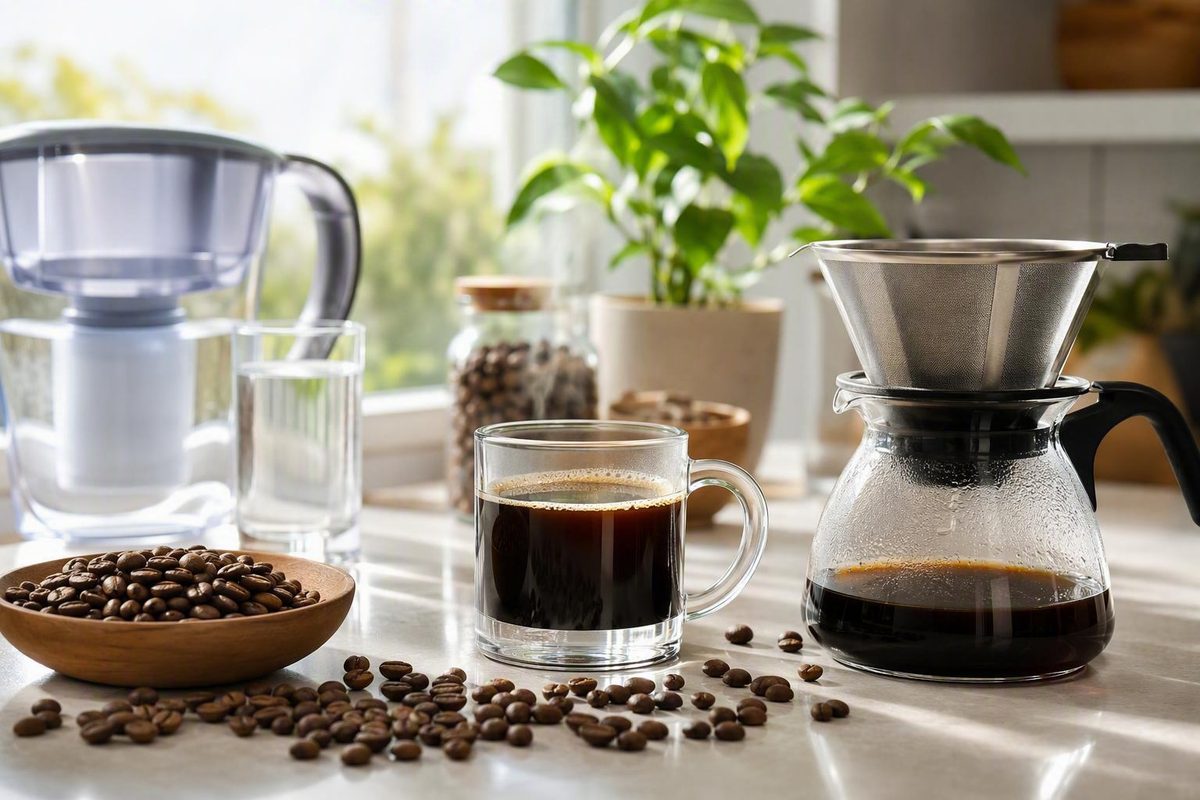
A roughly 230–250 ml serving of filtered coffee can contain about 70–175 mg of caffeine across published estimates. For everyday planning, 95–145 mg per 230–250 ml is a useful working range, not a guaranteed measurement. The lower end comes from estimates such as 70–140 mg per roughly 250 ml, while another published range reaches 115–175 mg per 230 ml (K Brew; Pebble & Pine).
Serving volume and the mass of coffee grounds are the most useful variables to track at home. Bean species and extraction conditions can shift the result further, which is why no single caffeine figure applies to every drip or pour-over recipe.
The short answer: expect a range, not one exact number
Published estimates differ substantially, even when their serving sizes appear similar:
| Published estimate | Serving volume | Caffeine | Best interpretation |
|---|---|---|---|
| Primo Caffè | 240 ml | About 96 mg | A commonly cited average |
| Pebble & Pine | 230 ml | About 145 mg; stated range of 115–175 mg | A higher planning estimate |
| K Brew | Roughly 250 ml | 70–140 mg; about 95 mg typical | A broad filter-coffee estimate |
| Healthline | 8 US fl oz | 95–200 mg | A wider brewed-coffee range |
Eight US fluid ounces is approximately 237 ml, not 250 ml. That difference is modest, but it matters when figures are compared as though the serving volumes were identical. The Healthline figure also applies to brewed coffee broadly rather than to one standardized pour-over recipe.
These estimates are not necessarily competing answers to the same controlled test. They may represent different beans, ground-coffee doses, recipes, measurement methods and definitions of a serving. Commercial summaries also do not always disclose enough methodology to treat their figures as laboratory reference values.
For that reason, the full 70–175 mg per 230–250 ml span is better understood as a synthesis of published estimates than as a precise established range for every filtered coffee. The narrower 95–145 mg range is useful when you need a planning figure, provided you continue to define the serving as roughly 230–250 ml.
A larger mug does not automatically contain proportionally more caffeine. It might hold more of the same batch, or it might have been brewed with more water but the same quantity of grounds. Volume becomes informative only when considered alongside the actual recipe.
Filtered coffee versus espresso: serving dose and concentration tell different stories
Espresso generally contains more caffeine per milliliter, but a 230–250 ml filtered coffee often contains more total caffeine than one 30 ml espresso shot. The distinction is between concentration and serving size.
One published comparison reports approximately 96 mg in 240 ml of filtered coffee and 63 mg in one 30 ml espresso shot (Primo Caffè). Using those inputs:
- 240 ml filtered coffee: about 96 mg per serving
- One 30 ml espresso: about 63 mg per serving
- Two 30 ml espresso shots: about 126 mg per drink
The last figure is a calculation: two shots at 63 mg each total approximately 126 mg. On the same basis, the espresso contains about 210 mg per 100 ml, while the filtered coffee contains about 40 mg per 100 ml. These calculated concentrations show why espresso is stronger sip for sip even though the single filtered serving contains more caffeine overall.
A double espresso reverses the single-serving comparison: approximately 126 mg from two shots exceeds the cited 96 mg filtered-coffee benchmark. A multi-shot café drink can therefore equal or surpass one filtered coffee, despite containing a much smaller volume of coffee.
Always compare like with like:
- Milligrams per serving answer the practical intake question: how much caffeine will you consume?
- Milligrams per 100 ml answer a concentration question: how densely is the caffeine packed into the drink?
Flavor cannot answer either question reliably. Espresso may taste stronger because it is concentrated. A filtered coffee may taste intense because of its roast, extraction or flavor profile. Bitterness and boldness are not dependable measures of total caffeine.
Why caffeine varies so much between filtered coffees
The mass of ground coffee and the final amount consumed are the most useful practical variables. A recipe using 15 g of grounds does not start with the same caffeine potential as one using 25 g, even if both are served in vessels labeled as one “cup.”
Brew ratio describes the relationship between coffee and water, but it does not reveal the absolute coffee dose unless the batch size is also known. For example:
- 15 g of coffee with 225 g of water is a 1:15 ratio.
- 30 g of coffee with 450 g of water is also a 1:15 ratio.
The second batch uses twice as much coffee and approximately twice as much water. If each batch is divided proportionally, the resulting servings may be similar in strength and caffeine. If one person drinks the entire larger batch, however, total intake will be much higher. Ratio alone cannot tell you how much caffeine that person consumed.
Bean species also matters. A peer-reviewed literature review reports average green-bean caffeine ranges of 0.9–1.5% of dry weight for Arabica and 1.2–2.4% for Robusta. The same review identifies origin, grind size, coffee-to-water ratio, extraction time, water temperature, pressure and preparation method as variables associated with caffeine in brewed coffee (review of factors influencing caffeine in coffee brews).
Those variables interact. A longer extraction does not automatically produce a more caffeinated serving if the recipe begins with fewer grounds, uses lower-caffeine beans or yields a smaller drink. A finer grind can affect extraction, but grind size alone cannot reveal the finished caffeine total.
Serving volume must also be interpreted carefully. Drinking more of the same batch generally means consuming more caffeine. Brewing with more water is different: if the quantity of grounds stays unchanged, the result may be a larger but less concentrated beverage rather than one containing proportionally more caffeine.
Roast level is a secondary and easily confused factor. Comparisons can change depending on whether light and dark roasts are measured by equal weight, equal scoop volume or equal bean count. Roasting changes bean mass and density, so a scoop-based comparison is not equivalent to weighing the coffee. The supplied sources also differ in how they explain roast effects.
It is therefore not reliable to declare light or dark roast categorically higher in caffeine without stating the measurement method. For home estimates, grams of grounds, bean species, finished serving volume and recipe are more useful than roast color alone.
A practical way to estimate and reduce your intake
Begin by recording the recipe instead of counting vaguely defined servings. For each batch, note:
- The grams of ground coffee
- Whether the beans are Arabica, Robusta or a blend, if disclosed
- The amount of brewing water
- The finished beverage volume
- The number and volume of servings you actually drink
This record will not produce an exact laboratory result, but it makes comparisons between your own brews more meaningful. If two batches use the same beans and method, a substantial change in ground-coffee dose or consumed volume is more informative than a change in mug shape or flavor intensity.
For an untested brew, use the planning range only as a starting point. Those are mathematical scenarios based on the published 95 mg and 145 mg benchmarks, not measured values for a particular 350 ml drink (K Brew; Pebble & Pine).
The same benchmarks show why serving count can mislead:
- Four 230–250 ml servings at 95 mg each total approximately 380 mg.
- Three servings at 145 mg each total approximately 435 mg.
Fewer servings can therefore deliver more caffeine when each serving contains a higher dose. The calculation is straightforward; the uncertainty lies in whether an untested beverage actually contains 95 mg, 145 mg or another amount.
To reduce caffeine, prioritize changes that directly reduce how much regular coffee or finished beverage you consume:
- Use fewer grounds. This reduces the caffeine available for extraction, although it may also change flavor.
- Choose a smaller finished serving. This works when you actually consume less of the batch.
- Favor Arabica over Robusta. This is useful when the species or blend is disclosed, because Robusta generally contains more caffeine.
- Replace part of the regular coffee with decaf. A half-caf blend allows a substantial reduction without eliminating regular coffee.
- Use fully decaffeinated coffee. This provides the largest reduction among these substitutions, although decaf is not necessarily caffeine-free.
Adding water after brewing has a different effect. If a finished coffee contains 100 mg of caffeine, adding hot water makes the drink less concentrated but leaves approximately 100 mg in the complete beverage. Intake falls only if you drink less of the diluted beverage or prepare it with a smaller quantity of regular coffee in the first place.
Do not calculate consumed caffeine by multiplying the weight of dry grounds by a theoretical caffeine percentage. That estimates caffeine potentially present before brewing, not necessarily the amount extracted into the beverage. Extraction is incomplete and varies with the bean and recipe. Exact intake must be determined from the finished drink.
Does the paper filter remove caffeine?
The reviewed evidence does not provide a controlled paper-versus-metal or paper-versus-cloth comparison that establishes a predictable, meaningful reduction in caffeine from filter material alone. That is narrower than claiming that every filter must produce identical caffeine levels.
Filters can change sediment, oils, clarity and body. Those observations do not, by themselves, demonstrate that the filter traps a significant amount of caffeine.
The caffeine literature review identifies bean species, coffee dose and ratio, grind, temperature, extraction time and preparation method as relevant variables, but it does not isolate filter material in a controlled comparison that would support assigning a specific caffeine reduction to paper or metal (review of factors influencing caffeine in coffee brews).
For planning purposes, estimate filtered-coffee caffeine from the ground-coffee dose, bean type, beverage volume and overall recipe—not from whether the drink looks clear.
Readers interested specifically in French-press screens, paper techniques and sediment reduction can consult Coffee Press Filters: Mesh, Paper Hacks & Getting a Cleaner Cup. That article concerns filtration and texture; it does not report caffeine measurements.
Putting filtered coffee into daily caffeine guidance
General guidance commonly cited for most healthy adults is no more than 400 mg of caffeine per day. The reviewed literature also cites 200 mg per day during pregnancy and breastfeeding. These are general reference points, not personalized or universally safe limits.
How many 230–250 ml filtered-coffee servings fit within 400 mg depends on the actual caffeine in each serving:
- At 95 mg per serving, four servings total approximately 380 mg.
- At 145 mg per serving, three servings total approximately 435 mg.
- At 175 mg per serving, two servings total 350 mg.
A fixed serving count is therefore less useful than an estimated milligram total.
Anyone who needs an individualized limit, including during pregnancy, breastfeeding or management of a medical condition, should consult an appropriate healthcare professional rather than relying on a general serving count.
Does light-roast or dark-roast filtered coffee have more caffeine?
Neither can be declared universally higher without defining how the coffee is measured. Equal-weight, equal-volume and equal-bean-count comparisons are not interchangeable because roasting changes bean mass and density.
For a home-brew estimate, weigh the grounds rather than relying on a scoop. The grams of coffee, bean species, recipe and finished serving volume are generally more informative than whether the roast is labeled light or dark.
Can I determine the exact caffeine in a homemade filtered coffee?
Not from the recipe alone. Recording ground-coffee mass, bean type, water, brewing conditions and finished serving volume can improve an estimate, but beans and extraction still vary.
An exact result requires measurement of the finished beverage. For routine planning, use the cited published estimates as a starting point, then improve consistency by tracking the coffee dose, bean type and amount consumed.
The practical takeaway: Filtered coffee is usually less concentrated than espresso but often contains more caffeine than one espresso shot because the serving is larger. Plan around approximately 95–145 mg per 230–250 ml, then refine that estimate from your recipe rather than relying on flavor strength or filter material.