
Filtered Water for Kombucha: How to Choose and Treat Brewing Water
Filtered tap water is generally suitable for kombucha, but filtration is not universally required. Potable tap water may also be usable when you know how the…
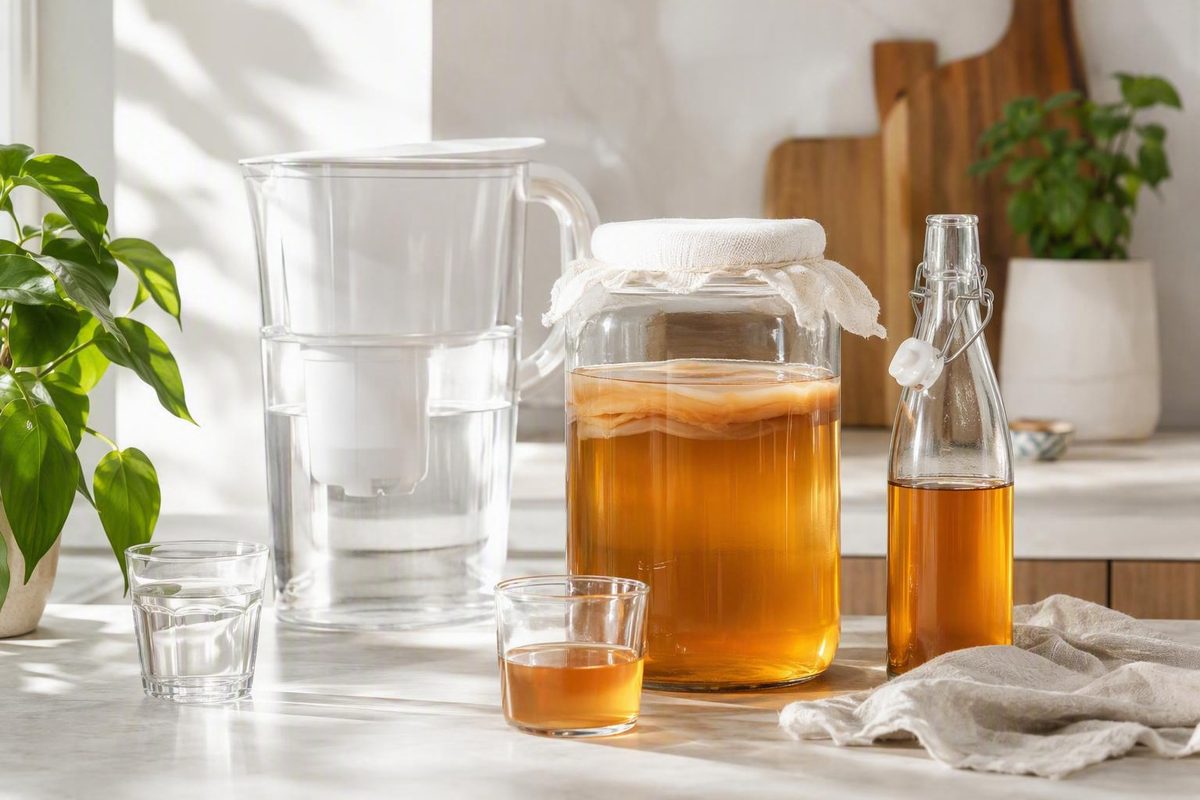
The short answer: filtered water is useful, not universally required
Filtered tap water is generally suitable for kombucha, but filtration is not universally required. Potable tap water may also be usable when you know how the supply is disinfected and choose an appropriate preparation method.
Water is one of kombucha’s four core ingredients, alongside tea, sugar, and culture. Because it provides the base for the drink, changing the water source may change flavor or make batches less directly comparable. Experienced brewers commonly favor filtered water for convenience and taste, while also reporting successful use of tap or spring water in home kombucha brewing.
That does not prove untreated potable tap water inevitably kills a SCOBY, causes mold, or weakens fermentation. Brewing guides often advise reducing chlorine or chloramine as a precaution, but the supplied evidence contains no controlled kombucha comparison or universal disinfectant concentration at which fermentation is known to be inhibited.
Separate three questions that are often conflated:
- Is the source established as drinking water? This guide addresses brewing-water preparation, not how to make an uncertain source potable.
- Which municipal disinfectant is present? Free chlorine and chloramine are treated differently in the supplied brewing guidance.
- Do you want a different flavor or a more repeatable starting point? Filtration or a consistent alternative water source can simplify comparisons between batches.
For most municipal-water users, the practical sequence is:
- Identify whether the supplier uses free chlorine, chloramine, or both.
- Choose a preparation method intended for that disinfectant.
- If using a filter, verify the exact system and cartridge rather than relying on the format or brand name.
- Operate and replace the cartridge according to its current documentation.
- Let boiled water or hot sweet tea cool before adding the culture.
- Keep the rest of the recipe consistent when judging whether water affected the batch.
This approach starts with the treatment target rather than with a pitcher, under-sink system, or bottled-water label.
Start by finding out what is in the water
Municipal treatment varies by location. A method that suits one brewer’s supply may not suit water from another city, building, or private system.
Consult your utility’s current water-quality information or contact the utility directly. Ask whether the water delivered to customers contains free chlorine, chloramine, or both. Commercial brewing guidance also recommends checking with the supplier before choosing a preparation method for tap water used in kombucha.
Useful questions include:
- Which residual disinfectant is used: free chlorine, chloramine, or both?
- Does the treatment change at certain times?
- Is the property supplied directly by the utility?
- Does the building have separate treatment equipment?
- Is the source municipal water or a private well?
- Does a refrigerator or dedicated drinking-water faucet have its own treatment path?
Instead, use current information from the supplier. If a property has its own treatment equipment, find out what happens to the water between the utility connection and the faucet you use.
Keep potability separate from fermentation suitability. This article cannot determine whether an unverified well, spring, rainwater collection system, or other uncertain source is safe to drink. Establish that first through evaluation appropriate to the source and local circumstances. A successful batch is not evidence that an uncertain source is suitable drinking water; supplied brewing guidance likewise treats source-water safety as a separate concern from routine kombucha preparation.
It is equally important not to overstate what a utility report can tell you. Identifying the disinfectant helps you select a treatment, but the supplied evidence does not establish a universal chlorine or chloramine concentration at which kombucha acidity, flavor, carbonation, or microbial activity will change. The report identifies a brewing variable; it does not predict the outcome of every batch.
Chlorine and chloramine require different treatment decisions
Free chlorine and chloramine are both described in the supplied sources as municipal disinfectants. Those sources distinguish between them because their recommended home-preparation methods differ: they present chloramine as the more persistent target and advise against treating brief boiling or passive standing as dependable chloramine removal.
A concise decision path is:
- Known free chlorine: Use a maintained carbon filter documented for chlorine reduction, or use boiling and cooling as described in brewing guidance.
- Known chloramine: Use a system whose documentation explicitly states chloramine reduction for the exact cartridge.
- Both disinfectants, or a changing treatment: Confirm that the selected method covers the relevant targets under its stated operating conditions.
- Unknown disinfectant: Return to the utility or property water-system operator before selecting a method.
Free chlorine versus chloramine
Question Free chlorine Chloramine How is it described in the supplied sources? A municipal disinfectant A municipal disinfectant treated as more persistent in home preparation Carbon filtration Use a filter documented for chlorine reduction Verify an explicit chloramine-reduction claim Boiling Presented by brewing guides as a practical reduction method Not presented as a practical removal method Passive standing Sometimes suggested, although results are not documented as universal Should not be relied on under the supplied guidance Practical next step Use documented carbon treatment or boil and cool Verify the exact filter’s chloramine claim
One specialist brewing guide recommends boiling and cooling for chlorinated water but directs brewers with chloramine toward charcoal filtration because it considers boiling insufficient for chloramine-treated supplies.
Evidence limit: These are practical recommendations from brewing publications, not controlled evidence that any detectable disinfectant residual damages a SCOBY. Ordinary potable tap water may ferment normally. Reducing a known disinfectant is best understood as a way to remove a plausible variable and make the brewing process easier to repeat.
That distinction is why “leave the water out overnight” is incomplete advice. Some guides suggest standing water for free chlorine, but the same instruction should not be extended to chloramine.
Some brewing articles propose chemical neutralizers, including vitamin C or Campden tablets. They are not recommended here because the supplied material does not provide adequately validated kombucha dosages, residual-sulfite guidance, sensitivity information, or evidence about effects on fermentation.
Compare boiling, standing, carbon filtration, and reverse osmosis
Each method addresses a different situation. Choose according to the known disinfectant, the status of the source as drinking water, the amount of equipment you want to maintain, and whether the system serves other household uses.
| Method | Useful target | Important limitation | Equipment or effort | Best-fit situation |
|---|---|---|---|---|
| Boiling and cooling | Free chlorine, according to supplied brewing guidance | Not presented as practical chloramine treatment or as a remedy for every possible water-quality problem | Pot, heat, cooling time, covered storage | Occasional brewer using potable water with confirmed free chlorine |
| Standing uncovered | Sometimes suggested for free chlorine | Variable and not recommended here for chloramine | Clean container, protected location, waiting time | A confirmed free-chlorine supply when the brewer accepts a less verifiable method |
| Activated carbon | Chlorine; chloramine only when the exact product supports that claim | Performance depends on the model, operating conditions, capacity, condition, and maintenance | Pitcher, faucet, countertop, refrigerator, or under-sink system; replacement cartridges | Regular brewing when a suitable documented cartridge is available |
| Reverse osmosis | Broader treatment than carbon alone, as described by commercial brewing guidance | Additional equipment and maintenance, mineral removal, and a reject-water stream | Prefilters, membrane, storage, sanitation, and replacement components | A household already using RO or treating water for a separate defined reason |
| Alternative drinking water | Avoiding an unsuitable or unclear tap-water setup | Product source and composition may vary; recurring transport, storage, and packaging | Containers and storage space | Temporary comparisons or homes where installing treatment is impractical |
Boiling. The supplied brewing sources present boiling as an option for potable water containing free chlorine, but not as a practical chloramine-removal method. They also caution against treating it as a universal answer to every possible chemical concern. This makes boiling a targeted brewing-water preparation method rather than a general purification claim.
Boiling can fit naturally into tea preparation. Brew the tea, dissolve the sugar, and allow the sweet tea to cool before adding starter liquid or culture. A separate brewing article likewise advises cooling freshly brewed tea before contact with the SCOBY during kombucha preparation.
Do not treat one fixed boiling time as a guarantee for every water supply. If chloramine is present, use a method documented for chloramine instead.
Standing. Leaving water uncovered is sometimes suggested for free chlorine. The supplied sources do not establish a universally effective standing time or set of conditions, so it is less verifiable than using a treatment system with documented performance.
Most importantly, standing should not be presented as a chloramine solution. Confirm the actual disinfectant rather than relying on a generic instruction to leave all tap water out overnight.
Activated carbon. Carbon filtration is a practical option for many regular brewers. A pitcher may be convenient for small batches, while countertop and under-sink systems may better suit frequent use. The physical format does not determine which disinfectants the product reduces.
“Activated carbon” or “charcoal” identifies the treatment medium, not guaranteed performance against every target. For chloramine in particular, look for an explicit claim covering the exact system and cartridge. The supplied commercial guidance notes that carbon performance varies and that not every carbon filter is designed or claimed to reduce chloramine.
Maintenance is part of the treatment method. Follow the documented capacity, operating conditions, installation procedure, flushing directions, and replacement schedule. A cartridge that is beyond its stated service conditions cannot simply be assumed to retain its original performance.
Reverse osmosis. Commercial kombucha guidance describes typical RO treatment as incorporating carbon pretreatment and addressing a broader set of dissolved substances than carbon alone. That is the treatment model reported by the source, not evidence that RO is required for kombucha.
RO introduces more components to maintain and removes dissolved minerals along with targeted substances. These tradeoffs do not make RO unsuitable; they mean that it should serve a defined household objective rather than be installed solely because kombucha supposedly demands it.
For three common situations:
- Simplest repeatable setup: Consider maintained carbon filtration matched to the confirmed disinfectant.
- Known chloramine supply: Choose a system whose current documentation explicitly lists chloramine reduction.
- Household already using RO: A properly maintained RO supply can be tried without installing a separate kombucha-only system.
How to verify that a carbon filter fits the job
The words “activated carbon” and “charcoal” do not prove that a pitcher, refrigerator filter, faucet unit, countertop cartridge, or under-sink system reduces chloramine.
Check the exact system and exact replacement cartridge.
Use this checklist:
- Identify the target. Confirm whether the supply contains free chlorine, chloramine, or both.
- Record the exact product. Note the system model and cartridge number.
- Find current documentation. Use the performance sheet or technical material for that precise model.
- Look for a named reduction claim. “Improves taste” or “uses activated carbon” is not equivalent to an explicit chlorine or chloramine statement.
- Read the stated conditions. Check the operating requirements identified by the manufacturer.
- Note the capacity and replacement basis. Follow the stated time, volume, or other service limit.
- Check installation instructions. Confirm that the cartridge has been fitted, flushed, and operated as directed.
- Maintain the system. Replace the cartridge and clean reusable components according to the instructions.
The supplied evidence supports the bounded conclusion that carbon-filter performance depends on the product, target, operating conditions, capacity, cartridge condition, and maintenance. It does not support assuming that every carbon filter works equally well or that a particular pitcher removes chloramine merely because another product from the same brand does.
If the documentation is inconclusive, contact the manufacturer and ask about the exact model. If no clear answer is available, choose another documented treatment method or another established drinking-water source. Do not infer performance from price, cartridge color, physical format, or marketing terms such as “advanced” or “premium.”
This product-specific approach remains useful when models change. The relevant question is not whether a brand is generally associated with filtration, but what the current cartridge claims under its stated conditions.
Carbon-filtered tap, RO, distilled, spring, and bottled water
No source is universally best. The practical choice depends on local treatment, brewing frequency, available space, maintenance preferences, and how consistently the same water can be obtained.
| Water source | Main advantage | Main tradeoff | Sensible use |
|---|---|---|---|
| Carbon-filtered tap | Convenient for repeat brewing when matched to the disinfectant | Requires verified performance and maintenance | Routine brewing in many municipal-water homes |
| Reverse-osmosis water | Consistent output from a maintained household system | More equipment, mineral removal, upkeep, and reject water | Homes already using RO for a defined reason |
| Distilled water | A low-dissolved-solids comparison water | Mineral removal and recurring purchase or production effort | A temporary control, or a trial when the brewer wants to isolate water as a variable |
| Spring water | Portable and sometimes preferred for taste | Source and composition can vary | Renters or occasional brewers using a product established as drinking water |
| Purified bottled water | Accessible without installing equipment | Recurring cost, transport, storage, packaging, and possible product variation | Temporary use or troubleshooting |
Carbon-filtered tap water is a practical recurring option when the source is potable, the cartridge is documented for the relevant disinfectant, and the system is maintained. Its suitability comes from matching the treatment to the water—not from carbon being universally effective.
Reverse-osmosis water can be evaluated in kombucha through a controlled batch. If a household already has a maintained RO system, the supplied evidence offers no basis for rejecting its water solely because dissolved minerals have been reduced.
Distilled water is sometimes discouraged by commercial brewing sources because it lacks dissolved minerals. Those same materials do not provide comparative evidence establishing that kombucha requires remineralization. One fermentation supplier permits distilled water while recommending mineral-containing alternatives, illustrating that this is a brewing preference rather than a demonstrated universal requirement in the supplied guidance.
Treat remineralization as an unresolved brewing hypothesis. Do not add arbitrary salts simply because water is described as “mineral-free.” An unmeasured addition introduces another variable, and the evidence does not establish which minerals or concentrations would improve kombucha.
Spring water may be convenient and may provide a flavor you prefer. The label alone does not demonstrate that every product will have the same composition. Switching sources or brands can also change the starting point of a batch.
Purified bottled water is useful when installing treatment is impractical or when you need a temporary comparison source. Use a product established as drinking water under the rules that apply where it is sold; labeling terminology and product composition may differ.
Scenario-based choices are more useful than declaring a winner:
- Budget-conscious regular brewer: Consider a maintained carbon system documented for the local disinfectant.
- Renter without a permanent installation: Consider a verified pitcher or countertop system, or use an established packaged drinking water temporarily.
- Household with existing RO: Try the maintained RO supply without assuming minerals must be added.
- Brewer troubleshooting inconsistent batches: Use one consistent alternative—such as RO, distilled, or packaged drinking water—as a temporary control.
The goal is safe source water with characteristics you can understand and reproduce, not the most impressive label.
Treat wells, springs, and rainwater as safety questions first
Private wells, collected rainwater, springs, and other nonmunicipal sources should not be assumed suitable for drinking because they look clear, taste pleasant, or come from a natural setting.
Before using such water, establish its drinking-water suitability through evaluation appropriate to the source and local circumstances. The supplied evidence does not support a universal do-it-yourself testing panel or purification recipe.
Ordinary beverage filters should not be presented as a substitute for that evaluation. A cartridge intended to improve taste or reduce a named municipal disinfectant does not thereby document treatment for every concern that may affect an uncertain source.
Some brewing guides describe boiling as part of well-water preparation while also acknowledging that it is not a complete response to all potential chemical concerns. Their well-water advice is cautious and location-dependent rather than a guarantee that boiling or pitcher filtration makes every source suitable for kombucha.
Pause use and investigate when the source changes noticeably, including:
- A new or strong odor
- Unexpected discoloration or cloudiness
- An unusual metallic, chemical, fuel-like, or sulfurous taste
- Flooding or runoff near a well
- Damage or alteration to a well, storage tank, or collection system
- A change following construction, maintenance, drought, or heavy rainfall
- Return of a long-unused source to service
Collected rainwater warrants the same source-specific caution. Commercial fermentation guidance notes that collection conditions can introduce debris or contaminants and does not support treating natural origin as proof of suitability.
This section deliberately does not provide a kitchen purification procedure. Establish drinking-water safety first. Only then consider whether disinfectant treatment, flavor, or consistency calls for additional preparation.
Troubleshoot water without blaming every bad batch on the filter
Water is one variable in kombucha, not a universal explanation for every problem.
Do not purchase a new treatment system based only on appearance.
Instead, run a controlled comparison:
- Select two or more water sources already established as drinking water.
- Make small batches with the same tea and sugar.
- Use starter liquid from the same well-mixed source.
- Keep starter quantity and total batch volume equal.
- Use equivalent vessels and covers.
- Keep the vessels in the same temperature environment.
- Start them together and use the same initial fermentation period.
- Change only the water source or water treatment.
- Record observations before changing the recipe.
Useful observations include aroma, taste progression, perceived acidity, the time required to reach your preferred balance, and later carbonation under matched bottling conditions. If you use a consistent acidity-measurement method, record the results without treating one isolated reading as a complete diagnosis.
Before replacing a filter, check:
- Whether the cartridge has reached its stated time or volume limit
- Whether it was installed and flushed according to instructions
- Whether the replacement cartridge matches the system
- Whether the system has a bypass setting
- Whether the collected water actually follows the intended treatment path
- Whether the utility has changed its disinfectant
- Whether the system has been maintained as directed
Then review non-water variables. Flat bottled kombucha, for example, does not identify water as the cause by itself.
One improved comparison batch is useful evidence for your setup, but it does not prove that every brewer needs the same water. Likewise, one unsuccessful batch made with RO or distilled water does not prove that mineral-free water requires supplementation. Repeat promising comparisons and change one variable at a time.
The operating rule is concise:
- Start with water established as suitable for drinking.
- Identify free chlorine versus chloramine.
- Choose a method explicitly suited to that target.
- Maintain the system according to its documentation.
- Cool heated water or sweet tea before adding the culture.
- Keep the recipe and fermentation conditions consistent.
- Investigate other variables before blaming the water.
Carbon-filtered tap water will be a straightforward option for many brewers. RO, distilled, spring, or packaged drinking water may suit other circumstances. The available evidence does not prove that ordinary potable tap water always harms a SCOBY or that water without dissolved minerals must be remineralized.
Frequently asked questions
Can I make kombucha with filtered tap water?
Yes. Filtered tap water is a practical choice when the original supply is potable, the treatment matches the disinfectant present, and the cartridge is maintained.
If the utility uses chloramine, look for an explicit chloramine-reduction claim for the exact cartridge. If it uses free chlorine, select a method documented for that target. Let hot tea cool before adding starter liquid or culture.
Is boiling tap water enough for kombucha?
It may be a practical preparation method for potable water known to contain free chlorine, according to the supplied brewing guidance. It is not presented as dependable chloramine treatment or as a solution to every possible water-quality concern.
Confirm the disinfectant first, and let boiled water or hot sweet tea cool before adding the culture. Do not use kombucha instructions as a substitute for evaluating an uncertain drinking-water source.
Does a standard pitcher filter remove chloramine?
Not necessarily. “Pitcher filter,” “activated carbon,” and “charcoal” do not establish chloramine performance.
Find the exact cartridge’s current documentation and look for an explicit chloramine-reduction statement, together with its operating and replacement conditions. If the information is inconclusive, contact the manufacturer or choose another documented method.
Can I use reverse-osmosis or distilled water without adding minerals?
The supplied evidence does not establish that remineralization is required for kombucha. Some commercial brewing guides prefer mineral-containing water, but they do not provide comparative evidence demonstrating a universal mineral requirement.
Use RO or distilled water in a controlled trial while holding tea, sugar, starter, temperature, vessel, and fermentation time constant. Treat any later mineral adjustment as a separate experiment, not a mandatory step.
How often should I replace a filter used for kombucha water?
Follow the instructions for the exact cartridge. There is no universal kombucha-specific replacement interval because products have different stated capacities and service conditions.
Track the replacement measures specified by the manufacturer, such as elapsed time or treated volume.