
Do Fridge Water Filters Remove Fluoride? The Model Decides
Most built-in cartridges target chlorine, taste and odor, not fluoride. Fluoride-specific evidence must match your household's actual operating conditions.
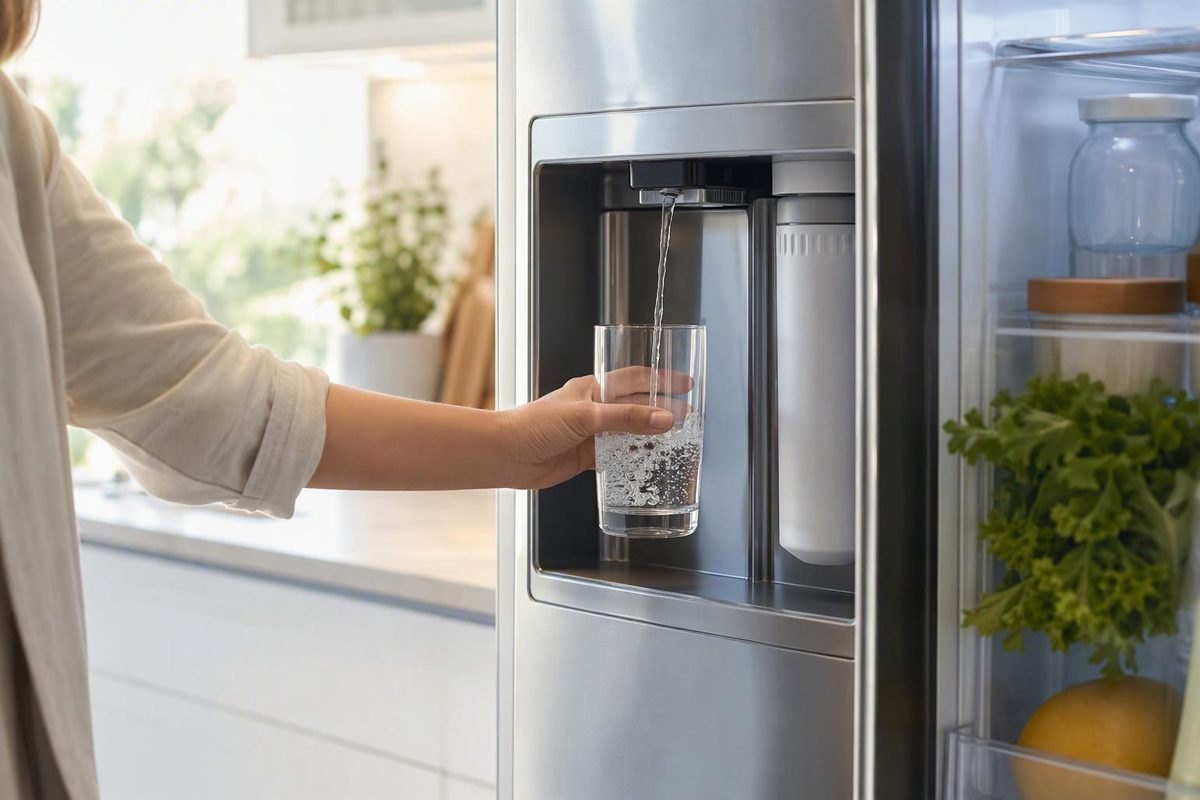
The short answer: most standard fridge filters do not significantly reduce fluoride
Most built-in refrigerator water filters should not be assumed to reduce significant amounts of fluoride. Typical cartridges are designed primarily to reduce chlorine and improve taste or odor, not to target fluoride. Commercial filtration guides consistently describe this limitation, although they do not provide independent testing of every refrigerator filter on the market (All Filters’ fluoride-filtration guide).
Three different products are commonly described as a “fridge filter”:
- The built-in cartridge inside the refrigerator
- A separate inline cartridge installed on the refrigerator supply line
- An under-sink treatment system that sends treated water to the refrigerator
The first is commonly a compact carbon cartridge focused on taste, odor, chlorine, and any additional contaminants named in its documentation. The second may contain media marketed specifically for fluoride reduction. The third may use reverse osmosis or another treatment process before routing water to the dispenser and ice maker.
Therefore, the answer to “does a fridge water filter remove fluoride?” depends on the exact product. If its official performance documentation does not explicitly list fluoride, do not infer fluoride reduction from broad language such as “reduces contaminants,” “improves water quality,” or “certified.”
It is also important to distinguish reduction from complete removal. A system may lower the fluoride concentration without eliminating every measurable trace. Without those details, “reduces fluoride” is the more defensible description.
Start with the model number rather than the filter’s appearance, price, or fit. The answer for your household depends on fluoride-specific evidence for the exact model and on using the system under the conditions covered by that evidence.
Built-in carbon cartridges and fluoride-specific systems are different products
A typical refrigerator cartridge is compact enough to fit inside an appliance while supplying water to its dispenser and ice maker. Many such cartridges use activated carbon and are promoted primarily for chlorine, taste, and odor reduction. Water can therefore taste noticeably different even when the filter has no documented fluoride claim.
Commercial filtration sources describe ordinary carbon refrigerator filters as having limited effectiveness against fluoride. That does not establish that every carbon formulation performs identically; it means a conventional taste-and-odor cartridge should not be treated as a fluoride filter unless its model-specific documentation says otherwise. A Culligan comparison likewise lists chlorine and taste or odor as typical refrigerator-filter targets while associating fluoride reduction with a particular reverse-osmosis configuration (Culligan Nation’s household-filter comparison).
A fluoride-reduction system generally needs a dedicated treatment stage, which may include:
- A reverse-osmosis membrane in a validated system
- Activated alumina or aluminum oxide
- Bone char
- Another fluoride-targeting medium supported by product-specific evidence
The word dedicated matters. A cartridge may combine activated carbon with another medium intended to target fluoride, but a generic carbon block is not automatically equivalent. The presence of specialized media also does not prove the performance of the finished system. The claim still needs to account for the product’s design, tested flow, capacity, operating conditions, and replacement criteria.
The three common configurations differ as follows:
| Configuration | Where treatment occurs | Common purpose | Main question to verify |
|---|---|---|---|
| Built-in refrigerator cartridge | Inside the appliance | Taste, odor, chlorine, and model-specific claims | Is fluoride explicitly included? |
| External fluoride-specific cartridge | On the cold-water line before the refrigerator | Treatment of refrigerator water and ice | Is the finished cartridge supported by fluoride-specific evidence? |
| Under-sink system feeding the refrigerator | Under a sink or in another service area | Treatment for a faucet and potentially the refrigerator | Can the system support the required routing, pressure, and flow? |
A broad contaminant list is not proof of fluoride performance. Neither is a certification mark viewed without its accompanying claim or listing. A product may be evaluated for one purpose without being evaluated for every substance a buyer wants to reduce.
Look for fluoride by name in the contaminant-reduction table or certification listing. If it is absent, treat the product as unverified for fluoride even if the water tastes better after filtration.
How to check whether your exact filter has a credible fluoride claim
Use a model-level verification process instead of relying on a general statement about a brand or refrigerator type.
-
Identify the refrigerator model. Find the appliance label, often located inside the fresh-food compartment, near a door frame, behind a drawer, or on an interior wall.
-
Identify the installed cartridge. Record the full filter model, including any suffix or revision. Multiple replacement cartridges may fit the same refrigerator.
-
Locate the official performance data. Search the filter or appliance manufacturer’s website for a performance data sheet. An installation guide may not contain the contaminant-reduction results.
-
Find the contaminant table. Look specifically for fluoride. General references to chemicals, dissolved substances, or “harmful contaminants” are not substitutes for a named fluoride claim.
-
Check the scope of any certification. Determine whether the exact model and the fluoride claim are covered. Do not treat a logo as proof that every possible contaminant was evaluated.
-
Review the tested conditions. Look for the initial fluoride concentration, treated concentration or percentage reduction, flow, pressure, temperature, total treated volume, rated capacity, and replacement criteria.
-
Request missing evidence. If a seller makes a fluoride claim without providing adequate documentation, ask for the test method, laboratory identity, complete results, operating conditions, and end-of-life data.
Certification and independent laboratory testing can both be useful, but their value depends on scope and protocol.
Manufacturer documentation can help when it provides a transparent test protocol. Retail descriptions and customer reviews are weaker forms of evidence. Reviews may reveal confusing instructions, leaks, difficult cartridge changes, limited replacement availability, or disappointing flow, but they cannot establish fluoride reduction without credible measurements under known conditions.
For reverse-osmosis systems, documentation may reference NSF/ANSI 58 in connection with contaminant-reduction claims, including fluoride. One dentist-authored commercial guide identifies that standard as relevant to RO fluoride claims, but the mere appearance of “NSF” in advertising is not enough; the exact system, claim, and certification scope still need to be checked (commercial guide discussing NSF/ANSI 58).
A useful report or certification listing should disclose enough information to answer these questions:
- What was the starting fluoride concentration?
- What was the treated concentration or percentage reduction?
- How many samples were taken, and at what points in the test?
- What flow rate was used?
- How much water had been treated at each sampling point?
- What operating pressure and temperature applied?
- What rated capacity was assigned?
- What criterion defined exhaustion or the end of useful life?
- What laboratory and test method were used?
A headline percentage without these details is difficult to apply at home.
Treat phrases such as “tested,” “lab grade,” “fluoride filter,” and “advanced filtration” as prompts to inspect the underlying evidence—not as conclusions.
Find out how much fluoride is in the source water first
Before buying treatment equipment, establish what is in the incoming water. A baseline helps determine whether treatment is wanted and provides a value against which the finished system can be evaluated.
For municipal water, begin with the water supplier’s current Consumer Confidence Report. Confirm that the report applies to your supplier, service area, and reporting period.
For private-well water—or when current, location-specific information is unavailable—consider a laboratory that offers fluoride analysis. Commercial filtration guidance recommends utility information for municipal customers and certified laboratory testing for well users, although that recommendation comes from a retailer rather than an independent public authority (All Filters’ source-water guidance).
Testing before treatment can:
- Confirm whether measurable fluoride is present
- Establish the incoming concentration
- Help determine whether a product’s tested conditions resemble your water
- Prevent selection based only on broad marketing language
- Provide a baseline for evaluating treated water
Municipal and private-well applications should not automatically be treated as interchangeable. For example, one manufacturer markets a refrigerator-compatible system for inorganic fluoride in municipal water but advises consultation regarding naturally occurring well-water fluoride. The page supplies product operating conditions and seller-reported capacity figures, but it does not provide an independent fluoride certification or complete test report (Crystal Quest’s refrigerator inline-filter specifications).
That restriction illustrates why source-water applicability matters. If the available evidence covers only a stated municipal-water application, it does not establish equivalent performance for a private well.
When real-world confirmation is important, use this sequence:
- Test the untreated water.
- Install and flush the treatment system as directed.
- Test water from the refrigerator after installation.
- If practical, test again near the system’s documented end-of-life point.
The first treated-water result shows how a new system performs under your conditions. Neither result should be replaced by observations about taste, clarity, or flow.
This measurement-first approach does not require taking a position for or against community water fluoridation. It is simply a way to determine what the source water contains and whether a selected system produces the intended result.
Fluoride-treatment options for refrigerator water and ice
Available treatment categories differ in evidence quality, installation needs, speed, maintenance, and ability to supply both the water dispenser and ice maker. The evidence provided here is predominantly commercial, so these should be treated as categories to investigate—not guaranteed solutions.
Standard carbon filtration
A standard refrigerator cartridge is compact and convenient when the main goals are reducing chlorine and improving taste or odor. Replacement is usually integrated into the appliance’s normal maintenance process.
Its limitation is the absence of a fluoride-specific claim on most typical models. Unless the exact cartridge documentation explicitly includes validated fluoride reduction, do not assume ordinary carbon filtration serves that purpose.
A built-in carbon cartridge may still operate as a taste-and-odor stage alongside a separate treatment system. Any combined arrangement must remain compatible with the refrigerator and the upstream equipment.
Fluoride-specific inline media
An inline cartridge is installed on the cold-water line serving the refrigerator. Depending on the product, it may contain bone char, aluminum oxide, another fluoride-targeting medium, or a combination of media.
The main advantage is its location: it treats the water going to the appliance rather than water throughout the home. When installed before the refrigerator inlet, it may supply both the dispenser and ice maker.
The main concern is evidence quality. Commercial refrigerator-compatible cartridges are sold with varying levels of documentation, and some product pages provide neither independent certification nor a complete test report. Before buying, verify:
- The type and source of fluoride covered by the claim
- Starting and treated concentrations
- Tested flow and operating conditions
- Fluoride-specific rated capacity
- The definition of end of life
- Replacement-cartridge availability
- Independent certification or complete laboratory support
Do not equate the presence of bone char or aluminum oxide with guaranteed finished-system performance. Media identity is only one part of the claim.
Reverse osmosis
Reverse osmosis uses pressure and a specialized membrane as part of a multistage treatment process. Among the available commercial sources, RO is the most consistently recommended household category for fluoride reduction. No universal reduction percentage is justified, however, because performance depends on the exact system, membrane condition, operating conditions, source water, and maintenance (Culligan’s fluoride-treatment overview).
An under-sink RO system may be configured to supply a dedicated faucet and, where the equipment and installation permit it, a separate refrigerator line. Questions to investigate include:
- Whether the exact model has a fluoride claim
- Whether its production and delivery rate can support the refrigerator
- Whether storage is part of the design
- What filter and membrane maintenance is required
- Whether the distance and elevation to the refrigerator are suitable
- Whether the system’s installation requirements are practical for the home
RO is not automatically the best choice for every household, but it is a principal plumbed category to investigate when fluoride reduction and treatment at more than one kitchen outlet are desired.
Activated alumina or aluminum oxide
Activated alumina and aluminum oxide are marketed as fluoride-targeting media in some specialized filters. Their performance should be evaluated at the finished-product level rather than inferred from the material name alone.
Relevant product documentation should address the starting concentration, water conditions, flow, total treated volume, rated capacity, and replacement point.
Bone char
Bone char appears in some commercial fluoride-specific inline cartridges. It may be used alone or combined with other media intended to address additional filtration goals.
As with aluminum-based media, finished-system validation matters more than the ingredient name. Buyers may also have dietary, religious, ethical, or personal reasons to avoid animal-derived media, so composition should be checked before purchase.
Distillation
Commercial filtration guides present it as a possible fluoride-reduction method while describing it as batch-based, slow, and electricity-using compared with a plumbed cartridge.
A countertop distiller may be relevant where plumbing modifications are impractical. It does not ordinarily feed a refrigerator automatically, however. Water must be produced and transferred manually, which may be inconvenient for supplying an appliance ice maker.
Comparing the options
| Treatment category | Installation | Delivery pattern | Maintenance question | Can it directly serve water and ice? |
|---|---|---|---|---|
| Standard refrigerator carbon | Built into the appliance | Designed for normal appliance demand | When must the cartridge be replaced? | Yes, but fluoride reduction is usually undocumented |
| Fluoride-specific inline cartridge | Added to the refrigerator line | Product- and pressure-dependent | Is capacity specifically validated for fluoride? | Usually, when placed before the refrigerator inlet |
| Under-sink RO feeding the refrigerator | Requires a compatible routed connection | Depends on system design and available delivery | What filters and membrane service are required? | Potentially |
| Activated alumina or aluminum oxide cartridge | Added inline or used in a specialized system | Product-specific | What defines fluoride breakthrough? | Potentially |
| Bone-char cartridge | Added inline or used in a specialized system | Product-specific | Is the finished system validated and the media acceptable? | Potentially |
| Countertop distillation | No permanent refrigerator connection | Batch production | How often must the unit be cleaned and operated? | Not automatically |
When the goal is limited to refrigerator drinking water and ice, point-of-use treatment is generally the most directly relevant comparison because it focuses on the outlets being used. A household that wants treatment at several taps may instead investigate a system capable of supplying a broader set of drinking-water outlets.
Two ways to send fluoride-treated water to the refrigerator
The first arrangement places a fluoride-specific inline cartridge before the refrigerator.
Water flow →

Cold-water supply
        │
        ▼
Shutoff valve
        │
        ▼
Fluoride-specific inline cartridge
        │
        ▼
Refrigerator inlet
        │
        ├──► Door water dispenser
        │
        └──► Ice maker
In this layout, the cartridge treats water before it enters the appliance. The refrigerator then sends that incoming water to its dispenser and ice-making components.
Commercial sellers market inline systems for this purpose and state that some can work alongside an existing internal refrigerator cartridge. Those are compatibility claims, not guarantees for every appliance or installation (Pure Water Freedom’s refrigerator inline-filter description).
Leaving the internal filter in place may preserve its documented taste, odor, or chlorine functions. If the appliance manufacturer specifies a bypass when the internal filter is removed, use the approved configuration.
The second arrangement starts with an under-sink system:
Water flow →

Cold-water supply
        │
        ▼
Under-sink treatment system
        │
        ▼
Treated-water outlet
        │
        ├──► Dedicated drinking-water faucet
        │
        └──► Properly configured refrigerator line
                    │
                    ▼
             Refrigerator inlet
                    │
                    ├──► Door dispenser
                    └──► Ice maker
This layout can allow one system to serve both a sink faucet and the refrigerator, but successful operation depends on the equipment’s design and the installation. Check:
- Refrigerator and treatment-system instructions
- Tubing dimensions and material
- Fitting compatibility
- Available mounting space
- Clearance for cartridge replacement
- Permitted inlet pressure
- Treatment-system delivery rate
- Refrigerator flow requirements
- Distance and elevation between the system and appliance
- Accessible shutoff locations
- Provisions for detecting leaks
Some commercial inline systems are offered for 1/4-inch outside-diameter tubing, while other configurations require adapters. That is a product-specific example, not a universal refrigerator specification. The same product page lists defined pressure, temperature, and flow ranges, reinforcing the need to check each model rather than assume compatibility.
The practical effect depends on available pressure, system sizing, tubing, line length, loading, and cartridge condition. Follow the appliance and treatment-system instructions; one inline-filter retailer recommends professional installation, while another manufacturer recommends considering a leak-detection valve because installations involve multiple variables.
Capacity, replacement, and real-world performance
Taste and continued flow are therefore not dependable indicators of fluoride performance.
Variables that may affect results include:
- Initial fluoride concentration
- Source-water conditions
- Flow rate
- Total water use
- Sediment loading
- Membrane or media condition
- Inlet pressure
- Water temperature
- Installation and maintenance practices
Use a fluoride-specific rated capacity and documented end-of-life criteria whenever they are available. A general instruction to replace a cartridge after a certain number of months may be convenient, but it does not necessarily show how fluoride performance was established.
A planning estimate can be useful only when the capacity is explicitly tied to fluoride reduction and a defined end-of-life threshold:
Estimated service life in days = validated fluoride-rated gallons ÷ average gallons per day sent to the refrigerator
For example, a fluoride-specific capacity of 600 gallons divided by average use of 2 gallons per day produces an arithmetic estimate of 300 days. That is a scheduling estimate, not proof that the system will maintain its claim for exactly 300 days. A manufacturer’s time limit or “whichever comes first” requirement may override the calculation, and different source-water or operating conditions may justify earlier replacement.
Do not use a generic seller capacity in this formula unless the documentation shows that it represents fluoride breakthrough under defined conditions. One manufacturer’s product page, for example, gives inconsistent gallon-based replacement guidance and conflicting cartridge information. Those figures should not be treated as independently established capacity data.
Useful documentation should explain:
- The starting fluoride concentration used in testing
- The treated concentration considered acceptable
- Whether capacity is based on fluoride breakthrough
- The tested flow
- Whether rated life is based on gallons, time, or whichever comes first
- The conditions that may shorten service life
Keep a service record containing:
- Installation date
- System and cartridge model numbers
- Baseline fluoride result
- Post-installation result
- Estimated refrigerator water use
- Cartridge-change dates
- Flow observations
- Maintenance performed
- Any end-of-life laboratory results
When capacity evidence is incomplete, testing near the expected replacement point provides more useful information than guessing from taste or elapsed time.
A practical decision path—and common approaches that do not solve the problem
Use this sequence to move from a general concern to a defensible treatment choice.
-
Identify the current cartridge. Record the exact filter model, not only the refrigerator brand.
-
Check for an explicit fluoride claim. Find fluoride in the official performance data and examine the scope of any certification.
-
Establish the source-water concentration. Use current utility information as a starting point for municipal water and consider appropriate laboratory analysis when precise or address-specific results are needed.
-
Define the treatment area. Decide whether you want to treat only refrigerator water and ice, a kitchen faucet plus the refrigerator, or several drinking-water outlets.
-
Compare systems using fluoride-specific evidence. Favor transparent certification or complete laboratory documentation over retail descriptions.
-
Confirm source-water applicability. Make sure the claim covers the type of source water and fluoride addressed by the test.
-
Check installation compatibility. Review tubing, fittings, space, pressure, flow, line routing, and cartridge access.
-
Plan verification and maintenance. Decide how initial performance and end of life will be evaluated before buying.
If the exact built-in cartridge has credible fluoride-specific evidence, use it under the tested conditions and replace it according to its documented criteria. There is no reason to add equipment merely because most other refrigerator cartridges lack the same claim.
If the built-in filter has no adequate fluoride evidence, the principal plumbed categories to investigate are:
- A validated fluoride-specific inline stage before the refrigerator
- A compatible under-sink reverse-osmosis system routed to the refrigerator
For renters or households unable to modify plumbing, countertop treatment or distillation may be worth investigating. Verify the exact product’s fluoride claim and consider batch speed, counter space, storage, and manual transfer. A countertop unit does not automatically treat an appliance ice maker.
Several common approaches should not be mistaken for verified fluoride treatment:
- An ordinary pitcher filter: Do not assume fluoride reduction unless the exact cartridge documentation includes it.
- A standard under-sink carbon filter: Better taste does not establish fluoride reduction.
- A typical refrigerator carbon cartridge: Chlorine and odor claims do not imply fluoride performance.
- Letting water stand: Commercial filtration sources say this does not remove fluoride.
- Boiling: The same commercial guidance says boiling is not a fluoride-removal method and may concentrate fluoride in the remaining water as some water evaporates. This is a commercial-source consensus, not independent technical proof (Culligan’s discussion of boiling and standing water).
Before buying, check that:
- Fluoride is explicitly named in the claim.
- The exact model is covered.
- The evidence applies to the source water.
- Starting and treated concentrations are disclosed.
- Tested flow and operating conditions are stated.
- Capacity is specifically connected to fluoride performance.
- End-of-life criteria are explained.
- The system can meet the refrigerator’s flow requirements.
- Replacement cartridges or membranes are available.
- Media composition is acceptable to the household.
- Installation and future service access are practical.
- A plan exists for testing when confirmation matters.
Frequently asked questions
Can an inline fluoride filter work with the filter already inside my refrigerator?
Potentially. An external inline stage can be installed before the refrigerator while the internal cartridge remains in place. The external stage would address its documented claims, while the internal cartridge could continue performing its own stated taste, odor, chlorine, or other functions.
Compatibility is not automatic. Two cartridges may create additional flow resistance, and performance depends on available pressure, tubing, system requirements, loading, and cartridge condition. Check both manufacturers’ instructions. If the internal cartridge must be removed, use the bypass arrangement specified for the appliance.
Will filtering the refrigerator supply line also treat the ice?
Usually, if the treatment stage is installed before the refrigerator inlet and both the dispenser and ice maker draw from that inlet. Water is treated before the appliance directs it to its internal components.
Confirm the plumbing arrangement for the specific refrigerator. A product being marketed for dispensers and ice makers does not by itself establish fluoride reduction or adequate flow; both claims still require model-specific evidence.
Is reverse osmosis better supported than a standard refrigerator cartridge for fluoride reduction?
Yes, as a general treatment category within the available commercial evidence. The cited guides consistently describe typical refrigerator cartridges as taste, odor, and chlorine filters while presenting reverse osmosis as a principal household fluoride-reduction option.
That does not mean every RO system performs equally. Verify the exact model’s fluoride claim, tested conditions, capacity, and maintenance requirements. A well-documented specialty inline cartridge may also be suitable, but its evidence must be evaluated at the finished-system level.
Does boiling water or leaving it out remove fluoride?
Do not rely on either method. The available commercial guidance says standing water does not remove fluoride and that boiling can leave fluoride in the remaining water as water evaporates, potentially increasing its concentration.
Households seeking verified reduction should use a fluoride-specific treatment process and confirm the result through appropriate testing rather than relying on standing time or evaporation.
How can I confirm that a filter is reducing fluoride in my home?
Test untreated water first. Then install and flush the treatment system according to its instructions and test water from the refrigerator. The report should identify the fluoride concentration, method, and detection limit.
Compare the result with the product’s claim and tested conditions. If practical, repeat the treated-water test near the documented replacement point. Keep the results with the installation and cartridge-change records.
The bottom line is straightforward: a typical built-in refrigerator cartridge should not be assumed to reduce fluoride. A refrigerator may still receive fluoride-treated water through a properly documented specialty inline stage or a compatible under-sink system. Check the exact filter claim, establish the source-water concentration, compare model-specific evidence and operating limits, confirm plumbing and flow compatibility, and verify performance through testing and timely maintenance.