
Most Refrigerator Filters Don't Reliably Remove Fluoride
Without an explicit fluoride claim in the exact model's performance data or certification listing, reduction is unproven. Fit alone is not evidence.
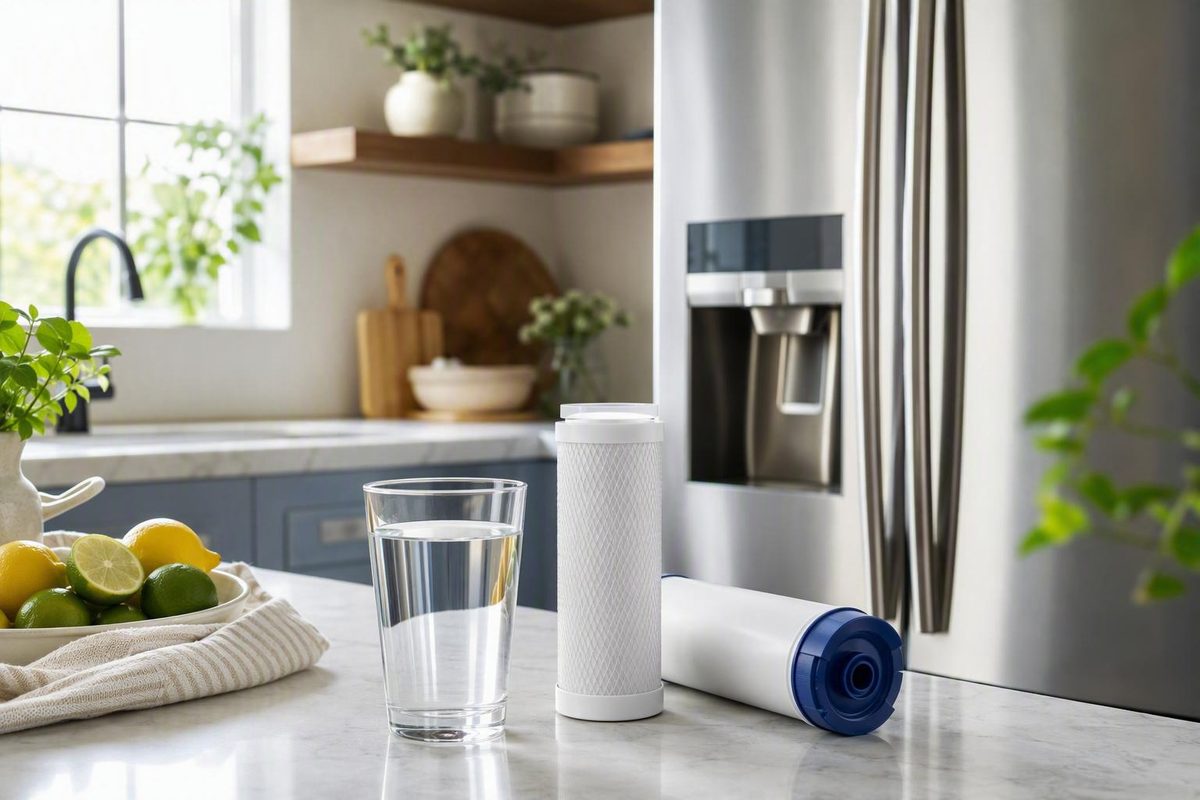
The short answer: most standard fridge filters do not meaningfully reduce fluoride
Generally, no: an ordinary built-in refrigerator filter should not be assumed to meaningfully reduce fluoride. Commercial filter retailers commonly describe standard refrigerator cartridges as unsuitable for that purpose, although their agreement is not a substitute for independent, category-wide testing. FridgeFilters.com, for example, says ordinary refrigerator filters generally use activated carbon and are not designed around dissolved fluoride reduction (FridgeFilters.com’s refrigerator-filter explanation).
Another commercial guide reaches the same qualified conclusion while emphasizing that individual products must be checked separately. Because the available evidence comes mainly from companies that sell filtration products, “generally no” is more defensible than “never” (Frizzlife’s commercial overview).
The answer for a particular refrigerator depends on the exact filter model and its current performance documentation. If the model’s performance data sheet or certification listing does not explicitly identify fluoride as a tested reduction claim, meaningful fluoride reduction has not been established by the supplied evidence.
Three terms are important:
- Reduce fluoride means lowering its concentration by a measurable amount. The treated water may still contain fluoride.
- Remove fluoride is often used informally to mean reduction, but it can imply a more complete result than the testing supports.
- Fluoride-free requires a defined laboratory result, including the analytical method and detection limit. It cannot be established from taste, a media name, or an unexplained seller promise.
A standard internal carbon cartridge and a specialized upstream treatment system are different product categories. Sellers market external cartridges that connect to a refrigerator’s incoming cold-water line, but connection compatibility does not establish treatment effectiveness.
The practical answer is therefore:
Most ordinary built-in refrigerator filters should not be relied on for fluoride reduction unless the exact model has an explicit, model-specific fluoride performance claim. Specialized upstream treatment may reduce fluoride before water reaches the refrigerator, but its performance and compatibility must be evaluated separately.
Why a typical activated-carbon cartridge is a poor match for fluoride
Commercial filtration sources describe granular activated carbon and carbon block as common media in standard refrigerator cartridges. Those sources associate ordinary carbon filtration mainly with goals such as reducing chlorine-related taste and odor and trapping sediment, while describing it as a poor match for dissolved fluoride ions.
The practical issue is that success against one substance does not prove success against another. A cartridge may improve taste while leaving the fluoride concentration approximately unchanged.
Imagine that incoming water has a noticeable chlorine taste and also contains fluoride. After filtration, the chlorine taste may be much less noticeable. That sensory improvement may be genuine, but it does not show that fluoride was captured. Fluoride performance must be measured separately.
The same caution applies to broad marketing phrases such as:
- “Cleaner water”
- “Advanced filtration”
- “Reduces contaminants”
- “Multi-stage protection”
- “Premium purification”
- “Healthier drinking water”
None of these phrases identifies the substances tested, the size of the reduction, the test conditions, or whether performance continued through the cartridge’s stated service life.
Do not infer fluoride reduction from claims involving lead, mercury, arsenic, pesticides, volatile organic compounds, pharmaceuticals, PFAS, chloramines, or other substances. Likewise, a fluoride claim does not prove performance against those contaminants. Each claim needs evidence for the exact model.
This is also why replacing one compatible carbon cartridge with another may not solve a fluoride-specific objective. Compatibility establishes that a cartridge is intended to fit a particular housing or appliance. It does not establish which substances the cartridge reduces.
How to verify whether your exact filter has a fluoride claim
Do not begin with the refrigerator brand alone.
Use this verification process:
-
Identify the exact cartridge. Record the complete model or part number from the filter itself. Do not rely only on the refrigerator model, package color, or a marketplace listing that says the product “fits.”
-
Locate the current performance data sheet. Look for documentation associated with the exact filter model. A contaminant-reduction table with identified test conditions is more useful than a general sales page.
-
Search specifically for “fluoride.” If fluoride does not appear in the tested-reduction table, do not reinterpret general filtration language as a fluoride claim.
-
Find the measured result. Look for a percentage reduction or both the incoming and treated fluoride concentrations. “Targets fluoride” and “contains fluoride media” are descriptions, not measured outcomes.
-
Check the rated endpoint. Determine whether the stated result applies only to fresh media or was demonstrated through a specified volume or service endpoint.
-
Classify the evidence. Useful labels include: - Independently certified: A recognized certification body lists the exact model and fluoride claim. - Independently laboratory tested: An identified third-party laboratory report gives the model, method, conditions, and results, but the claim may not be part of a certification program. - Manufacturer tested: The manufacturer reports testing without an independent certification listing. - Seller reported: A retailer or reseller makes the claim without identifiable supporting test documentation.
-
Confirm that the record covers the exact product. Do not transfer a claim from one cartridge to an entire product family, a larger treatment system, a generic replacement, or a similar-looking model.
A standard number or certification logo should not be treated as a universal list of everything a filter reduces. A commercial standards overview describes NSF/ANSI 42 and 53 as applying to specified aesthetic and health-effect claims, respectively, and NSF/ANSI 58 as relevant to reverse-osmosis systems. Because the supplied explanation is commercial rather than official standards documentation, use it only as a prompt to inspect the exact model’s listing—not as proof that a filter reduces fluoride.
A useful fluoride performance record should disclose as many of the following details as possible:
- Exact system and replacement-cartridge model
- Incoming fluoride concentration
- Treated fluoride concentration
- Percentage reduction
- Test method or protocol
- Testing laboratory or certification body
- Water pH and other relevant test-water conditions
- Pressure and temperature
- Flow rate
- Total tested capacity
- Results at or near the stated endpoint
- Required maintenance and replacement trigger
- Analytical detection limit if “fluoride-free” is claimed
Missing information does not prove that a product fails. It does make the claim harder to evaluate. Unexplained capacity language, unidentified test conditions, and “fluoride-free” wording without a detection limit are reasons to request better documentation before buying.
Ways to deliver fluoride-reduced water to a refrigerator
If the internal cartridge lacks a fluoride claim, treatment may be placed before the refrigerator. The appropriate arrangement depends on which outlet needs treated water, the available plumbing and space, household demand, and the quality of the product-specific evidence.
The comparison below includes the standard refrigerator cartridge as a baseline plus five treatment approaches commonly marketed or cited for fluoride reduction.
| Category | Where treatment occurs | Refrigerator use | Evidence limitations | Installation and maintenance considerations | What to verify |
|---|---|---|---|---|---|
| Standard refrigerator carbon cartridge | Inside the refrigerator | Serves whichever appliance outlets the refrigerator routes through it | Should not be assumed to reduce fluoride without an explicit claim | Usually follows the appliance’s normal replacement arrangement; capacity and flow are model-specific | Does the exact data sheet name fluoride? Was performance tested through the rated endpoint? |
| Fluoride-specific inline cartridge | On the cold-water line before the refrigerator | Can supply the refrigerator if installed on the line serving the intended outlets | Available examples in the supplied evidence rely primarily on seller claims | Requires compatible tubing, fittings, pressure, flow, mounting space, leak precautions, and cartridge replacement | What media are used? Who tested the fluoride claim? Under what water conditions and to what endpoint? |
| Reverse osmosis | Commonly at another point upstream of the refrigerator | May be considered if the system is designed and plumbed to deliver treated water to the appliance | A result for one RO system cannot be generalized to all RO units | System-specific storage, pressure, tubing, distance, membrane service, prefilters, and wastewater must be evaluated | Does the exact system have a fluoride claim? Can it meet the refrigerator’s documented delivery requirements? |
| Activated alumina or aluminum-oxide media | In a dedicated cartridge or treatment vessel | Potentially, when incorporated into a compatible upstream system | A media name alone does not prove product performance | Water conditions, flow, cartridge condition, and replacement requirements may affect seller-reported performance | What test water and operating conditions were used? Is there endpoint data for the exact cartridge? |
| Bone-char media | In an inline cartridge or treatment vessel | Potentially, in a compatible upstream installation | Refrigerator-line examples in the supplied evidence are seller marketed rather than independently verified | Requires cartridge changes and suitable delivery conditions; it is animal-derived | Is the medium acceptable to the household? Is there model-specific testing? |
| Distillation | In a separate batch appliance | Not ordinarily a direct pressurized refrigerator-line retrofit | Unit-specific performance documentation still matters | Requires batch production, cleaning, electricity, storage, and hygienic transfer | How much water is produced per cycle, and how will it be stored and delivered? |
Fluoride-specific inline cartridges
An inline cartridge is marketed for installation on the cold-water supply before water enters the refrigerator. If the line being treated supplies both the dispenser and ice maker, both may receive treated water; that plumbing arrangement must be confirmed for the particular appliance.
This arrangement may suit households interested only in refrigerator water and ice. However, the supplied evidence does not identify an exact refrigerator-compatible inline cartridge with independently verified fluoride performance.
Pure Water Freedom, for example, markets refrigerator-line systems using bone char and other media, but its category page does not provide a quantified fluoride result, identified test protocol, or independent certification record. Its performance statements should therefore be treated as seller claims rather than established results (Pure Water Freedom’s inline-filter listings).
Before considering an inline cartridge, ask for:
- An exact model number
- Identified media
- Incoming and treated fluoride concentrations
- Test-water chemistry
- Flow and pressure conditions
- Endpoint or end-of-life results
- The identity of the testing organization
- A replacement trigger tied to demonstrated performance
Reverse osmosis
Reverse osmosis uses pressure and a semipermeable membrane to separate water from many dissolved constituents. Commercial sources commonly cite it as a fluoride-reduction method, and some individual systems carry model-specific fluoride claims.
Culligan reports a high fluoride-reduction result for specified Aquasential reverse-osmosis systems. That statement applies only to the named systems and should not be extended to every RO unit, especially without checking the current exact-model certification record and performance documentation (Culligan’s model-specific RO discussion).
If an RO system is being considered for refrigerator service, verify rather than assume:
- Whether the system is designed to supply an appliance line
- Storage and delivery capacity
- Available pressure at the refrigerator
- Refill or recovery performance
- Tubing requirements
- Distance and elevation between the system and appliance
- Refrigerator manufacturer requirements
- Membrane and prefilter maintenance
- Whether simultaneous demand from multiple outlets is supported
RO may merit comparison when a household wants treated water at a separate faucet as well as the refrigerator. Any additional contaminant claims still need exact-model evidence.
Activated alumina, aluminum oxide, and bone char
Activated alumina and related aluminum-oxide media are commonly marketed for fluoride reduction. The media name alone does not establish how a particular cartridge will perform. Useful documentation must connect the exact product to stated water conditions, operating conditions, capacity, and measured fluoride results.
Bone char is another fluoride-targeting medium found in seller-marketed cartridges.
The supplied evidence does not support ranking either category as universally better. A documented claim for one exact product is more informative than a broad statement about an entire media class.
Distillation
Distillation heats water, captures the vapor, and condenses it into another container.
A commercial filtration guide describes household distillation as slow and electricity intensive. Those practical characteristics help explain why it is normally evaluated separately from refrigerator-line treatment (All Filters’ commercial treatment guide).
No technology is universally best on the supplied evidence. Selection should turn on model-specific fluoride documentation, source-water conditions, required output, installation constraints, maintenance, and post-installation verification.
Test the water before choosing a treatment system
Before selecting equipment, determine whether fluoride is present and at what concentration. Without a baseline, you cannot define the required reduction or determine whether a treatment system achieved it.
For public water, begin with the utility’s current Consumer Confidence Report and determine whether it provides fluoride results or directs customers to additional information. For a private well, the commercial guidance in the supplied evidence recommends appropriate laboratory testing rather than assuming that the well resembles municipal water.
Fluoride may occur naturally in source water or be added during municipal treatment. That distinction does not, by itself, establish which cartridge will perform adequately. One seller specifically limits its stated product application to municipal inorganic fluoride and advises consultation for well water, illustrating why source conditions and product scope must be checked.
Define a measurable objective before shopping:
- Starting concentration: What is the fluoride concentration in untreated water?
- Treated-water target: What concentration do you want at the intended outlet?
- Other treatment objectives: Which other substances, if any, have been identified and require separately documented treatment?
- Required output: How much dispenser water and ice must the system support?
- Maintenance capacity: Can the household replace components, follow sanitation instructions, and arrange follow-up testing?
The commercial evidence says performance may vary with initial fluoride concentration, pH, source-water chemistry, pressure, temperature, flow, media condition, household use, and maintenance. These variables should be treated as conditions to investigate rather than as a formula for predicting performance.
When achieving a particular concentration matters, compare untreated and treated samples collected according to the laboratory’s instructions. Retain both reports so later results can be compared with the original baseline.
The supplied evidence does not establish a universal retesting interval. A testing plan should instead reflect the system’s documented capacity, household use, source-water variability, replacement schedule, and the importance of maintaining the chosen target.
A satisfactory fluoride result validates only the fluoride objective. It does not confirm treatment of lead, arsenic, PFAS, chlorine, pesticides, or any other substance.
Inline-filter installation and refrigerator compatibility
A seller’s treatment claim does not establish that the product is suitable for a particular refrigerator. Before purchase, use the product and appliance documentation to answer the following questions:
- Where is the appliance’s incoming cold-water line?
- Is the shutoff accessible?
- What is the tubing’s outside diameter and material?
- Which fitting type does the treatment system require?
- Is there enough mounting and service space?
- Does the cartridge have a required orientation?
- What pressure range does the treatment-system manufacturer specify?
- What pressure and flow does the refrigerator require?
- Which outlets receive water from the proposed treated connection?
- What leak precautions does the manufacturer specify?
- Does the refrigerator require its internal cartridge or permit a bypass component?
- Could modifying the supply line affect either product’s warranty?
Do not assume that every refrigerator uses the same tubing. Crystal Quest, for example, states that one seller-marketed system has fittings for 1/4-inch outside-diameter copper or plastic tubing, requires an additional conversion package for a 3/8-inch configuration, operates at a stated 20–60 psi, and has a stated maximum flow of 0.3–0.5 gallons per minute. These are seller-reported specifications for that product, not universal appliance requirements or independently verified fluoride results (Crystal Quest’s product specifications).
Pure Water Freedom likewise markets systems for a standard 1/4-inch refrigerator line, but that specification establishes only the seller’s stated connection format—not fluoride performance or compatibility with every appliance.
What to do with the internal refrigerator filter
Do not assume that the internal cartridge should always remain installed or always be bypassed.
Consult the appliance instructions to determine:
- Whether a cartridge must remain in place
- Whether the model permits a specific bypass plug
- Whether upstream-treated water is an approved configuration
- What pressure and flow conditions must be maintained
- Which internal-filter functions would be lost if it were bypassed
The supplied evidence does not support a universal answer. The correct configuration depends on the refrigerator and treatment system.
A cautious installation sequence
A generic article cannot safely replace the installation instructions for the exact filter, fittings, tubing, and refrigerator. The applicable product and appliance manuals should govern shutoff procedures, pressure relief, line preparation, connection methods, housing support, flushing, and leak inspection.
Do not improvise around unidentified tubing or fittings, substitute a generic flushing period, or rely on a seller’s general assurance that pressure will remain adequate. Crystal Quest’s product page recommends an optional leak-detection valve because of potential property damage, while Pure Water Freedom recommends installation by a licensed local plumber for its listed systems. Those are seller instructions for their products, not universal plumbing rules.
Use a qualified installer when required by the product instructions, appliance terms, applicable plumbing requirements, or your own level of skill. After installation, follow the manufacturer’s documented commissioning, flushing, and inspection procedure exactly.
A change in dispenser output or ice production after adding treatment does not prove that the refrigerator itself is defective. Treat it as a reason to compare the observed performance with the documented pressure, flow, maintenance, and installation requirements for both systems.
Maintenance, service life, and the hidden limits of cartridge claims
A calendar interval or gallon rating is a starting specification, not proof that every household will receive the same fluoride reduction for the entire stated period.
Service life may depend on:
- Household consumption
- Initial fluoride concentration
- Water chemistry
- Sediment loading
- Flow and pressure
- Cartridge condition
- Installation quality
- Maintenance practices
Seller specifications also use measurements that may not mean the same thing. Crystal Quest lists an average capacity of 1,000–1,500 gallons for one inline product, but the supplied page does not establish independently verified fluoride performance through the final gallon (Crystal Quest’s seller-reported capacity).
Pure Water Freedom recommends replacement after one year for one listed cartridge and nine months for another. Those are product-specific seller recommendations, not universal schedules or proof that fluoride performance persists for the entire interval (Pure Water Freedom’s seller-reported replacement guidance).
When reading a capacity or service-life claim, ask whether it represents:
- The point at which the cartridge becomes physically clogged
- A taste-and-odor rating
- Total water that can pass through the unit
- A calendar-based replacement recommendation
- Demonstrated fluoride reduction through the rated endpoint
- A theoretical media capacity under specified test conditions
These measures are not interchangeable. Water may continue to pass through a cartridge even if its fluoride performance has changed. Conversely, another condition may restrict flow before the stated chemical capacity is reached.
Endpoint data are therefore more informative than an initial test with unused media. A fresh-cartridge result shows initial performance; a documented test through the stated capacity provides more information about whether the reduction persisted.
Keep a maintenance log containing:
- Installation date
- Water-use reading or estimate, if available
- Cartridge model and lot information
- Filter-change dates
- Changes in dispenser output
- Ice-production problems
- Leaks or repairs
- Untreated and treated fluoride results
Do not use taste as a fluoride indicator. Pleasant-tasting water does not confirm fluoride reduction, and an unusual taste does not identify fluoride as the cause.
Ownership costs may include replacement cartridges, adapters, installation, leak protection, laboratory testing, maintenance time, and any required prefiltration. For RO, also consider membrane and prefilter service and wastewater. For distillation, consider electricity, cleaning, batch time, and storage.
A practical decision path for fluoride treatment at the refrigerator
A defensible process is more useful than searching for a product advertised as “the best fluoride filter.”
-
Identify the existing refrigerator cartridge. Record its complete model number.
-
Check its fluoride-specific documentation. Find the current performance sheet or certification listing. If fluoride is not explicitly named, do not assume meaningful reduction.
-
Determine the source-water fluoride concentration. Start with the utility report for public water or obtain appropriate laboratory testing for a private well.
-
Define the treated-water target. Choose a measurable concentration rather than an undefined goal such as “less fluoride.”
-
List other objectives separately. Do not assume fluoride-targeting media address unrelated contaminants.
-
Compare exact systems. Evaluate inline cartridges, RO, or another suitable method using model-specific evidence rather than a media name alone.
-
Confirm plumbing and appliance compatibility. Check tubing, fittings, pressure, flow, mounting space, service access, internal-filter requirements, and warranty terms.
-
Install according to the exact manuals. Use compatible components and qualified help where required.
-
Flush and commission the system as directed. Do not substitute generic instructions for the manufacturer’s procedure.
-
Test the treated output. Compare the result with the untreated baseline and the target established before purchase.
If treatment is needed only for refrigerator water and ice, a properly documented inline cartridge may be worth investigating. The supplied evidence confirms that sellers offer refrigerator-line products, but it does not establish an independently verified example. Ask for the current testing or certification record before buying.
If the household also wants treated water from another faucet, a suitably documented upstream system such as RO may merit comparison. Verify that the exact system is intended to support the proposed outlets and operating conditions.
For a private well or unusual source-water chemistry, choose equipment from actual test results rather than advertising directed at typical municipal water. Seek qualified treatment guidance when product documentation does not address the measured water conditions.
Before purchasing, confirm:
- Exact system and replacement-cartridge model
- Explicit fluoride-reduction claim
- Evidence category: independently certified, independently laboratory tested, manufacturer tested, or seller reported
- Incoming and treated fluoride concentrations
- Test protocol and test-water conditions
- Rated endpoint and endpoint results
- Replacement trigger
- Media composition
- Animal-derived content, if relevant
- Tubing diameter and fitting type
- Required pressure and flow
- Available mounting and service space
- Internal refrigerator-filter or bypass requirements
- Separately supported claims for other contaminants
- Replacement and operating costs
- Post-installation testing plan
The central rule is simple: plumbing compatibility proves only that a system can be connected, while marketing language proves only that a claim has been made. Neither proves fluoride reduction.
Frequently asked questions
Will an inline fluoride filter treat both refrigerator water and ice?
It may, if the filter is installed on the incoming line that supplies both outlets. Commercial sellers market inline products for refrigerators and ice makers, but the actual appliance plumbing must be confirmed.
If the outlets do not use the same treated connection, one may remain untreated. Consult the appliance diagram or manufacturer’s documentation before deciding where treatment belongs.
Does an NSF/ANSI certification logo mean a filter removes fluoride?
No. A logo or standard number should not be interpreted as a universal list of every substance the product reduces.
Check the current certification record for the exact model and an explicit fluoride claim. A commercial standards summary describes NSF/ANSI 42 and 53 as covering specified aesthetic and health-effect claims and NSF/ANSI 58 as applying to RO systems, but the standard number alone does not provide a fluoride result for every certified product.
Is reverse osmosis better than a fluoride-specific inline cartridge?
Not universally. The better-supported choice is the exact system that has suitable fluoride documentation and meets the household’s water conditions, output requirements, space, maintenance, and plumbing constraints.
An inline cartridge may be considered when treatment is limited to the refrigerator. RO may merit comparison when treated water is also wanted at another outlet. Compare model-specific evidence rather than technology labels.
How can I confirm that fluoride treatment is actually working?
Test the untreated water to establish a baseline, then test the treated outlet after installation and manufacturer-directed flushing. Compare the result with the target selected before purchase.
If sustained performance matters, retain the reports and conduct later testing at a point relevant to the system’s documented service life. Taste, odor, clarity, and dispenser flow cannot confirm fluoride reduction.
Should I remove or bypass the refrigerator’s internal filter after adding upstream treatment?
Follow the refrigerator manufacturer’s instructions.
Leaving the internal stage in place preserves whatever separately documented functions it performs, but the complete system still must meet the appliance’s requirements. Bypassing it removes those functions and should be done only when the manufacturer permits that configuration. There is no universal answer.