
Boiling Water Leaves Fluoride Behind: Ways to Reduce It
To reduce fluoride, choose equipment designed and documented for it. The exact model must carry an explicit reduction claim supported by applicable evidence.
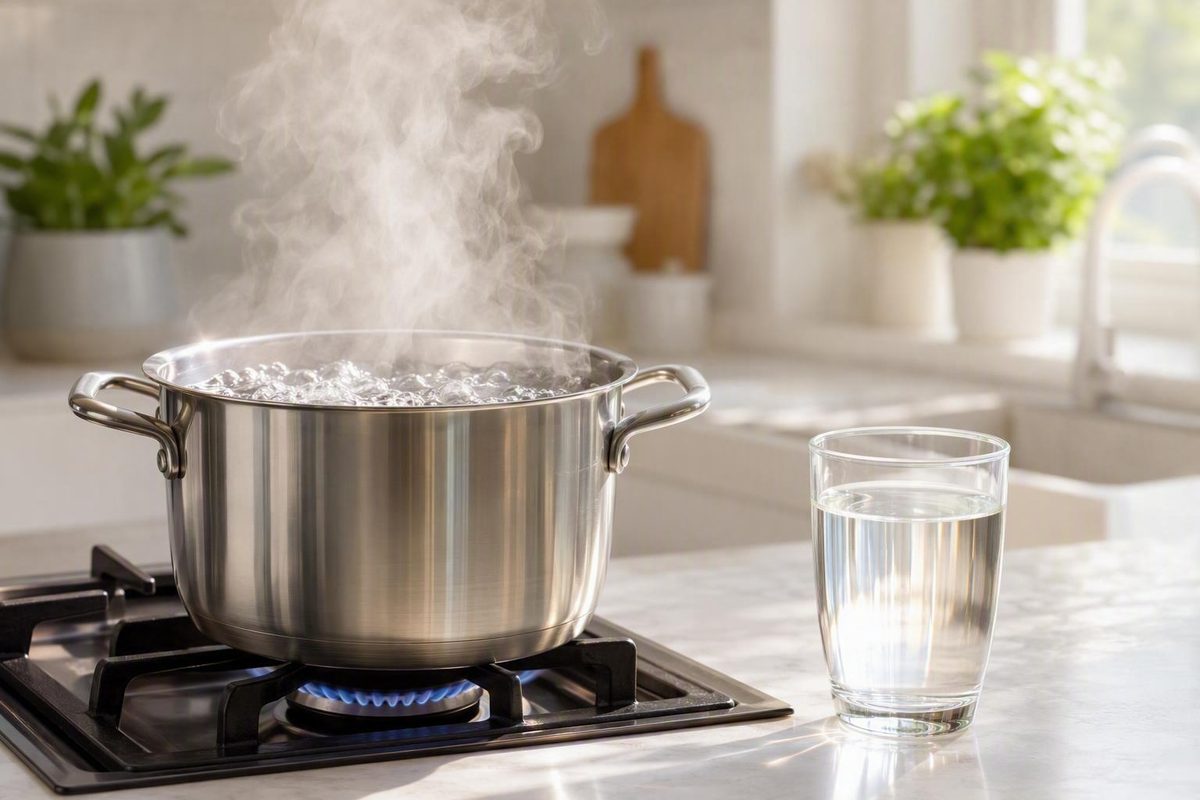
The short answer: boiling does not take fluoride out
No. Ordinary boiling does not remove fluoride from tap water or make the water fluoride-free. Most fluoride generally remains in the vessel rather than leaving with the steam, so boiling is not a reliable fluoride-removal method. Commercial water-treatment guidance consistently makes this distinction, including Culligan Quench’s overview of fluoride-treatment methods.
As water evaporates, the volume in the kettle or pan decreases. If approximately the same fluoride mass remains, that fluoride is distributed through less water, so its concentration may rise.
How much it rises depends primarily on how much water is lost. A kettle switched off as it reaches a boil may lose little water. A pot simmered uncovered for a long time may lose substantially more. There is no universal concentration increase that applies to every vessel, starting volume, heat setting, or cooking time.
The important distinctions are:
- Total fluoride in the vessel: Most generally remains during ordinary boiling.
- Water volume: This decreases as water becomes vapor.
- Fluoride concentration: This may increase because the remaining water volume is smaller.
Interactions with the vessel, deposits, spills, or measurement conditions can complicate individual results. They do not make ordinary boiling a dependable way to remove fluoride. Whether a household wants to reduce fluoride is a separate health or policy question; the narrow physical answer is that boiling does not take it out.
Why boiling can kill microbes but leave fluoride behind
Microbial disinfection and dissolved-substance removal are different treatment goals. Boiling may address bacteria and some other microbial hazards, but treatment guidance does not present it as effective for dissolved fluoride ions (RKIN’s discussion of boiling and fluoride treatment).
Fluoride is not a living organism that heat can kill. Under ordinary boiling conditions, it does not reliably leave with the escaping water vapor. A simple mass balance shows the likely result:
- The vessel begins with a particular volume of water and amount of fluoride.
- Heating converts some water into vapor.
- Most of the fluoride remains in the vessel.
- The remaining liquid volume is smaller.
- The fluoride concentration can therefore become higher.
Hypothetical example
Suppose two liters of water contain a fixed amount of fluoride. If the water is boiled down to one liter and no fluoride is otherwise lost, the remaining concentration would be approximately twice the starting concentration.
That is a mathematical illustration, not a measured prediction for every household boil.
The practical lesson is narrower: extending the boil does not turn ordinary boiling into fluoride treatment. If the concern is microbial, follow the instructions issued for that specific situation. Do not assume the same process removes fluoride or other dissolved substances.
Boiling and distillation are not the same process
Distillation starts with boiling, but it adds a critical separation step.
With ordinary boiling, water is heated and the liquid left in the original vessel is later used. Because most fluoride remains in that vessel, the retained water is not fluoride-free.
With distillation:
- Water is boiled in an initial chamber.
- The vapor is captured.
- The vapor is cooled and condensed.
- The condensate is collected in a separate container.
The separately collected condensate is the treated output. Fluoride generally remains behind in the original chamber with other nonvolatile dissolved substances. This is why treatment guidance distinguishes distillation from merely boiling and retaining the original water (Pro+Aqua’s explanation of fluoride-treatment methods).
A steaming pot is not automatically a distiller. A lid does not make the water distilled if condensation simply drips back into the original pot. The vapor must be captured, condensed, and collected separately.
Distillation should not be treated as a guarantee of complete removal. Performance still depends on the specific equipment and correct operation. The practical distinction is:
- Use the water left in the original pot: boiled water.
- Collect condensed vapor separately: distilled water.
Which treatment methods may reduce fluoride?
Households seeking fluoride reduction need equipment specifically designed and documented for that purpose. The supplied treatment guidance identifies reverse osmosis, distillation, activated alumina, bone char, and some anion-exchange systems as possible approaches; it identifies ordinary boiling and ordinary carbon filtration as ineffective or generally unsuitable for this purpose (Culligan Quench’s treatment comparison).
| Method | Expected role | Basic process | Important qualification |
|---|---|---|---|
| Ordinary boiling | Not an effective fluoride-removal method | Water is heated while the liquid in the original vessel is retained | Evaporation may increase the fluoride concentration in the water left behind |
| Ordinary activated carbon | Generally not designed for fluoride reduction | Water passes through porous carbon that adsorbs selected substances | Specialized products may include additional media, so check the exact model |
| Reverse osmosis | May reduce fluoride | Pressure moves water through a semipermeable membrane that separates part of the dissolved-ion load | Results depend on the membrane, pressure, water chemistry, condition, installation, and maintenance |
| Distillation | May reduce fluoride | Water is vaporized, captured, condensed, and collected separately | The collected condensate—not the liquid left in the boiling chamber—is the treated output |
| Activated alumina | May reduce fluoride | Water contacts specialized adsorptive media | Performance can vary with pH, competing ions, flow, contact time, media condition, and maintenance |
| Bone char | May reduce fluoride | Water contacts specialized media capable of retaining fluoride | Results depend on the particular media, water chemistry, contact conditions, and upkeep |
| Some anion-exchange systems | May reduce fluoride when configured for it | Specialized exchange media retain selected ions | Selectivity, competing ions, capacity, water chemistry, and media condition affect performance |
These are technology categories, not performance guarantees. A product labeled “reverse osmosis,” “multi-stage,” or “purified water” has not necessarily been verified for fluoride reduction. The exact model must carry an explicit fluoride-reduction claim supported by applicable evidence.
Performance can vary with:
- Starting fluoride concentration
- pH and broader water chemistry
- Competing dissolved ions
- Pressure in membrane systems
- Flow rate and contact time
- Membrane or media condition
- Installation and maintenance
- Operation within the manufacturer’s documented limits
Reverse osmosis can also reduce dissolved minerals other than fluoride. Anyone evaluating a system should understand its overall treatment output rather than considering a single constituent in isolation.
Why an ordinary pitcher or refrigerator filter may not work
Most standard pitcher, refrigerator, and faucet filters rely heavily on activated carbon. Ordinary carbon media can address selected tastes, odors, and other substances, but they generally are not designed to remove dissolved fluoride.
That is not an absolute statement about every filter containing carbon. A multi-stage product might combine carbon with activated alumina, bone char, ion-exchange media, or another specialized material. The carbon may perform one function while a separate stage addresses fluoride.
Before relying on a filter, check the exact model’s documentation for:
- An explicit fluoride-reduction claim
- The test or certification supporting that claim
- The conditions under which it was evaluated
- Its operating limits
- Required installation and maintenance
- Rated capacity where documented
“Filtered water” does not mean “fluoride-free water.” A filter may improve taste or reduce other substances while allowing most fluoride to pass through.
One commercial treatment guide identifies NSF/ANSI 58 as a relevant benchmark for residential reverse-osmosis fluoride testing. That statement should not be interpreted to mean every product associated with the standard has identical performance—or that the standard’s name alone proves an individual model carries a fluoride claim. Verify the exact certified model and its listed reduction claims in the applicable documentation (RKIN’s overview of reverse-osmosis testing).
The useful purchasing question is:
Does this exact model have an explicit, supported fluoride-reduction claim, and can it be operated under the documented conditions?
If the documentation is silent or unclear, fluoride reduction should be treated as unverified.
Check how much fluoride is in the water before treating it
Before choosing equipment, find out whether fluoride is present and what level has been reported or measured. Municipal-water customers can begin with the utility’s Consumer Confidence Report, sometimes called an annual water-quality report, or contact the utility for local fluoride information.
Private-well users do not have a municipal report for their individual well. If confirmation matters, appropriate fluoride testing can establish the starting condition. Before-and-after testing can also provide direct evidence of how an installed system performs in a particular home.
Advertised performance is not the same as measured household performance. A product may have been evaluated under defined conditions, while a home may have different water chemistry, pressure, flow, temperature, usage, or maintenance practices.
Use this evaluation checklist:
- Starting level: What does the water report or appropriate test show?
- Treatment goal: Which water uses—drinking, beverages, or cooking—are included?
- Explicit claim: Does the exact model claim fluoride reduction?
- Applicable evidence: Does the testing or certification apply to that model and claim?
- Operating requirements: What pressure, pH, flow, temperature, or source-water conditions apply?
- Maintenance: What care does the manufacturer require?
- Verification: How will performance be confirmed if the result matters?
- Broader output: What else does the process remove or alter?
This does not establish a target fluoride concentration or determine whether an individual should change fluoride intake. Those decisions can depend on personal health, dental circumstances, and local water conditions.
What boiling fluoridated water can mean for cooking
Cooking can move fluoride from water into food. It does not necessarily leave all fluoride in discarded cooking water, and the fluoride does not simply disappear because the water boils.
A peer-reviewed study in the Journal of Hazardous Materials found that rice and vegetables accumulated fluoride when soaked or boiled in fluoride-containing water. Rice accumulated fluoride through absorption and adsorption, and higher tested soaking temperatures—up to 100°C—were associated with greater accumulation in the foods studied (the study on boiling and fluoride adsorption in food).
The finding does not produce a universal estimate for every meal. Transfer can vary with:
- Food type and composition
- Starting fluoride level
- Water-to-food ratio
- Temperature and contact time
- Whether the food absorbs the cooking water
- Whether the remaining liquid is consumed or discarded
Rice that absorbs most of its water is different from a vegetable briefly blanched and drained. Soup, in which the liquid is consumed, presents another situation.
The study must also be interpreted within its scope. It examined fluoride accumulation in foods soaked or cooked in fluoride-containing water. It was not simply a before-and-after experiment measuring fluoride concentration in a plain household pot. It therefore supports the conclusion that fluoride can move into food during cooking, but it does not independently quantify how much ordinary boiling concentrates fluoride in plain water.
A practical decision path for households
If you want to reduce fluoride, use a treatment-selection process rather than adding boiling as an extra step:
- Identify the water source. Determine whether it is municipal water, a private well, delivered water, or a combination.
- Find the reported or measured level. Review the utility report, contact the utility, or obtain appropriate testing where needed.
- Define the treatment goal. Decide whether it applies to drinking water, beverages, cooking water, or all three.
- Compare exact products. Consider only systems with an explicit fluoride-reduction claim.
- Check applicable evidence. Confirm that testing or certification applies to the exact model and configuration.
- Verify operating requirements. Review water chemistry, pressure, flow, contact time, and other stated limits.
- Understand the broader output. Some treatments may reduce other dissolved minerals as well as fluoride.
- Maintain the system. Follow the manufacturer’s instructions so the membrane or media is used as documented.
- Confirm performance when necessary. Testing treated water provides more direct evidence than a general technology label.
Boiling does not belong in this sequence as a fluoride-removal step. It may serve a separate cooking or microbial-disinfection purpose, but retaining the boiled water does not reliably remove fluoride.
Compare products rather than category names. Two reverse-osmosis units may differ in membranes, operating requirements, condition, and supported claims. The same principle applies to distillers and systems using activated alumina, bone char, or ion-exchange media.
Anyone seeking individualized health or dental guidance should consult an appropriately licensed professional. Whether someone ultimately chooses to reduce fluoride does not change the physical answer: boiling water does not take fluoride out and may concentrate it as water evaporates.
Does boiling water for longer remove more fluoride?
No. A longer boil generally allows more water to evaporate; it does not progressively destroy fluoride or reliably carry it away. If most fluoride remains while the water volume falls, the concentration may increase.
Actual water loss matters more than time alone. A covered vessel may lose less water than an uncovered pot at a vigorous boil.
Can boiling increase the fluoride concentration in water?
Yes. If water evaporates while approximately the same fluoride mass remains, the fluoride is distributed through a smaller volume.
The increase is not universal. It depends mainly on how much water is lost and can also be affected by vessel interactions, deposits, spills, and measurement conditions.
Is distilled water the same as boiled water?
No. Boiled water is the liquid retained in the original vessel. Distilled water is produced by capturing vapor, cooling it, and collecting the condensate separately.
Water is not distilled merely because it reached its boiling point or produced condensation on a lid.
Do standard carbon pitcher or refrigerator filters remove fluoride?
Most ordinary activated-carbon pitcher and refrigerator filters are not designed for fluoride reduction. They may address other water-quality concerns while allowing most fluoride to pass through.
Specialized or multi-stage products may be different. Check the exact model for an explicit, supported fluoride-reduction claim.
Does cooking food in fluoridated water remove the fluoride?
Not necessarily. Fluoride can remain in the cooking liquid or move into the food. Research found increased fluoride accumulation in tested rice and vegetables soaked or boiled in fluoride-containing water.
The amount cannot be generalized to every recipe. Food type, temperature, contact time, starting concentration, and whether the cooking water is absorbed or discarded can all affect the result.