
Deionized Water for an Ultrasonic Cleaner: Uses & Risks
Best as a specified concentrate diluent or clean final rinse; use it alone only when the soil, workpiece, tank and cleaner instructions permit.
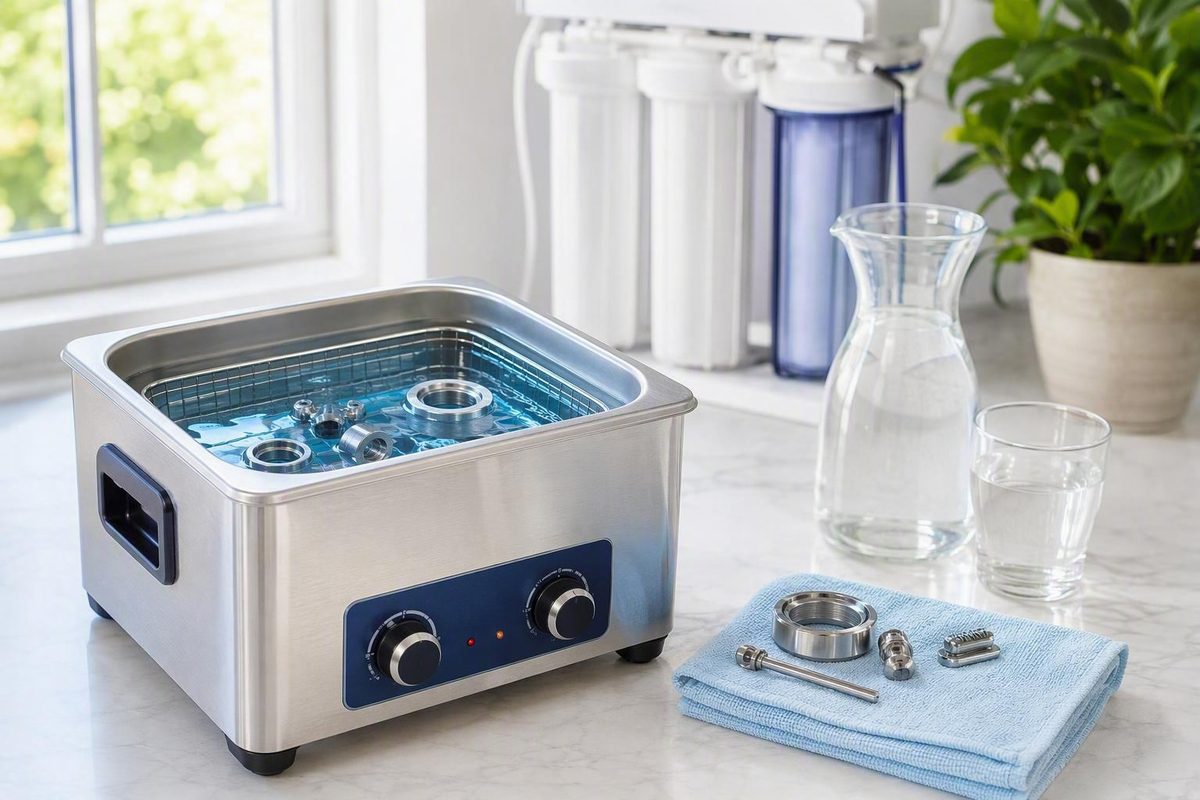
The short answer: yes, but decide where DI water belongs
You can use deionized water in an ultrasonic cleaner, but that does not mean additive-free DI water belongs directly in every tank or that it can replace cleaning chemistry in every process.
DI water can serve three distinct roles:
- An additive-free primary bath for light or water-soluble contamination when the item tolerates water and ultrasound but not detergent.
- A diluent for a compatible ultrasonic-cleaning concentrate, particularly when the formulation specifies DI water.
- A separate final rinse that removes cleaning-solution carryover while limiting the minerals left behind during drying.
The evidence is strongest for the second and third roles. Cleaning-fluid suppliers commonly formulate concentrates for dilution with DI water, while equipment manufacturers recommend low-mineral rinsing when spots or residual minerals matter. Water alone is not a universal cleaner: grease, oil, carbon, flux, and other stubborn soils often require compatible chemistry selected for both the contaminant and the workpiece. Omegasonics, an ultrasonic-equipment manufacturer, similarly distinguishes detergent-sensitive parts from oily or carbon-contaminated parts in its guidance on DI water in ultrasonic cleaning.
Before choosing the liquid, answer five questions:
- What is the contaminant? Loose dust and water-soluble salts behave differently from grease or baked-on carbon.
- What is the workpiece made from? Metals, plastics, coatings, adhesives, gemstones, electronic components, and delicate finishes have different limits.
- What cleaner do you have? Its manufacturer may restrict additive-free DI water, specific chemicals, or direct-tank processing.
- How mineral-rich is the alternative water? Hard water is more likely to contribute deposits during rinsing and drying.
- What finish is required? A household part that only needs to look clean has different requirements from a precision part with a documented ionic-cleanliness specification.
A practical default is:
Use DI water where low mineral residue matters—especially as the specified diluent for an ultrasonic concentrate or as a clean final rinse. Use it alone only after confirming that the soil, workpiece, tank, and cleaner instructions all permit that approach.
Most of the available performance guidance comes from companies selling ultrasonic equipment or cleaning fluids. These sources broadly agree that DI water can reduce mineral carryover, but they differ on whether it should be the primary bath and provide little controlled, independent comparison with distilled, reverse-osmosis, or tap water. Claims of universally stronger cavitation, faster cleaning, or superior soil removal should therefore be treated as vendor claims rather than settled findings.
What deionized water changes—and what it does not
Deionization is a water-treatment process aimed at removing ionic contaminants. Ion-exchange systems remove charged species such as calcium, magnesium, and other dissolved ions. Freshly produced and properly stored DI water therefore has low conductivity relative to untreated feed water.
That does not mean the water contains “nothing.” Deionization alone does not necessarily remove every dissolved organic chemical, bacterium, or suspended particle. Depending on the required water quality, those contaminants may require filtration, activated carbon, membrane treatment, ultraviolet treatment, or other process controls.
The clearest advantage: less mineral residue
Calcium, magnesium, and other dissolved ions can remain behind when water evaporates. Where feed water is hard, the result may be visible spots, streaks, or a mineral film.
Because DI water contains fewer dissolved ions, it can reduce that mineral contribution. This is particularly useful in the last rinse, because material present in the final droplets can become residue after drying.
DI water does not guarantee a spot-free finish. Low-mineral water controls one part of the process; it does not correct every possible source of residue.
Conductivity and resistivity measure ionic purity
Conductivity indicates how readily water conducts electricity through dissolved ions. Resistivity expresses the inverse relationship: higher resistivity generally indicates lower ionic contamination.
As a high-purity reference point, 18.2 megohm-centimeters at 25°C corresponds to approximately 0.055 microsiemens per centimeter. This is an example used in high-purity applications, not a requirement for ordinary ultrasonic cleaning. DI-water quality can also decline after production through exposure to atmospheric carbon dioxide and contact with storage or process materials, as explained in Best Technology’s commercial guide to DI, RO, and rinse-water quality.
No universal resistivity specification applies to every jewelry cleaner, electronics bath, mechanical-parts process, or final rinse. The useful question is not “Is this the highest grade available?” but “Does this water meet the residue or ionic-cleanliness requirement for this process?”
DI-water quality changes during storage and use
The water grade printed on a label describes the water at a particular point, not necessarily its condition after storage or use. DI water can collect contamination from:
- Air
- Bottles, tanks, caps, tubing, and dispensing equipment
- Baskets, inserts, and tank surfaces
- Parts and the contamination removed from them
- Cleaning concentrates and wash-solution carryover
- Hands, tools, and the surrounding workspace
A fresh DI rinse can therefore become an ion-containing and particle-containing process bath. The more contamination it receives, the less meaningful its original grade becomes.
In a repeatable precision process, conductivity trends may help reveal increasing ionic contamination in a final rinse.
What about claims of better cavitation?
Some ultrasonic-equipment vendors say DI water promotes cavitation, accepts displaced contaminants more readily, or allows detergent to work more efficiently because the detergent is not interacting with minerals already in the water.
Those are vendor explanations, not conclusions established here by controlled independent testing. The defensible finding is narrower: DI water reduces the ionic load introduced with the water and can reduce mineral residue. Whether it materially improves cavitation or cleaning speed depends on process conditions that have not been adequately compared in the available evidence.
Choose the liquid by soil: water alone, concentrate, or rinse
Ultrasonic energy produces cavitation that helps dislodge contamination from surfaces reached by the liquid. It does not make every contaminant water-soluble. The bath must still wet the surface, carry away displaced material, and, when necessary, chemically interact with the soil.
That makes the contaminant the best starting point.
| Contaminant or requirement | Likely liquid strategy | Why | Main check |
|---|---|---|---|
| Light dust or loose, water-compatible residue | Additive-free DI water may be suitable | Cavitation and water movement may dislodge light contamination without adding much mineral residue | Confirm tank and workpiece compatibility |
| Water-soluble salts or residue | DI-water bath and, if needed, a fresh DI rinse | Water may dissolve the residue; a clean rinse limits mineral carryover | Confirm that the residue and part tolerate water |
| Grease or oil | Compatible low-foaming ultrasonic concentrate, diluted as directed | Oil and grease are generally poorly matched to water alone | Match the chemistry to both soil and material |
| Carbon or stubborn grime | Specialized compatible chemistry | A longer water-only cycle may not address the chemical nature of the soil | Check chemical, temperature, and material limits |
| Flux or process residue | Formulation approved for that residue and assembly | Different fluxes and components can require different chemistry | Verify component and electronics compatibility |
| Spot-sensitive final finish | Separate clean DI rinse | Reduces wash-solution carryover and mineral residue in final droplets | Maintain rinse cleanliness and suitable drying |
| Detergent-sensitive part | Additive-free DI water may be considered | Avoids detergent exposure | Confirm water, ultrasound, tank, and insert compatibility |
Do not substitute a universal dose of household soap. A product not designed for the equipment or workpiece may foam excessively, leave residue, corrode materials, or rinse poorly. Choose a low-foaming ultrasonic formulation intended for the soil and workpiece, then follow its dilution and temperature instructions. Commercial concentrates differ substantially in materials, dosing, and operating conditions, which is why Allendale Ultrasonics recommends formulation-specific selection and dilution.
A separate DI rinse may be more valuable than using DI water only in the wash stage. The rinse removes dissolved soil and residual cleaner carried out of the bath. If it remains clean, its low mineral content also limits what the final droplets can leave behind.
Both wash and rinse liquids eventually become contaminated. Dirty liquid can lose effectiveness and redeposit material on later loads. Replace it according to the cleaner and chemistry instructions, its visible condition, process results, and any cleanliness controls required by the application.
Four practical scenarios
1. Lightly dusty precision part
If the part is water-compatible, suitable for ultrasonic processing, and free of oily contamination, additive-free DI water may be enough. Confirm that the cleaner permits direct-tank use; otherwise use an approved insert. Start with conservative settings, inspect the result, and dry the part promptly.
2. Greasy mechanical part
DI water alone is poorly matched to grease. Use a compatible low-foaming ultrasonic concentrate selected for the metal, finish, and oil involved. Dilute it with DI water if the formulation requires that grade, process the part in a basket, rinse with clean DI water where residue matters, and dry appropriately.
3. Spot-sensitive finished part
Use the appropriate cleaning bath first, then transfer the item into a separate clean DI rinse. A second rinse may be useful if the first receives substantial detergent carryover. Handling and drying remain as important as the starting water quality.
4. Detergent-sensitive part
Consider additive-free DI water only after confirming that the contamination is water-removable and that the item tolerates immersion and ultrasound. Tank compatibility must be checked separately. “Detergent-sensitive” does not mean “safe to clean ultrasonically.”
Check the tank before pouring in additive-free DI water
There is an important equipment-specific warning: BANDELIN advises against putting additive-free DI water directly into compact ultrasonic tanks made from 1.4301 stainless steel. The manufacturer says this can increase cavitation erosion and cause pitting at the tank bottom. When an additive-free DI process is necessary, it directs users to use an insert vessel. BANDELIN’s guidance is specific to the stated tank material and equipment construction.
Do not generalize that warning to every stainless-steel tank. BANDELIN specifically discusses compact 1.4301 tanks and contrasts them with equipment made from 1.4571 stainless steel. Different alloys, tank designs, surface treatments, power densities, frequencies, and operating requirements may behave differently.
Before filling a cleaner, check its manual or ask the manufacturer:
- What alloy or tank material is used?
- Is additive-free DI water approved for direct contact?
- Does the machine require an additive?
- Which cleaning chemicals are permitted?
- What are the minimum and maximum fill levels?
- Is indirect cleaning in an insert or container allowed?
- What basket and load limits apply?
- Does the warranty impose fluid restrictions?
Direct and indirect cleaning are different setups
In direct cleaning, the process liquid contacts the main tank. This maximizes usable space but also exposes the tank to the chemistry and contamination.
In indirect cleaning, the item and process liquid sit inside an approved insert vessel or compatible sealed container placed in the machine’s coupling bath. When the equipment manufacturer permits this arrangement, it can:
- Isolate additive-free DI water or specialized chemistry from the main tank
- Reduce contamination of the tank bath
- Allow smaller volumes of process liquid
- Keep compatible processes separate
The vessel material, closure, fill level, position, and coupling bath must still comply with the machine instructions. A random household container is not automatically suitable.
Three compatibility questions must be answered independently:
- Tank compatibility: Will the water or cleaning chemistry harm the tank?
- Workpiece compatibility: Will immersion, cavitation, heat, or the liquid harm the item?
- Chemical compatibility: Is the formulation suitable for the soil, part, tank, basket, seals, and process?
Passing one test does not imply passing the other two.
Parts should normally be held in a suitable basket or approved insert rather than resting directly on the tank bottom. Equipment guidance associates bottom contact and loading pressure with a risk of damage to the machine, so follow the model-specific loading instructions in the cleaner manufacturer’s operating guidance.
DI vs distilled, RO, and tap water
DI, distilled, reverse-osmosis, and tap water are not interchangeable labels. They describe different treatment histories, and actual quality can vary within each category.
| Water type | Treatment method | Ionic/mineral content | Likely residue risk | Typical ultrasonic-cleaning role | Key limitation |
|---|---|---|---|---|---|
| Deionized (DI) | Ion exchange removes charged contaminants | Low when fresh and within specification | Usually low for mineral residue | Concentrate diluent, final rinse, or conditional additive-free bath | May still contain organics, microbes, or particles; quality changes during storage and use |
| Distilled | Water is evaporated and condensed | Generally low in minerals | Generally low, depending on production and storage | Practical alternative for many non-critical household processes | Not necessarily equivalent to a specified DI grade |
| Reverse osmosis (RO) | Pressure moves water through a semipermeable membrane | Usually lower than the feed water, but system-dependent | Often lower than untreated feed water | General wash water, pretreatment, or non-critical rinsing | Quality depends on the membrane, feed water, maintenance, and system design |
| Tap | Municipal or private supply with variable treatment | Highly location-dependent | Greater risk where hardness or dissolved solids are high | Non-critical cleaning where the cleaner and chemistry permit it | Can introduce minerals and other variable constituents |
A commercial parts-cleaning guide reports that RO systems typically remove 90–99% of contaminants, but this is a broad vendor-reported range, not a guarantee for every membrane, contaminant, feed-water condition, or system. RO water should not be assumed equivalent to a defined DI grade solely on that basis. Best Technology provides the reported range and its comparison of hard, RO, and DI water.
Distilled water is often a practical low-mineral alternative for household use. It may be easier to obtain than DI water and may provide adequate residue control for non-critical parts. That does not establish identical performance in every bath or rinse.
Tap water can be adequate where the work is non-critical, local water is not especially hard, and both the cleaner and cleaning formulation permit it. Its primary disadvantage is variability. If local tap water leaves spots on glassware or fixtures, it is more likely to contribute visible mineral residue to cleaned parts.
The required result should determine the choice:
- If the goal is to remove ordinary dirt from a robust part, tap or distilled water may be an acceptable diluent only when the cleaning-formulation manufacturer permits it.
- If visible spotting matters, distilled or DI water may be worthwhile.
- If ionic cleanliness must be measured and documented, a defined DI grade and monitored rinse process may be justified.
- If no finish or cleanliness specification exists, laboratory-grade water may add cost without solving the actual cleaning problem.
No controlled comparison in the available evidence establishes that DI water universally removes soil faster or better than distilled, RO, or tap water. Its clearest advantage is control of ionic and mineral residue.
A compatibility-first ultrasonic-cleaning workflow
A repeatable process is more useful than a favorite water label. Use the following sequence as a framework, then defer to the cleaner, chemistry, and workpiece manufacturers.
1. Verify all compatibility requirements
Read the cleaner manual before filling the machine. Confirm:
- Approved tank liquids and tank material
- Direct versus indirect cleaning rules
- Minimum and maximum fill levels
- Basket and load requirements
- Allowed temperatures and cycle lengths
- Workpiece suitability
- Concentrate dilution, handling, and rinsing instructions
If the item is valuable, irreplaceable, safety-critical, or of unknown construction, obtain item-specific guidance instead of experimenting.
2. Identify the soil and assign DI water a role
Decide whether DI water will be:
- The additive-free wash bath
- The diluent for a compatible concentrate
- The final rinse
- Both the concentrate diluent and final rinse
Do not begin with “DI or not?” Begin with “What must be removed, and which materials must remain unharmed?”
3. Prepare the liquid as directed
Measure the formulation-specific dilution rather than estimating. Fill the tank or insert to the specified level.
Do not assume that a stronger concentration produces better cleaning. Excess chemistry may be harder to rinse and may increase residue or material-compatibility problems.
4. Degas newly prepared liquid
Newly prepared solution may require degassing before parts are loaded. Use the cleaner’s degas mode or its specified unloaded procedure rather than inventing a universal time. One equipment manufacturer gives an example of running a newly filled machine without parts for about 5–10 minutes, but presents that as broad guidance rather than a rule for every cleaner. Cleanstar Machines discusses this degassing example and related operating controls.
5. Load parts in a basket or approved insert
Keep parts off the tank bottom unless the manufacturer expressly provides a different arrangement. Avoid overloading, nesting parts, or pressing contaminated surfaces tightly together. Arrange delicate pieces so they do not collide.
When using an indirect vessel, follow the manufacturer’s requirements for its position, fill level, closure, and coupling bath. The basket and indirect-container guidance should be applied only where it is consistent with the instructions for the specific machine.
6. Start conservatively
Choose a conservative temperature and short initial cycle within all equipment, chemical, and workpiece limits. Inspect the part before increasing time, temperature, or concentration.
Published settings are examples, not universal recipes. Omegasonics discusses 110–120°F for its DI-water example, but that range is manufacturer guidance for the described use rather than a safe setting for every part or machine. See the stated Omegasonics temperature example.
Cleanstar gives 40–60°C as broad guidance for many industrial applications while warning that excessive heat may damage sensitive parts, increase evaporation, or reduce cavitation intensity. That range is likewise not universally safe or optimal. See Cleanstar’s temperature guidance and qualifications.
Extending a mismatched water-only cycle may increase exposure without resolving oily contamination.
7. Rinse when residue control matters
After a detergent bath, transfer the part into clean DI water when you need to reduce detergent carryover or mineral residue. Use a separate rinse container or stage so the contaminated wash bath does not also function as the rinse.
A heavily loaded first rinse may require replacement or a second rinse. The goal is not simply to expose the item to DI water; it is to leave it in contact with rinse water cleaner than the liquid carried over from the wash.
8. Dry promptly and appropriately
Use a drying method compatible with the workpiece. Limit pooling in cavities, under components, and along seams.
Electronics must be completely dry before power is restored. A hobbyist electronics demonstration also emphasizes complete drying before reconnecting power, although it should be treated as personal practice rather than a validated reprocessing protocol. XrayTonyB, “Using Ultrasonic Cleaner for Electronics”.
9. Maintain the bath and document the process
Replace cleaning and rinse liquids before accumulated contamination begins impairing results or redepositing soil. Clear water is not necessarily clean water.
For precision work, conductivity trends can help monitor ionic contamination in a final DI rinse. They do not measure every contaminant, and no universal replacement threshold applies to all processes. Set limits from the part’s cleanliness requirement and a validated procedure.
When developing a repeatable process, record:
- Cleaning product and chemistry
- Concentration
- Water type or measured water quality
- Bath temperature
- Degassing procedure
- Cycle time
- Load arrangement
- Rinse condition
- Drying method
- Inspection or test result
A process record makes troubleshooting more effective than simply changing to a more expensive water grade.
Special cases: electronics, jewelry, delicate parts, and precision work
Water compatibility does not establish ultrasonic compatibility. A part may tolerate immersion in DI water yet still be damaged by cavitation, heat, chemistry, vibration, prolonged exposure, impact with another part, or an unsuitable drying method.
Electronics
Do not assume that every circuit board or electronic assembly can be immersed. Suitability should be checked at the component level, including:
- Unsealed switches, relays, potentiometers, microphones, speakers, and displays
- Transformers, inductors, and fine-wire coils
- Batteries and energy-storage components
- Foil elements and thin metal
- Labels, inks, markings, conformal coatings, and adhesives
- Cavities and components that can retain water
Where chemistry is needed, use a compatible low-foaming formulation selected for the board, components, residue, and cleaner. Follow the specified rinse and drying process before restoring power.
In one hobbyist demonstration, ultrasonic operation visibly pitted and perforated aluminum foil; the presenter also cautioned about thin metal, foil components, fine-wire coils, and markings. That shows what happened to foil under those particular conditions, not the probability of damage to every component or cleaner. The video is a bounded user demonstration, not controlled safety evidence.
Jewelry and antiques
“Jewelry-safe” is too broad a category. Allendale’s commercial fluid guide specifically warns that some gemstones and stone-bonding adhesives are unsuitable for ultrasonic processing and recommends compatibility testing for delicate materials. Review its jewelry and material cautions before processing an unfamiliar item.
If the construction or repair history is uncertain, seek item-specific advice from a qualified jeweler or conservator. DI water reduces mineral input; it does not make an unsuitable item safe.
Delicate mechanical and finished parts
Thin sections, soft metals, coatings, precision edges, fragile assemblies, and printed or painted markings warrant conservative settings and close inspection. Use suitable fixturing to prevent parts from striking each other.
Compatibility therefore has to be evaluated for the complete assembly, not only its primary material.
Medical, dental, semiconductor, and other precision work
Equipment vendors identify detergent-sensitive medical, dental, semiconductor, and precision components as possible applications for DI-water cleaning.
For regulated, validated, or safety-critical work, follow the device manufacturer’s reprocessing instructions and the applicable facility procedure.
Troubleshoot poor cleaning, spots, residue, and corrosion
DI water is only one process input. When results are poor, inspect the complete workflow rather than assuming that a higher nominal water grade is the answer.
Grease or oily film remains
Water alone is probably mismatched to the soil. Increasing cycle time may expose the part and tank to more ultrasonic action without giving the oil a suitable removal mechanism.
Reassess:
- Whether the chemistry is designed for the grease or oil
- Compatibility with the workpiece and tank
- Dilution and temperature
- Whether gross contamination should be removed first
- Bath loading and contamination
Spots appear after drying
Check the last liquid that contacted the part, not only the original bath label.
Possible causes include:
- Contaminated DI rinse water
- Detergent carryover
- Hard-water contact in another stage
- Dirty baskets, inserts, containers, or tools
- Fingerprints or airborne contamination
- Droplets drying in recesses
- Inadequate or unsuitable drying
A second clean rinse may help if the first rinse receives substantial carryover. If fresh DI water still leaves spots, investigate handling, earlier process stages, and drying.
Haze or residue remains
Verify the concentrate dilution and rinse procedure. Excess chemistry may be difficult to remove, while an unsuitable formulation may react with the workpiece or leave a film.
Also check whether:
- The wash bath needs replacement
- The rinse is sufficiently clean
- The surface is being etched or otherwise altered
- The apparent soil is actually oxidation, corrosion, coating damage, or pre-existing wear
Soil redeposits on the part
A contaminated bath can release soil from one surface and deposit it elsewhere. Replace or manage the liquid instead of repeatedly processing parts in the same dirty bath.
For higher-throughput processes, filtration, circulation, or staged rinsing may help, but the system must be designed for the contaminant and required cleanliness.
The tank shows pitting or damage
End the process and consult the cleaner manufacturer before conducting further trials. Recheck the manual’s fluid restrictions and the machine’s condition, including:
- Tank alloy and construction
- Approved liquids and cleaning chemistry
- Fill level
- Basket use
- Evidence of parts contacting the tank bottom
- Operating time, temperature, and maintenance history
If additive-free DI water was used, revisit any model-specific restriction associated with the tank material. General manufacturer guidance warns that incorrect solution choice and operating practices can damage ultrasonic equipment, so troubleshooting should follow the machine maker’s instructions rather than ad hoc additive testing.
The workpiece is damaged
Stop processing the item. Reassess ultrasonic suitability, chemistry, temperature, cycle duration, loading, and part-to-part contact.
The practical conclusion
Choose DI water when the process benefits from low mineral residue, particularly as the specified diluent for a compatible concentrate or as a clean final rinse. Treat additive-free DI water as a conditional cleaning bath, not a universal solution.
Before starting a new process:
- Verify the tank and workpiece
- Match the chemistry to the soil
- Prepare and degas the liquid as directed
- Start with conservative settings
- Keep parts off the tank bottom
- Rinse when carryover or mineral residue matters
- Dry promptly and completely
- Investigate the whole process when results fall short
Frequently asked questions
Can I use only deionized water in an ultrasonic cleaner?
Sometimes. Additive-free DI water may handle light dust or water-soluble contamination on an item that tolerates both water and ultrasound. It is commonly insufficient for grease, oil, carbon, flux, and other stubborn soils.
You must also confirm that the cleaner permits additive-free DI water in direct contact with its tank. If direct use is restricted, an approved insert may be required. Water-only cleaning is therefore a conditional process choice rather than a universal default.
Should DI water go in the cleaning bath or only in the final rinse?
Either can be appropriate. DI water can serve as the primary bath for suitable detergent-sensitive work, the diluent for a compatible concentrate, the final rinse, or part of several stages.
Its most broadly defensible uses are as a concentrate diluent when the formulation specifies it and as a clean final rinse when mineral residue or detergent carryover matters. Choose its role according to the contaminant, workpiece, tank, and required finish.
Is distilled water an acceptable substitute for DI water?
For many non-critical household applications, yes. Distilled water is generally low in minerals and can be a practical alternative when the goal is to limit visible residue.
It should not automatically be treated as identical to a specified DI grade. If a process has a measurable conductivity, resistivity, residue, or ionic-cleanliness requirement, use water that meets that specification rather than relying on the label alone. If a cleaning concentrate specifies DI water, do not substitute distilled water unless its manufacturer permits the change.
Can additive-free DI water pit a stainless-steel ultrasonic tank?
It is a stated concern for certain equipment. BANDELIN specifically warns that additive-free DI water can increase cavitation erosion and pitting in compact ultrasonic tanks made from 1.4301 stainless steel. The warning is limited to the construction identified in BANDELIN’s technical guidance.
That does not establish the same risk for every stainless-steel tank. Check the model manual, tank alloy, approved liquids, and indirect-cleaning procedure.
What DI-water purity or resistivity does an ultrasonic cleaner require?
There is no universal requirement. The appropriate grade depends on the cleaner, chemistry, workpiece, and required cleanliness.
A value such as 18.2 megohm-centimeters at 25°C describes very high-purity water, not a normal minimum for household ultrasonic cleaning. For non-critical work, low-mineral distilled or DI water may be sufficient. For precision work, define acceptable conductivity or resistivity from the required result, monitor the process where justified, and account for contamination acquired during storage and use.