
Ultraviolet Light Disinfection Is Application-Specific
UV can inactivate susceptible microbes, but doubling lamp distance can require about four times the exposure in an ideal point-source example.
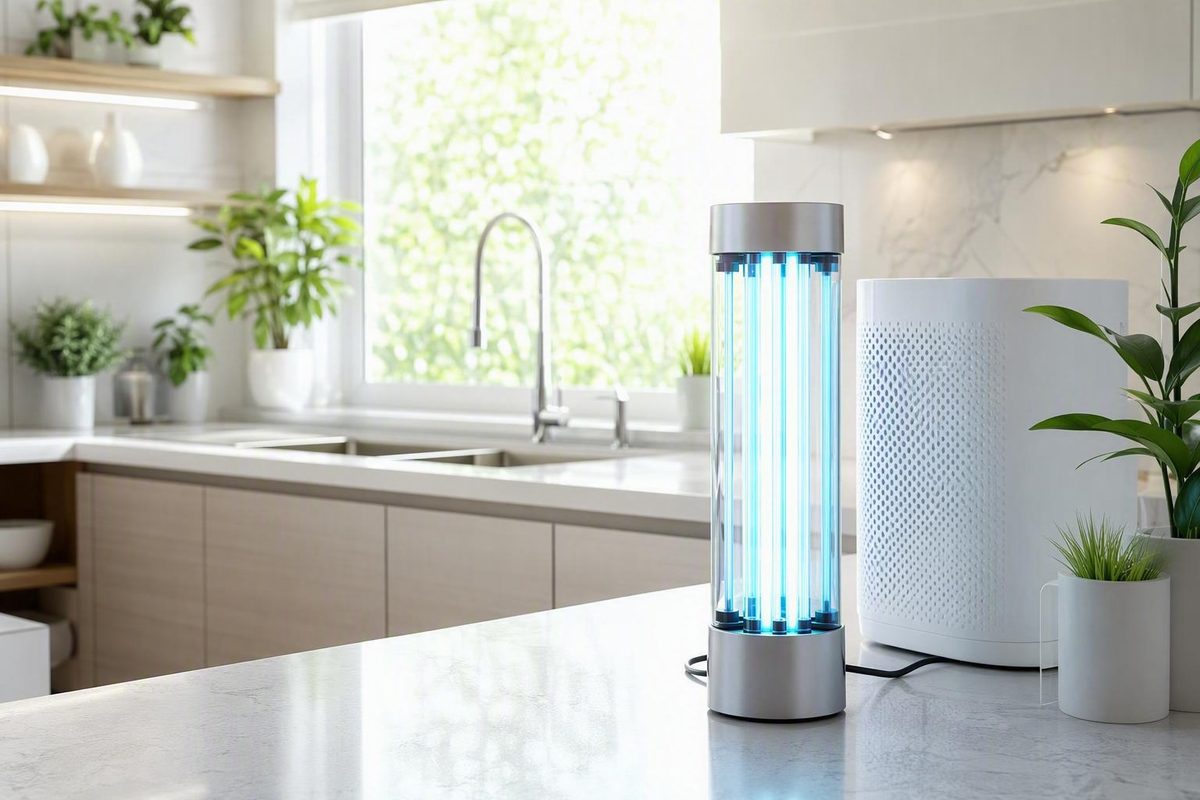
Ultraviolet light disinfection is established technology, but “uses UV-C” is not enough to prove that a device will work in a particular room, duct, cabinet, water system, or surface-treatment process. Wavelength matters, yet meaningful performance ultimately depends on how much ultraviolet energy reaches the microorganisms, for how long, and under what conditions.
That makes germicidal UV an application-specific treatment rather than a universal disinfectant. Air must pass through an adequately irradiated zone. Surface microorganisms must be exposed rather than hidden under soil or inside crevices. Water treatment requires equipment and evidence specific to that application. Occupants must be protected from hazardous exposure, and lamp output must remain adequate as equipment ages or becomes dirty.
When those conditions are controlled, UV can add a useful layer to ventilation, filtration, cleaning, and other established protections. When they are not, a germicidal label or percentage-reduction claim may say little about performance in ordinary use.
What ultraviolet disinfection is and how it inactivates microorganisms
Germicidal ultraviolet, usually shortened to GUV, means using ultraviolet energy to inactivate susceptible microorganisms. Ultraviolet germicidal irradiation, or UVGI, is a closely related and widely used term. In practical discussions, GUV and UVGI often refer to the same broad treatment approach.
Germicidal treatment generally centers on UV-C, but sources do not use one universally definitive boundary for the relevant range. Published descriptions include approximately 180–280 nanometers and 200–280 nanometers. Germicidal effectiveness is often reported as peaking around 260–265 nm, while conventional low-pressure mercury lamps commonly emit near 254 nm because that wavelength is readily produced by the lamp technology. Far-UV-C is a separate emerging category using shorter wavelengths around 207–222 nm. The purchasing lesson is to request the source’s actual wavelength or spectral distribution rather than treating “UV” as a complete specification (overview of UVGI wavelengths and applications; IUVA purchaser guidance).
UV-C works by damaging microbial genetic material. If enough energy reaches a susceptible virus, bacterium, fungus, or mold, damage to its DNA or RNA can prevent effective replication. That is why inactivate is usually more accurate than saying UV removes or physically destroys every organism. Susceptibility varies with the organism, life stage, wavelength, delivered dose, surrounding material, and environmental conditions.
This distinction is especially important for air treatment.
Far-UV-C is being investigated partly because it penetrates human tissue less deeply than conventional 254 nm UV-C. Reduced penetration alone, however, does not establish risk-free or indefinitely safe use around occupants. The actual wavelength, spectral impurities, irradiance, exposure duration, fixture arrangement, ozone output, and applicable safety requirements still matter.
Most importantly, UV is a treatment technology, not a filter. It can reduce the infectivity or reproductive capacity of microorganisms that receive an adequate dose, but it does not capture dust, allergens, smoke, droplets, or other particles. Germicidal UV and filtration therefore address different parts of an air-quality problem.
UV system types are not interchangeable
A UV lamp should not be evaluated separately from the system that controls its exposure geometry. Treating moving air in a duct differs from irradiating upper-room air, exposing a countertop, treating objects inside a cabinet, or passing water through UV equipment. Each application creates a different relationship among the source, target, exposure time, shielding, and operating environment.
| System type | Target | Typical configuration | Occupancy considerations | Key performance dependency | Principal limitation |
|---|---|---|---|---|---|
| Upper-room GUV | Airborne microorganisms | Shielded fixtures create an irradiated zone above occupants | May operate in occupied rooms when professionally designed, installed, tested, and maintained | Vertical air mixing, fixture placement, UV output, room geometry | Air that does not circulate through the upper zone may receive too little treatment |
| HVAC or duct UV | Moving air | UV sources installed inside ductwork or air-handling equipment | Direct light is isolated from room occupants | Air speed, residence time, lamp output, geometry, placement, maintenance | Short exposure or poor placement can limit delivered dose |
| Unoccupied-room system | Air and directly exposed room surfaces | Fixed or mobile sources operate after occupants leave | Access must be restricted and conventional UV-C exposure prevented | Dose at each target, treatment time, shadows, room layout | Covered or shaded areas may remain untreated |
| Enclosed cabinet | Objects and exposed object surfaces | UV sources operate inside a closed enclosure | Housing helps limit direct eye and skin exposure | Object placement, lamp arrangement, validated cycle | Folds, stacked items, and overlapping objects block light |
| Handheld device | Small exposed surface areas | Operator moves a lamp or wand over a target | Direct-exposure and consistency challenges must be controlled | Distance, speed, angle, measured irradiance | Human movement makes dose and coverage difficult to reproduce |
| Water system | Waterborne microorganisms | Water receives UV exposure in equipment intended for that medium | The source should be isolated from users | Application-specific optical, hydraulic, and microbiological performance | Air or surface evidence does not validate water treatment |
Upper-room GUV creates a ceiling-level treatment zone. Mechanical air movement, fans, convection, or other circulation carries room air through that zone. Susceptible microorganisms receive UV exposure as the air circulates, after which treated air returns to the occupied part of the room. Poor vertical mixing can leave much of the room air outside the effective treatment cycle.
HVAC and duct systems place UV sources away from direct occupant contact and can treat air moving through ventilation equipment. Containment is an exposure-control advantage, not proof of germicidal performance. Lamp output, air velocity, residence time, fixture orientation, geometry, temperature, fouling, and maintenance influence the dose delivered in transit.
Room-scale surface systems generally use fixed or mobile sources to expose an unoccupied area. They may treat air and illuminated surfaces, but surface performance is predominantly line-of-sight. Chair undersides, bed rails behind obstructions, folded fabrics, equipment recesses, and items covered by other objects may receive little or no useful dose.
Enclosed cabinets provide a physical barrier between the source and users. That can make exposure easier to control than with an open lamp, but an enclosure cannot make UV pass through opaque objects. Instruments that overlap, fabric that folds, or objects placed too close together can create untreated areas.
Handheld units place still more responsibility on the operator. A small change in distance, angle, or movement speed changes the delivered dose. Surface texture can also create shadows that are easy to overlook. A test conducted at one fixed distance does not establish performance when a wand is swept irregularly across a larger object.
UV can also be used for water disinfection, but evidence from upper-room, duct, cabinet, or surface equipment cannot automatically establish water-treatment performance. The reverse is equally true. Water applications require their own technical and regulatory evidence; this general guide does not provide reactor sizing, flow-rate, pretreatment, potability, or certification advice.
Dose, distance, and line of sight determine whether UV reaches its target
Two devices can emit the same wavelength and produce very different results because wavelength identifies the kind of radiation, not how much usable energy reaches the target.
Irradiance is the UV power reaching a given area, commonly expressed in units such as milliwatts per square centimeter. Dose, sometimes called fluence in particular technical contexts, combines irradiance with exposure time:
Dose = irradiance × exposure time
The International Ultraviolet Association gives a simple idealized example: if a target actually receives 10 mW/cm², delivering 40 mJ/cm² takes four seconds. Its guidance also emphasizes that performance depends on the material, organism, distance, exposure time, and unobstructed line of sight.
That calculation is not a universal prescription. A dose of 40 mJ/cm² is not guaranteed to achieve a particular reduction for every organism or material. Four seconds is also inadequate if the target receives less than the stated irradiance, the device is farther away than it was during testing, or microorganisms are protected by folds, soil, texture, or shadows.
Nominal lamp wattage is particularly easy to misinterpret. A high-wattage lamp can still deliver inadequate irradiance to a distant, poorly oriented, or obstructed target. Buyers need measured irradiance at a stated distance and orientation, not merely a wattage printed on the housing.
Distance can impose a steep penalty. In an ideal point-source illustration, doubling the lamp-to-surface distance can require approximately four times the exposure time to compensate for the reduction in irradiance. Real fixtures are not perfect point sources, however: reflectors, multiple lamps, source length, beam shape, nearby surfaces, and room geometry can change the relationship. The example explains why distance matters; it is not a substitute for measuring actual conditions (peer-reviewed review of UV performance variables).
Line of sight is equally important. UV cannot deliver a useful direct dose through an opaque covering. Common barriers include:
- Dirt, dust, grease, and organic residue
- Folds in fabric or masks
- Crevices, seams, joints, and recesses
- Ridges, bumps, and rough textures
- The undersides of handles or equipment
- Objects stacked or placed against one another
- Poor source angle or partial shielding
- Moving air that passes outside the irradiated zone
Performance can also change with wavelength, microorganism, material, temperature, humidity, airflow, exposure angle, lamp condition, and the intended reduction target. A susceptible organism on a clean, flat test coupon may require substantially less treatment than a more resistant organism embedded in residue or sheltered by a porous material.
Reduction percentages require careful interpretation. A one-log reduction means a 90% reduction in the measured viable or infectious population under the test conditions. A three-log reduction means 99.9%. Those are materially different targets, and neither percentage can be separated from the conditions under which it was measured (EPA explanation of one-log and three-log UV endpoints).
Laboratory evidence remains valuable because it establishes whether inactivation can occur under controlled conditions. But a result cannot be converted into a universal timer setting for a different lamp, organism, surface, room, or airflow pattern. The correct question is not simply “How long does UV take?” It is: “What dose reaches this target under these operating conditions, and what validated reduction does that dose produce?”
Test-report checklist
Before relying on a performance report, ask:
- Was irradiance measured at the intended operating distance?
- Does the reported wavelength match the purchased equipment?
- Is the target organism the same as, or meaningfully representative of, the organism of concern?
- Does the tested material resemble the intended surface or object?
- Was the target orientation realistic?
- Were shadows, folds, texture, and object overlap represented?
- For air systems, did the test reproduce relevant airflow and residence time?
- Were temperature and humidity reported where they could affect performance?
- Was dose measured at the target rather than inferred from nominal lamp power?
- Does the report distinguish 90%, 99%, and 99.9% reduction?
- Was testing performed independently using a documented method?
- Do the reported conditions match ordinary use rather than a best-case laboratory arrangement?
Where UV fits in an indoor-air strategy
Upper-room GUV is best understood as a treatment loop within a room. Air from the occupied zone moves into the irradiated area near the ceiling. Susceptible airborne microorganisms accumulate UV exposure there, and the treated air circulates back into the occupied zone. Repeated passes can add useful treatment when airflow and fixture placement are appropriate.
The process changes microbial infectivity; it does not make particles vanish. Ventilation still dilutes and removes indoor contaminants, while filtration captures particles passing through the filter. UV therefore complements rather than duplicates those controls.
CDC presents upper-room GUV as a supplemental ventilation intervention, not a replacement for required outdoor-air delivery or filtration. It describes the approach as especially promising in higher-risk group settings and where adequate mechanical or natural ventilation cannot be maintained. For upper-room installations, CDC says spaces must be at least 8 feet tall and expresses a preference for at least 8.5 feet. It also uses a typical 500-square-foot room to illustrate an installation with roughly two to three fixtures and an estimated installed cost of $1,500–$2,500. Those figures are examples, not universal design rules or price guarantees. The same guidance calls for special precautions where bunk beds, storage, ladders, platforms, or other activities could place someone inside the irradiated ceiling zone (CDC guidance on upper-room GUV).
Useful performance depends on more than installing fixtures above eye level. Designers must consider:
- Whether room air reaches the treatment zone
- Fixture output and distribution
- Ceiling height and room proportions
- Supply- and return-vent locations
- Fans and other sources of vertical mixing
- Reflective surfaces that could redirect UV into occupied areas
- Furniture, partitions, and equipment that alter circulation
- Occupant location and behavior
- Commissioning measurements
- Lamp aging, dirt, and maintenance access
Room shape, airflow, construction, access, electrical work, commissioning, and equipment selection can all change the necessary design and cost. A square-footage rule alone cannot account for those variables.
Incremental benefit also matters. Upper-room UV may be particularly useful where crowding or limited ventilation makes airborne exposure difficult to control. It may add less where outdoor airflow and efficient filtration already perform substantially above minimum requirements. That is not an argument against UV; it is a reason to compare its added value with other available upgrades.
Upper-room and HVAC systems should be professionally designed, installed, tested, and maintained. A do-it-yourself fixture-placement formula cannot adequately account for air mixing, reflections, occupant access, UV distribution, or existing ventilation performance.
Surface treatment works only where sufficient UV arrives
UV-C can be an additional surface-disinfection method, including in systems that operate automatically or remotely.
UV does not clean a surface. Dust, grease, bodily fluids, food residue, and other soil remain in place, and they may shield microorganisms from irradiation. UV also cannot reliably reach pathogens hidden inside crevices, under equipment, within folds, behind ridges, or beneath overlapping objects. Manual cleaning therefore remains necessary, and UV should not replace routine cleaning practices.
EPA research provides useful context for why dose figures must remain attached to their test conditions. A literature review cited by EPA estimated approximately 3.6 mJ/cm² as the median compiled dose—and as much as 10 mJ/cm² in the compiled data—for 90% SARS-CoV-2 inactivation. EPA also identified limited standardization around dose measurement, substrate material, and the matrix used to place the virus on a surface (EPA research summary on UV surface disinfection).
Those figures are research context, not consumer-device instructions. They do not establish that an unspecified lamp held over an ordinary household object will achieve a 90% reduction after a calculated number of seconds. Light source, wavelength distribution, substrate, contamination matrix, dose measurement, distance, and geometry can all differ from the compiled experiments.
A claimed 99.9% reduction is incomplete unless the seller identifies:
- The tested organism
- The starting concentration and measurement method
- The surface or material
- The lamp-to-target distance
- Irradiance at the target
- Delivered dose and exposure time
- Target orientation and treatment geometry
- Relevant environmental conditions
- Whether testing was independently conducted
- Whether the result applied across a full object or only an exposed coupon
Enclosed devices may control exposure and make object placement more repeatable. Handheld consumer devices may depend heavily on the user maintaining a precise distance, angle, and speed. These differences do not prove that every engineered system succeeds or every consumer device fails; they explain why results from one category cannot validate another.
A sound surface-treatment sequence is straightforward:
- Clean visible soil and residue.
- Arrange the target so every intended surface can receive the validated exposure.
- Use the documented distance, orientation, dose, and cycle.
- Prevent unsafe access while conventional exposed UV-C is operating.
- Reposition objects if the validated protocol requires multiple exposure angles.
- Verify that actual operating conditions match the evidence supporting the system.
What the evidence says about real-world effectiveness
UV evidence is easier to interpret when separated into three levels:
- Laboratory microbial inactivation: Can the technology produce a measured reduction under controlled conditions?
- Reduced environmental contamination: Does it lower viable microorganisms in room air, on surfaces, or in another treated medium during real operation?
- Reduced human infections: Does adding the intervention lead to fewer infections in the population being protected?
The first level is necessary but does not prove the third. A device may inactivate a test organism on a clean coupon yet fail to reach important surfaces in a room. Even reduced environmental contamination does not automatically show that people experience fewer infections, because transmission also depends on behavior, occupancy, ventilation, cleaning, personal protective equipment, pathogen routes, and other controls.
A 2025 systematic review of healthcare environments included 25 studies assessing infection outcomes. The technologies included UV-C, pulsed-xenon UV, and studies that did not specify the UV type. Several studies reported lower infection rates, while effectiveness differed by pathogen, technology, and setting; some studies found no statistically significant improvement. In selected pulsed-xenon studies, reported reductions in Clostridioides difficile infections reached as high as 70%, but that is not a general UV effectiveness figure. Although published in 2025, the review searched databases only through July 2023 (systematic review of UV and hospital-associated infections).
The distinctions among technologies are consequential. A mobile unoccupied-room system does not have the same workflow as upper-room GUV. Duct treatment has different airflow and residence-time constraints. A consumer wand does not become equivalent to an engineered healthcare installation because both are described as ultraviolet devices.
Study design and implementation also influence results.
The evidence therefore supports germicidal UV most strongly as one component of a broader infection-prevention strategy. It can provide meaningful microbial treatment when properly matched to the application, but no relative reduction from a study should be converted into a personal guarantee that an individual will avoid infection.
Eye, skin, ozone, and material risks require engineered controls
Conventional 254 nm UV-C can injure eyes and skin. Exposed lamps should not be treated as safe merely because a cycle is short or because occupants intend not to look directly at the source. Exposure can occur through direct or improperly reflected radiation, and the source does not need to look unusually bright to present a hazard (NIST discussion of conventional and 222 nm UV).
Appropriate control categories can include:
- Shielded upper-room placement
- Opaque enclosed housings
- Restricted room access
- Door controls
- Warning signs
- Timers
- Interlocks
- Motion-triggered shutoffs
- Documented shutdown and lockout procedures
- Commissioning measurements in occupied areas
These are control categories, not a do-it-yourself safety design. The correct combination depends on wavelength, fixture type, intensity, room geometry, access, intended occupancy, and applicable requirements. Conventional room-scale exposed treatment should generally take place in unoccupied spaces with safeguards that prevent accidental entry or operation.
Fixtures should be switched off before lamp maintenance or work near an upper-room irradiation zone. Servicing can put a worker much closer to a source than an ordinary occupant, and ladders can move the eyes and skin directly into the treated area.
Repeated exposure can affect the room and its contents. Plants may be damaged, while wood, wallpaper, plastics, fabrics, coatings, and other UV-sensitive materials may fade or degrade. Ozone is another consideration: sources emitting below 240 nm may generate it. Purchasers should therefore assess material compatibility and request wavelength-specific ozone-emission information for the exact equipment and operating mode (review of UV safety, ozone, and material effects).
Far-UV-C around 222 nm is promising partly because it penetrates human tissue less deeply than conventional 254 nm radiation. Reduced penetration, however, is not equivalent to established long-term safety. Exposure assessment must address the actual wavelength, spectral impurities, intensity, operating schedule, fixture arrangement, occupants, ozone emissions, and applicable current guidance.
Indoor chemistry matters as well. In a NIST experiment conducted over two weekends, 222 nm lamps generated ozone that reacted with chemicals in a fragrance-rich men’s restroom. Researchers detected formaldehyde, volatile organic compounds, and nanoparticles, and they compared conditions with and without ventilation (NIST report on 222 nm UV and indoor-air chemistry).
That result should neither be ignored nor generalized to every building. The restroom contained terpene-emitting fragrance products that reacted readily with ozone. Different spaces contain different chemical mixtures, and ventilation affects how long ozone and reaction products persist. The experiment detected secondary pollutants but did not establish their actual health effects.
Occupied-space far-UV-C should therefore receive a current, wavelength-specific assessment covering direct exposure, ozone emissions, indoor chemical reactions, applicable regulation, and professional safety review. The evidence supports neither blanket approval nor categorical rejection.
A practical checklist for evaluating a UV system
Start with the treatment objective, not the lamp.
- Identify the target: Is it moving air, upper-room air, a directly exposed surface, an object inside an enclosure, or water?
- Determine occupancy: Will people or animals be present during operation?
- Control direct exposure: Can the source be shielded, enclosed, isolated, or interlocked appropriately?
- Match the evidence: Was the equipment tested in the same type of application and under conditions resembling actual use?
- Assess added value: What ventilation, filtration, cleaning, or water-treatment controls are already in place?
Verify wavelength and output
Ask for the exact emitted wavelength or wavelength distribution. “UV,” “UV-C,” and “germicidal” are category labels, not sufficient technical specifications. For sources emitting at more than one wavelength, the complete spectral output may matter for germicidal performance, occupant exposure, ozone formation, and material effects.
Request:
- Irradiance at a specified distance and orientation
- The intended target dose
- The exposure time required to deliver that dose
- The measurement instrument and calibration basis
- Output distribution across the treatment area
- Expected output decline over the service life
Do not accept nominal electrical wattage as a substitute for irradiance measured at the target.
Match testing to the intended use
Independent testing should resemble the proposed application. Compare the tested organism, material, distance, orientation, airflow, room geometry, object arrangement, and use pattern with real operating conditions.
Ask what endpoint was measured. A report may demonstrate microbial inactivation in a laboratory, lower environmental contamination, or fewer human infections. These endpoints answer different questions and should not be presented as equivalent.
A useful report should explain its method clearly enough for a technical reviewer to determine what the reduction percentage means. Product marketing that extracts “99.9%” while omitting the organism, distance, dose, and exposure geometry is not adequate validation.
Evaluate ozone and indoor chemistry
Request ozone-emission data for the exact source and operating mode. If the system will operate in occupied air, consider whether the room contains fragrances, scented cleaners, solvents, terpenes, or other reactive chemicals. Ventilation and chemical sources can change the resulting indoor-air chemistry.
“No added chemicals” does not mean “no chemical effects.” Some UV sources can create ozone, and ozone can react with compounds already present in the room.
Review safety and regulatory status
Requirements vary by jurisdiction, equipment category, and intended use. Qualified professionals should identify which rules, registrations, standards, or approvals apply rather than assuming that one label covers every application.
Questions may include:
- Has electrical safety been evaluated?
- Has photobiological exposure been assessed for the actual wavelength and installation?
- Does the intended use place the equipment in a regulated product category?
- Are shielding and enclosure integrity adequate?
- Are interlocks and automatic shutoffs provided where needed?
- Are warning systems and restricted-access controls appropriate?
- Can maintenance be performed without unsafe exposure?
- Is there a documented response process for accidental exposure?
Check application-specific conditions
For upper-room systems, assess ceiling height, room-air mixing, fixture placement, reflective surfaces, overhead access, furniture layout, occupancy, and existing ventilation and filtration.
For duct systems, examine air velocity, residence time, source orientation, temperature, access, fouling, and whether measurements represent realistic HVAC operation.
For surface systems, look for shadows, roughness, crevices, soil, object overlap, and inaccessible undersides. Confirm whether the validated protocol requires turning or repositioning objects.
For enclosed cabinets, verify usable capacity rather than exterior dimensions alone. Overloading an enclosure can create shadowing even if every item physically fits.
For water treatment, require evidence specific to the water application and equipment. General claims from air or surface testing do not establish drinking-water suitability.
Plan for the full service life
UV performance can decline as lamps age, optical surfaces become dirty, room layouts change, or airflow shifts. A maintenance plan should answer:
- How is germicidal output verified?
- Where is irradiance measured?
- How often are sources and reflective surfaces inspected and cleaned?
- How is operating age tracked?
- What condition triggers replacement?
- How is the system shut down and secured before service?
- Who is authorized to perform maintenance?
- Are replacement sources spectrally equivalent to the validated source?
- When do room, duct, furniture, or airflow changes require recommissioning?
- How are interlocks and motion shutoffs tested?
- Where are commissioning and maintenance records kept?
For upper-room GUV, CDC says lamps generally require annual replacement, although some manufacturers specify two years. That is useful context, not a universal schedule. Replacement should follow system-specific instructions, verified output, operating hours, lamp technology, and maintenance findings rather than the calendar alone (CDC upper-room GUV installation and maintenance guidance).
Treat these claims as red flags
Be cautious when a seller promises:
- Instant universal disinfection
- One exposure time for every organism and surface
- A percentage reduction without a test distance
- Nominal wattage in place of delivered irradiance or dose
- “Hospital grade” without a defined standard or comparable test
- A 99.9% result with no organism, material, or method
- Safe occupied operation without wavelength-specific exposure evidence
- No ozone concern without emissions data
- Effective treatment through folds, dirt, or opaque barriers
- No need for commissioning or maintenance
- Elimination of filtration, ventilation, or routine cleaning
Frequently asked questions
Does ultraviolet light disinfection kill viruses and bacteria?
UV-C can inactivate susceptible viruses and bacteria by damaging their DNA or RNA and inhibiting replication. It can also act against susceptible fungi and molds. Performance varies with the organism, wavelength, delivered dose, surrounding material, and environmental conditions.
“Inactivate” is more precise than implying that every organism is physically destroyed or removed. A treated airborne particle can remain in the room even when its associated microorganism is no longer infectious.
Can UV-C disinfection be used safely while people are in the room?
It depends on the wavelength, system design, placement, shielding, measured exposure, and applicable safety requirements. Properly designed upper-room or enclosed duct systems can isolate conventional UV-C from occupants while treating circulating air.
Exposed conventional UV-C can injure eyes and skin and should not be operated around occupants without an engineered, application-specific control strategy. Far-UV-C may penetrate tissue less deeply, but occupied-space use still requires assessment of exposure, ozone, indoor chemistry, equipment output, and current requirements (university-hosted overview of UV performance and exposure risks).
Does UV disinfection replace HEPA filtration, ventilation, or surface cleaning?
No. UV inactivates susceptible microorganisms that receive enough energy; it does not capture airborne particles, provide required outdoor air, or remove dirt and organic residue.
For air, filtration captures particles and ventilation dilutes or removes contaminants. For surfaces, cleaning removes soil that can otherwise shield microorganisms. UV is best treated as a supplementary layer rather than a replacement for those controls.
How can I tell whether a UV disinfection device’s 99.9% claim is credible?
Look for a report identifying the organism, material, wavelength, irradiance at a stated distance, delivered dose, exposure time, geometry, orientation, environmental conditions, and test method. Confirm that the work was independent and that the tested conditions resemble intended use.
A 99.9% result applies only under its specified test conditions. It cannot automatically be transferred to another organism, distance, object, room, or operating method. A claim that omits the test distance or substitutes lamp wattage for measured target irradiance is particularly weak (discussion of independent testing and consumer-device claims).
Can ultraviolet light be used to disinfect drinking water?
UV can be used to inactivate susceptible microorganisms in water, but water treatment must be evaluated as its own application (overview of UV water applications).
Air- or surface-device evidence does not establish water-system performance or drinking-water suitability. Selecting a system for a particular supply requires application-specific technical and regulatory evidence. No conclusion about potability, reactor sizing, flow rate, UV transmittance, pretreatment, validation, or certification should be drawn from a general ultraviolet light disinfection guide.
Ultraviolet disinfection is credible technology, but credibility belongs to a validated system—not to the letters “UV” on a product page. Match the configuration to the target medium, verify the delivered dose under realistic conditions, account for shadows or airflow, prevent unsafe exposure, investigate ozone, and plan for monitoring and maintenance.
When those requirements are met, UV can add a valuable treatment layer. It should still operate alongside the filtration, ventilation, cleaning, and other controls appropriate to the setting.