
Culligan Whole House Filter: Models, Flow and Upkeep
Compare Culligan Aquasential and retail whole-house filters by treatment media, chlorine capacity, rated flow, maintenance and quoted cost.
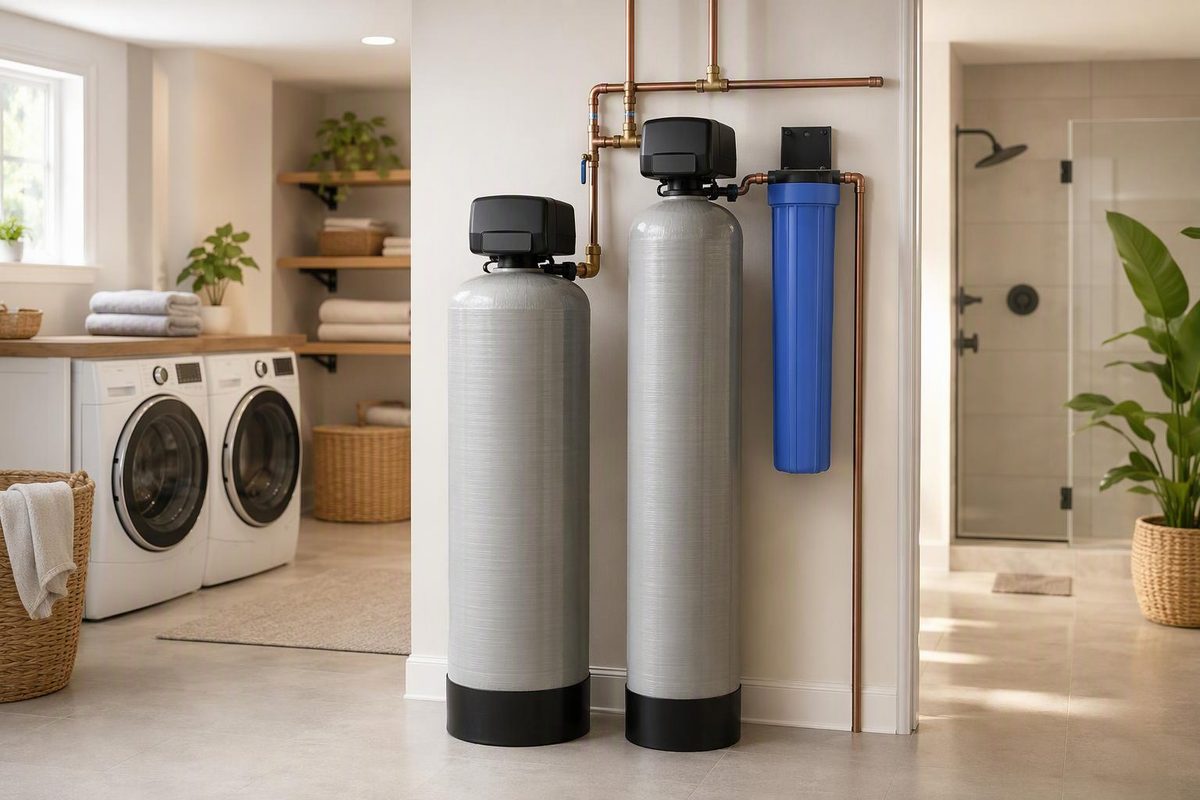
Choose the treatment media first, then the Culligan model and size. Cullar targets chlorine taste and odor; Filtr-Cleer targets sediment; Cullneu neutralizes acidic water. Iron, sulfur odor and arsenic require their own treatment configurations—not simply a more expensive version of a chlorine filter.
Also distinguish dealer-installed Aquasential tank systems from retail cartridge housings such as the WH-HD200-C. They share a brand, but not treatment capacity, servicing or installation requirements. (Culligan system guide, WH-HD200-C specifications)
Match the Culligan treatment name to the problem
Start with your utility’s water report or appropriate laboratory testing. Taste and smell alone cannot establish water safety; the CDC recommends choosing treatment for the particular substances found in your water. (CDC selection guidance)
| Water problem | Culligan configuration to consider | Important limit or upkeep |
|---|---|---|
| Chlorine taste and odor | Cullar, using activated carbon | Its chlorine claim does not establish chloramine, lead, PFAS or fluoride reduction. Carbon eventually needs replacement. |
| Sand, rust particles and other suspended sediment | Filtr-Cleer, using layered media | Smart HE and Advantage guides list certified Class IV particulate reduction: ≥15 to <30 microns. This is not fine-membrane filtration or dissolved-solids removal. |
| Acidic water | Cullneu, using calcium carbonate | Media dissolves and needs replenishment. Neutralization adds some hardness; this is not a softener. |
| Dissolved iron or persistent rotten-egg odor | Iron-Cleer, Iron-OX5, Sulfur-Cleer or Sulfur-OX3, selected by water chemistry | These are different oxidation/filtration systems. Check iron, hydrogen sulfide, pH, alkalinity and backwash requirements for the exact model. |
| Laboratory-confirmed arsenic | Smart HE Arsenic Reduction configuration | Requires suitable feed-water chemistry, treated-water testing after installation and periodic testing thereafter. Replace media at its rated capacity or earlier if exhausted. |
These distinctions and maintenance requirements come from Culligan’s Smart HE owner’s guide and 2026 Advantage owner’s guide.
For chloraminated municipal water, request a chloramine-specific performance sheet rather than accepting Cullar’s chlorine rating as equivalent. For hardness and scale, compare a softener separately; Culligan likewise distinguishes whole-home filtration from water softening. (Culligan treatment distinctions)
Aquasential chlorine filters: capacity and flow
For a chlorine taste-and-odor problem, the following Cullar specifications make a useful starting comparison. The inch designation refers to tank diameter, not plumbing connection size. Flow is in gallons per minute (gpm).
| Cullar configuration | Rated chlorine capacity | Rated service flow and pressure drop | Overall height |
|---|---|---|---|
| Smart HE, 9-inch | 120,000 gallons | 4.0 gpm at 2 psi | 54 inches |
| Smart HE, 10-inch | 180,000 gallons | 5.9 gpm at 5 psi | 60 inches |
| Advantage, 9-inch | 120,000 gallons | 4.0 gpm at 2 psi | 54 inches |
| Advantage, 10-inch | 180,000 gallons | 5.9 gpm at 5 psi | 60 inches |
Sources: Smart HE guide, March 2024, Advantage guide, April 2026. Both describe WQA certification to NSF/ANSI 42 for chlorine taste-and-odor reduction; actual performance depends on water conditions.
Size against simultaneous household demand, not just daily gallons. A 180,000-gallon rating does not mean the filter treats water at any flow you send through it. Ask the dealer to compare expected peak demand with rated treatment flow and the pressure remaining after every treatment stage.
Backwashing also needs its own supply and drain capacity. The Smart HE Cullar guide lists maximum drain flows of 3.5 gpm for the 9-inch and 5.5 gpm for the 10-inch, measured at 120 psi. Those are not interchangeable with service-flow ratings. Have the installer confirm requirements at your actual supply pressure. (Smart HE specifications)
Select and Select Plus systems also use Cullar, Cullneu and Filtr-Cleer configurations. Do not transfer the table above to those families: their specifications and capacities differ. Request the sheet matching the full model name on the quote. (Select/Select Plus guide)
Retail option: WH-HD200-C is a housing, not a complete treatment claim
The WH-HD200-C has 1-inch connections and is sold without a cartridge. Compatible cartridges include CW5-BBS, CP5-BBS and R50-BBSA. Its advertised flow is “up to 10 gpm,” but cartridge selection determines treatment, life and flow restrictions. The housing’s structural certification does not establish contaminant reduction. (Official product specifications)
This is an option for a cartridge-based sediment setup. Select the cartridge by its own rating—not the clear housing’s appearance or the “whole house” label. For finer sediment, understand the difference between nominal and absolute micron ratings.
What upkeep actually involves
Aquasential media tanks: Automatic reconditioning does not eliminate eventual media service. Cullar carbon needs replacement when it no longer adequately reduces chlorine; Filtr-Cleer may need media replacement if increased pressure loss persists after reconditioning; Cullneu needs periodic media replenishment. Culligan directs these services to its dealers. (Smart HE maintenance instructions)
WH-HD200-C cartridges: Its indicator flashes red after 90 days—a timed reminder, not a measurement of contamination or remaining capacity. Follow the selected cartridge’s limits and replace sooner if necessary. The manual calls for shutting off or bypassing flow and relieving pressure before opening, correctly seating the OR-250 O-ring, checking for leaks and flushing a new cartridge for 10 minutes. Routinely inspect the housing; Culligan says to replace the entire unit immediately if it shows stress marks, cracking, chipping, warping or discoloration. (Culligan WH-HD200-C manual)
Removing disinfectant throughout the house can allow more germs to grow in plumbing, so maintenance matters even when the water tastes better. These filters are not a substitute for disinfection of unsafe water. (CDC guidance, Culligan safety instructions)
Get an itemized Culligan quote
As of October 31, 2026, Culligan’s national page gives an approximate whole-home filter range of $1,999–$5,399, depending on the system. Treat that as a starting range, not an installed-price guarantee. (Culligan pricing guidance)
Ask the quote to specify:
- Full model, media, tank size and supported treatment claims.
- Rated service flow, pressure loss and backwash supply requirements.
- Plumbing, drain, electrical work and installation charges.
- Media replacement or replenishment costs, labor and service-plan terms.
If the problem affects only water for drinking, coffee or brewing, compare kitchen-only treatment with whole-house filtration before paying to treat every tap.