
Aquasana Whole House Filter: Which Rhino Fits?
Compare Aquasana Rhino whole-house filters by chlorine or chloramine treatment, rated flow, replacement schedule and the limits of optional upgrades.
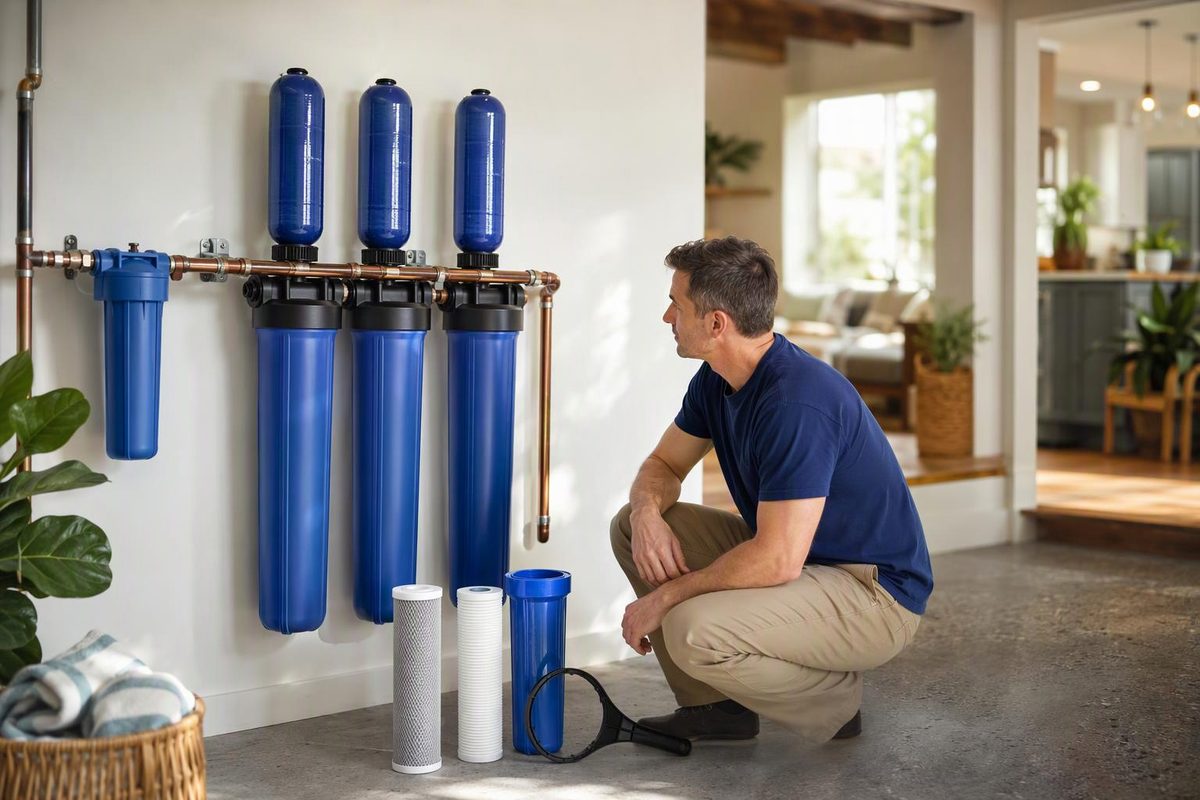
Match the Aquasana Rhino to your disinfectant first: standard Rhino models target free chlorine; Rhino Chloramines models target chloramines as well as free chlorine. Then size by rated treatment flow. A Max Flow version only fits if its rated flow covers your simultaneous household demand—not simply because it is the larger model.
The Rhino range is worth considering when you want disinfectant reduction throughout the house. It is not, by itself, a complete treatment plan for hardness, unsafe well water or every drinking-water contaminant. If your concern is limited to drinking and brewing water, first compare whole-house versus kitchen-only filtration.
Compare rated flow, not just peak flow
The following specifications are from Aquasana’s product pages and performance sheets available on October 25, 2026. All four main tanks are advertised for 1,000,000 gallons or up to 10 years; that does not describe the replacement interval of their sediment cartridges. (Rhino Max Flow product details)
| Rhino model | Model number | Published reduction target and laboratory result | Rated treatment flow |
|---|---|---|---|
| Rhino | WH-1000 | Free chlorine; overall reduction greater than 97.4% | 7 gpm |
| Rhino Max Flow | WH-1010 | Free chlorine; overall reduction greater than 97.4% | 14 gpm |
| Rhino Chloramines | WH-1011 | Chloramines and free chlorine; overall reductions of 83% and 97.4% | 7 gpm |
| Rhino Chloramines Max Flow | WH-1021 | Chloramines and free chlorine; overall reductions of 83% and 97.4% | 10 gpm |
Rated flow is the flow associated with the treatment claim. Peak flow is not a substitute. For example, Aquasana lists the standard Rhino at 14.6 gpm peak but only 7 gpm rated. The Chloramines Max Flow is 12 gpm peak and 10 gpm rated. Aquasana explicitly says reduction results vary with flow rate. (Rhino specifications, Chloramines Max Flow specifications)
Ask your utility which disinfectant it uses, including any seasonal changes. Then have the installer estimate simultaneous fixture demand and pressure loss through the complete configuration, including cartridges and optional equipment. Bathroom count alone is a rough screening tool, not a hydraulic calculation.
The 83% chloramine figure also does not mean chloramine-free water at every stage of tank life. Aquasana’s chloramine test table shows varying sample reductions, including 75.5% at 1,000,000 gallons. For brewing, verify the residual at your actual water-filling rate rather than assuming the headline percentage guarantees zero disinfectant.
What the testing and certification actually cover
The Rhino performance sheets describe independent testing according to NSF/ANSI 42. Separately, the WH-1000 manual states that its tank has WQA certification for materials safety and structural integrity, and is not certified for contaminant reductions by WQA. Do not turn that tank certification into a claim that the complete filter is certified to remove lead, PFAS or other unlisted contaminants. (Rhino owner’s manual)
NSF explains that Standard 42 addresses aesthetic effects such as chlorine and taste/odor, while Standard 53 addresses specified health-effect contaminants. Standard 61 evaluates the health effects of water-contact materials; contaminant-reduction performance falls outside its scope. (NSF treatment standards, NSF’s Standard 61 explanation)
For a lead, PFAS or fluoride concern, compare the exact model’s current performance data and certification listing. Aquasana’s drinking-water filter claims should not be transferred to a Rhino simply because both carry the same brand.
Optional upgrades solve different problems
Salt-free conditioner: This is a scale-control accessory, not a hardness-removing softener. Aquasana says it does not reduce hardness or total dissolved solids, and mineral spots can remain where water evaporates. It therefore does not supply a low-mineral starting point for a brewing recipe. If your goal is actual hardness reduction, compare softening with reverse osmosis. (Aquasana conditioner specifications)
City-water UV upgrade: Aquasana identifies the optional Rhino UV unit as NSF/ANSI 55 Class B. NSF describes Class B as supplemental treatment for non-disease-causing bacteria in disinfected drinking water—not the Class A treatment category for contaminated water. Do not choose this add-on as the sole response to a positive well-water microbial test. Start with a tested and sized well-water treatment plan. (Aquasana UV description, NSF’s UV classifications)
Installation and replacement budget
The standard WH-1000 manual requires installation on the incoming cold-water line, before the water heater, at 40–90°F and 20–100 psi. It recommends protection from sunlight and freezing, flushing before use, and locating the system where a leak will not damage the surroundings. Allow service clearance for cartridge removal and check the layout for your exact package—not just the tank diameter. (Installation manual)
For the WH-1000, that manual specifies:
- Standard 20-inch pre-filter: every 2 months, sooner if flow noticeably decreases.
- Low-maintenance pre-filter: every 6 months, sooner if flow decreases.
- 10-inch post-filter: every 6 months, sooner if flow decreases.
- Pre/post-filter housings: every 5 years.
That means budgeting for at least six standard pre-filter cartridges and two post-filter cartridges per year, or at least two of each with the low-maintenance option. Optional UV lamps have a separate annual replacement schedule. (Cartridge and housing instructions, UV replacement schedule)
Before ordering, get an installed quote that identifies the model, bypass arrangement, pressure-control work, cartridge costs and eventual replacement tank. The useful comparison is the complete system you can maintain—not the advertised ten-year tank life alone.