
How to Choose a Bottle-Filling Water Fountain
Decide whether drinking fountains are required, match filtration and chilling to demand, then verify mounting, plumbing, drainage, power and accessibility.
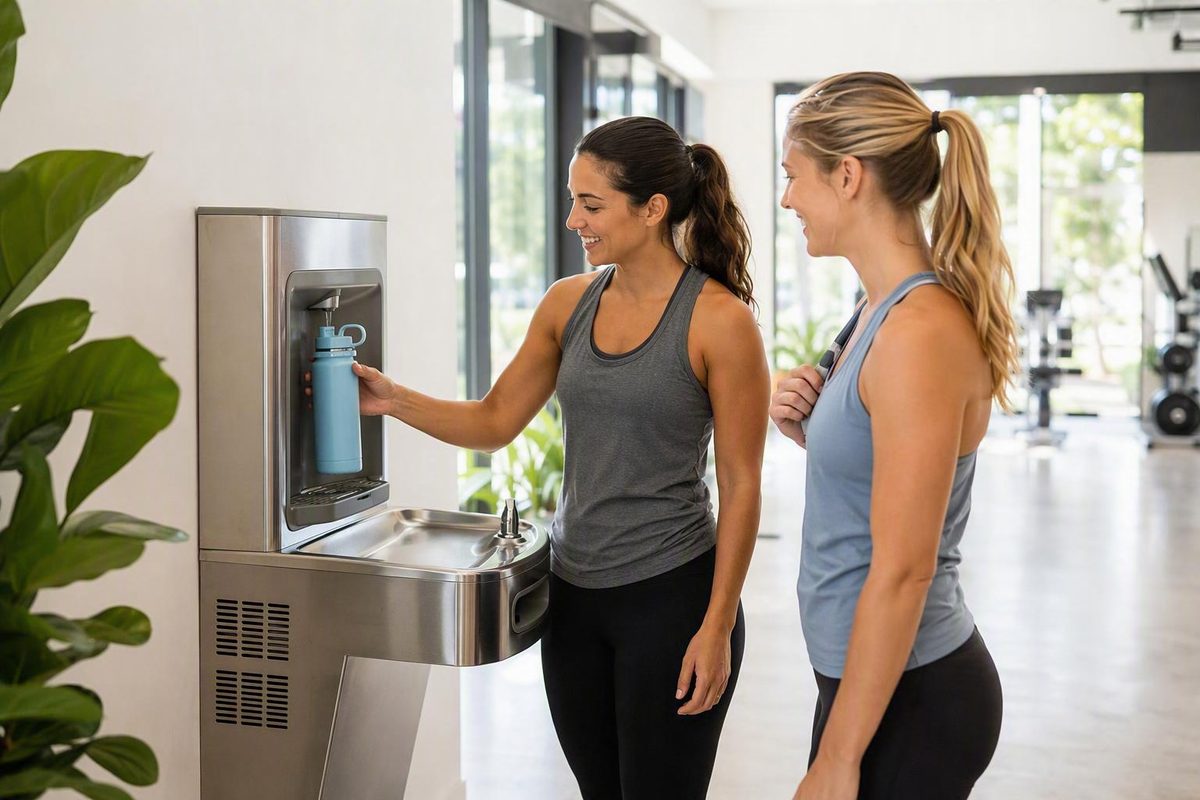
Choose a bottle-filling water fountain by making three decisions in order: determine whether the project must also provide accessible drinking fountains, decide whether users need filtered or actively chilled water, and confirm that the site can support the selected unit’s mounting, plumbing, drainage, power, and accessibility requirements.
This is a configuration and due-diligence framework, not a marketwide product comparison. Manufacturer classifications and list prices can narrow the shortlist, but the exact model, its current documentation, and the completed installation must be evaluated together.
Related: Water Filter for GenX and PFHxS: Claims That Work.
Start with this bottle-filling station decision table
Use this table to identify a configuration to investigate—not to approve a particular model. The final choice depends on the building, location, product documentation, and applicable requirements.
| Project need | Configuration to investigate | Checks still required |
|---|---|---|
| Bottle filling plus drinking access | Integrated bottle filler with one or more drinking fountains | Required wheelchair and standing access, fountain count, route, clearances, controls, plumbing, and drainage |
| Bottle filling where no fountain is otherwise required | Standalone in-wall or recessed dispenser | Whether local requirements call for drinking fountains; accessible route, approach space, wall conditions, and utilities |
| Cold drinking water | Refrigerated bottle filler or integrated refrigerated fountain | Power, cooling capacity, incoming-water temperature, ventilation, peak demand, and exact-model instructions |
| No suitable electrical service | Mechanically activated, non-refrigerated model listed as requiring no electricity | Plumbing, drainage, maintenance, water temperature, and whether powered features are needed |
| Defined water-treatment objective | Model explicitly labeled filtered | Certification, contaminant-reduction claims, capacity, replacement availability, and filter cost |
| Fixed installation in a public or employee area | Accessible configuration suitable for the location | Clear floor space, control reach and operation, circulation-path protection, and drinking-fountain scoping |
Elkay’s commercial catalog illustrates the available categories: standalone in-wall or recessed dispensers, integrated bottle-filler and drinking-fountain products, filtered and unfiltered configurations, refrigerated and non-refrigerated options, mechanical and hands-free activation, and some models listed as requiring no electricity. These are manufacturer classifications, not proof that a product is appropriate for a particular project.
Accessibility belongs in this initial decision. A fixed station can affect the accessible route, clear floor space, control reach, and circulation path. If drinking fountains are required, their number and arrangement may determine whether a bottle-filler-only dispenser is appropriate at all.
Understand the available form factors
“Bottle filler” and “bottle-filling water fountain” are often used interchangeably, but they can describe different equipment.
A standalone bottle dispenser is intended primarily to fill containers. It may be recessed or installed within a wall assembly, but it does not necessarily include a bubbler for direct drinking. This category may suit a location where bottle filling is desired and drinking fountains are not otherwise required, subject to project-specific review.
An integrated bottle-filler and drinking-fountain combination adds a bottle-filling outlet to one or more fountain bowls. This is the category to investigate when the project needs both bottle filling and required drinking access. High-low combinations may provide two drinking positions, while other arrangements pair a filler with one fountain. The selected arrangement must still satisfy the project’s scoping and installation requirements.
It does not automatically resolve circulation-path concerns: the result depends on the unit’s installed profile, the height of its leading edges, and the surrounding route.
Do not remove an existing required drinking fountain and assume that a bottle-filler-only dispenser is an equivalent replacement. Before beginning a replacement, establish why the fountain is present, what accessibility function it serves, and which alteration requirements apply.
Choose filtration, chilling, activation, and power
Treat these as separate specifications.
| Feature | What it means for selection | What to verify |
|---|---|---|
| Filtered | The model includes or accepts a treatment system | Exact certification, reduction claims, rated capacity, cartridge cost, and replacement process |
| Chilled | The unit actively cools supplied water | Power, incoming-water conditions, cooling rating, recovery, ventilation, and peak demand |
| Non-refrigerated | The unit does not actively chill water | Expected supply temperature and user expectations |
| Hands-free | A sensor or similar control initiates dispensing | Power, accessible operation, cleaning, and service procedure |
| Mechanical activation | A mechanical control initiates flow | Required force, one-handed operation, location, and service access |
| No electricity | The listed configuration has no electrical requirement | Whether refrigeration and powered controls are unnecessary; plumbing and drainage still apply |
Start filtration selection with the water-quality objective. “Filtered” does not identify which substances a cartridge is certified to reduce. Obtain the exact filter model and current certification documentation, then verify its certified reduction claims, rated capacity, replacement price, availability, and change procedure. Do not transfer claims from one cartridge or product family to another.
For cooling, Elkay’s catalog displays classifications of 1.0, 1.5, and 8.0 gallons per hour, along with non-refrigerated products. Those ratings do not establish how many cold bottles a unit will provide under a facility’s actual peak conditions. Review the manufacturer’s current product classifications.
Instead, document:
- Bottle sizes commonly used
- Expected fills during the busiest continuous period
- Incoming-water temperature
- Desired dispensing temperature
- Recovery time available between demand peaks
- Whether other outlets share the cooling system
Compare that demand profile with the technical documentation for the exact model.
Hands-free and mechanical activation are alternatives, not evidence that one is necessarily more sanitary, reliable, or accessible. A sensor needs an accessible operating arrangement and power where specified. A mechanical control must be appropriately located and satisfy applicable force and dexterity requirements.
A no-electricity configuration may be useful where active chilling and powered activation are unnecessary.
Treat convenience features as specifications, not performance guarantees
Secondary features can influence product selection and maintenance planning, but catalog labels should not be treated as promised outcomes. Use this checklist when requesting submittals:
- Laminar flow: Treat this as a manufacturer feature label. Confirm the exact outlet design and operating requirements without assuming a water-quality or sanitation benefit.
- Visual filter monitor: Verify what the indication represents, how staff interpret it, and what action is required.
- Automatic filter-status reset: Confirm the model-specific operation, reset procedure, and compatible cartridge rather than assuming how the feature works.
- Antimicrobial components: Determine which components carry the description. The label does not eliminate routine cleaning or establish an infection-prevention result.
- Real drain: Confirm what the catalog label means for the selected model, including its drain connection and maintenance requirements.
- Finish: Stainless steel and named colors including Aspen White, Midnight, Midnight Black, and Steel Gray appear in the Elkay catalog. Check the selected finish against expected cleaning products, moisture, traffic, and surrounding materials.
- Activation method: Compare sensor and mechanical operation based on utilities, accessibility, user needs, maintenance resources, and service availability.
Do not assume that a general product family is suitable outdoors. Limited indoor/outdoor coverage in a catalog does not establish resistance to freezing, humidity, salt, corrosion, weather, or vandalism. Obtain explicit environmental ratings and installation restrictions for the exact model.
Before purchasing, request the filter instructions, cleaning procedure, warranty terms, replacement-parts list, and local service information. A convenient feature can become an operating burden if compatible cartridges, sensors, valves, or finish-specific parts are difficult to obtain.
Use catalog pricing only as an equipment-budget reference
Visible Elkay manufacturer list prices span $1,902 to $12,533. The visible Liv EZ examples include a filtered dispenser at a $1,902 manufacturer list price and a filtered-and-chilled dispenser at $3,011. A visible integrated ezH2O mechanical bottle-filler and fountain example—described as filtered, non-refrigerated, and stainless steel—has a $7,751 manufacturer list price. These figures come from a partial manufacturer product display, may change, and are not verified dealer prices, market averages, or installed costs. Check the manufacturer’s current catalog and list prices before budgeting.
Compare quotations by exact model number and included components. A lower equipment price may exclude accessories or site work included in another quote.
Total-project budget worksheet
- Equipment and required accessories: ________
- Delivery, storage, and handling: ________
- Demolition or removal of existing equipment: ________
- Wall opening, framing, blocking, and finish repair: ________
- Water-supply plumbing: ________
- Drainage and waste connection: ________
- Electrical circuit, outlet, or controls: ________
- Permits, inspections, and design review: ________
- Initial filters and spare cartridges: ________
- Routine cleaning materials and labor: ________
- Planned filter replacements: ________
- Future parts, service, and repairs: ________
- Contingency for concealed site conditions: ________
- Total project allowance: ________
A bottle filler does not replace required accessible drinking fountains
Where drinking fountains are provided in covered facilities, access is generally required for wheelchair users and standing users. If one drinking-fountain location is planned on a covered floor, secured area, or exterior site, dual access generally requires two units or a combination high-low unit. Where multiple fountains are provided, 50% generally must be wheelchair accessible and 50% accessible to standing users, with the applicable rounding when the total is odd. Scoping is applied separately to each floor, secured area, and exterior site containing drinking fountains.
In covered new construction, additions, or alterations, a bottle filler, water cooler, or nearby sink cannot substitute for either required drinking-fountain type. A bottle filler may be added to compliant fountains or integrated into a compliant fountain arrangement. Adding a bottle filler does not, by itself, create a requirement to install a drinking fountain where none is otherwise planned.
For fountain dimensions, wheelchair-accessible spouts have a maximum height of 36 inches, while standing-user spouts must be 38 to 43 inches high. These dimensions address only part of the installation; approach space, knee and toe clearance, controls, fountain position, and circulation-path protrusion also matter. See the U.S. Access Board’s drinking-fountain guidance.
A manufacturer’s “ADA compliant” catalog label can identify a candidate product, but it does not prove that the completed installation complies. The same unit can produce different results depending on its mounting height, adjacent walls, available floor space, corridor placement, fountain arrangement, and control location.
Run this site and accessibility check before ordering
Complete this review using the installation manual for the exact model and revision under consideration.
Product and site checks
- Model documentation: Obtain the current specification sheet, installation manual, dimensional drawing, parts list, and warranty. Do not rely on instructions for a similar product.
- Wall and mounting conditions: Confirm wall construction, available cavity, structural support, blocking, service access, and the effect of cutting or reinforcing the wall.
- Water supply: Verify connection location, pressure and temperature conditions, shutoff access, flushing requirements, and model-specific treatment components.
- Drainage: Determine whether the unit requires a waste connection and whether the available drain location and capacity are suitable.
- Electrical service: For powered units, verify voltage, circuit, outlet or hard-wiring requirements, routing, and specified disconnects. Include refrigeration and sensor loads identified by the manufacturer.
- Environmental conditions: Confirm that the exact model is approved for the intended location and anticipated exposure.
Accessibility checks
- Accessible route: A fixed or built-in bottle filler must be on an accessible route.
- Clear floor space: Provide clear floor space for the required forward or side approach. Review nearby doors and obstructions under the standards applicable to the installation.
- Controls: Hand-operated controls must be within accessible reach, operate with one hand, require no tight grasping, pinching, or wrist twisting, and need no more than five pounds of force.
- Circulation path: Objects with leading edges above 27 inches generally cannot protrude more than four inches into a circulation path unless recessed or otherwise protected.
- Wheelchair-accessible fountain spout: The spout must be at least 15 inches from the vertical support and no more than five inches from the front edge, including bumpers.
- Knee and toe space: For a forward approach, the combined depth must be at least 17 inches and no more than 25 inches from the leading edge, including bumpers.
- Fountain scoping: Confirm whether the location needs both wheelchair-accessible and standing-user drinking access instead of evaluating the bottle filler alone. Consult the U.S. Access Board guide for these federal accessibility criteria.
Make the final purchase only after completing three checks: confirm whether compliant drinking fountains must accompany the bottle filler, match filtration and chilling to a documented need, and verify the exact model against actual wall, plumbing, drainage, electrical, accessibility, and environmental conditions. Finish by reviewing the manufacturer’s instructions and all applicable accessibility, building, plumbing, health, state, and local requirements rather than treating one catalog or federal guide as the project’s only authority.