
20-Micron Sediment Filter: What It Catches and When to Use It
A 20-micron sediment filter targets sand and larger particles but may pass finer silt. Compare it with 5 micron and check flow and maintenance trade-offs.
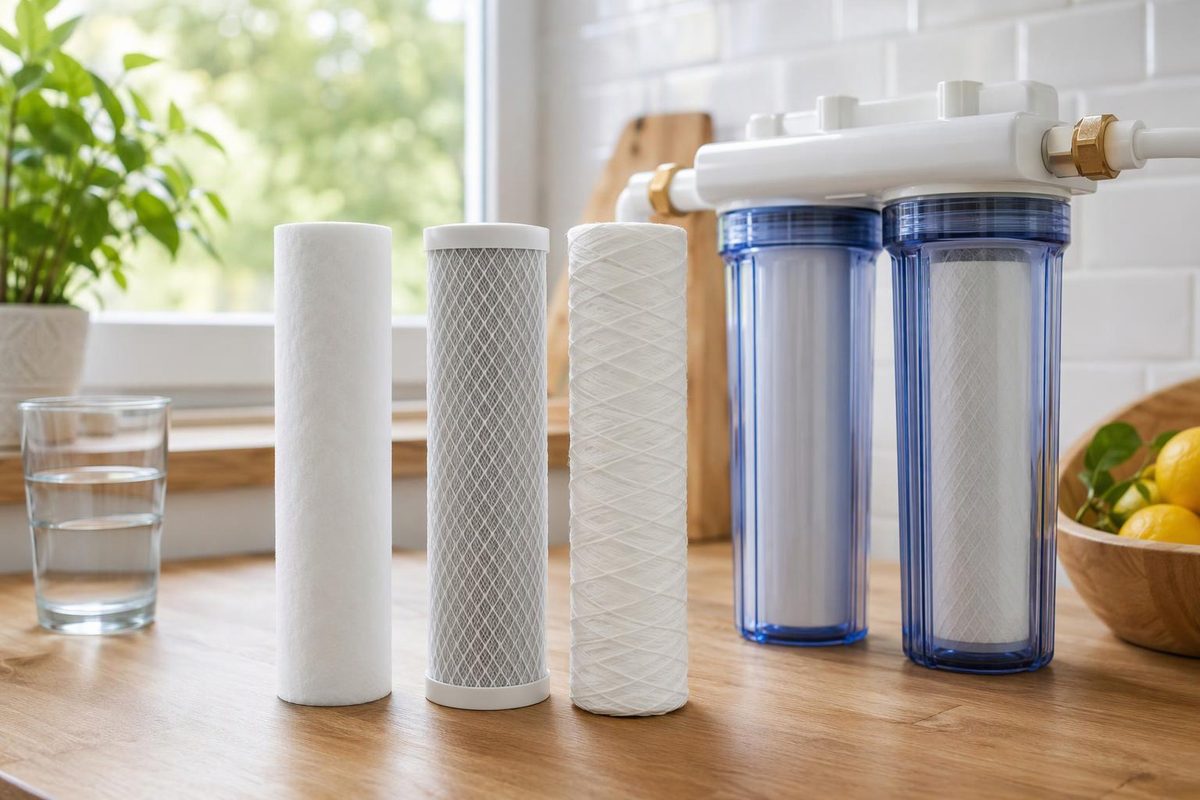
A 20-micron sediment filter targets suspended particles around 20 µm (0.020 mm) and larger. It is useful for sand, coarse silt and sufficiently large rust or scale particles—not for every kind of cloudy water. Choose it when those larger particles are the problem, or as a coarse prefilter before a finer stage.
The qualification is the rating: nominal 20 micron is not a guaranteed cutoff. Some larger particles can pass through a nominal filter, so check the manufacturer’s retention data rather than assuming complete removal. CDC explains the distinction between nominal and absolute pore sizes.
What does a 20-micron filter catch?
The particle’s size matters more than its name. “Silt” and “rust,” for example, do not each have one fixed particle size.
| Material in the water | What to expect from 20-micron filtration |
|---|---|
| Sand and coarse grit | A good target: typical sand particles are about 50 µm to 2 mm, larger than the rating. |
| Silt | Partial removal: the broad 2–50 µm range includes particles both below and above 20 µm. |
| Fine clay | Poor match: typical clay particles are much smaller, around 0.2–2 µm. |
| Rust, insoluble iron and loose scale | Can capture sufficiently large solid particles; cannot capture dissolved iron by ordinary sediment straining. |
These ranges and treatment limits come from University of Nebraska–Lincoln Extension’s sediment-filtration guide. They explain why a 20-micron cartridge can stop gritty deposits while leaving a fine haze.
A plain sediment cartridge is particle control, not comprehensive drinking-water treatment. It does not effectively remove dissolved contaminants or provide reliable microbial treatment. Clearer water is not proof of safer water; choose any health-related treatment from water-test results and the exact product’s verified claims. UNL describes sediment-filter limitations, and CDC recommends testing and matching the filter to the contaminant.
When to choose 20 micron rather than 5 micron
Choose 20 micron when larger solids are the intended target and no downstream equipment requires finer filtration. Capturing unnecessary fine particles can increase the maintenance burden. UNL recommends the largest rating that still removes the intended material, because small pores and high solids loads can cause rapid clogging. See its selection guidance.
Use these decision rules:
- Mostly sand or gritty particles, with no fine-particle requirement: 20 micron is a reasonable cartridge rating to evaluate. For a heavy sand load, consider a flushable spin-down filter instead of repeatedly filling disposable cartridges.
- Fine sediment remains after 20-micron filtration: compare a finer cartridge, such as 5 micron, while checking retention efficiency and pressure drop. Our 5-micron nominal-versus-absolute guide explains that comparison.
- A finer cartridge clogs quickly: a 20-micron stage ahead of it may help if larger particles are contributing to the load. It will not protect the finer stage from particles that pass through the 20-micron filter.
- A downstream system specifies 5 micron: do not substitute 20 micron as its only prefilter. Follow that system’s required rating and treatment sequence.
Persistent haze may need a different process rather than another cartridge: very fine clay can pass ordinary sediment filters, and dissolved material is not removed by simply tightening the sediment rating. UNL discusses both cases.
Flow and service life: the label is not enough
A 20-micron filter is not automatically a high-flow filter. Cartridge dimensions and construction also matter. For example, Pentair’s published S1 specification sheet lists two nominal 20-micron pleated-cellulose cartridges at the same 10 gpm (38 L/min) flow:
- S1, 2.63 × 9.75 inches: initial pressure drop of 2.4 psi.
- S1-20, 2.63 × 20 inches: initial pressure drop of 0.8 psi.
Those are cartridge figures, not complete installed-system pressure losses. Pentair S1 specification sheet.
The sheet is revision D, May 2015, and is linked from Pentair’s S1 product page as of November 5, 2026. Confirm the specification for the exact replacement you buy.
There is no universal service life for “20 micron.” Accumulated solids restrict flow, and sediment concentration makes gallon-capacity estimates unreliable predictors of replacement timing. Follow the manufacturer’s maintenance interval and pressure-drop limit, and inspect sooner if filtered flow noticeably declines. Clean a cartridge only if its instructions permit reuse. UNL’s maintenance guidance.
For coffee or brewing water, use this stage to control particles. Any adjustment to dissolved minerals or disinfectant taste is a separate treatment decision—not a reason to buy a finer sediment cartridge.