
Pleated Sediment Water Filters: When to Choose Them and How to Clean
Compare pleated sediment water filters with depth cartridges, check whether yours is washable, and know when cleaning should give way to replacement.
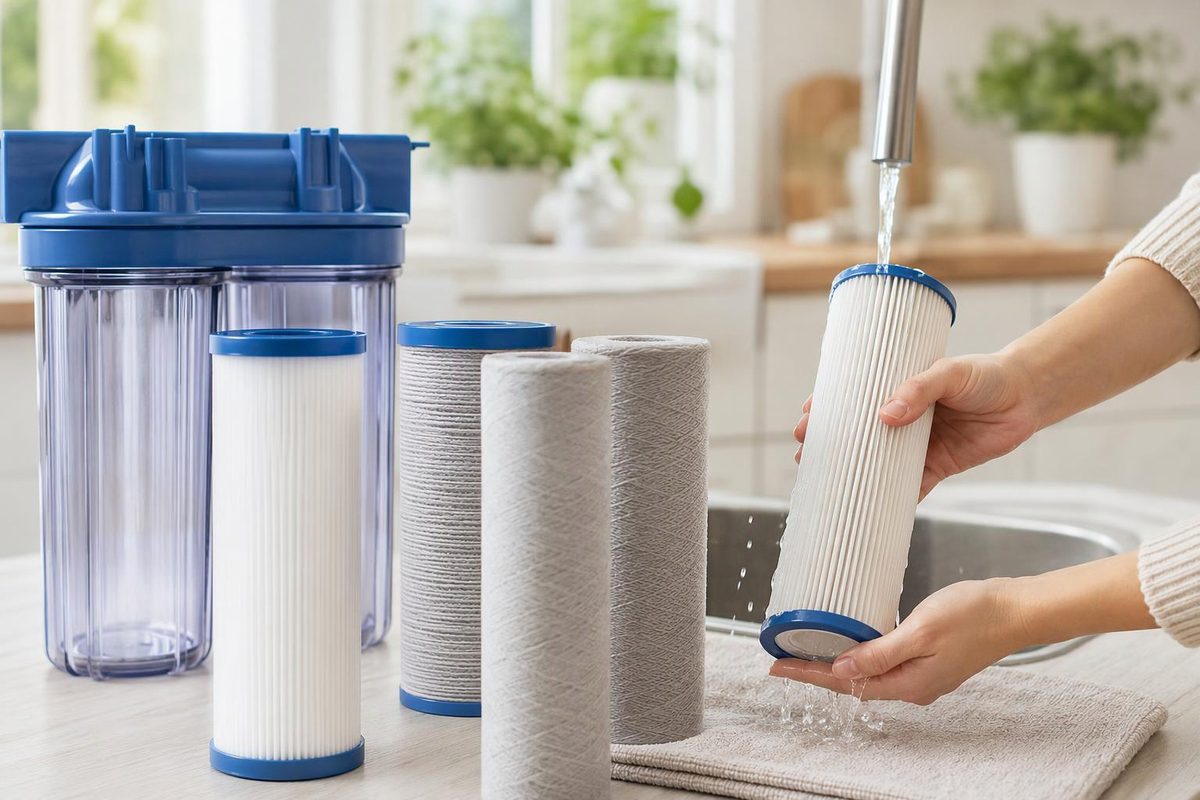
A pleated sediment water filter is worth considering when you want substantial filtering surface area in a cartridge—and, with an explicitly reusable model, the option to rinse away collected sediment. Choose a depth cartridge when inexpensive replacement and capture within thick filter media better suit your maintenance routine. Neither construction is automatically finer or longer-lasting: compare the actual cartridges at the required micron rating and flow.
How the pleats work
A pleated cartridge folds a sheet of filter media around a supporting core. Water pressure pushes water through the media into the central passage, leaving suspended particles behind. The folds pack more filtering area into the cartridge than an unfolded sheet would provide.
Particles accumulate mainly on the pleated surface, forming a filter cake. That deposit can help capture additional particles, but it also increases resistance and slows flow. A depth cartridge instead traps particles within its thickness; gradient-density designs have coarser openings outside and finer openings toward the core. University of Georgia Extension explains both constructions.
The pleated filter’s advantage is therefore area, not a uniquely small pore size. It remains particle treatment—not a way to adjust brewing minerals or a substitute for treatment of dissolved contaminants or microbes. University of Nebraska–Lincoln Extension describes sediment filtration’s limits.
Pleated or depth: which fits the job?
| Your priority | Construction to consider | What should decide the purchase |
|---|---|---|
| More filtering area and low clean-cartridge resistance | Pleated | Published pressure drop at your required flow—not the appearance of the folds |
| Removing collected sediment instead of discarding every cartridge | Explicitly reusable pleated media | Cleaning instructions for the exact model, micron grade and application |
| Low purchase cost and straightforward replacement | Depth | Replacement cost and actual service interval in your water |
| Capturing a range of particle sizes through successive layers | Gradient-density depth | Its outer and inner ratings, retention performance and loading capacity |
These are selection priorities, not a universal performance ranking. Georgia Extension describes pleated cartridges’ large surface area and depth cartridges’ generally lower purchase cost. Pentair’s DGD depth-cartridge design, for example, combines two gradient layers for prefiltration and final capture.
If cartridges repeatedly clog, changing construction alone may not solve the problem. Excessive solids or an unnecessarily fine rating can overwhelm either type. Choose the coarsest rating that meets the task and any downstream equipment requirement; persistent heavy sand may justify a separate flushable spin-down stage. UNL Extension explains the relationship between pore size, sediment load and clogging.
Compare ratings and dimensions, not just “pleated”
Check three things before ordering:
- Retention rating. Ask whether the micron rating is nominal or absolute and what efficiency it represents. Two cartridges marked “5 micron” are not necessarily equivalent; see nominal versus absolute ratings.
- Actual fit. Match diameter, length and end-seal arrangement to the housing’s approved replacements. A marketed “10-inch” cartridge may actually be 9.75 inches long.
- Pressure drop at flow. A clean-cartridge measurement is not the complete installed system’s service-flow rating.
For example, Pentair’s ECP5-10 specification lists a nominal 5 µm rating, maximum dimensions of 2.63 × 9.75 inches, and initial pressure drop below 1 psi at 10 gpm. Those are separate specifications; the last figure does not establish whole-house capacity after sediment loads the filter. See the Pentek ECP specification sheet.
Can you wash a pleated sediment filter?
Only if the manufacturer permits it. “Pleated” describes the shape, not washability.
Georgia Extension distinguishes non-reusable pleated paper from synthetic media that can be rinsed and reused. Blended media require their own instructions: adding polyester does not, by itself, establish a cleaning procedure. Pentair explicitly describes its R Series polyester cartridges as reusable; its ECP cellulose/polyester description is not equivalent permission to wash them.
Before paying extra for reuse, obtain the cleaning method and replacement criteria. Permission can depend on micron grade and what the cartridge has filtered. The Harmsco Hurricane manual, for example, permits cleaning in many applications but identifies exceptions. Do not transfer another cartridge’s procedure to yours.
Cleaning and replacement: a practical routine
- Record a clean baseline. Where inlet and outlet gauges are fitted, record their difference while water is flowing. Compare later readings at similar flow and follow the model’s maintenance limit. Harmsco’s manual recommends gauges for this purpose; its numerical thresholds are model-specific.
- Isolate and depressurize before opening. Follow the housing manual. Never try to unscrew a pressurized sump.
- Inspect the cartridge. Replace it rather than attempting reuse if the media, seam or end seals are damaged. A cleaner-looking cartridge is not enough if its construction no longer seals properly.
- Use only the authorized cleaning method. Harmsco’s Hurricane instructions specify angled spray from a standard hose for particulate removal. Do not substitute a pressure washer, detergent, bleach or acid soak unless your exact cartridge instructions authorize it.
- Service the housing separately. Follow its cleaning and sanitation directions, check the O-ring and use the specified lubricant. Cartridge washability does not eliminate housing maintenance.
- Reassemble, refill slowly, flush and check for leaks. Follow the assembly’s instructions rather than borrowing a universal flushing time. Pentair’s OmniFilter replacement instructions illustrate the housing and restart steps.
After cleaning, compare flow and pressure loss again. If acceptable performance does not return, replace the cartridge and investigate the sediment load rather than endlessly rinsing it. Also follow any manufacturer-specified replacement interval, even if cleaning restores flow; Georgia Extension emphasizes manufacturer maintenance and replacement recommendations.
There is no dependable universal cleaning interval or reuse-cycle count: sediment concentration and particle type affect service life. UNL Extension treats gallon ratings as guidelines, not reliable maintenance clocks.