
How to Tell If You Have Hard Water: Test, Read and Confirm
Check for scale and soap problems, then confirm total hardness in mg/L or grains per gallon. Use the result to decide whether treatment is worthwhile.
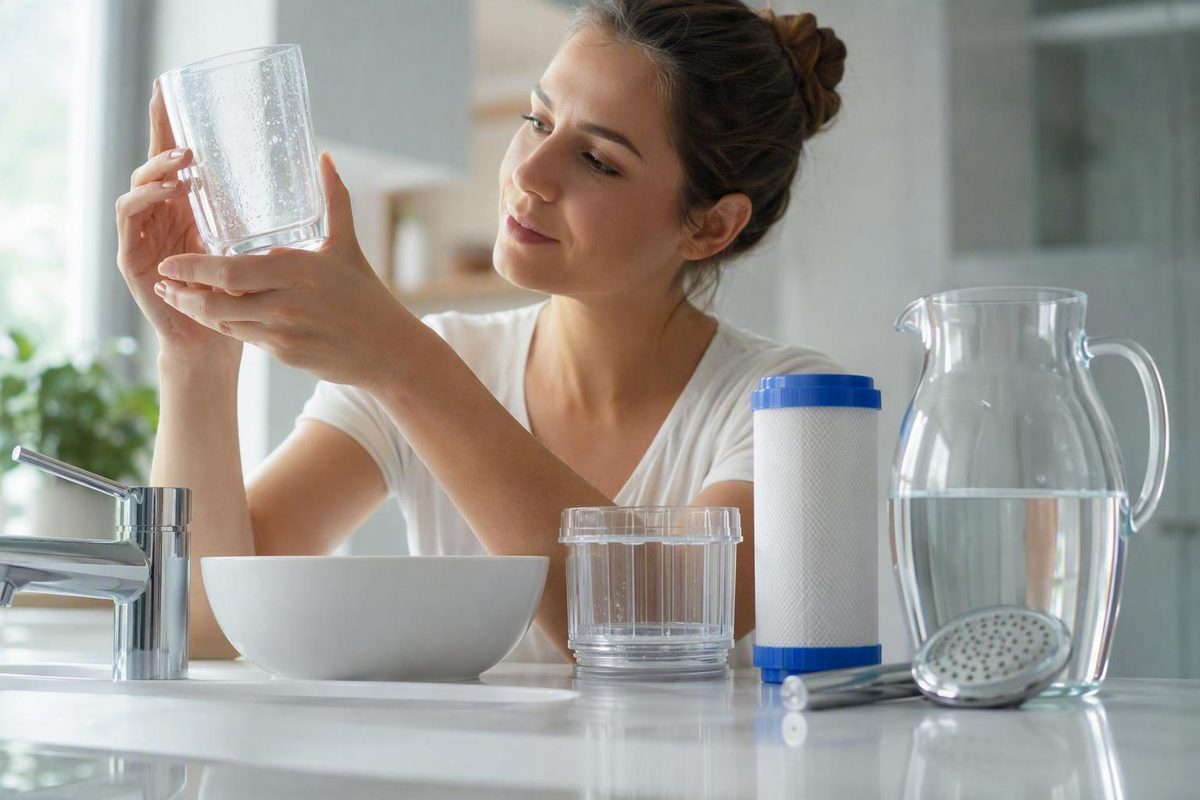
The reliable way to tell is to measure total hardness. Look for a result reported as mg/L (or ppm) as CaCO₃ or grains per gallon (gpg). A home hardness kit can screen your tap; use an independent laboratory result before buying or sizing treatment.
Hard water contains relatively high amounts of dissolved calcium and magnesium. The following signs make hardness likely, but none proves it by itself:
- White or gray scale on a kettle, coffee maker, showerhead or hot-water fixture
- Spots or cloudy film on clean glasses
- Soap scum or a residue after washing
- More soap or detergent needed to produce the expected cleaning effect
- Recurring mineral crust where water is heated or evaporates
The USGS explains that calcium in hard water reacts with soap to form soap scum and that heating hard water can produce calcium-carbonate scale in water heaters and coffee makers (USGS).
Read your hardness number
Use this USGS classification for total hardness as CaCO₃ (USGS):
| Result, mg/L or ppm as CaCO₃ | Approx. gpg | Classification |
|---|---|---|
| 0–60 | 0–3.5 | Soft |
| 61–120 | 3.6–7.0 | Moderately hard |
| 121–180 | 7.1–10.5 | Hard |
| More than 180 | More than 10.5 | Very hard |
To convert mg/L to gpg, divide by about 17. To convert gpg to mg/L, multiply by about 17. Penn State Extension identifies 1 gpg as approximately 17 mg/L or ppm (Penn State Extension).
A reading near a category boundary does not suddenly change what the water does. Scale also depends on where water is heated or allowed to evaporate, while your tolerance for spotting and soap use is personal.
Three ways to check
1. Check your water supplier’s information
If you receive public water, search the utility’s water-quality report or website for hardness, total hardness or hardness as CaCO₃. If it is not listed, call the utility and ask for the current range at your service area. Source changes and blending can affect the number; New York is one example where the source can change the hardness classification.
Treat a regional hardness map only as background. The USGS cautions that its national map is not intended for decisions at an individual property and directs readers to their utility or local agency for locally relevant information (USGS).
2. Use a home total-hardness kit
Buy strips or a drop-count kit labeled for total hardness, not pH, total dissolved solids (TDS) or alkalinity. Those measurements are not interchangeable. Follow the kit’s timing, sample and color-reading directions exactly, and make sure its range extends beyond 180 mg/L (about 10.5 gpg) if very hard water is possible.
Test the cold water that represents the supply you want to evaluate. If the home already has a softener, compare an untreated tap or softener-bypass sample with a treated indoor tap. That separates the incoming-water question from “Is my softener working?”
3. Use an independent laboratory when the number will drive a purchase
A laboratory total-hardness test is the stronger choice when you are sizing a softener, checking a private well or resolving conflicting home results. Penn State Extension recommends an independent laboratory evaluation before selecting a softener, rather than relying only on free testing from a company selling equipment (Penn State Extension).
Do not diagnose hardness from color alone
White scale and soap problems fit hardness. Orange, black or blue-green stains point toward other possibilities and need the appropriate test. EPA associates reddish-orange staining with iron, black staining with manganese, and blue-green staining with copper or corrosion (EPA). A hardness strip cannot identify any of those causes.
Likewise, a TDS meter is not a hardness test. It responds broadly to dissolved ions rather than reporting calcium-and-magnesium hardness as CaCO₃.
What to do with the result
If the result is below about 120 mg/L (7 gpg) and the water causes no practical problem, treatment may offer little value. At higher levels—or whenever scale is disrupting hot-water equipment, coffee makers or cleaning—compare the cost of descaling with treatment.
A conventional ion-exchange softener reduces calcium and magnesium; it is not a general-purpose purifier. Penn State Extension notes that softening removes hardness minerals but does not necessarily remove serious drinking-water contaminants (Penn State Extension). If hardness and a drinking-water contaminant are separate problems, choose treatment for each job; this softener-versus-reverse-osmosis comparison explains the distinction.
For existing deposits rather than incoming-water treatment, use a surface-safe cleaning method. See the separate guide to removing hard-water stains from windows.