
Does Boiling Remove Chlorine? The Type Matters
Fifteen minutes may reduce free chlorine and improve chlorine-related taste, particularly in a wide, uncovered vessel, but it does not guarantee complete removal.
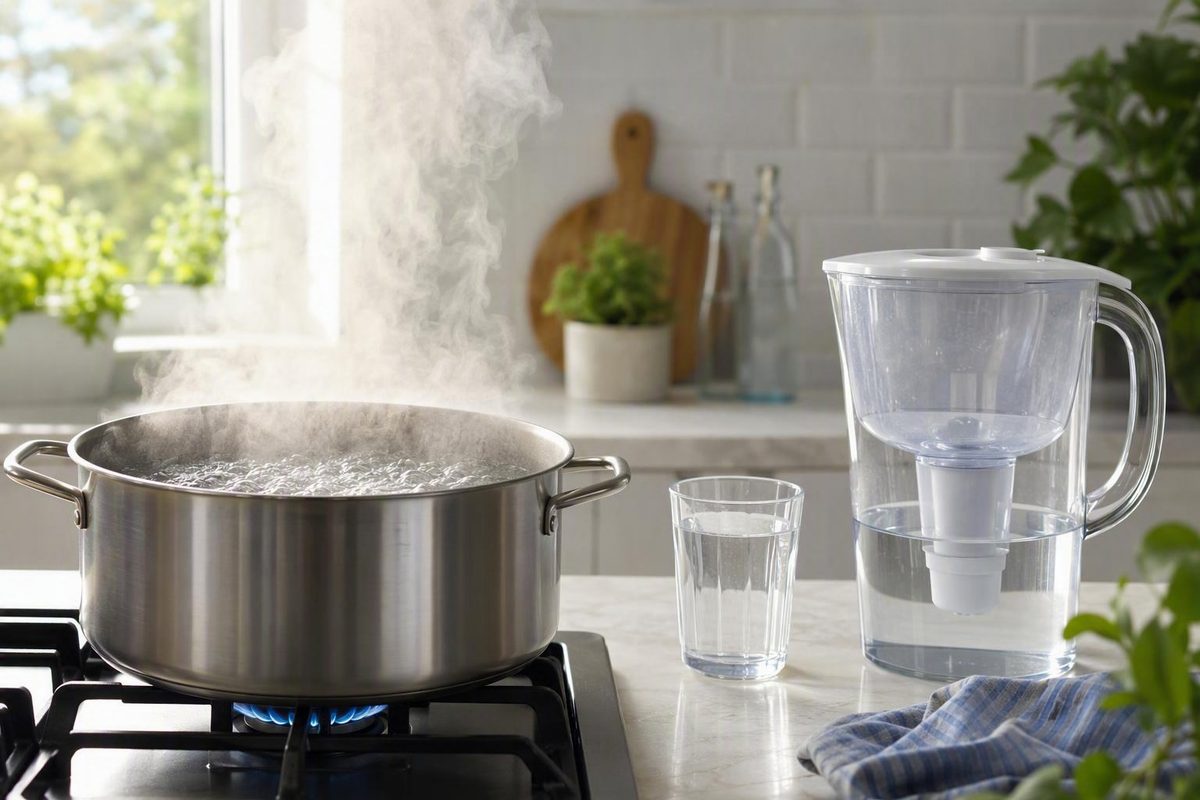
The short answer: boiling reduces some chlorine, not every chlorine disinfectant
Boiling can reduce free chlorine in tap water, especially when the water is heated in a wide, uncovered container. It does not guarantee complete removal, however, and ordinary household boiling is not a reliable way to remove chloramine.
The qualification matters because “chlorine” is often used loosely. Those disinfectants behave differently during heating and air exposure.
It also matters what you mean by “remove.” Water may taste or smell better after boiling while still containing a measurable disinfectant residual. Sensory improvement can be an acceptable endpoint for tea, coffee, cooking, or drinking water. It is not proof that the concentration has reached zero or met a technical requirement.
A practical decision summary:
- Known free chlorine: Uncovered boiling can reduce it, but the result varies and should not be assumed to be complete.
- Known chloramine: Choose treatment with a specific, verified chloramine-reduction claim instead of relying on ordinary boiling.
- Unknown disinfectant: Check the water supplier’s report or contact the supplier before choosing a method.
- Defined final concentration required: Test the cooled, treated water. Do not rely on boiling time, taste, or smell.
Boiling is therefore best understood as a possible free-chlorine reduction method, not universal dechlorination. That distinction prevents three common mistakes: treating free chlorine and chloramine as interchangeable, assuming that a fixed boiling time guarantees a fixed result, and confusing better-tasting water with complete purification.
Free chlorine and chloramine are not interchangeable
Free chlorine is the disinfectant residual more readily lost when household water is heated and exposed to air. From a practical household perspective, greater heat, water movement, and air exposure can accelerate its decline.
Chloramine is generally formed by combining chlorine with ammonia during water treatment. That same stability makes ordinary standing or boiling unreliable as a household removal method (AMPAC USA’s comparison of free chlorine and chloramine).
This explains why apparently conflicting answers about boiling can both sound plausible. “Boiling removes chlorine” may refer to a reduction in free chlorine under favorable conditions. “Boiling does not remove chlorine” may be an imprecise warning about chloramine or about the absence of a guaranteed chlorine-free endpoint.
Three categories must remain separate:
- Free chlorine is a disinfectant residual that may decline through heating and air exposure.
- Chloramine is a more stable combined disinfectant residual, commonly formed using chlorine and ammonia.
- Disinfection by-products, including trihalomethanes, are compounds formed during chlorination. They are not the same substances or measurements as free chlorine or chloramine.
The distinction applies to testing as well as treatment. A free-chlorine result cannot automatically be treated as a chloramine result. “Total chlorine” and “free chlorine” are also different measurements, and a change in trihalomethane concentration does not prove that either disinfectant residual has disappeared.
For ordinary taste improvement, the rule is straightforward: identify the disinfectant first. If the utility reports free chlorine, boiling or standing may help. If it reports chloramine, select a treatment with verified performance for chloramine. If the report is ambiguous, ask the utility rather than trying to identify the disinfectant by odor.
How heat, air exposure, and the pot affect free-chlorine loss
This is a simplified household explanation rather than a complete account of every chemical reaction occurring during heating.
An uncovered vessel is preferable when the goal is free-chlorine reduction because it provides greater air exchange than a covered container. A wide saucepan also generally exposes more water surface than a narrow kettle holding the same volume. These conditions favor free-chlorine loss, but they do not establish a predictable final concentration.
The principal variables include:
- starting free-chlorine concentration;
- water volume;
- surface area exposed to air;
- whether the vessel is covered;
- water temperature and circulation;
- duration of heating;
- altitude, which affects boiling temperature;
- air exchange around the vessel; and
- water chemistry.
These interacting factors prevent a universal household prediction. Two people can boil water for the same number of minutes and obtain different results because one uses a shallow, uncovered pan while the other uses a narrow container. Results can also change if the batch volume or starting residual changes.
Accordingly, the time shown on a stove timer does not fully describe the treatment. Pot geometry, exposed surface, water volume, initial concentration, and heating conditions can all affect the result (commercial guidance summarizing household boiling variables).
Longer heating also means more evaporation and energy use. As the finished water volume falls, boiling becomes less convenient for routine treatment of large batches. A suitable filter may be more practical, but only when its verified performance matches the disinfectant and intended endpoint.
The defensible conclusion is narrow: wide, uncovered heating generally provides more favorable conditions for free-chlorine reduction than narrow or covered heating. No ordinary household setup should be promised to produce zero chlorine or an undetectable concentration without testing.
How long should water boil?
There is no proven number of minutes that guarantees complete free-chlorine removal from every household water supply. There is likewise no single removal percentage that applies across different starting concentrations, pots, batch volumes, altitudes, and water chemistries.
The Alaska Department of Environmental Conservation recommends boiling water for about 15–20 minutes as a faster way to reduce chlorine taste. It recommends placing the cooled water in a clean container in the refrigerator. The agency presents this as taste guidance, not as a verified chlorine-free endpoint, and it provides no removal percentage for that duration (Alaska DEC guidance on reducing chlorine taste).
That recommendation must remain within its stated scope. It suggests that extended boiling may improve chlorine-related taste more quickly than leaving water to stand. It does not prove that every starting residual will reach zero after 15 or 20 minutes. Because the guidance does not distinguish free chlorine from chloramine, it should not be treated as evidence that the same method works for chloraminated supplies.
One limited example illustrates why fixed-time guarantees are misleading. In 1.2-liter samples from one water source, mean free chlorine reportedly declined from 0.69 ppm to 0.24 ppm after five minutes of boiling. That was a meaningful reduction, but not complete removal. The result involved free chlorine from one source under one set of conditions and cannot predict the outcome for another water supply, volume, pot, altitude, or heating arrangement (reported boiling example and its limitations).
Claims that a 15–20 minute boil removes 50–90% of chlorine under typical household conditions go beyond the evidence available here. Without controlled information about the disinfectant, initial concentration, vessel, water volume, heating conditions, and final test method, that range is not a dependable household prediction.
A cautious process is more useful than a universal countdown:
- Confirm that the supply uses free chlorine. If it uses chloramine, ordinary boiling is not the appropriate primary method.
- Use a wide, uncovered vessel. Leave enough room to heat the water without overflowing.
- Treat duration as approximate. Additional heating may promote further free-chlorine loss, but it also increases evaporation and energy consumption.
- Allow the water to cool. Evaluate or test the treated water only under the conditions required by the selected test.
- Test when a defined residual matters. A measured result is more meaningful than elapsed stove time.
- Handle the cooled water cleanly. If keeping it for later use, use a clean container. The government guidance recommends refrigeration but does not establish a universal storage-life limit.
For someone interested only in milder-tasting water, an exact endpoint may be unnecessary. For brewing, aquarium care, laboratory work, or another concentration-sensitive process, boiling time alone is not adequate control.
Find out what disinfectant your water supplier uses
Before selecting boiling, standing, carbon filtration, or another method, determine whether the supply uses free chlorine or chloramine. This step removes much of the uncertainty.
Start with the utility’s annual water-quality report, often called a Consumer Confidence Report in the United States. Search for terms such as:
- disinfectant;
- disinfectant residual;
- free chlorine;
- total chlorine;
- chloramine;
- monochloramine; and
- distribution-system residual.
Do not assume that a table labeled only “chlorine” answers every relevant question. Read the treatment description and surrounding notes. A report may describe what is added at the treatment plant, what is measured in distribution, or whether the treatment changes during the year.
If the report is unclear, ask the supplier directly:
- Which residual disinfectant reaches my address: free chlorine or chloramine?
- Does the utility switch disinfectants at any time?
- Has the treatment method changed recently?
- Where does the annual report explain disinfectant residuals?
A method that previously seemed effective may become unsuitable if treatment changes. Direct confirmation is more dependable than assuming that last year’s household experience still applies.
Taste and smell cannot identify the disinfectant with confidence or quantify how much remains. A faint odor does not establish a low concentration, and the absence of an obvious odor does not show that the residual is zero.
When a numerical endpoint matters, use an appropriate test on cooled water or arrange suitable laboratory analysis. The test must correspond to the measurement of interest. A generic “chlorine” reading should not be substituted automatically for free chlorine, chloramine, or total chlorine. Follow the validated instructions supplied with the selected method rather than improvising a universal test procedure.
If an unusual taste or odor persists after treatment, do not simply continue boiling. Contact the utility, especially if the change is sudden or affects nearby properties. State guidance also recommends contacting the public water system or considering testing for other contaminants when taste problems persist.
Boiling, standing, and filtration compared
No single method is best for every household. The practical choice depends on the disinfectant, treatment volume, frequency of use, and whether the goal is approximate taste improvement or a verified final concentration.
| Method | Usefulness for free chlorine | Usefulness for chloramine | Principal limitation | Best-fit goal |
|---|---|---|---|---|
| Standing uncovered | May gradually reduce free chlorine | Ineffective or unreliable | Slow and variable; unverified without testing | Occasional taste improvement when free chlorine is confirmed |
| Boiling uncovered | Can reduce free chlorine faster than standing | Not reliable | Variable results, evaporation, energy use, and cooling time | Treating a limited batch for less free-chlorine taste |
| Granular activated carbon | Commonly used for free-chlorine taste and odor | Performance must not be assumed | Depends on the specific filter and operating conditions | Routine taste and odor treatment |
| Filter with a verified chloramine claim | May also address free-chlorine concerns if specified | Suitable when the exact model’s claim covers chloramine | Requires model-specific verification | Routine treatment of known chloraminated water |
| Complete reverse-osmosis system with suitable pretreatment | Depends on system design | May address chloramine when the full configuration is verified | The membrane alone should not automatically receive credit | Multi-stage treatment matched to a defined goal |
Standing uncovered water
Leaving water in an open container gives free chlorine time to decline without using stove energy. The outcome remains sensitive to the starting concentration, volume, surface area, temperature, and air exchange. A broad container generally exposes more surface than a narrow bottle.
Standing is not a dependable chloramine treatment.
Use a clean container and protect the water from debris and cross-contamination. “Uncovered” describes the air exposure used during treatment; it does not mean water should be left indefinitely in an unsuitable location.
Boiling
Boiling combines heat, circulation, and air exposure, so it can reduce free chlorine more quickly than standing. It is most practical for a limited batch, particularly when the water will already be heated for tea, coffee, or cooking.
Its disadvantages become more significant at larger volumes: boiling consumes energy, requires cooling time, and reduces the finished volume through evaporation. Because the result varies, it is better suited to improving free-chlorine taste than to meeting an untested numerical specification.
It is also poorly suited to chloraminated water.
Activated carbon
Granular activated carbon is commonly used to reduce free-chlorine taste and odor. It may appear in pitcher, faucet-mounted, under-sink, or larger treatment systems.
The generic description “carbon filter,” however, does not establish chloramine performance. If chloramine is the target, require a model-specific, independently verified claim covering that substance. Broad marketing language about “chlorine” should not automatically be interpreted as including chloramine.
Performance can also depend on water quality, flow, contact time, and the condition of the treatment media. Follow the manufacturer’s operating instructions while confirming that the claim applies to the specific disinfectant and endpoint.
Reverse osmosis
A reverse-osmosis membrane should not automatically be described as the chloramine-removal stage. A complete RO system may depend on suitable carbon pretreatment to reduce disinfectants before the water reaches downstream components.
The relevant question is therefore not simply “Does this use reverse osmosis?” but “Does this complete configuration have verified performance for my disinfectant and intended endpoint?” Activated-carbon and RO claims should be evaluated at the model or complete-system level rather than inferred from a broad technology category (treatment comparison and model-specific cautions).
Match certainty to the use
If the goal is better-tasting water known to contain free chlorine, standing, boiling, or a suitable carbon filter may all be reasonable. An approximate result may be acceptable because sensory preference is the endpoint.
Brewing, aquarium care, laboratory work, and other concentration-sensitive uses require a different standard. Select treatment with a verified claim for the relevant disinfectant and measure the treated water when the process depends on a defined concentration. Do not adopt a target from an unrelated application, and do not treat improved taste as evidence that a technical requirement has been met.
Boiling is not complete chemical purification
Boiling is used during many boil-water advisories because heat can inactivate disease-causing microorganisms. That public-health purpose is different from reducing a disinfectant residual and different again from removing dissolved chemical contaminants (overview of boiling’s microbial purpose and chemical limitations).
An informal dechlorination routine is not a substitute for official advisory instructions. If the issuing authority directs residents to boil water in a particular way, use bottled water, discard ice, or take other precautions, follow those incident-specific directions.
Boiling does not broadly remove dissolved contaminants such as:
- lead;
- arsenic;
- PFAS;
- nitrate;
- salts; or
- hardness minerals.
These substances do not simply disappear when the water reaches its boiling point. As water evaporates, many nonvolatile substances remain behind. With less water carrying the remaining material, their concentrations may increase. The amount of concentration depends on how much water is lost, but the possibility is why prolonged boiling should not be presented as comprehensive chemical purification.
Three separate questions are involved:
- Microbial treatment: Have disease-causing organisms been inactivated?
- Disinfectant reduction: Has free chlorine or chloramine been reduced to the required level?
- Chemical treatment: Has a particular dissolved contaminant been removed or reduced?
Success at one task does not prove success at the others. Water may contain less free chlorine while still containing lead or nitrate. Water boiled for microbial control may retain chloramine and other dissolved chemicals. Water may also taste better without meeting a concentration-sensitive requirement.
If chemical contamination is known or suspected, identify the contaminant and follow advice specific to it. “Boiled,” “dechlorinated,” and “chemically pure” are not synonyms.
Residual chlorine is not the same as a disinfection by-product
Residual disinfectants and disinfection by-products arise from related treatment chemistry, but they are not the same substances or measurements.
Residual free chlorine or chloramine is disinfectant remaining after treatment and during distribution. Trihalomethanes, often abbreviated THMs, are compounds that can form during chlorination. Measuring a THM concentration does not reveal the remaining free-chlorine or chloramine concentration.
A 2013 experiment involving Barcelona tap water examined how boiling and filtration affected disinfection by-products. Across the experiments, THM concentrations decreased by 48% to 97%, and boiling was particularly effective for chloroform. The researchers tested an electric kettle, saucepan, and microwave, but stopped heating when the water reached boiling rather than evaluating a prolonged household boil (peer-reviewed study of boiling, filtration, and disinfection by-products).
Those findings have important limits. The tested water contained unusually high levels of brominated disinfection by-products, so the results may not represent other supplies. Heating stopped at the boiling point, and the experiment therefore does not answer what happens during an additional 5, 15, or 20 minutes of boiling.
Most importantly, although the researchers measured free and total chlorine, the available study excerpt does not report those chlorine results. It would therefore be incorrect to reason that:
- boiling reduced trihalomethanes;
- trihalomethanes are associated with chlorination;
- therefore, all residual free chlorine or chloramine must have been removed.
The conclusion does not follow because the experiment measured different substances. A volatile by-product may decline while a disinfectant residual remains.
The central measurement rule is simple: test the substance and endpoint that actually matter. If the concern is free chlorine, measure free chlorine. If it is chloramine, use treatment and measurement appropriate to chloramine. If it is a particular disinfection by-product, rely on analysis for that compound rather than using “chlorine” as a universal proxy.
Frequently asked questions
Does boiling water for 15 minutes remove all chlorine?
No. Fifteen minutes may reduce free chlorine and improve chlorine-related taste, particularly in a wide, uncovered vessel, but it does not guarantee complete removal.
The 15–20 minute recommendation is government guidance for reducing chlorine taste, not proof of a chlorine-free endpoint. It should not be extended to chloramine, which ordinary boiling does not reliably remove (Alaska DEC taste guidance).
If a particular final concentration matters, allow the water to cool and test it.
Should I cover the pot while boiling water to reduce chlorine?
No. When the goal is free-chlorine reduction, an uncovered pot provides more air exposure. A broad vessel also generally provides more exposed surface than a narrow container.
These conditions favor free-chlorine loss, but they still do not guarantee complete removal. Avoid overfilling the vessel and use ordinary precautions around boiling water and steam.
Can I remove chlorine by letting tap water sit overnight?
Leaving tap water uncovered may gradually reduce free chlorine, making it a low-energy option for taste improvement. The result varies with the initial concentration, water volume, container shape, temperature, and air exposure. “Overnight” is not a verified treatment specification.
Standing is ineffective or unreliable for chloramine. Identify the utility’s disinfectant before depending on this method.
Does boiling remove chloramine from tap water?
Ordinary household boiling is not a reliable chloramine-removal method. Chloramine is more stable than free chlorine and does not readily leave water through ordinary boiling or standing.
Choose treatment with a specific, independently verified chloramine-reduction claim. Do not assume that every carbon filter or reverse-osmosis system qualifies; verify the exact model and complete system configuration.
Can I tell that chlorine is gone when the water no longer smells like chlorine?
No. Reduced odor shows only that the water’s sensory character has changed. It cannot prove that free chlorine has reached zero, that chloramine is absent, or that a defined residual target has been met.
Use a three-step rule: identify the disinfectant, match the method to the goal, and verify the result when concentration matters. Boiling in a wide, uncovered pot can help reduce free-chlorine taste, but it is not a guaranteed endpoint, a dependable chloramine treatment, or a substitute for appropriate filtration, testing, or official boil-water-advisory instructions.